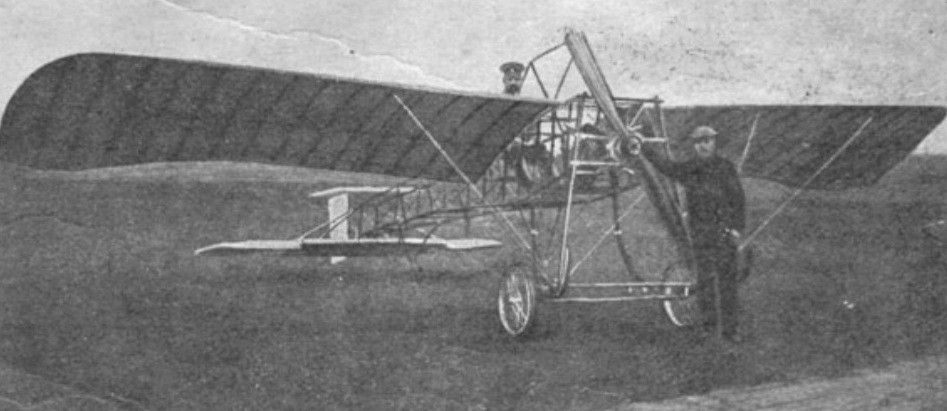
This monoplane of Captain N.P.Stasenko [Н.П.Стасенко] – a trained engineer – was built in 1910 in St. Petersburg and was financed from his own funds, it was not successful in intersting the Russian military.
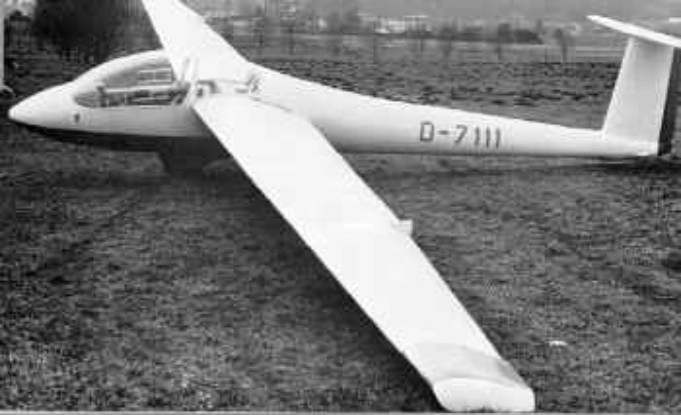
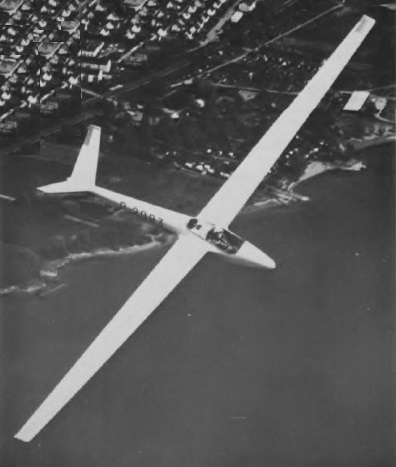
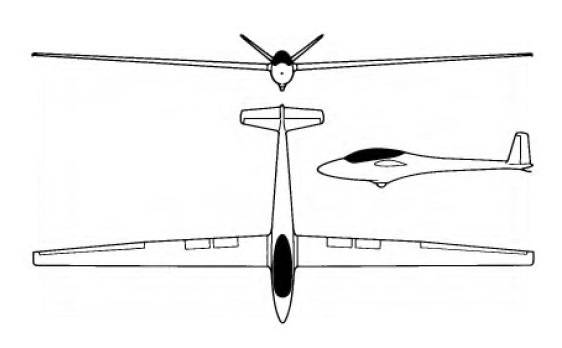
Designed by Walter Stender and Ursula Hanle and originally known as the Schulmeister, this side-by-side two-seater training sailplane first flew in prototype form on 28 July 1977, and production began in March 1978. The Globetrotter is a cantilever mid-wing monoplane of 17m span with a T-tail, and mainly of glassfibre reinforced plastic construction. The wings have an Eppler E 603 aerofoil section and are swept forward 2° 30′; air brakes are fitted in the upper surfaces, and there is provision for water ballast. Landing gear consists of a non-retractable monowheel and tailwheel, and the two pilots sit under a one-piece canopy that slides forward to open over the tip of the nose.
Only one was built.
Wing span: 17 m Wing area: 15.8 sq.m Aspect ratio: 18.29 Airfoil: Eppler 603 Empty Weight: 400 kg Gross Weight: 600 kg Wing Load: 38 kg/sq.m L/DMax: 36 100 kph Min Sink: 0.65 m/s 80 kph Seats: 2
Span: 55 ft 9.25 in Length: 25 ft 1.5 in Height: 3ft 5.25 in Wing area: 170.1 sqft Aspect ratio: 18.3 Empty weight: 639 lb Max weight: 1,102 lb Max speed: 155 mph Min sinking speed: 2.13 ft/sec at 50 mph Best glide ratio: 36:1 at 62 mph
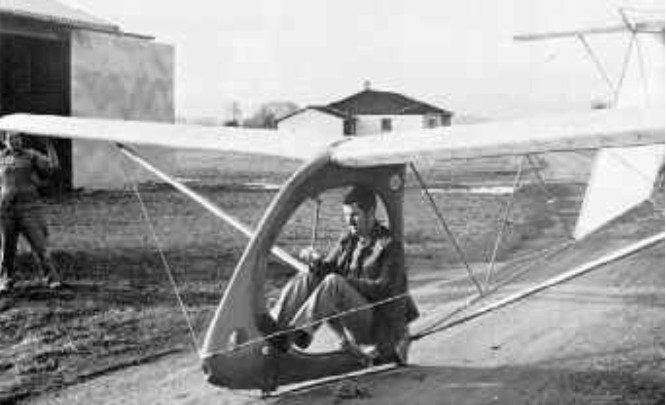
Designed by Ursula Hanle, this simple ultra-light single-seat glider weighs only 106lb without the pilot and is designed to achieve take-off by a variety of methods: by foot-launch, auto-tow, winch launching or any other suitable form of assisted launch.
It has strut-braced dihedral wings of constant chord with small endplate-type fairings and Wortmann aerofoil sections. The basic structure is of glassfibre with carbon-fibre reinforcement; the wings are plastic-covered and the tail surfaces fabric-covered, the tail being carried on an open girder-type framework, and the braced tailplane being mounted on the large fin. The landing gear is formed by the glassfibre seat fairing which has a small keel surface underneath it, and there is a metal hoop at the base of the rudder to form a tailskid. The pilot sits behind a windscreen extending from the leading edge to the front of the seat fairing.
For a foot-launch the product of the hill’s angle in degrees and the wind speed in metres per second should be a figure of 80 or above. After foot-launching, the pilot draws up his legs into the hoop-like glassfibre seat fairing at the front of the aircraft, which also serves as the landing skid.
The Hippie flew for the first time on 15 August 1974 and examples were flying in five countries outside Germany.
The airframe can be dismantled and packed into a carrying case measuring 5m (16ft 4.75in) by 1.10m (3ft 7.25in) by 0.60m (1ft 11.75in).
A new version of the Hippie was available, with wings of honeycomb construction, a longer tail structure of aluminium tubing, an enlarged rudder, quick-connect fittings and an enlarged seating area for the pilot.
35 were built.
Wing span: 10 m / 32 ft 9.75 in Wing area: 9 sq.m / 96. 9sq ft Length: 18 ft 8.5 in Height: 4 ft 7 in Empty Weight: 48 kg / 110 lb Gross Weight: 133 kg / 298 lb Wing Load: 14.8 kg/sq.m Max speed: 37 mph Aspect ratio: 11.11 Airfoil: FX S 02 L/DMax: 12 at 45 kph Min Sink: 1.3 m/s 40 kph
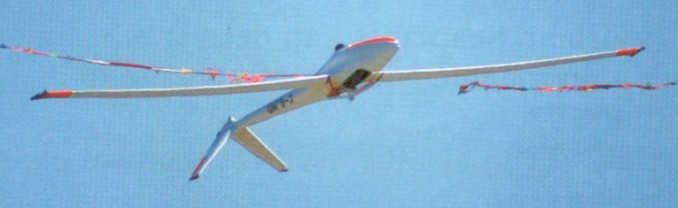
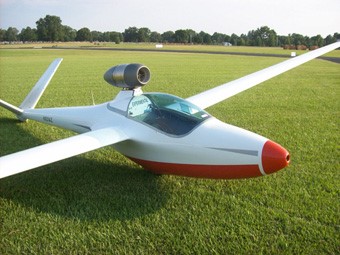
The H 101 Salto is an aerobatic version of the Standard Libelle developed by Frau Ursula Hanle, widow of Ing Eugen Hanle, the former Director of Glasflugel; the Salto (this word is German for loop) is produced by Start + Flug GmbH formed by Frau Hanle.
The design of this single-seat 13 metre sailplane draws extensively on that of their glassfibre sailplane, the H-30, designed by Hutter, and of the Standard Libelle. The Salto is manufactured so that several components are interchangeable with those of the Libelle.
The Salto differs from the Standard Libelle largely in having a V-tail with an included angle of 99°. The Salte also owes something to the V-tailed Hiitter H-30 GFK. Four flush-fitting air brakes repositioned on the wing trailing edges replace the more conventionally-sited air brakes of the Standard Libelle; the Salto’s air brakes are hinged at their mid-points so that half the surface projects above the wing and half below. The fuselage has a fixed, faired wheel, and a tailskid, and the one-piece canopy is hinged to open sideways.
The Salto employs a Standard Libelle wing shortened at the root to produce a span of 13.6 m (44 ft 7.5 in), and fitted with trailing edge dive brakes and a tail parachute for approach control. Tip extensions have been designated extending the wingpspan up to a much as 15.8 m/ 51.8 ft. G limitations are +7 and -5.
The Salto prototype first flew in March 1970 and 60 had been delivered by the spring of 1977; German type certification was granted on 28 April 1972 and the Salto has also been certificated by the FAA as well as Germany in the Normal and Aerobatic catergories.
Later production was by Dokter Fiberglas.
Bob Carlton’s Super Salto has been retrofitted with a 225 lb thrust jet from PBS in the Czech Republic. Powered by this new Jet engine, the highly modified Super Salto jet sailplane self-launches and performs both a classic sailplane aerial ballet and screamin’ low-level jet aerobatics.
The first flight of the Super Salto Jet Sailplane took place on October 8, 2008.
Start + Flug Salto Wing span: 13.6 m (44 ft 7.5 in) Length: 5.95 m (19 ft 6.25 in) Height: 0.88 m (2 ft 10.75 in) Wing area: 8.58 sq.m (92.4 sq ft) Wing section: Wortmann FX-66-17-Al 1-182 Aspect ratio: 21.6 Empty weight: 180 kg (397 lb) Max weight: 310 kg (683 lb) Water ballast: None Max wing loading: 36.13 kg/sq.m (7.4 lb/sq ft) Max speed: 135 kt (250 km/h) Stalling speed: 35 kt (65 km/h) Min sinking speed: 0.6 m/sec (2 ft/sec) at 40.5 kt (75 km/h) Max rough air speed: 135 kt (250 km/h) Best glide ratio: 35 at 48.5 kt (90 km/h)
The Star-Lite Warp 1-A is an American homebuilt aircraft that was designed and produced by Star-Lite Engineering of Englewood, Ohio, introduced in 1996.
The aircraft was designed to comply with the US FAR 103 Ultralight Vehicles rules, including the category’s maximum empty weight of 254 lb (115 kg). The aircraft has a standard empty weight of 250 lb (113 kg). The original Star-Lite used a Rotax 447 engine.
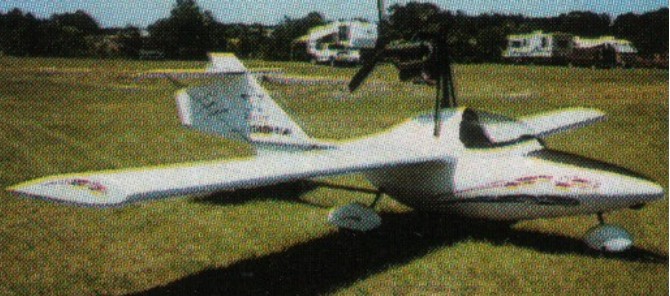
The Warp 1-A features a cantilever mid-wing, a single-seat enclosed cockpit under a bubble canopy, fixed tricycle landing gear with wheel pants, a boom-mounted T-tail and a single pod-mounted engine in pusher configuration.
The aircraft is made from composites. Its 25.0 ft (7.6 m) span wing is made with an aluminum spar and S-glass vinyl-ester resin, is detachable for ground transport or storage and has a wing area of 87.5 sq ft (8.13 m2). The standard engine used is the 50 hp (37 kW) Rotax 503 two-stroke powerplant.
Introduced in 1996, the aircraft was supplied as a kit for amateur construction. The manufacturer estimated the construction time from the supplied kit as 100 hours. The kit, including engine, propeller and instruments, cost US$26,995.00 in 1998.
In March 2014 one example, the prototype, was registered in the United States with the Federal Aviation Administration as an Experimental – Amateur-built, although its registration expired in June 2013.
Star-Lite M2
Brian Burghgrave built a Star-Lite M2 using a Rotax 503, necessitating a new cowl. In addition, he installed flaps and counterbalanced the ailerons and elevator. First flown in October 2009, these changes add the “M2” to the name.
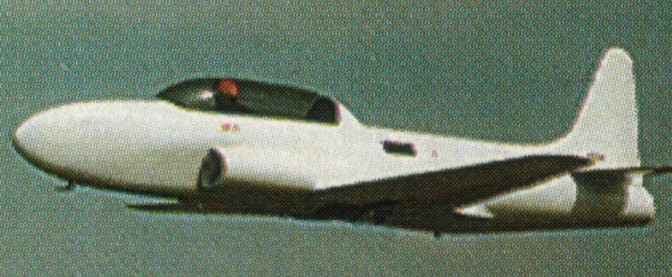
First flown in 1995 and presented at Oshkosh 1995, the Stargate YT-33 was built by Bo Case McMinnville (OR) on behalf of Sid Hendricks Mille Valley (CA). It is a fairly faithfully 2/3 scale reproduction of a Lockheed T-33.
Of composite construction, it is equipped with a Turbomeca Marbore IIA turbojet of 400 Kp. The tricycle undercarriage is electrically retractable and steerable through 40°.
Engine: Marbore IIA Turbojet, 880 lbs thrust Length: 25.83 ft Wing span: 26.67 ft / 7.80 m Wing area: 110 sq.ft Weight empty: 1750 lbs Gross: 3600 lbs Fuel cap: 200 USG VNE: 500 mph Speed max: 320 mph Cruise: 300 mph Range: 1200 sm Stall: 75 mph ROC: 1500 fpm Take-off dist: 2500 ft / 600 m Takeoff speed: 130 km / h Landing dist: 3000 ft Service ceiling: 30,000 ft Seats: 2 Landing gear: nose wheel
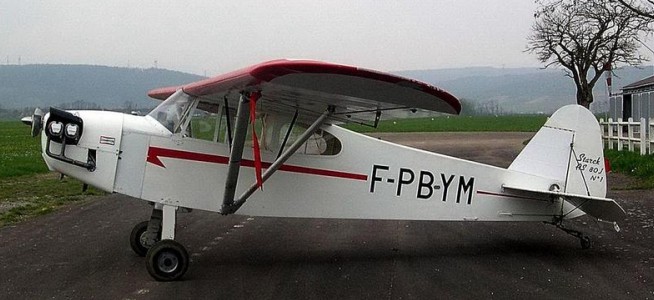
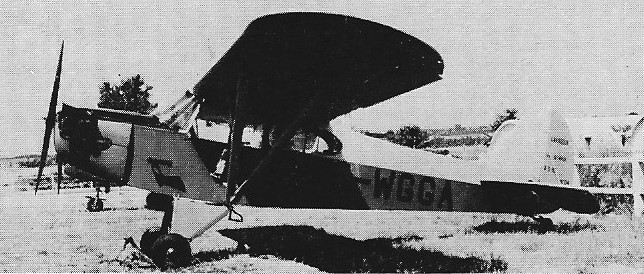
André Starck continued construction of a range of eight aircraft after 1945: AS-37, AS-57/3, AS-57 / 4, AS-57/5, AS-70 “Jac” AS-71 AS-80 “Holiday” and AS-90 “New Look”.
The AS.80 was a tandem two-seat cabin monoplane of wooden construction with fabric covering, designed primarily for construction from kits of parts by amateurs.
Engine: 75 hp Regnier 4D2 Max speed: 98 mph Cruise: 88 mph ROC: 590 fpm Range: 200 mi Empty weight: 720 lb Loaded weight: 1210 lb Wingspan: 32 ft 10 in Length: 21 ft 7.5 in Height: 6 ft 3 in
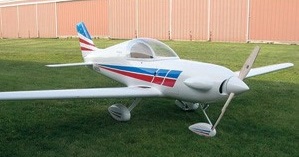
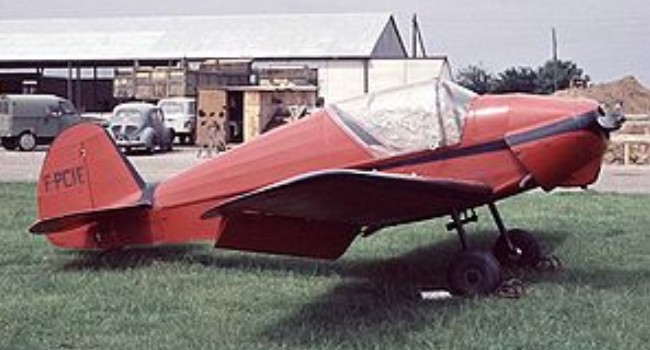
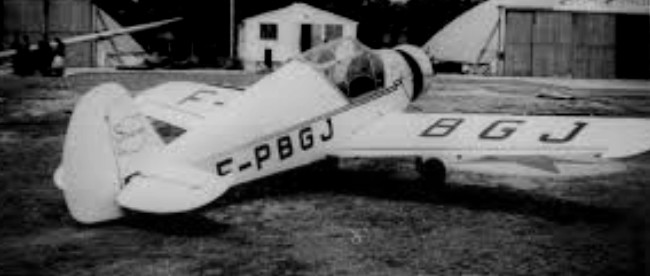
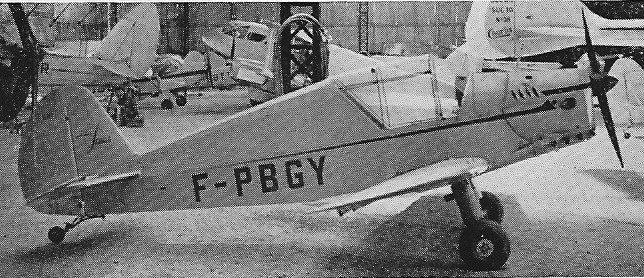
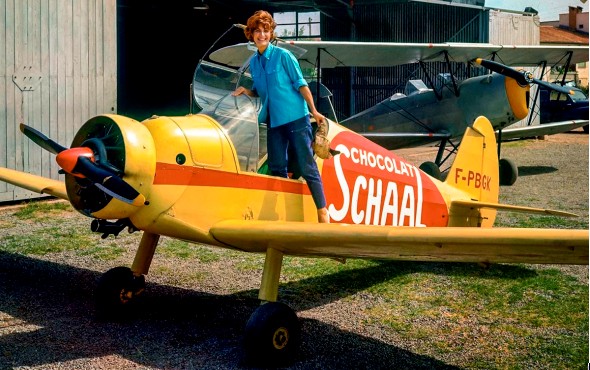
First flown on 23 May 1945, the AS-70 was developed during 1945 as a single-seat light low-wing monoplane aircraft to serve the early postwar needs of French private pilots and aero clubs. It is of mixed welded steel tube and wooden construction with fabric covering, and is fully aerobatic.
A small series of 19 Jacs was constructed by Avions Starck. These were fitted with a range of engines with power outputs of between 45 to 65 hp (34 to 48 kW). Different designations were given to aircraft powered by the various engines.
AS.71 Jac
The Jac proved to be a popular aircraft with private pilots and aero clubs and four examples remained in service in 2009.
Starck AS-70
Variants:
AS-70 fitted with 45 hp (34 kW) Salmson 9 Adb radial engine
AS-71 fitted with 65 hp (48 kW) Walter Mikron II engine
AS-72 fitted with Salmson 9 ADr radial engine
AS-72/1 fitted with a Percy II engine.
AS-75 fitted with 65 hp (48 kW) Continental A65-8S engine
Specifications:
Starck AS-70 Engine: Salmson 9Adb, 45 hp Wingspan: 7.40 m / 24 ft 3 in Length: 5.33m / 17 ft 7 in Wing area: 8 sq.m / 86 sq.ft Empty weight: 202 kg / 467 lb Maximum weight: 300 Kg / 705 lb Max speed: 115 mph Cruise: 185 km / h / 104 mph Ceiling: 6200 m Range: 420 km / 260 mi
Starck AS-75 Engine: 1 × Continental A65-8S, 65 hp (48 kW) Length: 17 ft 7 in (5.36 m) Wingspan: 24 ft 3 in (7.39 m) Wing area: 86 sq ft (8.0 m2) Height: 5 ft 3 in (1.60 m) Empty weight: 435 lb (197 kg) Gross weight: 698 lb (317 kg) Maximum speed: 126 mph (203 km/h; 109 kn) Cruise speed: 115 mph (100 kn; 185 km/h) Range: 320 mi (278 nmi; 515 km) Crew: one Capacity: one passenger


 All Aero