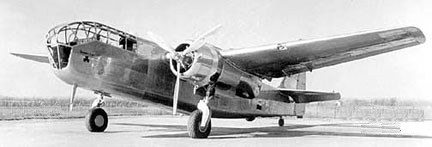
The 1939 Stearman XA-21 40-191 was designed as a USAAF attack-bomber. Fitted with a cantilever wing with flaps and crew of four, the one built was used as a flying laboratory at Wright Field.
Engines: 2 x 1150hp P&W R-2180-7 Wingspan: 65’0″ Length: 53’9″ Gross wt: 18,230 lb Useful load: 5470 lb Max speed: 257 mph Cruise: 232 mph Range: 1200 mi Crew: 4
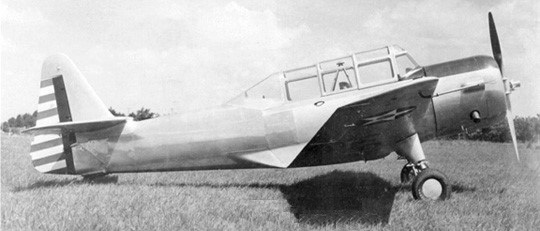
The Stearman models X-90 and -91 of 1940 were two-place primary/basic trainer. They featured a metal fuselage, and metal-framed fabric-covered wings and tail.
One prototype as the X-90 42-8726 went for military evaluation.
The model 91 was the final model with a 450hp P&W Wasp engine as the XBT-17.
90 Engine: Lycoming R-680, 225 hp Length: 28 ft 6 in Wing span: 35 ft 9 in Wing area: 200 sq.ft. Max weight: 2810 lb Useful load: 709 lb Ceiling: 15,000 ft Max speed: 140 mph Cruise: 115 mph Stall: 58 mph Seats: 2
X-91 / XBT-17 Engine: Pratt & Whitney Wasp Jr, 450 hp Wing span: 35 ft 9 in Wing area: 200 sq.ft. Length: 28 ft 6 in Max weight: 2810 lb Useful load: 1070 lb Max speed: 190 mph Cruise: 160 mph Stall: 68 mph Ceiling: 15,000 ft Seats: 2
In 1934 Rudolph & Anna Stepanich built the single-place, open cockpit, mid-wing monoplane, powered with a 40hp Salmson AD-9 engine, and registered NX14378.
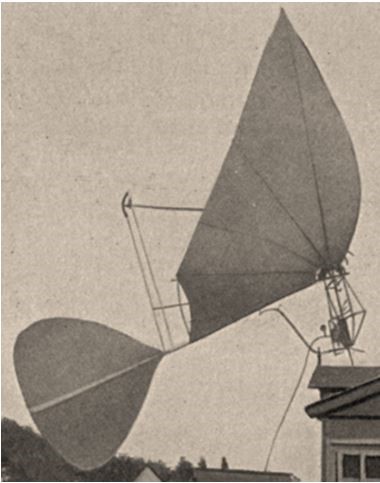
Arthur Stentzel of Hamburg-Altona, Germany, began experimenting with gliders and ornithopters in the early 1890s. In 1896, he demonstrated his flapping wing flying machine at Berlin. The Stentzel machine had cambered bird-like wings of 6.5 m. wingspan and a rounded cruciform tail. It was powered by a carbonic acid engine mounted forward and below the wings. The flying machine ran along a horizontal wire, off which it lifted when in motion. The machine achieved a speed of 4.5 m/s.
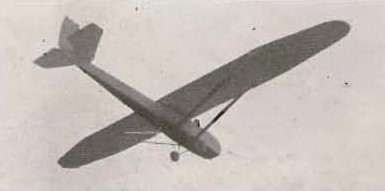
The Stedman TS-1 City of Leeds was a two-seat tandem sailplane designed and built by R.F. Stedman in Leeds, UK, in 1932. It was first flown on 21 July 1934 at Baildon, UK. It became BGA.213 and survived the war. . Wingspan: 50 ft Wing chord: 6 ft Wing area: 295 sq.ft Weight: 424 lb Wing loading: 2-2.48 lb/sq.ft Seats: 2
One other military aircraft project was undertaken by St. Louis Aircraft during the Second World War. Having already placed large-scale aircraft production contracts with the major airframe builders, the Army sought to employ secondary sources when it decided in 1941 to develop a significant glider assault capability. Not being burdened at the time with aircraft production contracts, St. Louis Aircraft was invited to participate in the Army’s glider program, obtaining contracts to develop eight-place and fifteen-place troop-carrying gliders. The eight-place XCG-5 demonstrated serious aerodynamic flaws during its first test flights (at Lambert Field) in 1942. The redesign necessary to correct the aerodynamic, as well as significant structural, problems doomed the XCG-5. The larger, heavier XCG-6 was never built.

 All Aero