In 1929 Stepnic built, in the USA, a single-place, open cockpit, high-wing monoplane, powered by a 40hp Lawrance engine.
Monoplane
Stephens & Fisher Scamp 36
The 1936 Stephens & Fisher Scamp 36 was a single-place, open cockpit monoplane, powered by a Salmson AD-9 engine. It was registered N15893 c/n 1.
It was sold on 26 February 1940, dismantled on 11 February 1940, and sold to Fleetcraft Co (Alexandria MN), who gave it to the National Guard as a ground-school instructional airframe.
The registration was cancelled on 26 April 1948.
Stephens Akro / Aircraft Technologies Akro 1
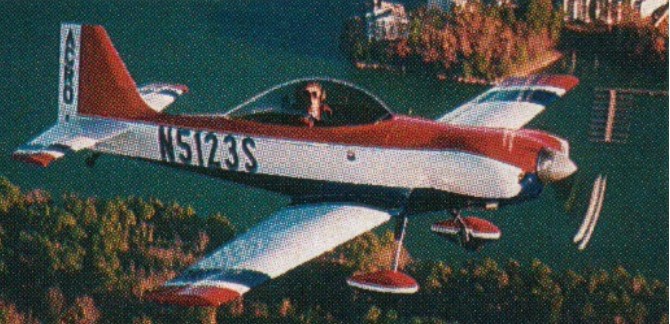
This homebuilt was designed to meet the requirements of aerobatic competition. It is stressed to + 12G and -11G. The Akro’s wing is a one-piece, all-wood structure with two spars, and its fuselage is a fabric-covered steel tube frame. Seating is for one under a sliding bubble canopy. The Model B has both a fuel and an oil system for inverted flight. The Akro is one of the most popular aerobatic ships in the monoplane class. All control surfaces are fully static-balanced.
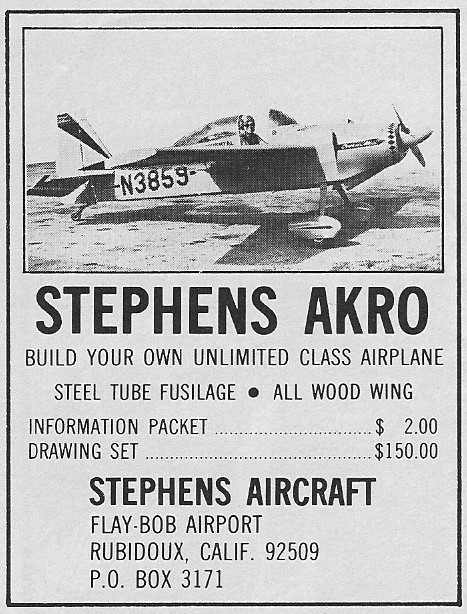
The Aircraft Technologies Akro 1 first flew in March 1994.
Gross Wt. 1100 lb
Empty Wt. 830 lb
Fuel capacity 21 USG
Wingspan 24’4”
Length 19’
Wing area: 98 sq.ft
Engine 180-hp Lycoming
Top 192 mph
Cruise 175 mph
Stall 54 mph
Climb rate 2100 fpm
Ceiling 22,000 ft
Takeoff run 400 ft
Landing roll 900 ft
Range 375 sm
Seats: 1
Aircraft Technologies Akro 1
Engine: Lycoming IO-360, 200 hp
HP range: 100-200
Top speed: 270 mph
Cruise: 220 mph
Stall: 58 mph
Range: 1000 sm
ROC: 3500 fpm
Service ceiling: 25,000 ft
Fuel cap: 47 USG
Empty wt: 780 lbs
MTOW: 1250 lbs
Length: 17 ft
Wing span: 20 ft
Wing area: 60 sq.ft
Seats: 1
Undercarriage: tailwheel
Ultimate load: +/- 15g
Roll rate: 360 deg./sec
Aircraft Technologies Akro 1
Engine: Lycoming IO-360, 200 hp
Wing span: 6.1 m
Wing area: 5.52 sq.m
MAUW: 567 kg
Empty weight: 354 kg
Fuel capacity: 178 lt
Max speed: 434 kph
Cruise speed: 354 kph
Minimum speed: 93 kph
Climb rate: 15 m/s
Seats: 1
Fuel consumption: 40 lt/hr
Plan price (1998): $225
Kit price (1998): $22,900
Stepanchonok Kacha
The “Kacha” (Russian: Степанчонок “Кача”) was designed by pilot Vasili Andreyevich Stepanchonok in 1930, during his time as an instructor at the Kacha flight school in Sevastopol.
The “Kacha” was designed as a cantilever high-wing glider. The wing had a double wooden spar structure and was covered with plywood sheets up to the position of the second spar. From there the covering was made of fabric.
The wide, angular fuselage featured a duralumin nose with the rest in plywood-coated wood. The bow area featured a removable aluminum deck. At the rear of the cabin there was another one made of plywood. A towing hook with release system was installed in the first frame of the fuselage.
The landing gear consisted of a central wheel with steel sheet.
The “Kacha” glider was completed in 1930 and his main purpose was to serve as a trainer at the Kacha Higher Flight School. It was presented without great success in the VII National Sailing Competitions, held in 1930 in Koktebel .
Despite the great wing aspect ratio (18.7), the good finish and the excellent construction lines, the flight characteristics of the “Kacha” were quite poor. This was largely due to the poor selection of the TsAGI-311 wing profile, of a high relative thickness and the poor aerodynamic shape of the wide fuselage, with resistance surfaces perpendicular to the air flow.
Kacha
Wingspan: 16.20 m
Wing area: 14.00 m²
Aspect ratio: 18.7
Length: 5.55 m
Empty weight: 150 kg
Wing loading: 16.4 kg / m²
Surface of the horizontal planes: 3.16 m²
Elevator area: 1.74 m²
Rudder surface area: 0.87 m²
Accommodation: 1
Stemme S.10 / TG-11A
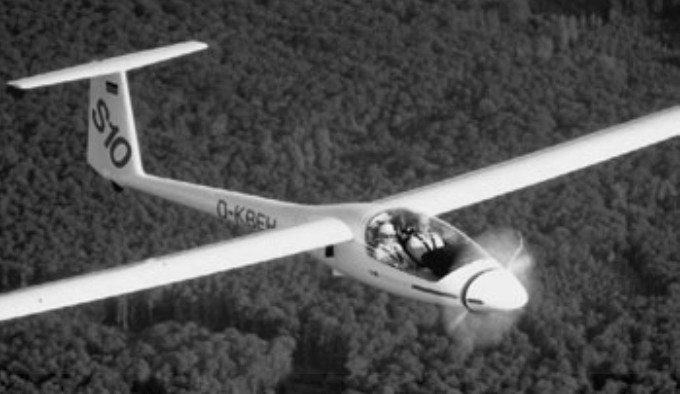
A two seat, side-by-side, motor-glider designed by Reiner Stemme, first flown in 1986, and first produced in 1990 at the Stemme factory at Strausberg Airfield, east of Berlin. The fuselage has a central steel tube frame, which forms the attachments for the wings, undercarriage and fixed internal powerplant. The carbon fibre rear fuselage bolts onto this frame, and the cockpit sec¬tion, which is a Kevlar lined carbon fibre shell, fits on the front. It has an electrically retractable undercarriage; not the conven¬tional glider mono wheel, but the more con¬ventional powered aircraft variety (although the track is quite narrow at 1.15 m). The engine is mounted behind the cockpit with a carbon shaft running through a Kevlar tunnel to a folding prop located behind a large retracting nose cone.
There are three basic varia¬tions of the Stemme, the S10, the S10V and the S10VT. The S10 has a four cylinder 93 hp Limbach four-stroke engine powering a fixed-pitch propeller. This combination gives a cruise speed of 90 knots. The S10V uses the same engine but with a variable-pitch propeller, giving a higher cruise speed of 121 knots.
The S10VT utilises a 115 hp turbocharged Rotax 914 engine, which gives a cruise speed of 140 knots at 10,000 ft. All variations a have a 23 m wingspan and can achieve a glide ratio of 50:1 while accommodating a crew of two. The three piece, 23 metre span, folding wings, contain two 45 litre fuel tanks.
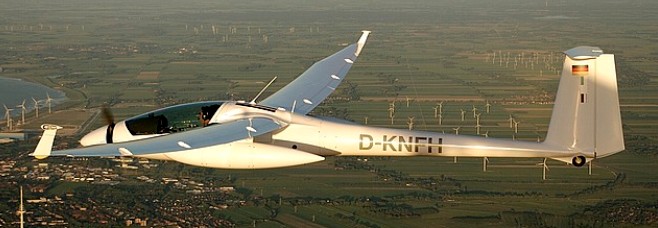
The S 10 VT engine, a 115 horsepower Rotax 914 Turbo (thus the “T” in the designation) with water cooled heads and a dual ignition system, is located in the lower fuselage be¬hind the cockpit. A centrifugal clutch turns a carbon fibre driveshaft, which is encased in a Kevlar tunnel and runs through the cen¬tral console to a reduction gearbox (0.9: 1) mounted behind the propeller in the nose section. The variable pitch (the “V” in the designation) folding propeller blades extend au¬tomatically by centrifugal force when the engine is started, with the nose cone mov¬ing forward and out of the way. When the engine is stopped, the blades fold inwards by a spring system and the nose cone is re¬tracted (which takes about six seconds) and the machine becomes a glider. The two-seater has carbon-fiber wings and solar panels for 30W of electrical power once airborne.
No. Built: 60
The U.S. Air Force Academy operates 2 S 10’s as the TG-11 A model (S 10VT), 94-1400 and 94-1500 also as civil N94FT and N94FW.
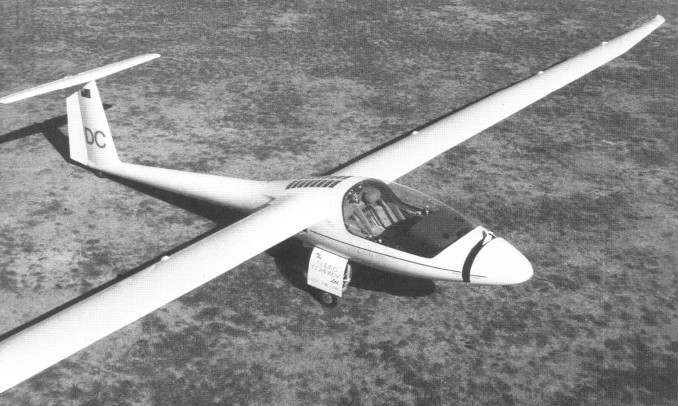
S10
Engine: 69 kW/ 93 bhp Limbach L2400 EB1. D
Wing span: 23m / 75.46 ft
Wing area: 18.74sq.m / 201.7sq.ft
Aspect ratio: 28.22
Airfoil: HQ-41
Empty Weight: 635kg / 1400lb
Payload: 215kg / 474lb
Gross Weight: 850kg / 1874lb
Wing Load: 45.39kg/sq.m / 9.29lb/sq.ft
Cruise: 90 kts
L/DMax: 51
MinSink: 0.56 m/s / 1.83 fps / 1.08 kt
Structure: GFRP/ CFRP/ Kevlar/ Steel tube
Seats: 2
S10V
Engine: Limbach, 93 hp
Prop: variable pitch
Wing span: 23m / 75.46 ft
Wing area: 18.74sq.m / 201.7sq.ft
Aspect ratio: 28.22
Airfoil: HQ-41
Cruise: 121 kts
S10
Engine: Rotax 914, 115 hp
Wing span: 23m / 75.46 ft
Wing area: 18.74sq.m / 201.7sq.ft
Aspect ratio: 28.22
Airfoil: HQ-41
Cruise: 140 kts
Steinleher SH-2H
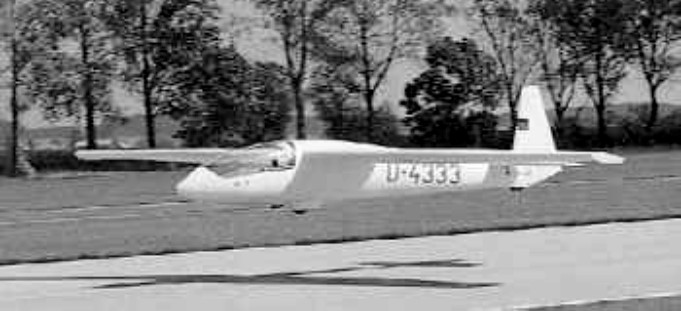
Wing Span: 10.4m
Wing Area: 11.4 sq.m
Empty Weight: 245 kg
Gross Weight: 340 kg
Wing Load: 29.8 kg/sq.m
Aspect ratio: 9.49
Airfoil: FX 71-L-150/20
Min Sink: 0.8m/s
L/D Max: 26
No. Built: 1
Seats: 1
Steffen Monoplane
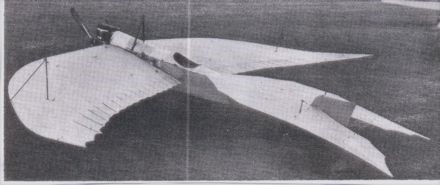
The exact identification is disputed, but in the source of the photo it is identified as the “Steffen-Falke 1911”, powered by a 50 hp Argus engine, built for Heine, which crashed on its first flight. The builders of the Zanonia-winged monoplane were the Steffen brothers of Kiel.
Stefanutti Tourer
Ing. Sergio Stefanutti had gained some experience in the mid 1930s with a little two seat tail first tourer.
Steen Steenship
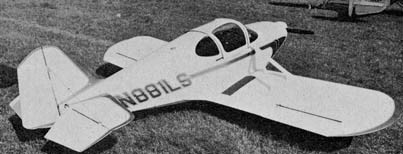
LaMar Steen’s first airplane was a two-place, low-wing design named the Steenship. The Steenship has wooden wings, a tube-and-fabric fuselage, and originally sported a many-coat nitrate dope covering job. The modified O-290-G engine produced 140hp and gave the plane a very respectable cruise speed of 165 mph. In addition, it was stressed for aerobatics (+/- 9 G). Construction took 3-1/2 years and cost $3,800.
It first flew in July 1966 as N881LS. No plans were ever made available for the Steenship, and no original blueprints or construction drawings exist today.
The May 1989 issue of Sport Aviation had an article about Bob Leonard’s restoration of the plane in Healdsburg, CA. In mid-2002, Burt Nichols in Arkansas purchased it (still retaining the original registration number N881LS) and flew it regularly. After 200 hours in the first 9 months he decided to upgrade the original Lycoming O-290 to a Lycoming O-320. As of July 2003, it was very close to first flight with the new engine.
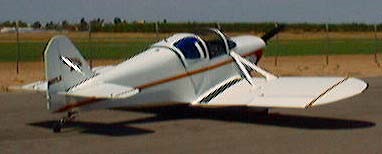
In late Jan. 2005, it was in the process of a rebuild.
Engine: 140hp Lycoming O-290G
Cruise: 145 mph
Stall: 60 mph
Load factor: 9G±
Seats: 2
Aerial Aircraft Model A / Model B / Model C / Steaman Aircraft Company B-2
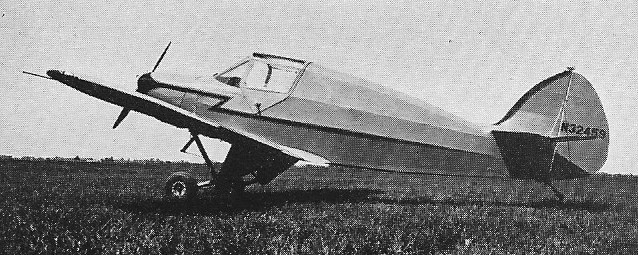
The Aerial Model B first appeared in 1941.
In February 1942 Aerial Aircraft Inc changed its name to Steaman Aircraft Company (not related to the Stearman Aircraft Company).
Production of the Model B resumed in 1944 when three were built.
The Models A, B, and C differed with the engines.
Aerial Model B
Engine: 65 hp Lycoming O-145-B2
Seats: 2
Aerial Model B
Engine: 75 hp Continental A75
Seats: 2
Aerial Model B
Engine: 80 hp Franklin 4AC-176
Seats: 2
Stearman B-2
Engine: 75 hp Continental A75
Wingspan: 30 ft
Length: 20 ft 2.5 in
Empty weight: 680 lb
Loaded weight: 1200 lb
Max speed: 125 mph
Cruise: 110 mph
ROC: 930 fpm
Range: 430 mi
Seats: 2
 All Aero