Stroukoff YC-134 Pantobase

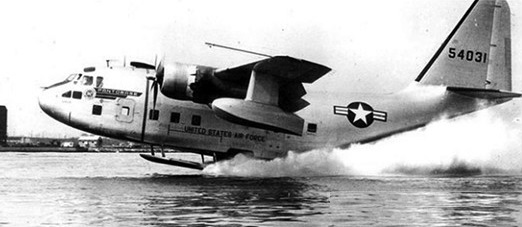
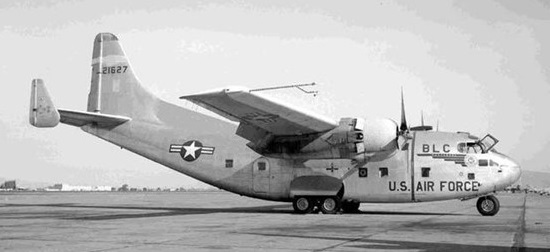
YC-134 52-1627 at Moffett Field, June 1959

The Stroukoff YC-134, designed in 1956, was based heavily on the Fairchild C-123 Provider. The United States military contracted with Stroukoff Aircraft Corporation to develop an improved version of the aircraft, combining features that the company had developed for the YC-123D and YC-123E.

The product of a US Air Force contract in 1956, a single C-123B from the -CN production block (serial 52-1627) was modified by Stroukoff Aircraft to become the YC-134. This aircraft was heavily modified with the following new features:

New Engines: The YC-134 was equipped with two 3,500 hp (2,600 kW) Wright Turbo Compound R3350-89A radial engines, turning four-blade, thirteen foot Aeroproducts constant-speed fully feathering propellers.

A new thickened wing. In the root of the wing they installed two turbocompressors with 400 hp each

Improved Control Surfaces: The YC-134’s horizontal stabilizers were given endplates to improve directional stability.

Improved landing gear: While the nosewheel from the C-123B was retained, both main gears were given a third wheel to improve weight distribution.

Fuel was no longer housed in the rear of the engine nacelles, but in an expanded center-wing fuel tank. In addition, two plumbed hardpoints for 550-gallon drop tanks were also added to each wing.

Stroukoff’s BLC and Pantobase: the YC-134 was fitted with Stroukoff’s own BLC and all three aircraft had they been delivered were to have been fitted with the Pantobase equipment designed for the YC-123E.

The features gave an empty weight increase over the C-123B from 31,058 lb (14,088 kg) to 37,965 lb (17,221 kg), and a maximum loaded weight increase from 60,000 lb (27,000 kg) to 74,700 lb (33,900 kg). The aircraft’s cruising speed was 219 mph (352 km/h), compared to the C-123B’s 190 mph (310 km/h), and the YC-134 had a 1,600-mile (2,600 km) range with a 24,000 lb (11,000 kg) payload. The BLC allowed the YC-134’s take-off distance to decrease from 1,850 feet (560 m) to 750 feet (230 m), very similar to that of the YC-123D.

The aircraft for the first time rose into air on 19 December, 1956, on the tests were obtained good results, and servicemen ordered two additional machines. On them they installed the modernized boundary-layer control system with one more powerful compressor and “pantobase”. The YC-134 gained the designation “Pantobase” after hydro-skis were added. The YC-134 demonstrated following: takeoff on the earth – 244 m, on the snow and the water – 458 m; path on the earth – 320 m, on the snow – 305 m, on the water – 228 m. In the beginning of 1958 all three YC-134 were transferred to the Air Force.

One conversion to a YC-134 (YC-123D) was made in 1956 (53-8068), powered by two 3500hp Wright R-3350, with similar dimensions to the Fairchild C-123B. Fitted with a boundary layer control system, tailplane endplates, and tandem mainwheels.

The 1958 YC-134A had a sealed and strengthened fuselage and “Pantobase” multi-purpose landing gear fitted with land/water skis and wingtip floats. Began as Chase C-123B 52-1627 rebuild then was modified by Fairchild as YC-123B with wingtip J44 jets, and later reputedly converted by Stroukoff as YC-134A “Pantobase” with R-3350-89A engines and boundary layer control.

The U.S. Air Force, however, deemed that the YC-134 did not offer substantial improvement over the C-123, nor did it have a requirement for a piston-engined amphibious assault transport, and decided to purchase the Lockheed C-130 Hercules.

YC-134A 55-4031) with Pantobase system for amphibious operations

YC-134-SA
Engine: 2 × Wright R-3350-89A, 3,500 hp
Payload: 24,000 lb
Empty weight: 37,965 lb (17,221 kg)
Max. takeoff weight: 74,700 (33,900 kg)
Cruise speed: 219 mph (352 km/h)
Range: 1,600 miles (2,600 km) with 24,000 lb (11,000 kg) payload
Take-off distance: 750 feet (230 m)

Strom 1911 monoplane

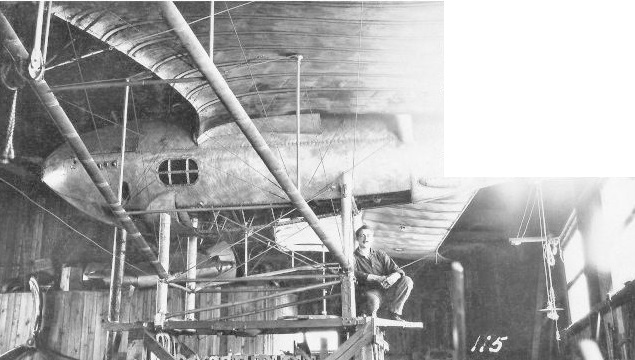
Designed by Carl Strom, a Dane, this was an all-steel passenger-carrying monoplane. Dimensions were 49 feet span, 24 feet height and the wings had a chord of 11 feet. Construction started late in 1911, with Strom building his machine with Oscar Olesen in Mineola, New York, USA.

Appears to have never been completed.

Strojnik S-2

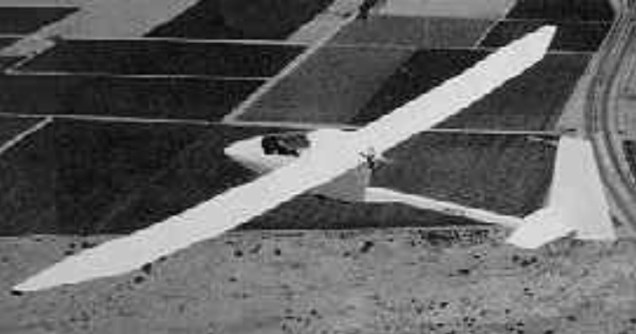
Designed by Alex Strojnik, the S-2 uses carbon fiber and aluminum wing spars with fiberglass skins. The fuselage pod is wood skinned with fiberglass, the boom is aluminum and the tail group is carbon-reinforced and skinned with fiberglass. The fixed gear consist of two small wheels in tandem. The Kohler engine drives a foldable propeller. Glidepath control is by flaps.

Designed by Alex Strojnik, the S-2a is a pod and boom pusher with folding propeller. The span is 15 meters and the best L/D is about 34:1. Alex made many excellent soaring flights with his motorglider, including diamond goal distance. A number of these have been built. Plans are no longer available for sale.

S-2
Wing span: 15 m / 49.2 ft
Wing area: 11.8 sq.m / 127 sq.ft
Aspect ratio: 19
Airfoil: Modified Wortmann
Empty Weight: 280 kg / 617 lb
Payload: 165 kg / 363 lb
Gross Weight: 445 kg / 980 lb
Wing Load: 37.11 kg/sq.m / 7.7 lb/sq.ft
L/DMax: 34 88 kph / 48 kt / 55 mph
MinSink: 0.67 m/s / 2.2 fps / 1.30 kt
Seats: 1
Structure: aluminum, wood and fiberglass

Strohbach 1910 Monoplane

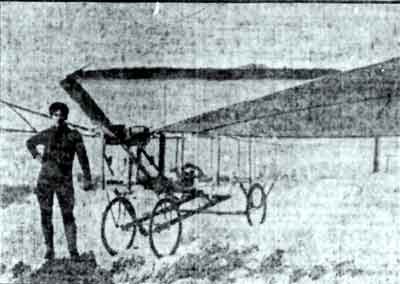
Constructed by George Strohbach, a skilled mechanic in Company E of the Fifteenth Infantry at Fort Douglas near Salt Lake City, Utah. In April of 1910 however, prior to finishing the project, Strohbach deserted the Army and disappeared. A fifty dollar reward for his apprehension was offered, but the Army also had another problem. Still in its box at Fort Douglas was the motor for the flying machine, ordered from St. Louis, yet no one knew how to handle either the motor or the monoplane, and neither was anyone willing to pay the C.O.D. charges on the crated engine – thus leaving the Army’s aeroplane-building attempt forever grounded.

Striplin Star Ranger

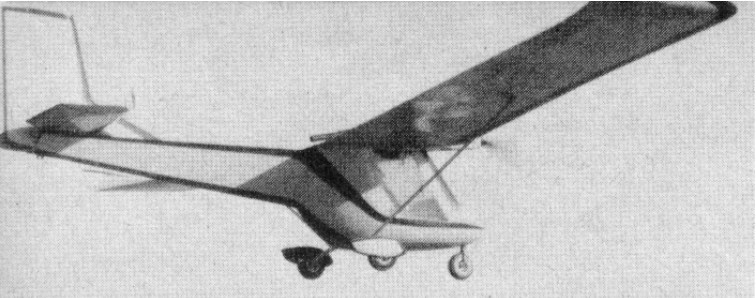
High monowing with enclosed cabin. Control surfaces include tip rudders, which can be split When applied simultaneously they act as air brakes. Construction consists of layered foam and fiberglass from premolded external skins and some spruce. Wings, tail surfaces and fuselage are covered with fiberglass. Powerplant: One Yamaha mounted in a pusher position aft of the wing on the centerline. A reduction gear of 3.6:1 turns a two-blade wooden Ritz propeller. Fuel is carried in a fiberglass tank mounted in the wing. Landing Gear: Shock-mounted tricycle gear with a fiberglass leaf spring and steerable nosewheel. Options include wheel fairings for all three wheels for $100, larger diameter wheels (16 inch, 40 cm) $105, skis $150, floats $750, removable side windows $100, instrument panel, radio, shoulder harness $22, ballistic deployment parachute $850.

Engine displacement 100 or 225cc, 12 or 20 hp
Static thrust, 70 lbs or 110 lbs
Wingspan, 32 ft
Wing area, 151 sq.ft
Aspect ratio, 7:1
Overall length, 14 ft
Empty weight. 185 lb
Usable payload (include fuel), 250 lb
Wing loading, 31 lbs/sq.ft
L/D power-off glide ratio,17:l
Cruise speed (85% power), 59 mph
Stall speed, 18 mph
Ap¬proach speed, 35 mph
Flair speed, 25 mph
Liftoff speed, 25 mph
Takeoff roll distance, 225 ft
Rate of climb, 250 fpm
Fuel capacity, 5 Usgal
Range at cruise, .325 mi

Striplin Sky Ranger

A high monowing with enclosed cabin. Three-axis controls with conventional aileron, rudder and elevator. The elevator and rudder are operated separately, and all are operated by a control stick. Construction makes use of some spruce, but is mostly composed of layered foam and fiberglass from premolded external skins. The wings. tail surfaces and fuselage are covered by some fabric. POWER-PLANT: One Cuyuna mounted in a tractor position forward of the wing on the centerline. A 2:1 reduction gear turns a two-blade wooden Ritz propeller. Fuel is carried in a fiberglass tank mounted in the wings. LANDING GEAR: Shock-mounted tricycle gear with a fiberglass leaf spring, a steerable nosewheel and no brakes. All wheels are 12-inch. Options include wheel fairings for all three wheels for $100, larger diameter wheels (16 inch, 40 cm) $105, skis $150, floats $750, removable side windows $100, instrument panel, radio, shoulder harness $22, ballistic deployment parachute $850.

First year built. 1981. Units delivered by June 1981 4.

Trike undercarriage, brake on steerable nosewheel.

Sky Ranger
Engine: Cuyuna 429cc, 40 hp
Static thrust 300 lb
Wingspan, 36 ft
Wing area, 180 sq.ft
Aspect ratio, 7:1
Overall length, 17 ft
Empty weight, 360 lb
Usable payload (include fuel), 440 lb
Wing loading, 4.5 lbs/sq.ft
L/D power-off glide ratio, 15:1
Cruise speed (85% power), 77mph
Stall speed, 30 mph
Approach speed, 40mph
Flair speed, 35 mph
Liftoff speed, 35 mph
Takeoff roll distance, 250 ft
Rate of climb, 1000 fpm
Fuel capacity, 5 Usgal
Range at cruise, 250 mi
Max pilot wt: 470 lb
First year built: 1981

Sky Ranger Silver Cloud
Engine: Cuyuna 430, 420cc, 30 hp
Wingspan 33’6”
Wing area 127 sq.ft
Aspect ratio 8.6:1
Length 16’
Empty weight 350 lb
Payload 450 lb
Gross weight 800 lb
Wing loading 7 lbs/sq.ft
L/D 13:1
Cruise speed 80 mph
Stall speed 29mph (flaps)
Takeoff and landing roll 250 ft
Climb rate 600 fpm
Fuel capacity 10 USG

Striplin Lone Ranger / Silver Cloud

The prototype Lone Ranger made its first flight on the 23 October 1980. It is a development of the Super Flac with which it shares the integral cockpit, but unlike its predecessors, the Lone Ranger has a triangular section spar carrying a conventional tailplane and its wing is fitted with ailerons. Sold in kit form, one requiring 150 h for assembly (fast flight kit) and the other less elaborate (economy kit), the Lone Ranger was tried with various engines and in 1982 was offered with Yamaha KT100S 15 hp, Zenoah G25B 20 hp, or Cuyuna 215R 20 hp engines.

Striplin Lone Ranger Article

In a dramatic development at Sun’n’Fun in March 1983 at Lakeland, Florida, the company announced that it was renamed Ranger Aviation and released literature on a single seater named the Silver Cloud. Differing from the earlier Lone Ranger, the principal modifications involve the wing, which benefits from a new high lift profile, wind tunnel and flight tested, and which exhibits a coefficient of lift of 1.9. As well, the rectangular planform wing (without leading edge sweepback) of the Lone Ranger has been dropped for a tapered wing having 7 deg of leading edge sweepback.

The Lone Ranger shown at Sun ‘n’ Fun in 1983 had already abandoned the two V struts under each wing in favour of a single strut, which according to the previews will disappear altogether on the Silver Cloud to give a cantilever wing, an arrangement which was purely optional for the earlier models. Another modification is that the ailerons are not tacked on to the trailing edge but are integral within the wing profile and run full span, using the same new profile as the wing.

They are usable not only as ailerons but also together as flaps, coming down to 30 deg, and are quoted as giving a coefficient of lift of more than 2.4, which lowers the stalling speed to 25 mph (40 kph). Finally, the preview plans showed that the monobloc elevator of the new model is now carried midway down the tail cone instead of being level with its top surface.

The Silver Cloud is not only different in terms of design; it also represents a change of marketing policy, as it will be sold complete rather than in kit form one of the first composite construction ultralights to be produced in quantity. Ready to fly it costs around $10,000, exact price depending on specification. Options include wheel fairings for all three wheels for $100, larger diameter wheels (16 inch, 40 cm) $105, skis $150, floats $750, removable side windows $100, instrument panel, radio, shoulder harness $22, ballistic deployment parachute $850. Three engine types are offered: the Zenoah G25B with 22 hp, a Rotax whose type is not quoted giving 20 hp, and the Cuyuna 215R.

Single seat single engined high wing monoplane with conventional three axis control. Wing has swept back leading and trailing edges, and tapering chord; conventional tall. Pitch control by fully flying tail; yaw control by fin mounted rudder; roll control by full span ailerons; control inputs through stick for pitch/roll and pedals for yaw. Cantilever wing; wing profile; double surface. Undercarriage has three wheels in tricycle formation; suspension on all wheels. Push right go right nosewheel steering connected to yaw control.

Composite construction fuselage partially enclosed (totally enclosed optional). Engine mounted above wing driving tractor propeller. Construction uses carbon fibre, Keylar, fibreglass, various foams and epoxy resin; steel and aluminium fittings.

First year built 1980. Units delivered by June 1981 150.

The Sky Ranger Silver Cloud is a two-place version of Lone Ranger SC. The Silver Cloud II was basically the same as the Silver Cloud except being a side by side two seater. glass fibre on main wheels. Fuselage totally enclosed. As with the single seater, the reshuffle at Striplin reflects directly on this product. Previously called Sky Ranger, the company’s two seater is now called Silver Cloud II and is classified in the US as an experimental aircraft, requiring a pilot’s licence.

The prototype Sky Ranger, developed by Keith Striplin from the Lone Ranger, was on static display in August 1981 at Oshkosh and differs principally from its successor by having Fowler flaps and a T tail. The latter was dropped in 1982 for a conventional tail which is retained for the Silver Cloud II.

At Sun ‘n’ Fun in March 1983 Ken had on show the first prototype of the Sky Ranger, but this aircraft is being used as a flying test bed and has changed greatly since its debut in 1981. It sported not only a conventional tail but also a new wing with flaperons (ailerons usable as flaps) and the new profile destined for the Silver Cloud IL The two V struts carrying each wing had been replaced by single struts, although production models will be cantilevered. The landing gear had also been redesigned to give greater ground clearance.

Originally the Sky Ranger prototype used an engine mounted above the cabin and driving two twin blade propellers mounted on the leading edges, but at Sun ‘n’ Fun a similar motor was used to drive a single tractor propeller. An engine mount shaped like a fairing allows this propeller to operate in front of the fuselage nose, the engine intended for the standard Silver Cloud II being the Rotax 503.

The aircraft was sold ready to fly for $15,000 in 1983 in the standard version, which includes wheel fairings, removable side windows, shoulder harness, instrument panel and strobe. Otherwise, the options are as for the single seater.

Lone Ranger
Engine: Yamaha 100cc, 12 or 20 hp
Static thrust, 70 lbs or 110 lbs
Wingspan, 32 ft
Wing area, 144 sq.ft
Aspect ratio, 7:1
Overall length, 15 ft 8 in
Empty weight 196 lbs
Usable payload (include fuel), 240 lbs
Wing loading, 31 lbs/sq.ft
L/D power-off glide ratio, 17:1
Cruise speed (85% power), 61 mph
Stall speed, 21 mph
Approach speed, 40 mph
Flair speed, 29 mph
Liftoff speed, 27 mph
Takeoff roll distance, 225 ft
Rate of climb, 250 fpm
Fuel capacity, 5 Usgal
Range at cruise, 350 mi
Max pilot wt: 230 lbs
First year built: 1980

Lone Ranger Silver Cloud
Engine: Cuyuna 215R, 20 hp at 5500 rpm
Propeller diameter and pitch 54 x 27 inch, 1.37 x 0.68 m
Planetary gear reduction, ratio 2.2/1
Power per unit area 0.17 hp/sq.ft, 1.8hp/sq.m
Fuel capacity 5.0 US gal, 4.2 Imp gal, 18.9 litre
Length overall 16.0 ft, 4.87 m
Height overall 7.0ft, 2.13m
Wing span 32.0ft, 9.75m
Chord at root 4.0ft, 1.22m
Chord at tip 3.0ft, 0.91m
Dihedral 5 deg
Sweepback 7 deg
Total wing area 120 sq.ft, 11.14 sq.m
Wing aspect ratio 8.6/1
Wheel track 4.0 ft, 1.22 m
Wheel¬base 4.0 ft, 1.22 m
Nosewheel diameter over¬all 8 inch, 20 cm
Main wheels diameter overall 8 inch, 20cm
Empty weight 245 lb, 111kg
Max take off weight 500 lb, 227kg
Payload 255 lb, 116kg
Max wing loading 4.18 lb/sq.ft, 20.4kg/sq.m
Max power loading 25.0 lb/hp, 11.3kg/hp
Load factors +6.0, 4.0 design
Max level speed 63 mph, 101 kph
Never exceed speed 80 mph, 129 kph
Stalling speed 25 mph, 40 kph
Max climb rate at sea level 600 ft/min, 3.1 m/s
Best glide ratio with power off 14/1
Take off distance 75ft, 23m
Landing dis¬tance 75ft, 23m
Range at average cruising speed 210 mile, 338 km

Silver Cloud II
Engine: Rotax 503, 46hp at 6500rpm
Propeller diameter and pitch 60 x 36 inch, 1.52 x 0.91 m
Power per unit area 0.36hp/sq.ft, 3.9hp/sq.m
Fuel capacity 10.0 US gal, 8.3 Imp gal, 37.8 litre
Length overall 16. 0 ft, 4.87 m
Height overall 8.0ft, 2.44m
Wing span 33.4ft, 10.18m
Mean chord 3.8ft, 1.16m
Dihedral 5 deg
Sweepback 7 deg
Total wing area 127sq.ft, 11.8sq.m
Wing aspect ratio 8.6/1
Nosewheel diameter overall 8 inch, 20 cm
Main wheels diameter overall 8 inch, 20cm
Empty weight 350 lb, 159kg
Max take off weight 1000 lb, 453 kg
Payload 650 lb, 295 kg
Max wing loading 7.87 lb/sq.ft, 38.4 kg/sq.m
Max power loading 21.7 lb/hp, 38.6 kg/hp
Never exceed speed 100mph, 161kph
Max cruising speed 80mph, 129kph
Stalling speed 29mph, 47 kph
Max climb rate at sea level 600 ft/min, 3.1 m/s
Best glide ratio with power off 13/1
Take off distance 150ft, 23m
Range at average cruising speed 250 mile, 402 km
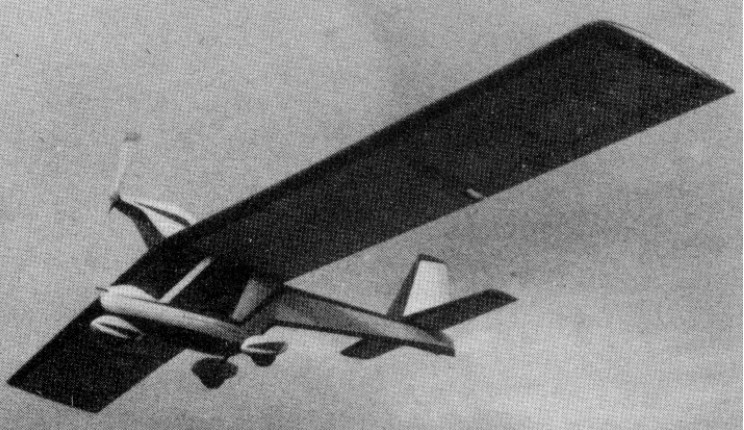
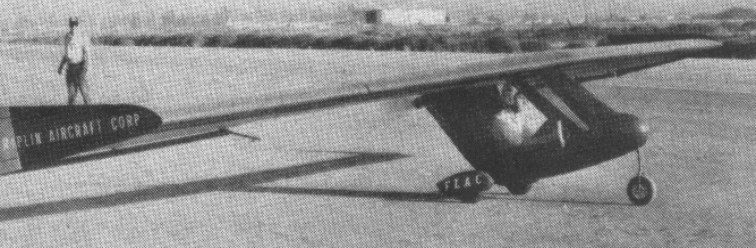
Striplin FLAC / Super FLAC

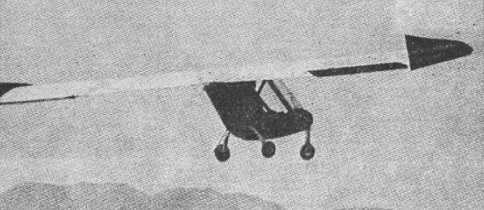
Single seat twin engined high wing mono¬plane with conventional three axis control. Wing has swept back leading edge, and tapering chord; no tail. Pitch/roll control by stabilator; yaw control by tip rudders; control inputs through stick for pitch/roll and pedals for yaw. Cantilever wing; wing profile Worthmann FX 126; double surface. Undercarriage has three wheels in tricycle formation; nosewheel retractable; suspension NC on nosewheel and glass fibre suspension on main wheels. Push right go right nosewheel steering connected to yaw control (Flac). No ground steering (Super Flac). Brakes Nod. Glass fibre/foam fuselage, totally enclosed. Engines driving pusher propeller.

Designed in June 1977, the prototype Flac (Foot Launch Air Cycle) made its first flight on the 24 October 1978 and despite its name was fitted with an auxiliary undercarriage to help the legs of its occupant. A tail less aircraft with a cantilever high wing set at 3 deg incidence with 8 deg of leading edge sweep back, even the earliest Flacs had a closed cabin of glass fibre and polyurethane foam, mounted under the wing. The wing tips were furnished with fins carrying rudders, while the stabilators at the trailing edge acted as elevators when used together or as ailerons when used differentially. The wing structure was glassfibre and epoxy on a foam base, fabric covered between spar and trailing edge. The main undercarriage was mounted on glassfibre legs, while the steerable nosewheel was manually retractable into the fuselage nose.

With two Chrysler Westbend motors giving 9hp each, the Flac cruised at 65mph (105kph) with a Vne of 80mph (129kph), a stall around 20 mph (32 kph) and a climb rate of 1630 ft/min (8.3 m/s). Add in weights of 156 I.P (71 kg) empty and 386 lb (175 kg) at maximum gross and a range of 200 mile (322km) on 5.0 US gal (4.2 Imp gal, 18.9 litre.

In addition to two prototypes, five Flacs had flown by January 1980 and 79 were being built by amateurs. Ken Striplin was not content with that and that Spring announced the Super Flac, which had more space for the pilot’s legs, thanks to a fixed nosewheel, and Soarmaster rather than Chrysler engines.

FLAC
Engine: Mac 101, 12-hp
Cruise: 25-30 mph

Air Cycle II
Engines: 2 x West Bend, 10 hp
Cruise: 65 mph
Stall: 23-30 mph
MAUW: 550 lb
Useful load: 300 lb

Super Flac
Engine: Two Soarmaster, 11.5 hp
Propeller diameter 48 inch, 1.21 m
Power per unit area 0.15 hp/sq.ft, 1.6 hp/sq.m
Fuel capacity 5.0 US gal, 4.2 Imp gal, 18.9 litre
Length overall 7.0ft, 2.13 m
Height overall 4.0ft, 1.22m
Wing span 32.0ft, 9.75m
Mean chord 4.911, 1.47m
Dihedral 8 deg
Sweepback 0 deg
Total wing area 155 sq.ft, 14.4 sq.m
Wing aspect ratio 6.6/1
Empty weight 200 lb, 91 kg
Max take off weight 434 lb, 197kg
Payload 234 lb, 106kg
Max wing loading 2.80 lb/sq.ft, 13.7 kg/sq.m
Max power loading 18.9 lb/hp, 8.6 kg/hp
Never exceed speed 80 mph, 129 kph
Max cruising speed 55 mph, 88kph
Stalling speed 24mph, 39kph
Min sink rate 180ft/min at 36mph, 0.9m/s at 58 kph
Best glide ratio with power off 20/1 at 38 mph, 61 kph
Take off distance 150 ft, 45 m
Landing distance 100 ft, 30 m

Air Cycle II
Engines: 2 x West Bend, 10 hp
Cruise: 65 mph
Stall: 23-30 mph
MAUW: 550 lb
Useful load: 300 lb