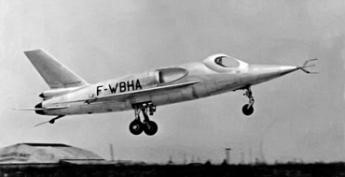
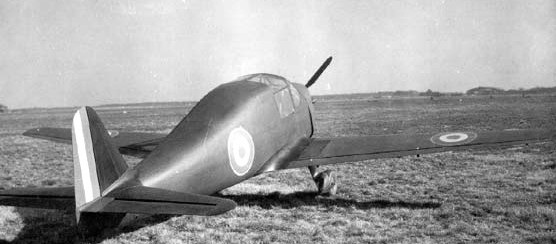
The Deltaviex is an experimental aircraft designed by ONERA for development of supersonic aircraft. designed in 1953 by ONERA, the prototype was built by SNCASO in Courbevoie, under the direction of engineer Aliette.
The aircraft was intended for multiple testing, including a roll stabilization device obtained by the profile of the trailing edge landing flaps. This device was developed lift while providing propulsion. Conventional ailerons were located at the ends of the wings. At 3.40 m they were partly intended to produce a very low inertia and damping in roll. The jet was formed by air bled from the engine in a small proportion (about 2%). The system has a switchable ramp equipped with many output holes. The steering was done with an extremely short period of around five hundredths of a second, producing a flap ange of + / – 2 °. The 70° wing thickness does not exceed 6%. It is adjustable in flight to 1 ° -4 °. The tricycle undercarriage is retractable.
The Deltaviex made its first flight in 1954 with Robert Fouquet at the controls, registered F-WBHA c/n. 001. It was mainly flown by Robert Fouquet, chosen due to his small size, essential in the cramped cockpit of the minuscule aircraft. Its small size allowed testing it in the wind tunnel at Modane (Savoy) at full scale in order to precisely measure its behaviour in various flying situations. The aircraft served for trials with blown ailerons, whereby bleed air from its Marboré II engine was blown over the wing trailing edge, a system later installed for example on the F-104 Starfighter. An innovative directional control system was installed, using pressurised air instead of a rudder and elevator to change direction.
Testing remained secret until November 8, 1956, when the Deltaviex was introduced to the press.
During testing (at Brétigny, Meudon, and Modane), the Deltaviex changed canopy type three times.
The single example of the Deltaviex finished its career at Modane (Savoie). It was recovered in 1984, from a garage owner in the region, by the Association of Ailes Anciennes Toulouse. It is held association at: Ailes Anciennes Toulouse Derrière le 5 chemin de Laporte Saint Martin du Touch 31300 Toulouse
Engine: Turbomeca Marbore II turbojet, 400 Kp Wingspan: 3.40 m Length: 7.10 m Height: 2.50 m Empty weight: 550 kg Max weight: 920 kg Wing area: 5 m² Max speed: 400 km h Range: 300 km
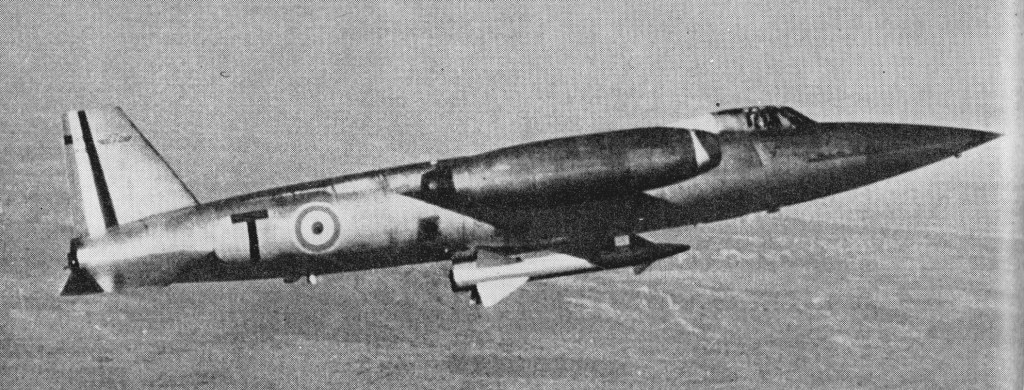
Embodying experience gained with the SO 9000, the SO 9050 – two prototypes of which were ordered in 1954 – embodied considerable redesign, entrusted to Dassault. A smaller wing of reduced thickness/chord ratio was adopted, the cockpit was enlarged, air brakes were transferred from the wing to the rear fuselage, a taller undercarriage was provided and a two-barrel SEPR 631 rocket motor of 3000kg / 6614 lb was adopted, combined with wing-tip 2425 lb st Turbomé Gabizo turbojets. It could carry a 330 lb Matra self-homing missile under the fuselage.
Sud Ouest SO 9050 Trident II Article
The first prototype SO 9050 was flown on 19 July 1955, its first flight on rocket power taking place on the following 21 December, and the second prototype flew on 4 January 1956, but was destroyed during its second flight. A third prototype had meanwhile been ordered, this flying on 30 March 1956, and some 10 weeks later, on 11 June, a contract was placed for six pre-series aircraft, a supplementary contract for a further four following (although the latter was to be cancelled on 24 October 1957 as an economy measure). The pre-series SO 9050 differed from the prototypes primarily in having 1100kg Turbomeca Gabizo turbojets in place of the Vipers at the wingtips and provision for nose-mounted AI radar and a single ventrally-mounted Matra R 511 air-air missile. The first pre-series aircraft was flown on 3 May 1957 and the third on 30 January 1958, but three months later, on 26 April, the programme was cancelled. During tests, Mach=1.9 was achieved at 19500m and an altitude of 26000m exceeded.
Both prototypes were lost in aerial accidents, the second confirming the inherent dangers of a rocket engine with its immensely volatile fuel.
SO-9050 Trident II Engines: 2 x Turbomé Gabizo turbojets, 2425 lb st, 1 x SEPR rocket, 6614 lb thrust. Loaded weight: 5900 kg / 13007 lb Empty weight: 2910 kg / 6415 lb Wingspan: 6.95 m / 23 ft 10 in Length: 13.26 m / 44 ft 6 in Height: 3.20 m / 11 ft 6 in Wing area: 14.50 sq.m / 156.08 sq ft Max speed: M1.8 (1188 mph)
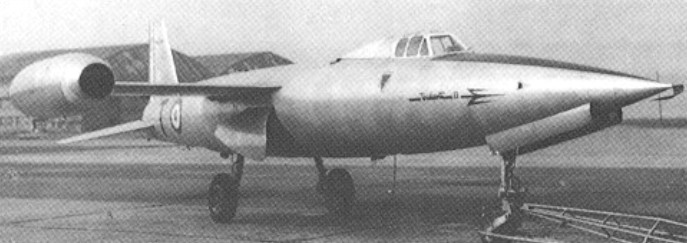
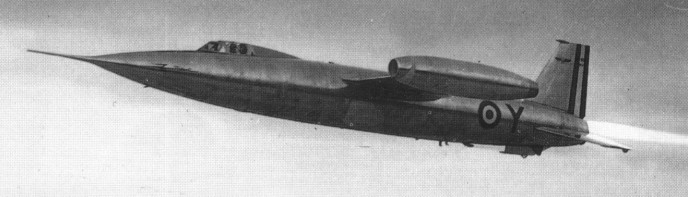
Stemming from the lightweight fighter philosophy that emerged from the Korean conflict, the SO 9000 Trident single-seat interceptor developed by a team led by Lucien Servanty was of unusual concept in employing turbojets for auxiliary power and a rocket motor for primary thrust. Two prototypes of the Trident were ordered on 8 April 1951, the first of these flying on 2 March 1953 solely on the power of two wingtip-mounted Turbomeca Marbore II turbojets each rated at 400kg, the more powerful Vipers being substituted in 1955. The second prototype was destroyed on its first flight on 1 September 1953, but development continued with the first example, which, on 4 September 1954, flew for the first time with its primary power plant, a triple-barrel SEPR 481 triple-chamber liquid rocket motor providing a total thrust of 4500kg. As the aircraft could not take-off on the power of the Marbores at fully loaded weight, these gave place to Dassault MD 30 (Viper ASV 5) turbojets of 745kg, with which it flew on 17 May 1955. Although conceived as a combat aircraft, the SO 9000 had meanwhile been overtaken by a more advanced development, the SO 9050, and its test programme was terminated on 10 December 1956, the prototype having achieved a speed of Mach=1.63 – the highest speed attained by any piloted aircraft in Europe at that time – and an altitude of 15,000m.
SO 9000 Trident
SO-9000 Trident I 2 x Marboré II turbojets, 800 lb st
SO-9000 Trident I 2 x Armstrong Siddeley Viper 5 turbojet, 1640 lb st, 1 x SEPR 481 rocket, 9920 lb thrust Wingspan: 26 ft 8.75 in (8.15m) Length: 45 ft 11.25 in (14m) Wing area: 99.03 sq.ft (9.2 sq.m) Max wt: 12,125 lb (5500kg) Max speed: 1056 mph @ 36,000 ft Crew: 1
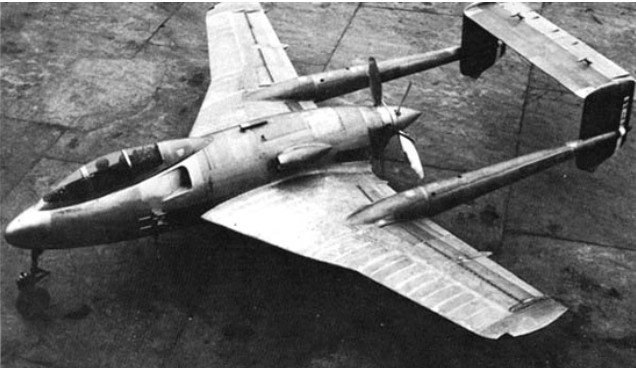
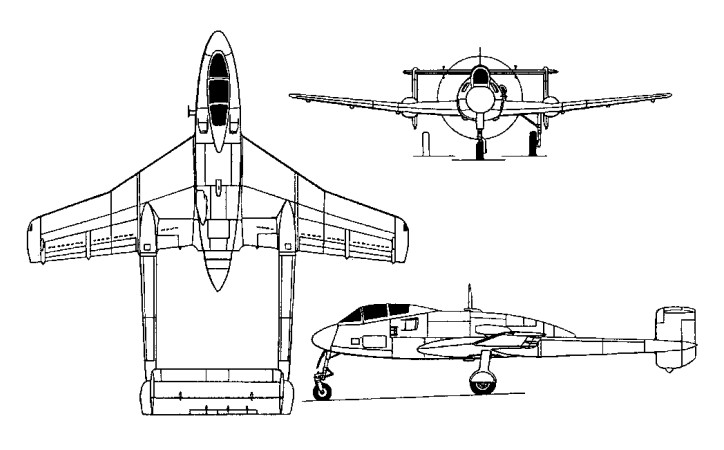
The subject of an order for two prototypes on 31 May 1946, the SO 8000 Narval (Narwhal) was conceived by a team under the leadership of Ing Dupuy at the Societe Nationale de Constructions Aeronautiques de Sud-Ouest (SNCASO) as a shipboard fighter and attack aircraft. Of twin-boom configuration with a sweptback wing – 24 degrees inboard and 13.5 degrees outboard on the leading edge – and a tricycle undercarriage, the Narval was powered by an Arsenal 12 H-02 (Junkers Jumo 213) engine rated at 2,250hp, installed as a pusher and driving contra-rotating propellers. Proposed armament comprised six 20mm cannon with provision for up to 1000kg of external ordnance.
Development was somewhat protracted, and the first flight (by the second prototype) did not take place until 1 April 1949, the second following on 30 December. Numerous problems arose during the test programme, dictating changes in the control surfaces, the air intakes and the propellers (Rotol propellers replacing the original Chauviere units); constant troubles were experienced with the engine, and, following the generally unfavourable results of evaluation at the Centre d’Essais en Vol in January 1950, development of the Narval was discontinued. The second prototype effected its 43rd and last flight on 8 January 1950, and the first prototype flew only once. Proposals to adapt the design for a Rolls-Royce Nene turbojet as the SO 8010 were not pursued. The quoted performance was not, in fact, achieved during flight test.
Loaded weight: 6606 kg / 14564 lb Empty weight: 4821 kg / 10629 lb Wingspan: 11.77 m / 39 ft 7 in Length: 11.83 m / 39 ft 10 in Height: 3.20 m / 11 ft 6 in Wing area: 26.30 sq.m / 283.09 sq ft Max. speed: 730 km/h / 454 mph Range w/max.fuel: 4500 km / 2796 miles
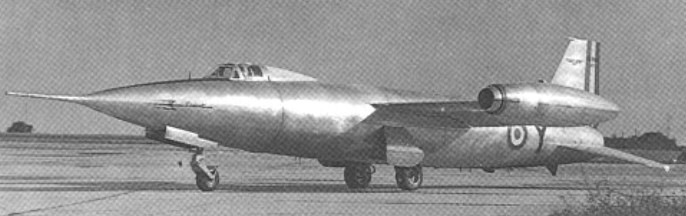
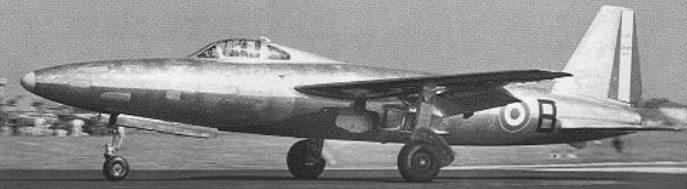
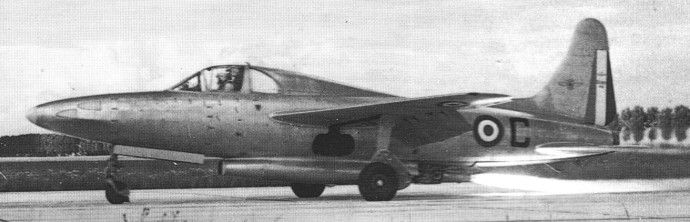
The first turbojet-powered single-seat fighter of French design to be built, the SO 6020 Espadon (Swordfish) interceptor was developed by the Societe Nationale de Constructions Aeronautiques de Sud-Ouest (SNCASO) under the design leadership of Lucien Servanty. Conceived to meet the requirements of a programme promulgated on 25 March 1946, and the subject of an order for three prototypes placed two months later, on 28 June, the SO 6020 was powered by a 2268kg Rolls-Royce Nene turbojet with, unusually, an aft-mounted ventral air intake. The SO.6020 featured flush inlets on the fuselage sides aft of the wing trailing edge. Proposed armament was initially to have comprised four 30mm cannon and four 12.7mm machine guns, this later being changed to six 20mm or 15mm weapons.
The first prototype flew on 12 November 1948 and the second on 16 September 1949, the latter being modified, after initial test, with NACA-type lateral intakes in place of the ventral intake. It was appreciated at an early stage that the SO 6020 was underpowered and would offer inadequate performance, a major redesign as the SO 6021 therefore paralleling initial flight testing of the SO 6020. The third prototype, intended for tactical reconnaissance, was completed as the SO 6025 with lateral intakes and a ventrally-mounted SEPR 25 auxiliary rocket motor of 1500kg thrust, this flying on 28 December 1949.
Sud-Ouest SO 6021 Espadon
The SO 6021 represented an attempt to reduce the weight and alleviate some of the aerodynamic problems that had beset the SO 6020 from the outset of flight test. Retaining the same Nene engine, but having a 1.30sq.m increase in wing area, an entirely redesigned vertical tail and a 604kg reduction in empty weight, the SO 6021 was equipped with servo controls and flew on 3 September 1950. Armament comprised six 20mm cannon. In June 1951, a ground attack version of the SO 6021 was offered to the Armee de l’Air with an afterburning Rolls-Royce Tay engine and an armament of two 30mm cannon. However, testing of the SO 6021 indicated that some of the difficulties experienced with the SO 6020, notably the shortcomings of the air intake arrangement, had not been overcome. A speed of Mach=0.96 was attained in a shallow dive, but serious buffet occurred at Mach=0.75, and further development was abandoned, the sole SO 6021 serving as a test bed for small wingtip-mounted turbojets associated with the SO 9000 programme, continuing in this role until 1956.
SO.6025 Espadon
The second prototype, with a similar rocket motor installed in the rear fuselage, became the SO 6026, flying in this form for the first time on 28 March 1953.
In 1953 the third prototype built had its wings replaced by bigger ones and fitted with rocket engine SEPR. This resulted in being the first European aircraft to break the sound barrier in level flight on 15 December 1953.
Considerably more development followed, but by 1953 the type was clearly obsolescent and further work was abandoned.
The third prototype was once being used a target at firing range before being recovered to the Ailes Anceinnes museum in Toulouse by August 2018.
Sud-Quest SO 6025 Espadon 03
SO-6020 Loaded weight: 7454 kg / 16433 lb Empty weight: 5354 kg / 11804 lb Wingspan: 10.60 m / 35 ft 9 in Length: 15.00 m / 49 ft 3 in Height: 4.55 m / 15 ft 11 in Wing area: 25.20 sq.m / 271.25 sq ft Max. speed: 967 km/h / 601 mph
SO 6021 Espadon Loaded weight: 6870 kg / 15146 lb Empty weight: 4750 kg / 10472 lb Wingspan: 10.60 m / 35 ft 9 in Length: 15.00 m / 49 ft 3 in Height: 4.72 m / 16 ft 6 in Wing area: 26.50 sq.m / 285.24 sq ft
The Sud Ouest SO 6000 Triton, first flying on 11 November 1946, was the first French jet powered aircraft to fly. Five were built. The first was powered by a 1980 lb thrust Junkers Jumo 004-B2 with a nose intake. Later versions had a 4850 lb thrust H-S Nene with both nose and fuselage scoops.
They were used as test beds and side-by-side trainers.
The third built, SO-6000-03, is at the French Musee de L’Air.
Engine: Rolls Royce Nene 101, 21582 N Length: 34.121 ft / 10.4 m Wingspan: 32.644 ft / 9.95 m Wing area: 162.536 sq.ft / 15.1 sq.m Max take off weight: 10363.5 lb / 4700.0 kg Weight empty: 7056.0 lb / 3200.0 kg Max. speed: 513 kt / 950 km/h Cruising speed: 462 kt / 855 km/h Initial climb rate: 9842.52 ft/min / 50.0 m/s Service ceiling: 39370 ft / 12000 m Wing load: 63.76 lb/sq.ft / 311.0 kg/sq.m Crew: 2
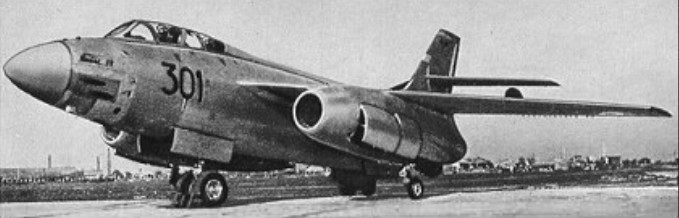
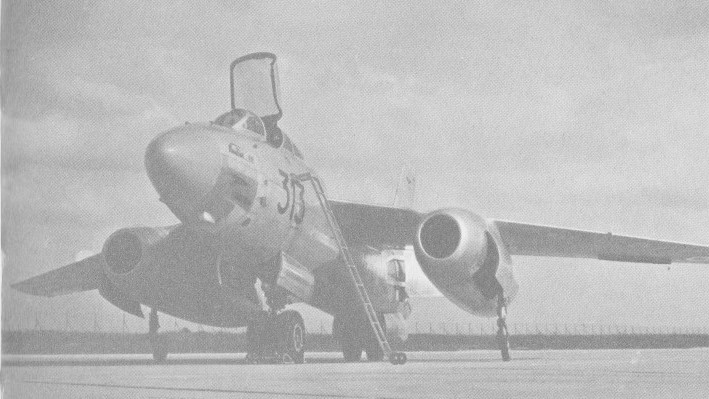
After the cancellation of the SO.4000, the Sud-Ouest design team turned to a more refined type, the SO.4050 Vautour that eventually entered service in three versions optimized for MK.IIN all-weather interception, Mk.IIA close support, and Mk.IIB bombing from medium and high altitudes.
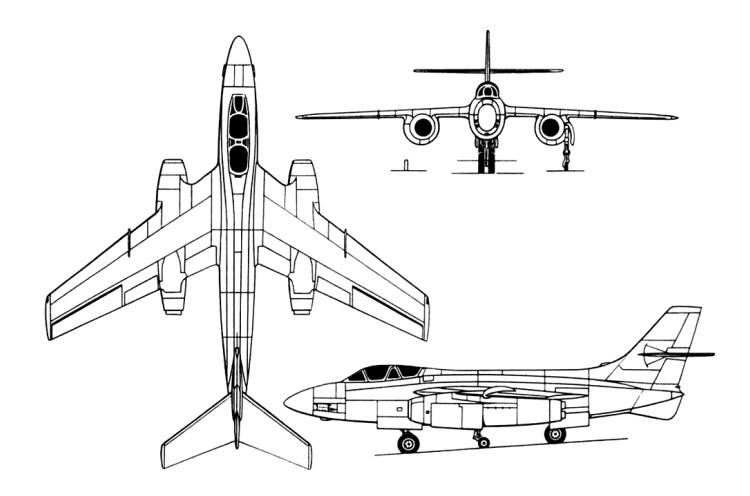
The SNCASO SO.4050 Vautour (Vulture) was first flown on 16 October 1952. Midway in size between small fighters and jet medium bombers, it had the same layout as the much bigger Boeing B 47, with a mid-high 35 degree swept wing, under-slung engines, a fighter type nose cockpit and so-called bicycle landing gear. The front wheels retract forward and the rear wheels rearward. Small balance wheels were under each engine nacelle. Fitted with conventional ailerons, rudder, all-moving tailplane, split flaps, and an air brake on each side of the rear fuselage.
Each engine was fed from its own set of fuel tanks. The inner 17 fuel tanks had an automatic system to “isolate” cells which caught fire or to neutralize leaks in the passages. The pilot could direct or divert flow of fuel in case of damaged pipes or engine malfunction. The Vautour didn’t have inflight refuelling devices. Only the experimental (FR-AF) IIA(R) s/n 8, was tested as an air tanker for the Mirage-4.
The Vautour prototype was the first French twin-jet aircraft to exceed the speed of sound in a shallow dive. Various engines were fitted in the three prototype and six pre-production models but all production Vautours had Atar turbojets.
Produc¬tion took place later in three versions. The Vautour IIA is a single seat tactical fighter, of which 30 were built, the first production machine flying on 30 April 1956. Twenty-five Vautour II-As were supplied to Israel.
Vautour IIA
Vautour IIB
Only one of the six pre-production Vautours was a bomber, the others consisting of two tactical support aircraft and three all-weather fighters. The Vautour IIB had a single seat pilot cockpit similar to that of the Vautour IIA attack version, but added a glazed nose for a navigator/bombardier who could use a conventional bombsight. Navigation was mainly by a twin gyro platform and Doppler radar, and considering the small dimensions of the aircraft an excellent bombload could be carried both internally and externally. The first production aircraft of this IIB sub type flew on 31 July 1957 and eventually 40 were delivered to equip the Armee de l’Air’s 92e Escadre, which was the original operating ele¬ment of the Commandement des Forces Aeriennes Strategiques (strategic air command). Special bomb-dropping gear was developed for them in which the weapons were extended below the bomb bay prior to release, to make possible attack a transonic speeds from all altitudes. The Vautour IIB (redesignated Vautour IIAB after fitting one piece tailplanes in the early 1960s) was replaced by the Dassault Mirage IVA from 1965.
The first of 70 Vautour II-N all weather fighters flew on 10 October 1956.
SO.4050 Vautour II-N
It was in service with the air forces of France (II-Bs and II-Ns) and Israel (25 II-As).
Mk.IIA Engine: 2 x SNECMA Atar 101F-3, 34.3kN, 7716 lb Wingspan: 15.09 m / 49 ft 6 in Wing area: 484.4 sq.ft Length: 15.57 m / 51 ft 1 in Height: 4.5 m / 15 ft 9 in Max take-off weight: 20000 kg / 44093 lb Empty weight: 10000 kg / 22046 lb Internal fuel: 5,364 lt / 17 tanks Weapon bay fuel capacity: 3,000 lt (2 x 1,500 lt tanks) External fuel: 2 drop tanks of 1,300 lt or 600 lt Max fuel capacity: 10,964 lt / 8,771 kg Max. speed: 1105 km/h / 687 mph at SL Ceiling: 15000 m / 49200 ft Armament: 4 x 30mm cannons, 1850kg / 6000 lb of bombs Seats: 1
Mk.IIB Type: two seat bomber Engines: 2 x Powerplant: 2 x SNECMA Atar 101 E 3 turbojets, 3500 kg (7,720 lb) Wing span: 15.1 m (49 ft 6.5 in) Length: 15.55 m (51 ft 0.25 in) Height: 4.32 m (14 ft 2 in) Wing area: 45.00 sq.m (484.4 sq ft) Empty wt: 10470 kg (23,082 lb) MTOW: 21000 kg (46,300 lb) Max speed: 1100 km/h (685 mph) at low level and 950 km/h (590 mph) at 12190 m (40, 000 ft) Radius with max bombload: 930 km (580 miles) Max range: 5950 km (3,700 miles) Armament: internal six bombs of 340 kg (750 lb) Hardpoints: four – 500 kg (1, 102 lb) each Weapon bay fuel capacity: 3,000 lt (2 x 1,500 lt tanks) External fuel: 2 drop tanks of 1,300 lt or 600 lt
Mk.IIN Engines: 2 x SNECMA Atar 101E-3 turbojet, 7716 lb Wingspan: 49 ft 6.5 in Length: 14 ft 1.75 in Wing area: 484.4 sq.ft Empty weight: 23,150 lb MTOW: 45,635 lb Internal fuel: 4426 lt Weapon bay fuel capacity: 3,000 lt (2 x 1,500 lt tanks) External fuel: 2 drop tanks of 1,300 lt or 600 lt Max fuel capacity: 10,026 lt / 8,021 kg Max speed SL: 685 mph Max ROC: 11,800 fpm Service ceiling: 50,000 ft Armament: 4 x DEFA cannon Hardpoints: 4 Seats: 2
IIBR Engines: 2 x Powerplant: 2 x SNECMA Atar 101 E 3 turbojets, 3500 kg (7,720 lb) Max speed: 1100 km/h (685 mph) at low level and 950 km/h (590 mph) at 12190 m (40, 000 ft) Radius with max bombload: 930 km (580 miles) Max range: 5950 km (3,700 miles) Empty wt: 10470 kg (23,082 lb) MTOW: 21000 kg (46,300 lb) Wing span: 15.1 m (49 ft 6.5 in) Length: 15.55 m (51 ft 0.25 in) Height: 4.32 m (14 ft 2 in) Wing area: 45.00 sq.m (484.4 sq ft) Weapon bay fuel capacity: 1 x 1,500 lt tank External fuel: 2 drop tanks of 1,300 lt or 600 lt Max fuel capacity: 9,464 lt
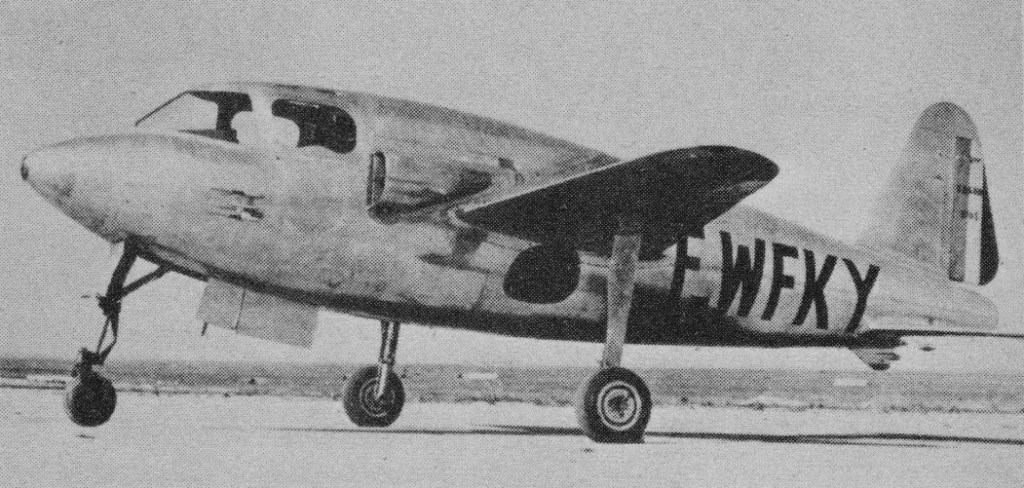
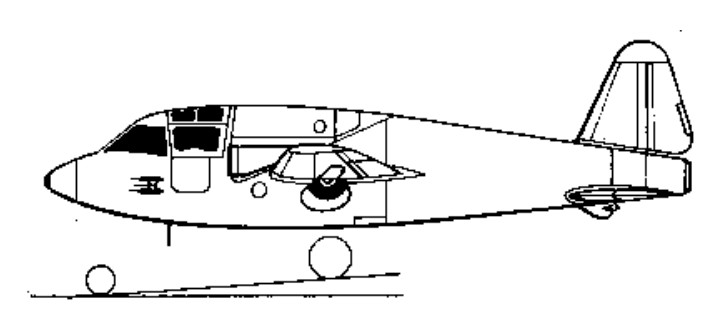
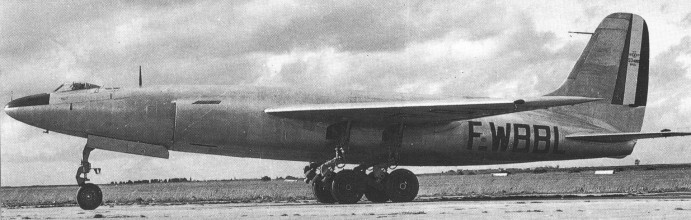
The SO 4000 was developed by the Société Nationale de Constructions Aéronautiques de Sud-Ouest (SNCASO) to meet an Armée de l’Air requirement formulated shortly after WWII for a twin-turbojet bomber capable of high subsonic speeds and having a maximum loaded weight of 25-30 tonnes. The SO 4000 project competed with the NC 270 project tendered by the SNCA du Centre, and after the flight testing of manned scale models, the SNCASO bomber was selected for further development. The half-scale model predecessors of the SO 4000 were the SO M.1 glider (F-WFDJ) and the powered SO M.2 (F-WFDK).
The single prototype of the full-scale SO 4000 bomber, (F-WBBL) had been rolled out for the first time on 5 March 1950. While essentially similar in configuration to the M.1 and M.2, the SO 4000 featured a tall undercarriage comprising a single nosewheel and tandem mainwheels each with independent legs. This undercarriage proved somewhat fragile, collapsing during ground trials on 23 April. After repairs were completed, flight testing finally commenced at Orleans-Bricy on 15 March 1951, test pilot Daniel Rastel being accompanied by flight engineer Pistrak.
The SO 4000 was powered by two Rolls-Royce turbojets mounted side-by-side in the rear fuselage, these being fed via lateral intakes immediately aft of the pressurised forward fuselage. Fuel was accommodated above the weapons bay in the centre fuselage and proposed defensive armament consisted of remotely-controlled gun barbettes at the wingtips. The 31 deg swept wing had a 10 per cent thickness/chord ratio from root to tip and the control arrangement was fundamentally similar to that of the M.2. The initial flight of the SO 4000 was also to prove its last as the undercarriage collapsed once more on alighting, the programme subsequently being discontinued as a result of a reduction in military credits.
Engines: 2 x Rolls-Royce Nene 102 turbojets, 4,980 lb st (2 260 kgp) Fuel cap: 1430 ImpGal (6500 lt) Wing span: 58 ft 7 1/8 in (17,86 m) Length: 64 ft 9½ in (19,75 m) Wing area of 807.32 sq ft (75,00 sq.m) Empty wt: 36,5581b(16 583 kg) Loaded wt: 48,510 lb(22 005kg) Estimated performance – Max speed of 528 mph (850 km/h) at 29,530 ft (9 000 m) or Mach 0.78 and 515 mph (830 km/h) at sea level or Mach 0.675.
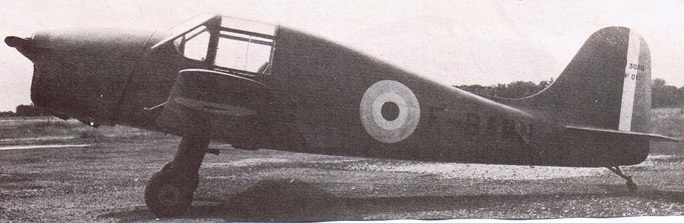
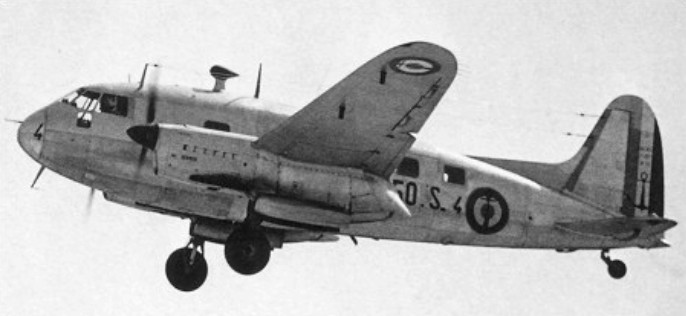
The SO.95 Corse II was a light twin-engined transport, the prototype flying on 17 July 1947. The type was originally fitted with a tailwheel undercarriage, which was retained in the civil version, but the military variant featured a tricycle landing gear. The Corse II was used almost exclusively by the light transport units of the French Naval Air Arm; only two saw regular airline service, operating with Air Services of India between Bombay, Bangalore and Delhi before being withdrawn in 1950.
Engine: 2 x 580hp Renault 12S-02-201 V-12 Max take-off weight: 5600 kg / 12346 lb Wingspan: 18.00 m / 59 ft 1 in Length: 12.32 m / 40 ft 5 in Height: 4.30 m / 14 ft 1 in Max. speed: 330 km/h / 205 mph Ceiling: 7000 m / 22950 ft Range: 1300 km / 808 miles Crew: 2 Passengers: 10-13












 All Aero