Sukhoi Su-7 (I)

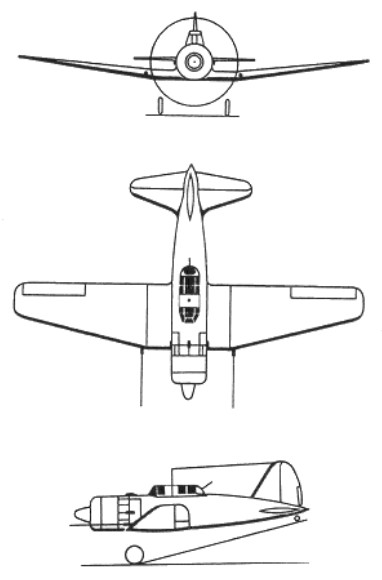
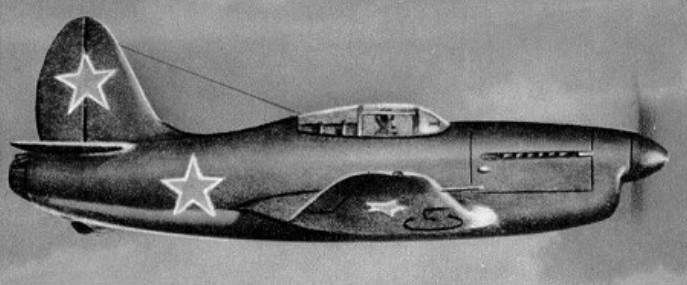
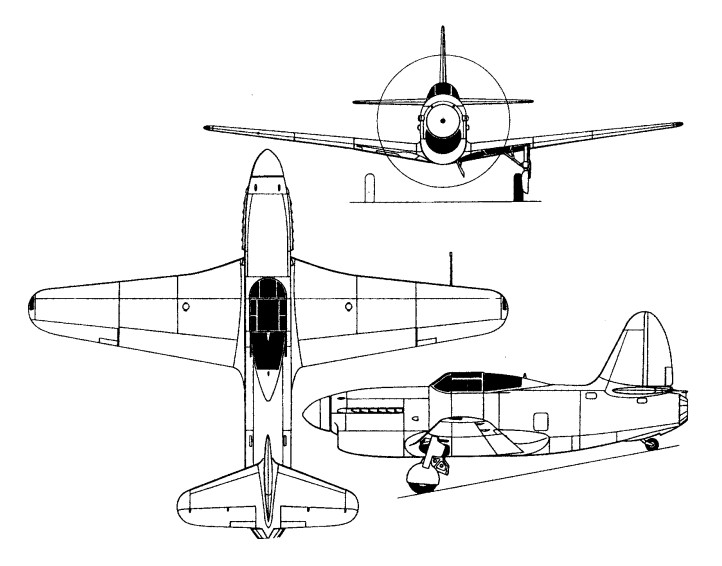
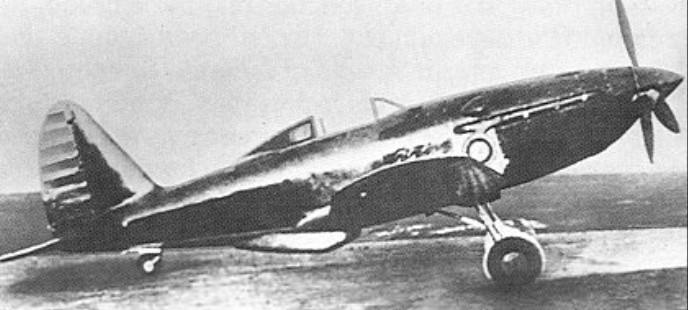
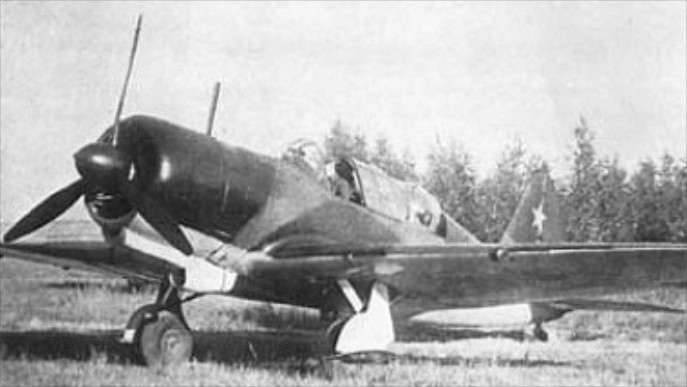
Chronologically, the Su-7 mixed-power high-altitude interceptor preceded the Su-5, being based broadly on the single-seat Su-6(A) assault aircraft. Intended to fulfil a 1943 requirement, the Su-7 retained the single-spar metal wing of the experimental shturmovik, mated to a new all-metal semi-monocoque fuselage. It was proposed that the fighter be powered by the 2,200hp Shvetsov M-7118-cylinder two-row radial engine with paired TK-3 turbo-superchargers, but non-availability of this power plant led to the decision to install a 14-cylinder two-row Shvetsov M-82FN radial engine rated at 1,850hp and supplemented by a Korolyov-Glushko RD-1KhZ bi-fuel rocket motor developing 300kg thrust with a burn time of four minutes.

Flight testing of the Su-7 with the rocket motor commenced in the late summer of 1944. Although the unstable nature of the rocket power plant motivated against adoption of the Su-7, flight testing revealed that it boosted maximum speed by 83km/h at 7,500m and by 195km/h at 13,000m. Armament comprised two wing-mounted 20mm cannon, and the sole rocket-powered Su-7 prototype was being prepared for the first post-World War II air display over Moscow in 1945 when the rocket motor exploded, killing the pilot and destroying the aircraft.

Engine: Shvetsov M-82FN radial, 1,850hp and 1 x Korolyov-Glushko RD-1KhZ bi-fuel rocket motor, 300kg thrust
Max take-off weight: 4340 kg / 9568 lb
Wingspan: 13.50 m / 44 ft 3 in
Length: 9.60 m / 32 ft 6 in
Wing area: 26.00 sq.m / 279.86 sq ft
Max. speed: 680 km/h / 423 mph
Range: 1240 km / 771 miles
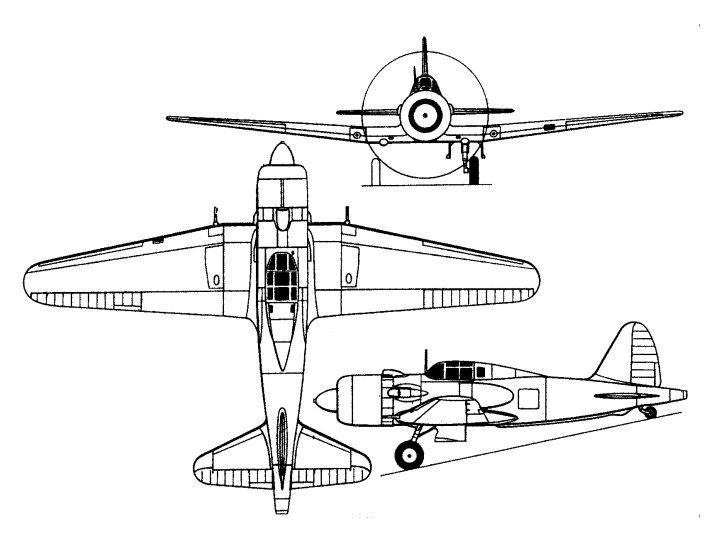
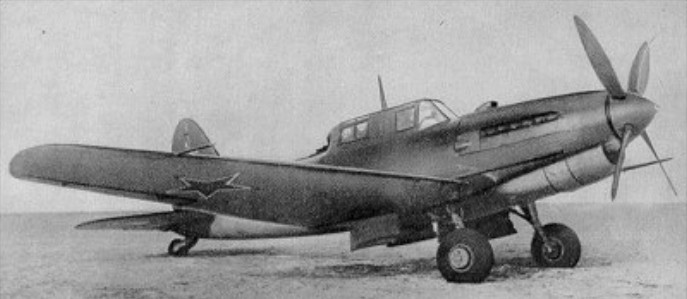
Sukhoi Su-7 (I)

Sukhoi Su-6

The Su 6 single seat assault aircraft was designed around the experimental M 71 engine and intended to compete with Ilyushin’s Il 2. The Su 6 offered a considerably higher performance than the Il 2, and carried a more effective armament, but by this time the Ilyushin design was already in production, and as manufacture of the M 71 engine had not begun.

Development started in 1939. Second Su-6-2 (improved) version was built in 1942, and the last one (Su-6-3), powered by liquid-cooled 2000hp AM-42 started flight testing early in 1944.

Engine: 1 x ASh-71F, 1620kW
Max take-off weight: 6500 kg / 14330 lb
Empty weight: 4000 kg / 8819 lb
Wingspan: 13.5 m / 44 ft 3 in
Length: 9.2 m / 30 ft 2 in
Wing area: 26.0 sq.m / 279.86 sq ft
Max. speed: 500 km/h / 311 mph
Ceiling: 8100 m / 26600 ft
Range w/max.fuel: 970 km / 603 miles
Armament: 2 x 37mm machine-guns, 3 machine-guns, 10 missiles, 400kg of bombs
Crew: 2

Sukhoi Su-6

Sukhoi Su-5 / I-107

The development at the TsIAM (Central Aero Engine Institute) by K V Kholshchevnikov of the so-called “accelerator”, or VRDK (Vozdushno-reaktivny dvigatyel kompressorny, or Air-reaction engine compressor), prompted the development of mixed-power single-seat fighters as an interim means of meeting the potential threat of German turbojet-powered fighters. Both Mikoyan-Gurevich and Sukhoi bureaux were assigned the task of creating such fighters, the former developing the MiG-13 alias I-250(N) and the latter the Su-5 alias I-107. The VRDK provided 300kg thrust for up to 10 min at high altitude to boost the power available from the Klimov M-107A (VK-107A) 12-cylinder Vee-type liquid-cooled engine which delivered 1,650hp for take-off. An all-metal stressed-skin single-seat monoplane with a monocoque fuselage, the Su-5 had an armament of one 23mm engine-mounted cannon and two 12.7mm machine guns.

First flown in April 1945, the prototype was soon fitted with a new wing of laminar-flow type developed by the TsAGI, and during one subsequent flight test a speed of 793km/h was attained at 4350m, this being 25km/h faster than had been calculated for that altitude. The effect of the VRDK was a gain of 90km/h at low altitude rising to 110km/h at 7800m, at which it was anticipated that maximum speed would be 810km/h. Early in July 1945, before this speed could be attained, the M-107A engine suffered some damage in flight and when it was found to be irreparable, the Su-5 flight test programme was abandoned.

Engine: Klimov M-107A (VK-107A) V-12, 1,650hp & 1 x VRDK Air-reaction engine compressor
Max take-off weight: 3804 kg / 8386 lb
Empty weight: 2954 kg / 6512 lb
Wingspan: 10.56 m / 35 ft 8 in
Length: 8.51 m / 28 ft 11 in
Height: 3.53 m / 12 ft 7 in
Wing area: 17.00 sq.m / 182.99 sq ft
Max. speed: 810 km/h / 503 mph
Range: 600 km / 373 miles

Sukhoi Su-5 (I-107)

Sukhoi Su-3 / I-360

At the time of the evacuation of the Sukhoi OKB to Novosibirsk, the prototype of a developed version of the Su-1, the Su-3, was under construction. Initiated under the designation I-360, the Su-3 mated the Su-1 fuselage and tail surfaces with an entirely new wing of revised profile with shorter-span outer panels resulting in a 2.00sq.m reduction in wing area. The radiator bath was enlarged, but in all other major respects the Su-3 was similar to the Su-1. Retaining the M-105P engine and the same armament, the Su-3 was completed at Novosibirsk and entered flight test in the late summer of 1942. Although the TsIAM had meanwhile undertaken much development work on the TK-2 turbo-supercharger, the principal defects were found to remain, and, as a consequence, development of the Su-3 was discontinued towards the end of 1942.

Engine: Klimov M-105P V-12, 1,100hp
Max take-off weight: 2860 kg / 6305 lb
Empty weight: 2490 kg / 5490 lb
Wingspan: 10.10 m / 33 ft 2 in
Length: 8.42 m / 28 ft 7 in
Height: 2.71 m / 9 ft 11 in
Wing area: 17.00 sq.m / 182.99 sq ft
Max. speed: 638 km/h / 396 mph
Range: 700 km / 435 miles
Armament: one 20mm cannon and two 7.62mm machine guns

Sukhoi BB-1 / Su-2

During 1939, Sukhoi established his own design bureau, and began the redesign of the ANT 51 with an M 88B engine, a low wing and an increased offensive load, this emerging as the BB 1, entering series production in 1940, and being redesignated Su 2 in 1941.

The Sukhoi Su-2 entered service with the V-VS early in 1941 but, as far as is known, was not encountered during the Winter War which ended the previous year. Derived from Sukhoi’s ANT-51 and designated BB-1 during its early trials, the aircraft was fairly efficient by current standards once the M-87 engine had been replaced by the M-88 and then the M-88B.

Despite being further improved by installation of the 746kW M-88B radial, the Su-2 was found to be desperately vulnerable and virtually unable to defend itself with its single small-calibre machine-gun in the unwieldy manually-operated dorsal turret. Estimates suggest that about 100 were in service with the Frontovaya Aviatsya at the time that the German army rolled into the Soviet Union in June 1941, but that dozens were shot down by flak and fighters in the first few disastrous weeks.

The Su 2 was built in fairly substantial numbers, both with the IM 88B engine and with the more powerful M 82. The state of the Soviet aircraft industry in 1941 prevented much being done to remedy the immediate lack of suitable ground support aircraft (until production of the two-seat Il-2m3 could be stepped up) and recourse was made to further attempts to improve the Su-2 by installation of the 1134kW M-82 radial and freguent deletion of the dorsal turret, but with little tactical benefit. Accepting that losses would remain high, the Soviets therefore simply loaded the aircraft with further bombs and rockets on the supposition that the more explosive delivered against the enemy the better the chances of some degree of success. This version, as well as the completely redesigned Su-6, were abandoned in favour of all-out dependence on the Il-2m3. The Su-2 probably did not survive in production beyond mid-1942.

Engine: 1 x M-88B, 735kW
Max take-off weight: 4400 kg / 9700 lb
Empty weight: 3000 kg / 6614 lb
Wingspan: 14.3 m / 47 ft 11 in
Length: 10.3 m / 34 ft 10 in
Wing area: 29.0 sq.m / 312.15 sq ft
Max. speed: 460 km/h / 286 mph
Ceiling: 3800 m / 12450 ft
Range w/max.fuel: 1200 km / 746 miles
Armament: 5 x 7.62mm machine-guns
Bombload: 600kg
Crew: 2

Sukhoi Su-2

Sukhoi Su-1 / I-330

Pavel O Sukhoi established his own OKB, or Experimental Design Bureau, in December 1938, and, early in the following year, was assigned the task of designing an advanced single-seat high-altitude fighter. Initially designated I-330, the fighter was of mixed construction, with a single-spar all-metal wing of comparatively high aspect ratio with flush-riveted light alloy skinning, and a wooden semi-monocoque fuselage with shpon, or bakelite-ply, skinning. Power was provided by a Klimov M-105P 12-cylinder liquid-cooled Vee-type engine rated at 1,100hp for take-off and fitted with a pair of TsIAM-developed TK-2 exhaust-driven turbo-superchargers, the radiator being accommodated in the fuselage aft of the cockpit and exhausting over the rear decking. Armament consisted of one 20mm cannon and two 7.62mm machine guns. Factory testing commenced late 1940, by which time the designation Su-1 had been adopted, State testing being performed in the following summer. The turbo-superchargers proved capricious and the Su-1 was flown on several occasions with the TK-2s removed. Although the fighter met its specified performance with the turbo-superchargers functioning, their failure frequency was unacceptable and the TsIAM had failed to improve reliability by October 1941, when the OKB was evacuated from Moscow to Novosibirsk, the Su-1 being damaged in the process. This prototype was not rebuilt, development continuing with the Su-3.

Engine: Klimov M-105P V-12, 1,100hp
Max take-off weight: 2875 kg / 6338 lb
Empty weight: 2495 kg / 5501 lb
Wingspan: 11.50 m / 38 ft 9 in
Length: 8.42 m / 28 ft 7 in
Height: 2.71 m / 9 ft 11 in
Wing area: 19.00 sq.m / 204.51 sq ft
Max. speed: 641 km/h / 398 mph
Range: 720 km / 447 miles
Armament: one 20mm cannon and two 7.62mm machine guns

Sukhoi Su-1 (I-330)

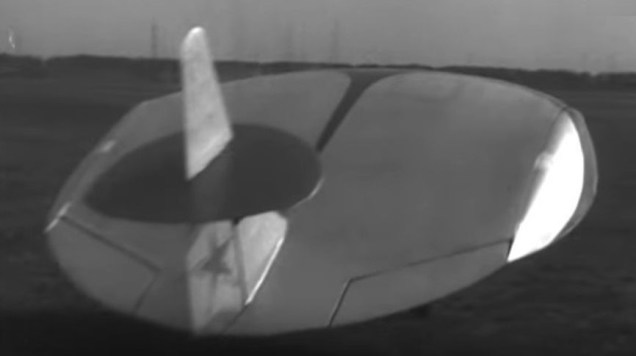
Sukhanov Diskoplan-2

Sukhanov Diskoplan-2

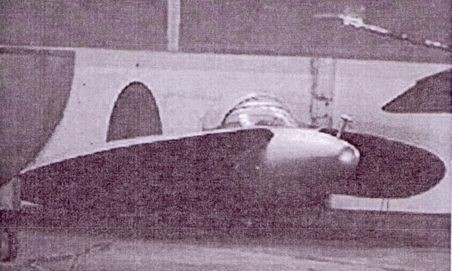
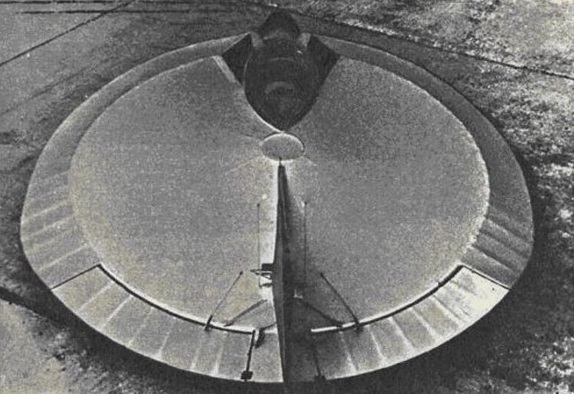
A 1960 version of the Discoplan 2 aircraft’s structure appears to have been based on a wooden or steel truss covered with lacquered canvas — standard lightplane and glider construction. Apparently the disc-shaped vertical “fin” was designed to revolve on a horizontal axis like a bicycle wheel — possibly to provide some sort of gyroscopic stabilization to the aircraft’s control system via a system of cables and struts.

The construction was carried out by Lavochkin. The circular wing has neither ribs or longerons. The light alloy edging around the perimeter of the “wheel” serves only to give a streamlined form to the tip. It is controlled by ailerons and rudder.

Reported in March 1963, the circular wing Discoplan II was successfully tested on an airfield near Moscow in the previous Autumn.

The Discoplan-II was piloted by Vladimir Ivanov, a glider expert.

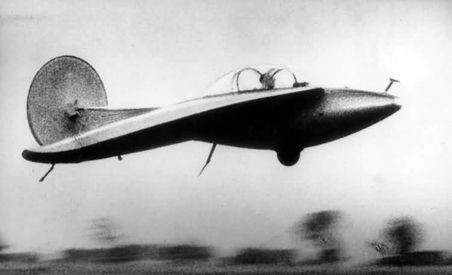
One of the main features of the machine discovered during tests was the aerodynamic effect of the ‘air cushion’. Owing to the proximity of the wing to the ground, and thanks to its circular form, the influence of the cushion on the landing and take-off characteristics proved most beneficial. At a height of 1.5-2m / 59-79 in Discoplan-II automatically stabilised both in the lateral and transverse directions and could fly without the pilot touching the controls. In gliding down to land the pilot also felt how the Discoplan was “padded” by the air cushion. Thus, the landing was also of an automatic.

Wingspan: 5 m / 16 ft 5 in
Wing area: 20 sq.m
Empty weight: 240 kg
Gross weight: 240 kg / 529 lb
Wing loading: 12 kg/m2
Seats: 1

Sukhanov Diskoplan-I

.During 1949-50 Master of Technology M.V.Sukhanov built an experimental single seat glider having a wing and control surfaces circular in planform, which he called Discoplan-I. The wing diameter was 3.5 m / 11 ft 6 in, and the gross weight was 230 kg / 507 lb.

The flight trials of the Diskoplan-I were carried out under the direction of the designer by a team of young engineers from the Voluntary Society for Assisting Army, Air Force and Navy, and covered aerobatics. It proved absolutely spin-proof.

It was flying in 1957.

Sukhanov “Discoplan I” 1957 on the Ground and in the air.

Sud-Ouest SO.7050 / SO.7055 / SO.7060 Deauville

SO.7060 Deauville

Developed from the SO.7050 and SO.7055 two-seat cabin monoplanes, the SO.7060 Deauville differs primarily in having the 75 hp Mathis 4GO replaced by a 105 hp Walter Minor 4-III.

The first of two Deauville prototypes flew on 22 March 1948. Of all-metal construction, dual controls are provided and a third seat may be fitted aft of the side-by-side front seats.

SO.7050
Engine: 75 hp Mathis 4GO

SO.7055
Engine: 75 hp Mathis 4GO

SO.7060 Deauville
Engine: 105 hp Walter Minor 4-III
Wing span: 34 ft
Wing area: 161.4 sq.ft
Length: 21 ft 10 in
Height: 7 ft 11 in
Empty weight: 1140 lb
Loaded weight: 1760 lb
Max speed: 127 mph
Cruise: 105 mph at 3280 ft
Range: 500 mi