Sunderland MOBA 2

Sunderland MOBA-2C

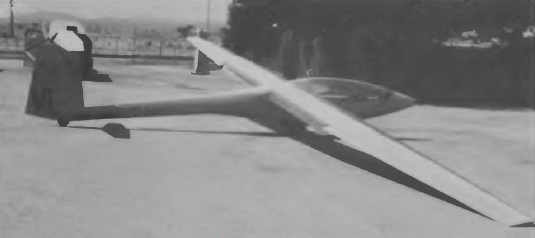
In 1972 the MOBA-2A, designed by an aircraft engineer, Gary Sutherland, was one of the two winners of an Australian Gliding Federation competition to design a 13 m (42 ft 8 in) sailplane which could be built in a small workshop with limited tools.

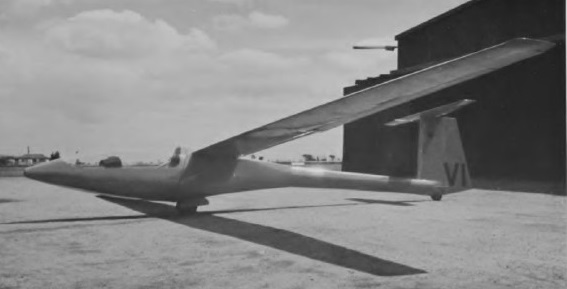
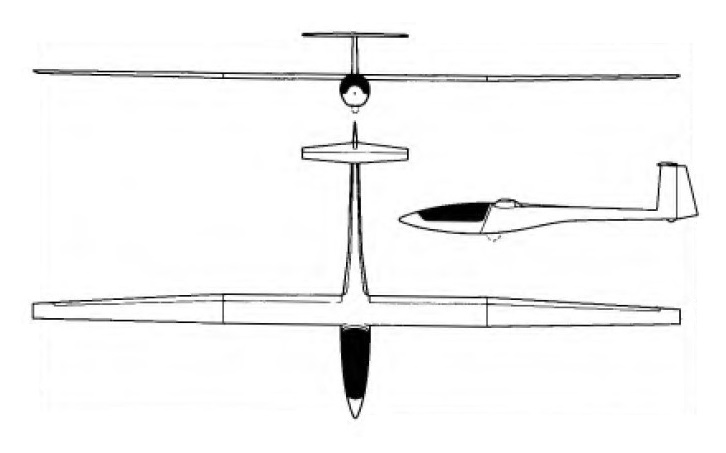
Designed and built by Mr Gary Sunderland of Heatherton, Victoria, an engineer with the Australian Department of Civil Aviation, the MOBA 2C is a Standard Class single-seater developed from the MOBA 2A, one of two 13m span sailplanes that competed with each other in 1972 in a design competition organised by the Australian Gliding Federation. MOBA is an acronym for My Own Bloody Aircraft, and the MOBA 2B was a 15m span version of the 2A; the 2C is an improved version of both the earlier models with a 15m span and the fin and rudder height increased to 4ft.

MOBA-2C

The prototype 2C made its first flight on 12 December 1979 and is a cantilever high wing monoplane of mixed construction with a T-tail; series production was not intended. The single-spar wings are built in three pieces and have plywood ribs with PVC foam infilling, and a skin of pop-riveted aluminium alloy sheet covered with glassfibre. The plain aluminium alloy flaps on the trailing edge also serve as air brakes, and the wooden ailerons are plywood-covered. The nose and centre fuselage are box structures of sheet aluminium alloy with a non-structural glassfibre skin, while the tail boom is of flush-riveted aluminium alloy sheet. The fin and rudder are also of flush-riveted aluminium, while the tailplane and elevator are of wood and plywood. Landing gear consists of a retractable monowheel and a fixed tailskid, while the pilot sits under a forward-sliding canopy.

MOBA-2A
Wingspan: 42 ft 8 in / 13 m

MOBA-2C
Span: 49 ft 2.5 in / 15.0 m
Length: 22 ft 3in / 6.78 m
Height: 4 ft 4 in / 1.32 m
Wing area: 97.7 sq ft / 9.08 sq.m
Wing section: Wortmann FX-67-K-150
Aspect ratio: 24.74
Empty weight: 499 lb / 226 kg
Max weight: 730 lb / 331 kg
Max wing loading: 36.5 kg/sq.m / 7.48 lb/sq ft
Max speed: 121 mph / 105 kt / 194.5 km/h (in smooth air)
Max aero-tow speed: 101 mph / 88 kt / 163 km/h
Stalling speed: 42 kt / 78 km/h
Min sinking speed: 2.0 ft/sec / 0.61 m/sec at 52 mph / 45 kt / 83 km/h
Best glide ratio: 37:1 at 57.5 mph / 50 kt / 93 km h

MOBA-2C

Sun Aerospace Sun Ray 100

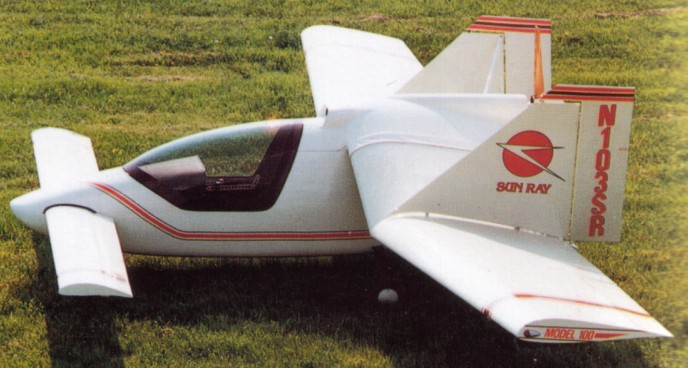
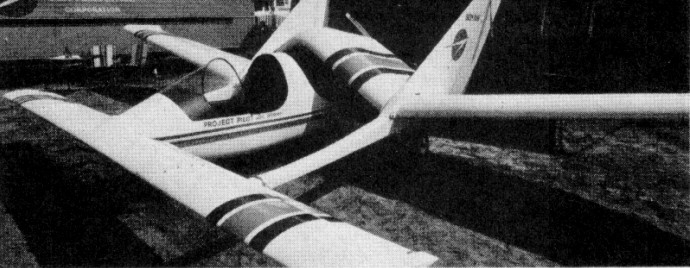
One of a steadily increasing number of American companies catering for the burgeoning homebuilder’s market, Sun Aerospace is a comparatively small concern based at Nappanee, Indiana. Sun Aerospace’s main product is the Sun Ray 100, a canard type that first flew in prototype form during September 1983 and is one of many sporting lightplanes clearly derived from the pioneering canard work of Burt Rutan.

The type is available in kit form, and it is estimated that some 500 man-hours are required for assembly of such a kit. The result is a trim single-seater with enclosed accommodation and non-retractable tricycle landing gear, but the overall appearance is perhaps marred by the size of its twin vertical surfaces, located above the main wing to the sides of the engine and its pusher propeller.

Sun Aerospace Sun Ray 100 Article

The construction of the Sun Ray 100 is typical of many current aircraft for the homebuilt market, and is centred on a fuselage that uses a primary structure of welded aluminium alloy tubes covered with three pre-moulded glassfibre shells. The main wing is attached to the top of the rear fuselage, and is sharply anhedralled to the locations of the vertical surfaces, and is flat outboard of that point: the wing structure has extensive reinforcement of spruce and comprises a pre-moulded glassfibre leading edge, an aluminium alloy trailing edge and glassfibre-wrapped ribs all covered with Ceconite or Stits Poly-Fiber. The canard foreplanes use pre-moulded glassfibre skins, and all the control surfaces (twin rudders, two wing-mounted ailerons and two canard-mounted elevators) are made of aluminium tubing.

Companies such as Sun Aerospace are keen to capitalize on all the possibilities of a successful basic design, and it is thought that under development are an amphibious version of the Sun Ray 10 and a two-seater known as the Sun Ray 200.

First flying on 13 January 1987, N222SR, another showed up at the 1987 Paris Air Show, N103SR c/n 100-103

Sun Ray 100 N103SR

Type: sport lightplane
Powerplant: one 38.8-hp (52-kW) Rotax 503
Maximum cruising speed 100 mph (161 km/h)
Initial climb rate 800 ft (244 m) per minute
Service ceiling 13,500 ft (4115 m)
Range 425 miles (684 km)
Empty weight 550 lb (249 kg)
Maximum take-off 850 lb (386 kg)
Wingspan 32 ft (9.75 m)
Length 13 ft (3.96 m)
Height 6 ft (1.83 m)
Wing area 157 sq.ft (14.59 sq.m) including canard foreplanes
Accommodation: one

Sun Aerospace Sunray

Single seat single engined monoplane with conventional three axis control. Wing has swept back leading and trailing edges, and tapering chord; no tail, canard wing. Pitch control by elevator on canard; yaw control by fin mounted rudders; control inputs through stick for pitch/roll and pedals for yaw. Retractable undercarriage has three wheels in tricycle formation. Ground steering by differential braking; (limited castoring nosewheel optional). Composite construction fuselage, partially enclosed (totally enclosed optional). Engine mounted level with centre part of wing driving pusher propeller.

Russ Mcdonald of Sun Aerospace announced that the test flights on the prototype, which is radical both in terms of its aerodynamics and the technology used, were under way from the end of March 1983 and the aircraft was scheduled to he shown in August at Oshkosh, where the Sun Ray will be in the running for the $10,000 prize offered by DuPont to promote the use of advanced materials and design concepts in lightweight aircraft construction.

The Sun Ray is a conventional control aircraft with a side mounted control stick. Its wing has a laminar profile and is made up of two outer half wings with a large dihedral and a central inverse V wing forming the engine housing and carrying the pusher propeller. Below the joints between the centre section and the outer wings are twin parallel booms, which ensure the structural rigidity of the assembly by running forward to carry a canard at the nose of the fuselage, while above each joint is a fin and rudder assembly, inclined slightly outwards.
The fuselage forms the hull and has a float attached, adding to the buoyancy of the parallel twin booms, which act as under wing floats. The single hull float and the outboard sponsons are detachable to take advantage of US law, which dictates that removable floats are not included in the empty weight of an ultralight. For ease of transportation, the outer wing and canard sections are removable, leaving a structure 8ft (2.4m) wide.

The Sunray makes extensive use of the Dupont fibre Kevlar, which is lighter and stronger than glass fibre and which allows more elaborate shapes while giving an impeccable surface finish.

In 1984 the Sun Ray kits started at $7595.

Engine: Kawasaki TA 440, 30 hp
Power per unit area 0.24hp/sq.ft, 2.6 hp/sq.m
Length overall 13.3 ft, 4.06 m
Height overall 6.0ft, 1.83m
Wing span 32.0ft, 9.75m
Canard span 8.0ft, 2.44 m
Total wing area 126 sq.ft, 11.7 sq.m
Empty weight 250 lb, 113kg
Max take off weight 510 lb, 231kg
Payload 260 lb, 118kg
Max wing loading 4.05 lb/sq.ft, 19.7 kg/sq.m
Max power loading 17.0 lb/hp, 7.7kg/hp
Max level speed 63 mph, 101 kph
Never exceed speed 85 mph, 137 kph
Max cruising speed 56 mph, 90 kph
Economic cruising speed 43 mph, 69 kph
Stalling speed 27 mph, 43 kph
Max climb rate at sea level 600 ft/min, 3.1 m/s
Service ceiling 13,500ft, 4100m
Range at average cruising speed 145 mile, 233 km

Summit Aeronautical HM-5

Summit HM-5 NX25332

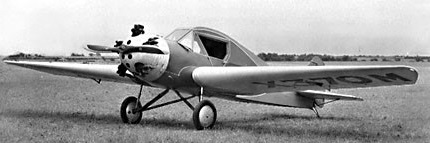
In 1941 Summit Aeronautical Corp was testing and developing HM-5 two-seat cabin monoplane designed by Howell Miller and built by Vidal process (molding under fluid pressure), for which company held license from Aircraft Research Corporation. War production of other items then supervened.

Only one was built, NX25332, the design evolving into 1940 Westfield.

Engine: 75hp Continental A-75
Windspan: 28’0″
Length: 22’0″
Max speed: 142 mph
Stall: 38 mph
Seats: 2
Undercarriage: retractable

Sullivan K-3 Crested Harpy

X370M

In 1930 Sullivan Aircraft Manufacturing Co built a low-wing cabin monoplane which was developed as the K-3 Crested Harpy. Laird Co’s Jake Moellendick reportedly was involved to some extent.

A three-place cabin monoplane, it is known that two were built, NR127V and X370M, and perhaps more.

X370M

Engine: 100hp Kinner K-5
Wing span: 36’0″
Length: 24’0″
Useful load: 766 lb
Max speed: 126 mph
Cruise: 105 mph
Stall: 44 mph
Seats: 3

Sullivan Goblin

The 1931 Sullivan Goblin N10694 c/n SC-1 was a two-place open cockpit monoplane powered by a 38hp Continental.

Sold and resold many times around the Bay Area and Santa Rosa. Officers in the Sullivan company were J W Robb and J J Schmidt, who also show up later as principals in the Ful-Vue Fixtures Co Ltd, one of the plane’s buyers (24 June 1932).

Universal Engine & Propeller Co, Berkeley (SF Bay Airdrome, Alameda 1937), acquired it on 29 January 1934 and installed their 50hp Universal Indian with variable-pitch prop.

After several more changes of owners, and a 60hp LeBlond in 1937, the reg was cancelled on 15 April 1940 Its registration expired in 1940 and was cancelled.

Sukhoi T6-1

Earlier experience with the T-58VD design, manufacturing and flight testing gave the design bureau the capability to design a STOL aircraft, designated T6-1, which became the first new-generation attack aircraft. Conceptual design work began in 1965. For the first time in the history of the Design Bureau, the loft technique was used for structural assembly coordination.

In one of the design rooms was a 49 ft 3 in (15 m) long drawing board, installed vertically and covered with a reference grid, on which a reduced scale aircraft side view was drawn. This drawing included external aircraft lines, air ducts, boundary layer air bleed wedges, additional air intakes and nozzle units, fuel tank contours, engine contours, radio equipment, aircraft system units contours, aircraft and engine control circuits, electrical wiring, hydraulic and pneumatic pipelines, fuel pipelines and ventilation system ducts and some structural members, including the landing gear assemblies in a retracted position. In addition, all of this information was plotted on fuselage cross section lofts in full-scale.

A T6-1 prototype was manufactured by the summer of 1967. It flew for the first time, with Vladimir Ilyushin at the controls, on July 2. It was planned to display the aircraft at the Domodedovo air show. However, the aircraft was not fully developed and it did not fly at Domodedovo.

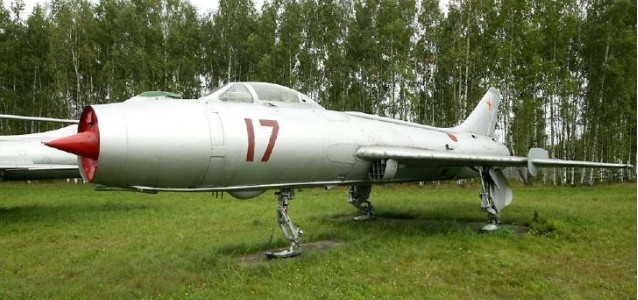
In 1969, after intensive tests, the R-27F2-300 cruise engines of the T6-1 were replaced by Arkhip Lyulka AL-21 Fs. For this purpose, the rear fuselage was reworked. This involved not only the external contours but also the structure. The air brake panels, which had been placed on the rear fuselage, were removed. As a result of the flight tests, to improve directional stability characteristics, the wing tips were turned down and ventral strakes were installed on the fuselage bottom.

Because of the radar designer’s requirement, the fuselage nose radome dimensions were changed. Initially, the radome dimensions were chosen to meet the required supersonic performance. The radome became shorter and more obtuse. Tests proved the aircraft, with the new radome, to be capable of the required speed.

Sukhoi T6-1A more precise definition of the requirements for the new generation of attack aircraft along with the T-58VD and T6-1 flight test results and the theoretical analysis of twelve different aerodynamic shapes resulted in the Chief Designer abandoning the hybrid powerplant. Thus began the design of a variable-geometry attack aircraft. Further tests of aircraft with lift engines were stopped and the T6-1 was used as a test bed for radio equipment. From 1967 until 1970, the aircraft flew approximately 120 test flights. From 1971 until 1974, it was used more efficiently and flew more than 200 flights. In 1974 its service career was over. Today, the composite powerplant T6-1 prototype is an exhibit at the aircraft museum in Monino.