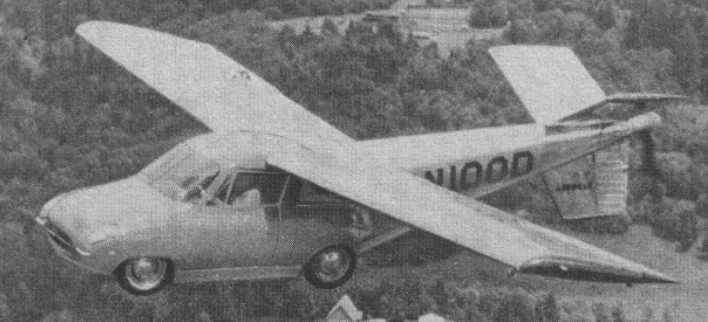
Extensive development was undertaken to enhance flight and road performance. Accumulated road travel on six Aerocars exceeded 200,000 miles (321,865 km) and more than 5,000 flying hours.
One prototype was built in 1949 (N31214/N4994P), sold to B F Goodrich Co c.1952 for $10,000. In 1956 production under 4A16 totalled 5 (N100D/103D), plus 1 unlicensed for testing. Certification was in 1956.
With business recessions in the 50’s and 60’s, a war priorities in Korea and Vietnam, the Aerocar was never put into large scale production.
The most famous was NC102D, serial number 4, sold to actor/pilot Bob Cummings who used it on his long running TV show, as well as for everyday transportation. That machine was specially fitted and certified with a 135hp O-290 Lycoming. The other Aerocars were powered with 143hp versions of the O-320.
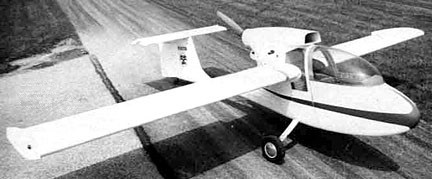
The Aerocar II Aeroplane aka 1-A of 1964 was a four seat non-roadable tri-gear version of the original Aerocar using many of its components and with a fiberglass cab. Power was a135hp Lycoming O-290-D2 pusher. The project was considered by Ford Motor Co but never pursued. The Model II first flew in August 1953.

The Aerocar (TC 4A16) was developed through three models, and the two place Aerocar III, aka 1-C, first flew in 1968. A small, streamlined red car about the size of a Honda Civic, with a pair of bucket seats, deep pile carpet and a woodrim steering wheel. It has a 143 hp Lycoming engine with a fluid drive system for its retractable road wheels and dry fluid drive for the Hartzell ground-adjustable pusher propeller mounted behind the aircraft’s distinctive Y shaped tail unit. In the air it would cruise at 217 kph (135 mph), at 97 kph (60 mph) on the road, and go 24 km (15 miles) for every 4.55 litres of fuel burned, flying or driving. The car is 11 feet long and five feet wide. The wings and tail fold to only eight feet wide for highway travel. When it turns into an Aerocar, the plane is 23 feet long. Possibly was the one advertised as Sky Car in a non-flying version.
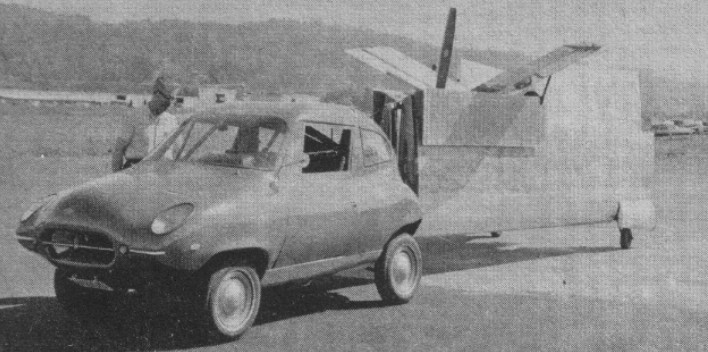
The most famous was NC102D, serial number 4, that was sold to actor/pilot BobCummings who used it on his long running TV show, as well as for everyday transportation. That machine was specially fitted and certified with an O-360 Lycoming. The other Aerocars were powered with versions of the O-320.
With business recessions in the 50’s and 60’s, a war priotites in Korea and Vietnam, the Aerocar was never put into large scale production.
Extensive development was undertaken to enhance flight and road performance. Accumulated road travel on six Aerocars exceeded 200,000 miles (321,865 km) and more than 5,000 flying hours.
The Aerocar was developed through three models, and the Aerocar III first flew in 1968. A small, streamlined red car about the size of a Honda Civic, with a pair of bucket seats, deep pile carpet and a woodrim steering wheel. It has a 143 hp Lycoming engine with a fluid drive system for its retractable road wheels and dry fluid drive for the Hartzell ground-adjustable pusher propeller mounted behind the aircraft’s distinctive Y shaped tail unit. In the air it would cruise at 217 kph (135 mph), at 97 kph (60 mph) on the road, and go 24 km (15 miles) for every 4.55 litres of fuel burned, flying or driving. The car is 11 feet long and five feet wide. The wings and tail fold to only eight feet wide for highway travel. When it turns into an Aerocar, the plane is 23 feet long.
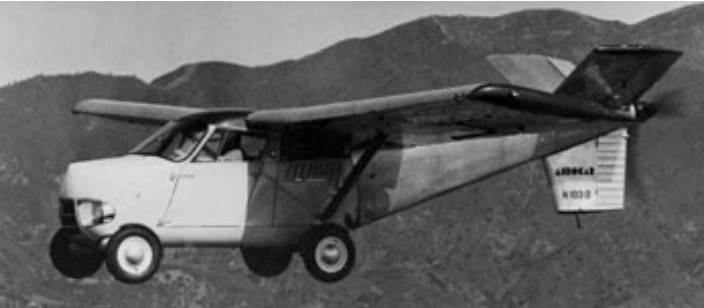
The Model II Aerocar was a pure aeroplane (non-roadable) that used the Aerocar I wings, tailcone and tail plus some fuselage parts. It has a tricycle gear instead of the Aerocar I’s 4-wheel landing gear. Molt sold this maching to Ed Sweeney (who also owned Bob Cummings machine).
The Aerocar III was an updated version of the Aerocar I with a more modern shape for the car body that incorporated an improved fiberglass body and retractable wheels. The machine is displayed at the Museum of Flight in Seattle.
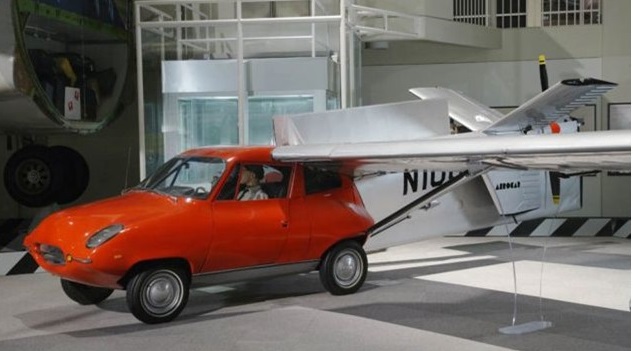
Aerocar I serial number 2, registered N103D was owned by Gary Norton.
Molt Taylor donated the prototype of his flying automobile, the Aerocar, to the EAA Aviation Foundationn. A complete restoration was commenced at Hales Corner. This halted during the move to Oshkosh. The Buehler Foundation then provided a grant to provide the financial resources and the skilled manpower to complete the restoration. Molt Taylor was providing photographs, documentation, and his knowledge to assist.
Ford Motor Company wanted to build Aerocars, but the Federal Aviation Administration said no way did they want the sky full of flying automobiles. They were going to build 25,000 of them the first year and with their dealer organization they figured they could sell them. It never happened.
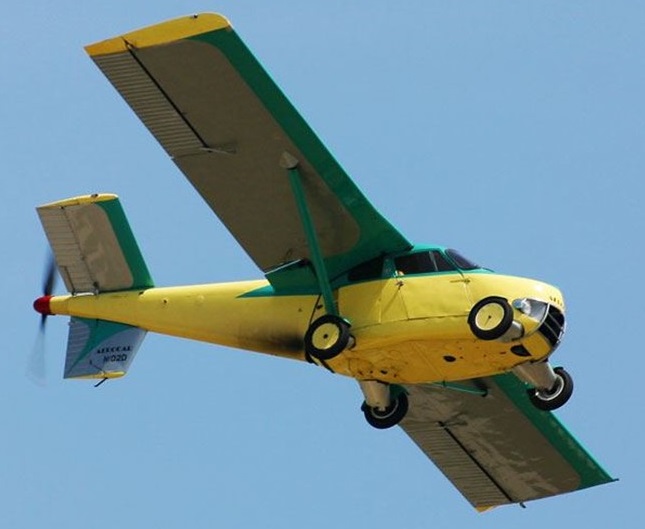
Aerocar I
Engine Lycoming O-290, 135-hp / Lycoming O-320, 143 hp
Wing span: 34’0″
Length: 21’6″
Gross wt. 2,050 lb
Empty wt. 1,400 lb
Fuel capacity 24 USG
Top speed 112 mph
Cruise 100 mph
Stall: 50 mph
Range 300 miles
Ceiling 12,000 ft
Initial climb rate 500 fpm
Takeoff run 655 ft
Landing roll 300 ft
Seats 2
Aerocar II / 1-A
Engine: 135hp Lycoming O-290-D2
Wingspan: 34’0″
Wing area: 168 sq.ft
Length: 22’9″
Height: 7 ft 2 in
Empty weight: 1408 lb
Loaded weight: 1950 lb
Useful load: 900 lb
Max speed: 112 mph
Cruise speed: 100 mph
Stall: 50 mph
Range: 300 mi
Ceiling: 13,000′
ROC: 500 fpm
Price: $9,995
Seats: 4
Aerocar III / 1-C
Engine: Lycoming O 320 AlA 4 cylinder, 143 hp (auto 40 hp)
Length: 21 ft 6 in
Wingspan: 36 ft
Useful load: 720 lb
Max speed (air) 137 mph, (road) 67 mph
Cruise spped: 120 mph
Stall: 50 mph
Ceiling: 12,000 ft
Range: 500 miles
Seats 2
 All Aero