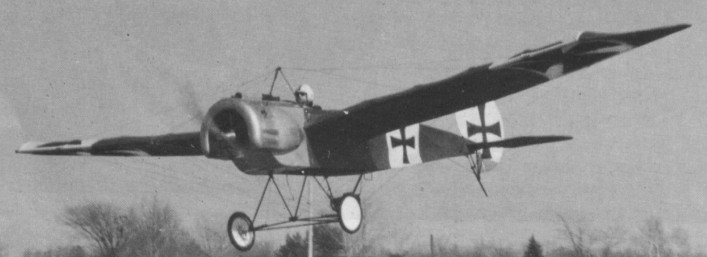
One aircraft that lends itself admirably to replication by virtue of its design is the Fokker Eindecker. This 1914 design has been reproduced in scale by the Aeroplane Factory, Dayton, Ohio; its original flying and landing wire concept adapting readily to modern microlight construction methods. Powered by a Rotax 277 developing 27 hp, this 36 foot wing span replica has a cruise speed of 45 mph and comes in kit form. Centre mounted joy stick, rudder pedals, tail wheel steerable through rudder pedals.
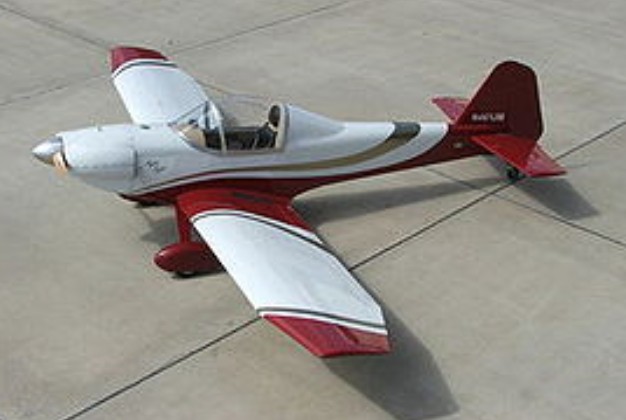
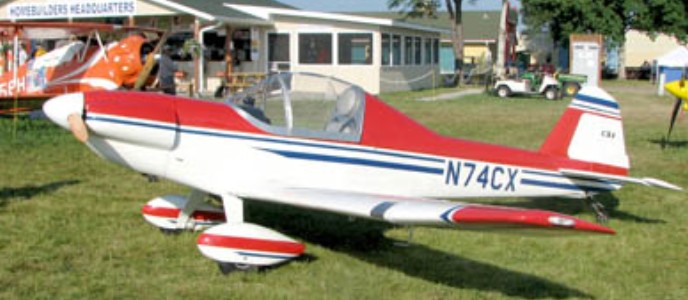
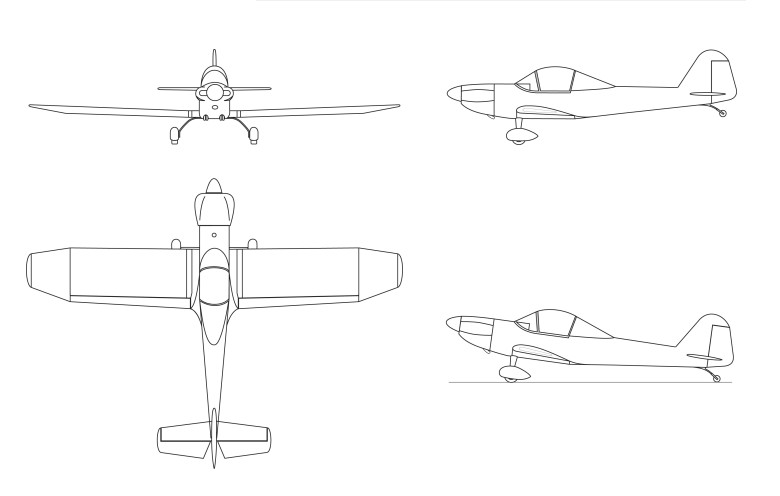
The CX4 is a low wing, single-seat aircraft designed to be simple to build and safe to fly. The name of the plane, CX4, is taken from an old radio show featuring Hop Harrigan, whose plane was called CX4.
The aircraft is all metal, 6061-T6 aluminium, except the cowling. It has hydraulic disc toe brakes and a heater and ventilation system for all season flying. The aircraft can be built with an optional 3 gal aux fuel tank. The CX4’s standard specified powerplant is a Volkswagen air cooled engine. The design load factor is 3.8 g, with an ultimate load of 5.7 g
The CX4 first flew in 2004. At the end of 2010, there were eighteen flying CX4s in the United States and South Africa. Parts and kits are currently supplied by Peter Beck.
Powerplant: 1 × Volkswagen Length: 18 ft 3 in (5.56 m) Wingspan: 24 ft (7.3 m) Height: 4 ft 8 in (1.42 m) Wing area: 48 sq ft (4.5 sq.m) Empty weight: 520 lb (236 kg) Gross weight: 850 lb (386 kg) Cruise speed: 109 kn; 201 km/h (125 mph) Stall speed: 35 kph 64 km/h (40 mph) Never exceed speed: 135 kn; 249 km/h (155 mph) Service ceiling: 10,000 ft (3,000 m) Rate of climb: 825 ft/min (4.19 m/s) Crew: 1
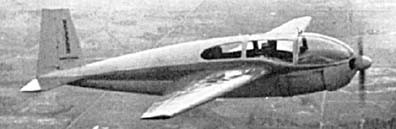
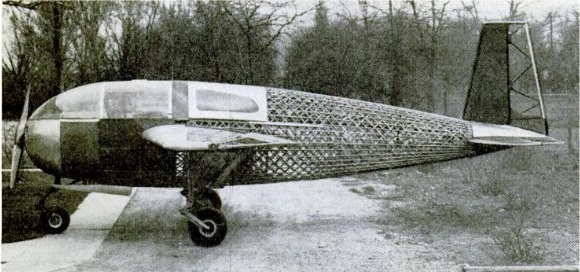
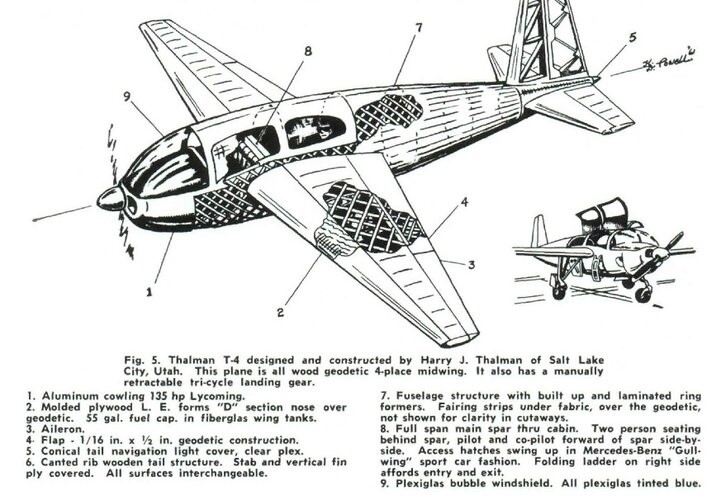
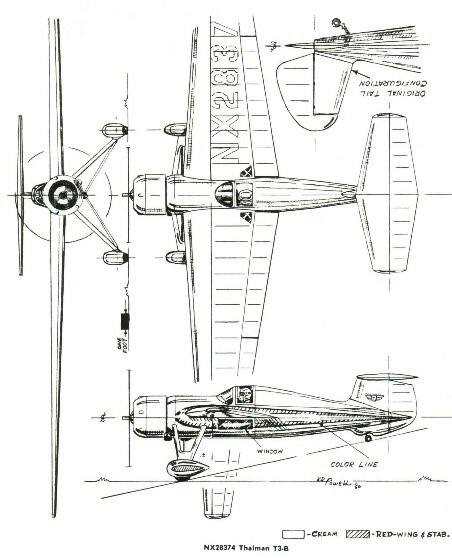
In 1949, Harry formed Thalman Aircraft Inc. at Salt Lake City. In the same year, he designed the Talman T-4 which, flew in 1951. The 1953 Thalman T-4 was a four-pace mid-wing cabin monoplane of all-wood geodetic construction. The T-4 followed the same wooden geodetic construction employed by Harry J. Thalman and William Earl Player when they helped form Plxweve Aircraft. (Construction techniques followed those of Thalman’s Oregonian mentor, George Yates – bending strips of cedar around heated former moulds.) In general construction technique, the T-3 and T-4 were similar – the T-3 being fabric-covered, the T-4 having a fibreglass covering.
Designed by Harry J. Thalman, the one built, N53389, had manually retracting undercarriage. Initially powered by a 135hp Lycoming O-290, it was later converted to T-tail with a 170hp O-340.
Convinced that serial wooden geodetic construction would be less expensive than by-then conventional metal construction, Thalman spent the next decade trying to get the T-4 into production. At one point, Thalman approached the Cache Chamber of Commerce in Utah for start-up funds of $50,000 (and a suitable workspace) to launch T-4 production – presumably near Logan, UT. The Chamber passed.
By 1960, Thalman Aircraft Corp. was doing business as Thalman Industries (sometimes given as Thalman Aircraft Industries). However, the firm was now planning to relocate to Roseburg, OR – 900 miles to the west. Roseburg businessman Lynn Andreas had become president and it was Andreas who was announcing the construction of a new factory on 5 acres of leased land at the Roseburg municipal airport. Early reports said that site ground preparation work had begun and that a “plywood plane” would be built. Harry Thalman is quoted, saying that his aircraft will sell for less than $14,000.
By 1963, Harry Thalman was working as a mechanic for Kelsey-Ellis Air Service at Salt Lake City Airport. The T-4 was in storage (and possibly disassembled by then) but Harry was still flying the T-3B. On 15 March 1963, Harry was doing flying cross-country when he flew into a blinding snowstorm. Harry Thalman died instantly when he crashed his T-3B monoplane in a gully outside of Grantsville, UT.
Engine: 135hp Lycoming O-290, later 170 hp Lycoming O-340 Wingspan: 40 ft 2.5 in Length: 21 ft 6 in Height: 6 ft 0 in Empty weight: 1050 lb MTOW: 2000 lb Useful load: 1050 lb Max speed: 175 mph Cruise: 155 mph Stall: 45 mph Range: 700 mi Seats: 4 Undercarriage: manual retractable
Single seat single engined high wing mono¬plane with conventional three axis control. Wing has unswept leading and trailing edges, and constant chord; conventional tail. Pitch control by elevator on tail; yaw control by fin mounted rudder; roll control by half span ailerons; control inputs through stick for pitch/roll and pedals for yaw. Wing braced from below by struts; wing profile Worth¬mann FX63 137; double surface. Undercar¬riage has three wheels in tricycle formation with additional tailskid; suspension on all wheels. Push right go right nose¬wheel steering connected to yaw control. No brakes. Aluminium tube framework, without pod. Engine mounted below wing driving pusher propeller.
An important manufactur¬er of hang gliders, producing around 300 of these aircraft per year, Thalhofer produced its first microlight in 1976. Two prototypes of the Bronco were built and flew for the first time at the end of March 1983. Production got under way in 1983, after the certification of the model.
Length overall 18.7ft, 5.70m Wing span 28.5 ft, 8.70 m Constant chord 3.9 ft, 1.20 m Sweepback 0 deg Tailplane span 5.2ft, 1.60 m Total wing area 114 sq.ft, 10.6 sq.m Total aileron area 6.9 sq.ft, 0. 64 sq.m Total fin and rudder area 16.4 sq.ft, 1.52 sq.m Total tailplane and elevator area 17.2 sq.ft, 1.60 sq.m Wing aspect ratio 7.1/1 Wheel track 5.9 ft, 1.80 m Engine: Konig SC430, 25hp at 4200rpm Propeller diameter 55 inch, 1.40 m Belt reduction, ratio 1.8/1 Max static thrust 132 lb, 60 kg Power per unit area 0.22 hp/sq.ft, 2.4 hp/sq.m Fuel capacity 5.3 US gal, 4.4 Imp gal, 20.0 litre Empty weight 221 lb, 100 kg Max take off weight 486 lb, 220 kg Payload 265 lb, 120 kg Max wing loading 4.24 lb/sq.ft, 20.7 kg/sq.m Max power loading 19.4 lb/hp, 8.8 kg/hp Load factors; +6.0, 3.0 ultimate Max cruising speed 59 mph, 95 kph Economic cruising speed 40mph, 65kph Stalling speed 24mph, 40 kph Max climb rate at sea level 400 ft/min, 2.0 m/s Take off distance 165 ft, 50 m Land¬ing distance 100 ft, 30 m
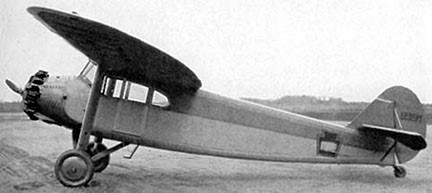
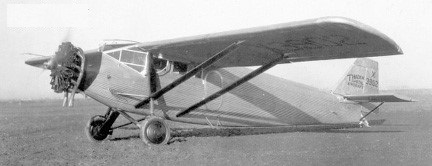
The 1928 Thaden T-1, or Argonaut, (ATC 2-29) was designed by Herbert von Thaden, registered NX3902, and first flew on 15 January 1928, piloted by George R Pond. The only one built crash-landed on 30 March 1933 in Chitkina AK., was recovered in 1988 and restored by an EAA group.
Engine: P&W Wasp A, 400-420hp Wingspan: 53’0″ Length: 35’3″ Useful load: 2200 lb Max speed: 135 mph Cruise speed: 105 mph Stall: 52 mph Seats: 6-8
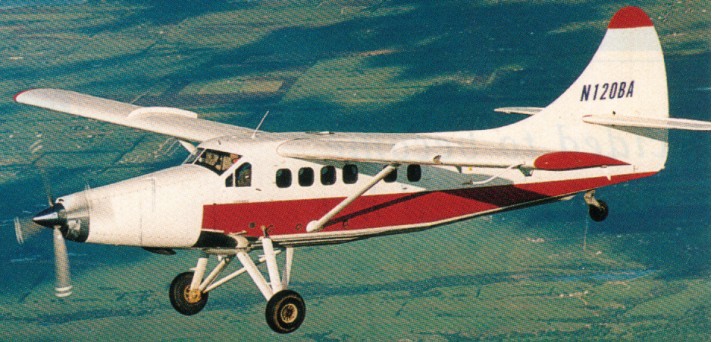
Airplane modifier Texas Turbine Conversions has begun flight testing of its conversion of the de Havilland DHC-3 Otter. The modification includes the replacement of the original 600 hp, nine cylinder Pratt & Whitney radial with an AlliedSignal/Garrett TPE331 10 turboprop engine flat rated to 900 horsepower. While the airframe is limited to a 125 knot airspeed, the additional power helps the Otter climb better and fly at max speeds to much higher altitudes than it could with the radial. The engine swap saves 400 pounds, which translates into a better useful load, and gives operators a greatly increased TBO up to 5,400 hours over the P&W radial.
 All Aero