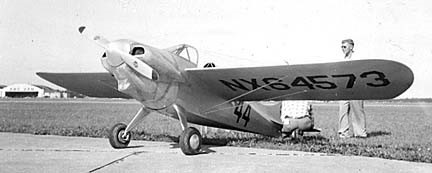
Built in 1948, the A-1 Special was a Goodyear-class racer registered NX64573 and piloted by Harold Neumann and Warren Siem, and powered by an 85hp Continental C-85.
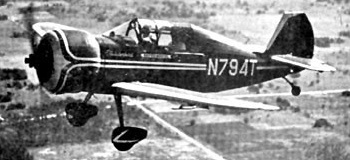
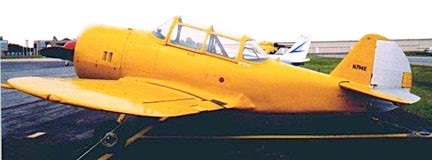
It competed in 1948 as Townsend Special, reportedly modified as a two-place with a 245hp Jacobs and re-registered N794T as Loose Racer.
The Townsend Thunderbird was assembled in 1955 from parts of at least four different planes. The fuselage structure (20′ in length) appears to be a cut-down Fairchild PT-26 with its canopy. The cowling is from a Stearman, the landing gear from a Cessna 190 or 195. Its wings, vertical and horizontal stabs are from a Vultee BT-13 or -15. The wings are just the outer panels (wing span is 25′) and the stabs have been cut down in size. Engine is a Wright R-975, which suggests BT-15.
Registered N749T, the aircraft started out fabric covered, but was later metalized.
Townsend Thunderbird N749T
In September 2002 Tony Pileggi purchased the home-built Thunderbird. With quite a history and, while it’s a shame to change all that, it was not safe to fly. Actually, it was really great in the air. Take-off and landing were scary. It was too short-coupled and over-powered, and it had an aft c/g or not enough horizontal stabiliser. The tail would not come off the runway until about 65 mph with full forward stick.
During flight-testing, the clean power-off stall speed was about 80 mph. At the first flap setting, the power-off stall speed was between 85 and 90, with a very abrupt snap into a spin. Attempting to recover from the spin under 100 mph resulted in a secondary stall, again with a tight spin. This was attributed to the very small flap size as they ran from the fuselage outboard only 16″. The size of the flaps created a thicker wing section at the root, and so caused the tips to stall long before the roots.
Tony Pileggi decided to disassemble the ship after the landing gear collapsed and made for a very exciting landing. When he removed the forward fuselage aluminium, he found some old cracks and some scary welding on the frame. A first impulse was to scrap the entire aircraft, but he then began thinking about redesigning it and building a replica of a WWII-era fixed-gear fighter. After extensive research, he found a plane that the Thunderbird most closely resembled, the Nakajima Ki-27.
The Towner Thunderbolt was a single-place cabin, low wing monoplane, based on the Culver Dart design. It was aerobatic and powered by a 220hp Continental engine.
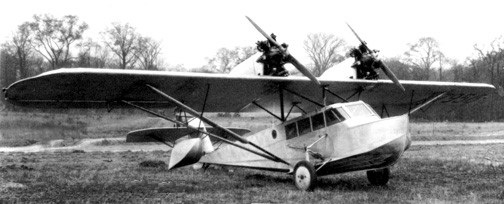
A 1931 eight-passenger high-wing cantilever monoplane amphibian flying-boat, it was powered by two 225hp radial Packard DR-980 diesel engines mounted on muitistrut pylons on the wing upper surface. The TA-3 received certification ATC 2-291.
Towle TA-2 was built as a successor to the WC model. In 1930 one was built, NX491H, powered by two 240hp Wright Whirlwind J-6 on a faired housing and wing struts were omitted. Only the one was built.
Engines: 2 x Wright Whirlwind J-6, 240hp Wingspan: 56’0″ Length: 42’0″ Useful load: 2257 lb Max speed: 120 mph Cruise speed: 100 mph Stall: 55 mph Range: 500 mi
Thomas Towle was an engineer who had been involved with many early aircraft designs. Having just co-designed the Eastman E2 Sea Rover, Towle was commissioned by Henry McCarroll to promote Detroit’s aviation production capabilities.
The 1928 Towle WC was built for businessman H G McCarroll and USN Lt George Pond by a group of Detroit engineers under the direction of Towle. An all-metal wing design (Towle F-2) essentially eliminated ribs and spars with its unique, internal zig-zag pattern of corrugated aluminum as a framework. The covering also was corrugated sheet aluminum. Wings were strut-braced. One WC was built, NX7956.
Priced at $25,000, the WC flying boat was first flown in November 1928. The prototype WC flew as far as Brazil before engine reliability issues forced the cancellation of the round-the-world flight attempt.
The 1930 TA-1 was the first production version of the WC with 150hp Comet engine. The one bult was registered NX5328.
WC Engines: 2 x Comet, 150hp Wingspan: 52’0″ Length: 35’0″ Useful load: 11,670 lb Max speed: 115 mph Cruise speed: 95 mph Stall: 45 mph Range: 350 mi Seats: 6
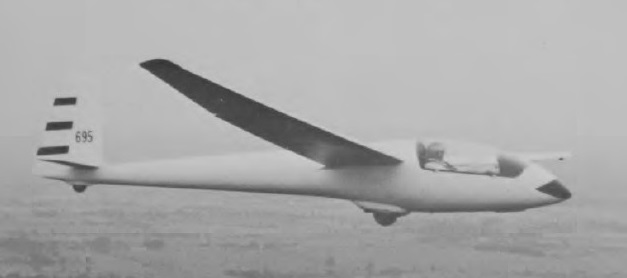
This Standard Class single-seater was designed by John Sellers, who was also responsible for the Slingsby T53, for Torva Sailplanes Ltd of Scarborough, Yorkshire, which company he had formed in September 1969 with Chris Riddell, and it was intended to be a moderately priced type with good performance suitable both for clubs and the private owner and competition pilot, for whom two production versions were to have been marketed.
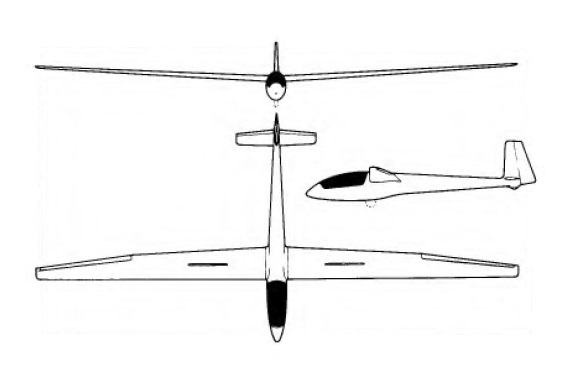
These were the Torva 15 Standard for club use and the Torva 15 Sport for the private owner and contest flying, the latter being fitted with flaps and having a retractable monowheel, while the Standard had provision for up to 130lb of water ballast. The Torva 15 was noteworthy as being the first British designed sailplane to be constructed largely of glass-reinforced plastics (GRP), although the wings have plywood ribs and the fuselage has plywood and foam sandwich frames to support its GRP shell and side longerons. Design work began on 6 October 1969 and construction of the Torva 15 Sport prototype (also known as the Torva TA 1) commenced on 16 March 1970; this first flew on 8 May 1971 in the hands of Chris Riddell. A modified Wortmann aerofoil section was chosen for the cantilever shoulder wings to give a very high lift coefficent for achieving a good rate of climb in weak British thermals, and also to give a low stalling speed for short-field landings. The wings have a GRP spar with ply webs and GRP/balsa shell; both the ailerons and flaps are of GRP with a foam core, the ailerons having variable differential and drooping with the flaps, but being isolated from the latter at the flap full-down position. Light alloy Schempp-Hirth air brakes are also fitted. The fuselage and canopy shape were computer calculated to achieve a good aerodynamic shape and roomy cockpit; the pilot sits under a Suntex lift-off transparent one-piece canopy and has a GQ five-point seat harness. The tail surfaces have GRP/balsa shells and plywood webs, the tailplane being an all-moving surface with a geared anti-balance tab. The retractable rubber-sprung monowheel is located forward of the eg and is manually retracted, with an internal expanding brake; there is also a GRP sprung tailskid with a small wheel.
Only three more Torva 15s were built after the prototype, as the company was forced to close down; these were also known as TA 2 Sprites.
Torva 15 Standard Span: 15.0 m / 49 ft 2.5 in Length: 7.11 m / 23 ft 3.25 in Height: 5 ft 0 in Wing area: 11.3 sq,m / 121.5 sq.ft Aspect ratio: 20.0 Empty weight: 238 kg / 525 lb Max weight: 408 kg / 900 lb Water ballast: 59 kg / 130 lb Max speed: 134 mph / 116 kt / 216 km/h (in smooth air) Max rough air speed: 80 kt / 148 km/h Stall speed: 35 kt / 65 km/h Min sinking speed: 0.62 m/sec / 2.03 ft/sec at 50 mph / 43.5 kt / 81 km/h Best glide ratio: 37:1 at 51 mph / 44 kt / 82 km/h
In 1936 Oliver Topliff built the Quail or Model A ultralight N14834. The single-place open (later closed) cockpit monoplane was powered by a 15hp Saxon engine.

 All Aero