Tremaine Humming Bird / Tremaine-Thaheld / Pacific J-30

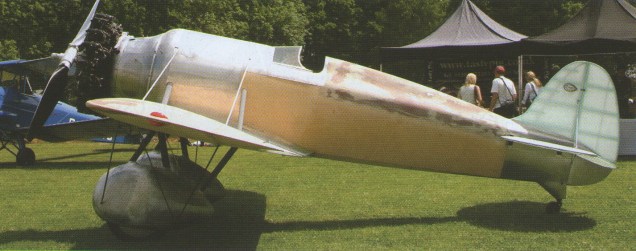
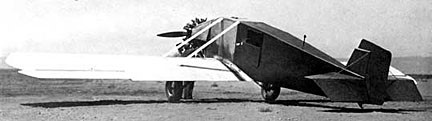
Tremaine Humming Bird Dole Race entry

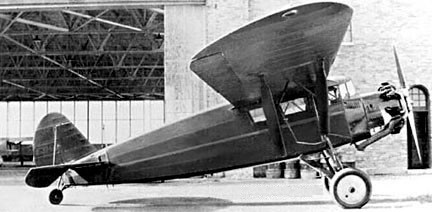
Designed by Frederic Thaheld three were built, all based on the German Junkers design.

One was Dole Race entry Spirit of John Rodgers, piloyed by George A Covell and Richard Waggener, possibly registered N1239. It had 645-gallon fuel tanks, and was originally designed for a non-stop Japan flight attempt. Lack of forward visibility was because it covered the forward fuselage and required installation of a periscope in the manner of Lindbergh’s Spirit of St Louis. It crashed and was destroyed in fog at Point Loma enroute to Oakland from San Diego.

Another, also named Humming Bird, was a 1927 two place low wing monoplane sport plane with 120hp Super Rhône. The maximum speed was 130 mph, cruise of 105 mph, and stall of 35 mph.

The third with a Hisso engine was registered as a Pacific J-30 NX87N c/n 34.

The name bird was applied to a 1924 flivver-type, also designed by Thaheld, built in Tremaine’s garage.

Engine: 225hp Wright J-5
Span: 48’0″
Length: 29’0″
Seats: 3

Trella T-106 / T-107

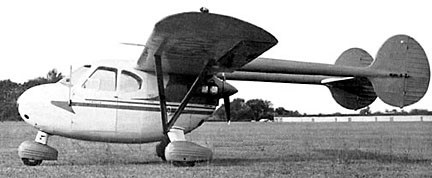
Trella T-106 N450C

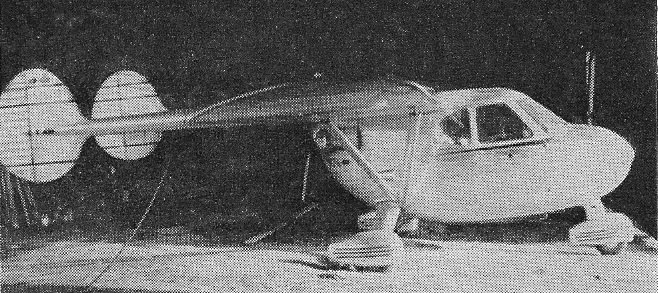
The 1949 Trella T-106 was a two place high wing cabin monoplane. All metal with twin tails on booms, the one built, N450C, was first flown in September 1949 by Paul Holst.

A highly-modified five place retractable gear twin version was planned in 1954 as T-107 never went past the mock-up stage because of funding problems.

T-106
Engine: 85hp Continental C-85-12J pusher
Span: 34’0″
Length: 21’9″
Useful load: 470 lb
Max speed: 112 mph
Cruise: 102 mph
Stall: 42 mph
Range:: 400 mi
Seats: 2

Treadwell P-38

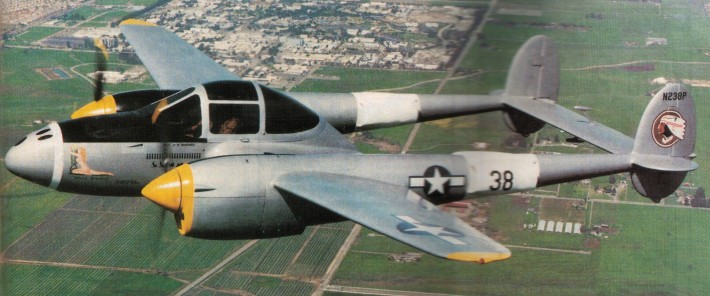
Walter Treadwell decided to design and build his own P-38 as a 55% scale replica. Treadwells is a P-38J.

Cooling the engines are four custon built copper radiators installed in the tail booms, made to form fit within the contours. Designed by Treadwell, the cores were fabricated by a Livermore radiator shop, and a friend, Norm Daniel braied the copper. Small, bullet shaped intakes provide airflow, where the supercharger air intake was on the original.

Contra-rotating was not feasible and each engine uses a 2.37-1 cogbelt PSRU reduction gearbox designed by Reductions Inc, and turns a 3 blade 66 in Warp Drive ground adjustable prop. Exhaust is through a single stack that exits below each engine nacelle.

Each part of the undercarriage was independently machined from solid stock. That included oleos, linkages and wheel forks, attachment fittings and retraction mechanism.

Although the replica is mostly composite construction, plywood was used to establish the cross sections, then stripped with foam that was then sanded into shape. Over this, fibreglass was laid, and when finished, the plywood formers removed, then replaced with bulkheads of honeycomb/glass that were glassed into the shell.

The twin booms are built the same way, but they are connected to wood stringers, then formed with foam, then wrapped with fibreglass.

The main spar is a box type built of Douglas fir in three sections. A centre section that connects the fuselage pod to each boom and the outer panels. All are covered, cap-stripped with carbon fibre, wrapped with fibreglass, then vacuum bagged. Ribs are traced from a CAD program onto full size templates, then each is individually cut from Bluefoam using hot wire. Each is then finished with ply cap strips. The aerofoil begins as an NACA 23015 at the root, then tapers into an NACA with washout at the tip of the entire wing, then covered with 1/16 inch plywood over which fibreglass cavering is applied. The control surfaces are statically balanced.

Primary controls are operated through a complex system of cables, pushrods and fittings that run from the fuselage and wings through the booms to move the ailerons, flaps, elevators, rudders and trimtabs. All this requires 34 sheaves out to the booms to accomplish this. The ailerons are controlled buy a series of bell cranks activated by cables and pushrods, and the same for the elevator. The rudders are cable controlled.

The landing gear is hydraulically operated.

The result is an airplane stressed to 9.9G. The landing gear has been drop tested for a 2000 lb landing weight.

The canopy frame is identical to the original P-38, complete with a flat forward panel, while the sides are molded. The canopy slides fore and aft to facilitate entry into the cockpit for two, and the top panel swings up and rearward.

Unlike the real P-38, Treadwell’s has a stick (topped off with an F-4 Phantom grip) to simplify linkages.

A major problem has been the engine/propeller combination with only 70% of the engine output being achived. Treadwell made the decision to ground the P-38 and replace the Suzuki engines with a pair of Walter Loms.

Engines: 2 x Suzuki 1.3 lt 4-cyl, 100 hp at 6400 rpm
Wingspan: 30.6 ft
Length: 21.9 ft
Wing area: 110 sq.ft
Empty weight: 1500 lb
Gross weight: 2000 lb
Cruise: 150 mph TAS
Top speed: 200 mph TAS
Service ceiling: 12,000 ft
Range: 525 sm
Travel Air 5000

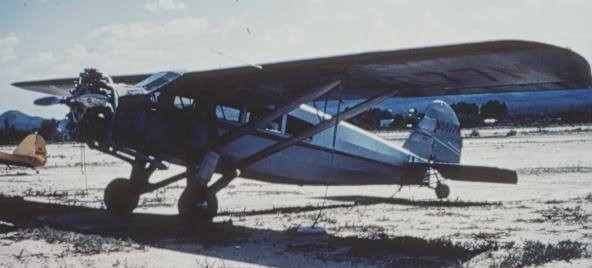
Travel Air 5000 Original windshield

Fourteen of the 1926 Travel Air 5000 (ATC 2-27) were built. A five place cabin, high wng monoplane, eight wet to Natl Air Transport in 1927 with 200hp Wright J-5 engines.

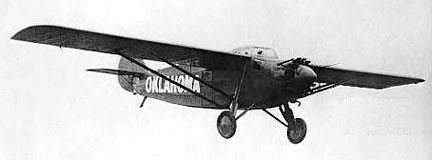
Two were built with 220hp Wright J-5C engines for the 1927 Oakland-Hawaii Dole Race winner Woolaroc (piloted by Art Goebel, NX869), and entrant Oklahoma (piloted by Bennett Griffin, NX911).

Travel Air 5000 Dole Race Oklahoma

5000
Engine: 150hp Axelson
Wingspan: 50’5″
Length: 30’0″
Seats: 5
4 built

5000
Engine: 200hp Wright J-5
8 built

5000
Engine: 220hp Wright J-5C
Length: 30’8″
Useful load: 1440 lb
Max speed: 123 mph
Cruise speed: 105 mph
Stall: 55 mph
2 built, NX869 and NX911

Travel Air 10

Travel Air 10-B N8844

The 1929 Travel Air 10-B (ATC 278) was a four place cabin monoplane, effectively a scaled down 6000.

The 10-D of 1929, also ATC 278, was a 10-B N8844 with a 300hp Wright J-6 engine. Eleven were built; NC150V, NC368M, NC374M, NC414N/N416N, NC418N, NC471W, NC676K, and NC693K/N694K.

Travel Air 10-D N418N

The design led to the Curtiss-Wright CW-15.

10-B
Wingspan: 43’6″
Length: 26’10”
Useful load: 1270 lb
Max speed: 126 mph
Cruise speed: 106 mph
Stall: 55 mph
Range: 550 mi

10-D
Engine: 300hp Wright J-6

Travel Air R Mystery Ship / R-613 Mystery Ship

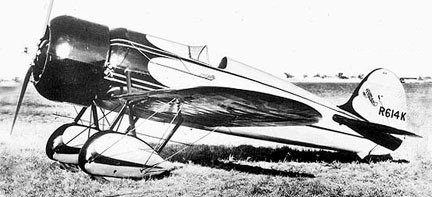
Travel Air R NX614K

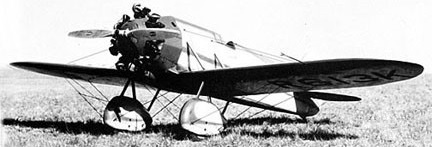
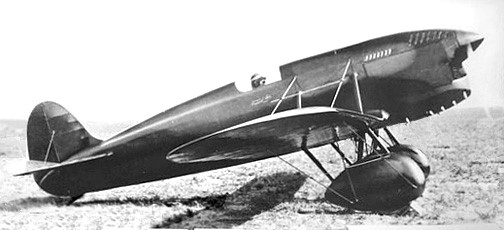
The 1929 Travel Air R Mystery Ship was designed by Walter Burnham and Herb Rawdon. The R became S through a newspaper’s abbreviation of “Mystery Ship” to “Mystery S”.

Five were built, of which 3 were racers; NR614K, NR482N, NR1313. One plane, N11717, with a 300hp Wright, was bought by the Italian government in 1931 “for study”.

The Mystery Ship held an official record at 236 mph. As Texaco 13 and piloted by Frank Hawks, NR1313 set transcontinental speed record 1929 and was at the time faster than any existant military plane, continued in 1930-32 to establish numerous new intercity speed records in the US and Europe.

Travel Air R-613 NX613K

Mystery Ship NR482N, piloted by Jim Haizlip, reached second place in the 1930 Thompson races.

Travel Air R Chevrolair NR613K

The 1929 R-613 Mystery Ship NX613K was fitted with a 250hp Chevrolair D-6 engine. As NR613K it raced in the 1929 Thompson Trophy piloted by Doug Davis.

Travel Air R-613 NX613K

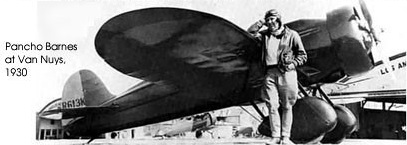
It was later refitted with a 330hp Wright R-975 for Florence “Pancho” Barnes. At the 1968 Tallmantz auction, word got around that 67-year-old Pancho was there, hoping to buy her plane to restore. When the auctioneer announced a low starting bid, Pancho waved her bid paddle. That was followed by silence. The auctioneer got the message, so he nodded and pointed at her, “Sold!” and the audience applauded.

Mystery Ship sister

Frank Hawks flew to glory in 1930 in a Travel Air Mystery Ship.

Replica: Aero-Antiques Travel Air R

R
Engine: 400hp Wright supercharged Cyclone
Wingspan: 29’2″
Length: 20’2″
Useful load: 456 lb
Max speed: 235 mph
Cruise speed: 150 mph
Stall: 70 mph
Range: 525 mi
Seats: 1

R-613 Mystery Ship
Engine: 250hp Chevrolair D-6, later refitted with 330hp Wright R-975
Wingspan: 29’2″
Length: 21’0″

Travel Air 6000 / 6

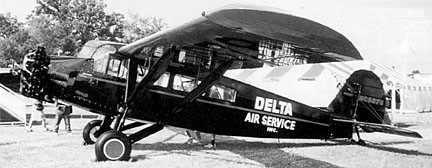
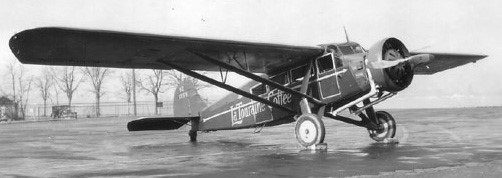
Travelair A-6000-A NC377M s/n A6A-2003

In 1929, the Travel Air Company under Walter Beech’s direction developed the 6000 (ATC 100, 2-28, 2-167, 2-234, 2-296). An improved version of the 5000, it sold for $12,000.

The Travel 6000 six place cabin monoplane was equipped with a Wright J-5 220 hp engine.

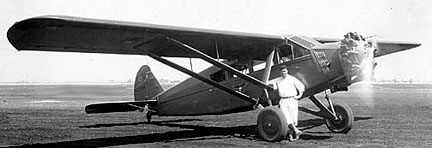
Travel Air 6000B NC8878

The prototype was NX4765 (2-28, superseded by 100).

Travel Air S-6000B NC9914

25 of the 1929 A-6000 were built (ATC 116), priced at $18,000.

Travel Air A-6000A

ATC 2-76 was for eight 7-place conversions, and ATC 2-308 for a 420hp P&W Wasp C version as A-6000-A Special.

Almost all were eventually converted under (2-167, 2-234 and 2-296) to 300hp Wright J-6 as S-6000B.

The 1929 S-6000B, or B-6000 (ATC 130) were six-place with a 300hp Wright J-6 engine. Priced at $13,000 fifty-five were built, including modifications of model 6000. The model evolved into the 6-B and ATC 2-138 was issued for seven-place conversions. ATC 2-153 was for the five-place 6000-B Special, and ATC 2-294 for four-place conversions, with ATC 2-302 for weight adjustments.

The one Model B-6, built in 1925, was a B-2000 with a 160hp Curtiss C-6 engine, and 31’6″ modified wing, without elephant-ears.

In 1930 eight Model 6-B were built which were the 6000-B with a 330hp Wright J-6 engine.

Travel Air 6-B

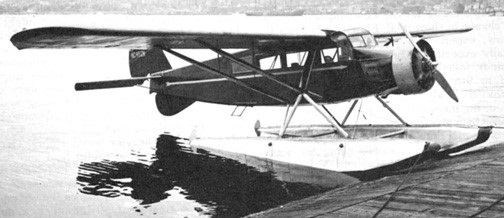
The 1929 SA-6000A (ATC 175) was a six-place pontoon version of the A-6000, priced at $20,000. At least two were built.

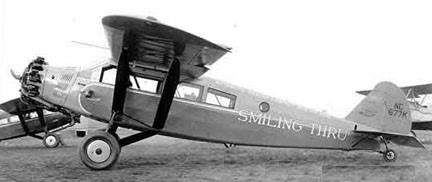
Travel Air S-6000D NC677K

6-B
Engine: Wright J-6, 330hp
Wingspan: 48’7″
Length: 31’5″
Useful load: 1713 lb
Max speed: 135 mph
Cruise speed: 115 mph
Stall: 66 mph
Range: 575 mi

6000
Engine: 220hp Wright J-5
Wingspan: 48’7″
Length: 30’10”
Useful load: 1670 lb
Max speed: 120 mph
Cruise speed: 102 mph
Stall: 55 mph
Range: 560 mi
Seats: 6

S-6000B / B-6000
Engine: 300hp Wright J-6
Wingspan: 48’7″
Length: 30’10”
Useful load: 1622 lb
Max speed: 130 mph
Cruise speed: 110 mph
Stall: 60 mph
Range: 550 mi
Seats: 4-7

6000-B Special

SA-6000A
Engine: P&W Wasp, 450hp
Wingspan: 54’5″
Length: 31’2″
Useful load: 1824 lb
Max speed: 130 mph
Cruise speed: 108 mph
Stall: 65 mph
Range: 540 mi

A-6000
Engine: P&W Wasp C, 450hp
Wingspan: 54’5″
Length: 31’2″
Useful load: 2025 lb
Max speed: 140 mph
Cruise: 120 mph
Stall: 60
Range: 680 mi
Seats: 6-7

A6000A Special
Engine: P&W Wasp C, 420hp
Wingspan: 54’5″
Length: 31’2″
Seats: 6

B-6
Engine: 160hp Curtiss C-6
Wingspan: 31’6″