Tsybin Ts-25 / NK-25

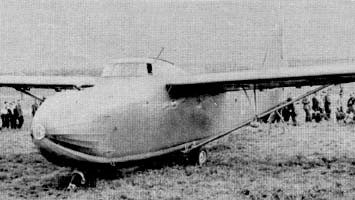
Designed by Pavel Tsybin to a 1944 specification, the Ts-25 was of a high-wing design, with a box-shaped fuselage featuring a hinged nose for ease of loading the aircraft’s cargo. The aircraft had a fixed tricycle landing gear, with skids to aid in landing, and was of steel-tube-braced wooden construction with the nose covered in fabric. The fuselage was otherwise covered in plywood; the wing was tapered, with its spar being steel-tube strut braced. The intended load of the aircraft consisted of a jeep-type vehicle and a 57 mm (2.2 in) anti-tank gun.

Following flight tests that completed in 1948, the Ts-25 was accepted for production;[1] it is regarded as the first domestically produced glider to be built in significant quantities for the Soviet Airborne Forces (VDV). It was first publicly displayed at the 1948 Tushino Air Display. Eventually up to 480 of the aircraft were built at the Chkalovsk manufacturing plant between 1948 and 1954. Some were used by the VDV in training maneuvers. One was modified with 25 passenger seats for evaluation for potential civilian use on routes including Moscow, Gorki, and Novosibirsk. Two were supplied to the Czechoslovak Air Force in 1952 and given the desigation NK-25; the Yakovlev Yak-14 was preferred by the Czechs.

In 1950 two Ts-25s, towed by Ilyushin Il-12 transports, were used to resupply Polar Station SP-2.

Variants

Ts-25
Main production version, 480 built.

Ts-25M
Powered version; one built. Powered by two Shvetsov M-11FR-1 radial engines each producing 165 hp (123 kW).

NK-25
Czech designation for Ts-25.

Wingspan: 24.38 m (79 ft 11.875 in)
Length: 16.15 m (52 ft 11.8 in)
Height: 5 m (16 ft 5 in)
Wing area: 75.0 m2 (807 sq ft)
Empty weight: 1,787 kg (3,940 lb)
Max takeoff weight: 4,200 kg (9,259 lb)
Maximum speed: 230 km/h (140 mph, 120 kn) in tow
Landing speed: 90 km/h (56 mph; 49 kn)
Crew: two pilots
Capacity: 25 troops or 2,500 kg (5,500 lb) cargo
TsAGI ANT-51

During 1937 8, Sukhoi was primarily concerned with the design of a light reconnaissance bomber intended to succeed the R 10, this being the ANT 51 two seat mid wing monoplane which, powered by an M 62 radial, flew in 1938. During the following year, Sukhoi established his own design bureau, and began the redesign of the ANT 51 with an M 88B engine, a low wing and an increased offensive load, this emerging as the BB 1, entering series production in 1940, and being redesignated Su 2 in 1941.

TsAGI ANT-31 / I-14

In 1932 Sukhoi was responsible for the design of a single-seat low-wing cantilever monoplane fighter, incorporating an enclosed cockpit and retractable undercarriage. This aircraft, the ANT-31 or I-14, flew in October 1933, and series production of an improved version, the I-14bis which first flew on 14 February 1934, was ordered but cancelled two years later when it was found impossible to eradicate some of the fighter’s shortcomings.

True Sport

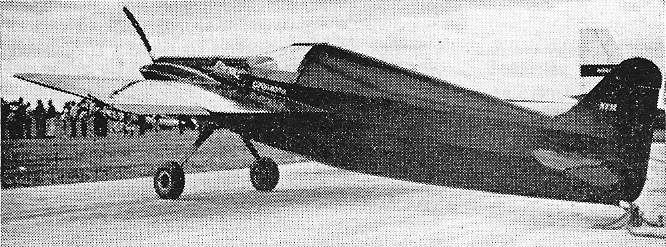
The 1953 Sport N7M, built by Roy True, was conceived as a racer ‘Slow Poke’, but was used only for sport flying. It was a mid-wing monoplane.

Engine: Continental C-85, 85hp
Wingspan: 15’6″
Length: 17’6″
Useful load: 180 lb
Max speed: 210 mph
Cruise speed: 165 mph
Stall: 65 mph
Range: 450 mi
Seats: 1

Troyer PR Mid-wing

The Troyer “PR’ Mid-Wing was designed in 1931. It has a welded steel tube fuselage and tail assembly. Wing spruce spars and ribs are built from ¼ inch square spruce. A VW engine can be used instead of the 4-cylinder Henderson.

Gross Wt. 450 lb
Empty Wt. 290 lb
Fuel capaci¬ty 5 USG
Wingspan 23’9”
Length 15’6”
Engine 4 cyl. Inline Henderson
Cruise 80 mph
Climb rate 500 fpm

Trident Aircraft Trigull / TR-1

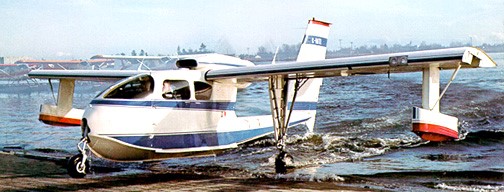
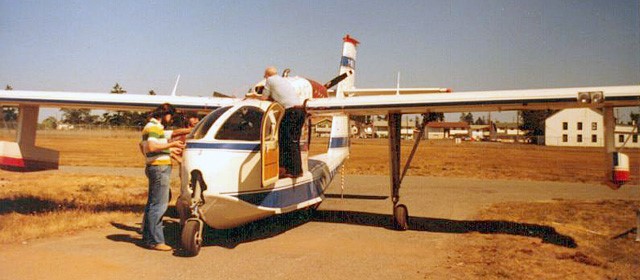
Canadian firm Trident Aircraft Ltd of Vancouver, BC, tried to resurrect the Seabee in the form of the TR-1 Trigull. Trident Aircraft was established in early 1970s to develop Trigull-320 six-seat light amphibian The factory was in Sydney, British Columbia, Canada. The Trigull resembled the Seabee closely enough to be confused with it, Spence Spencer apparently having a hand in the design. The Trigull could be distinguished from the Seabee by the angular swept tailfin, floats that retracted up to the wingtips, and tricycle landing gear, the long main gear hinging to retract outward into the wings, and the nose gear pivoting up to retract into the nose.

Two flight prototypes were built, first flown on 5 August 1973, the second taking to the air in 1973. The aircraft had a price tag of $111,360 in 1979. A Turbo Trigull was offered with turbocharged engines.

third prototype, c.1978, at Victoria, BC.

Production machines were to be powered by a Lycoming IO-540-M1A5 air-cooled flat-six engine, with 255 kW (340 HP), though the prototypes were powered by the less powerful Teledyne Continental Tiara flat-six. The Trigull was about a tenth longer and a tenth heavier than the Seabee, and could have seating for four or six, the rear seat in the six configuration apparently being intended for kids since it would be pretty cramped for adults.

The stop go progress of Trident Aircraft reached its fourth and probably final “stop” in 10 years in November 1980 as costs continued to escalate ahead of the latest funding programme. With $Can10m spent already, the company estimated that another $Can8.5m was needed to establish full production of the Tri Gull amphibian at the new plant set up for the purpose on Vancouver Island. All employees were dismissed and survival of the project appeared unlikely; the two prototypes of the Tri Gull have been put into storage, the company going under in the early 1980s.

Viking Air LTD of Vancouver obtained the rights to the Trigull; Viking, incidentally, also had rights to de Havilland Canada classics like the Beaver, Otter, and Twin Otter, performing turbo conversions of Beavers and Otters, plus building Twin Otters new. Viking has dropped hints of producing the Trigull, presumably to see if there was any interest, and saying that a production machine would have a turboprop powerplant. Apparently there wasn’t any interest, since it never happened.