Tupolev ANT-40 / SB-2 / PS-40 / PS-41 / Avia B-71 Katyushkas

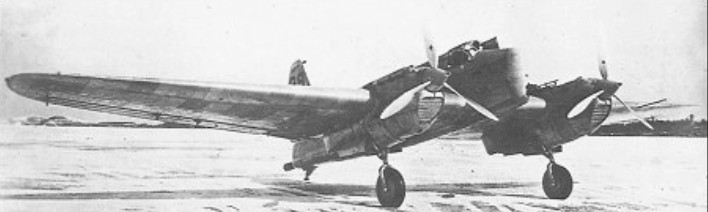
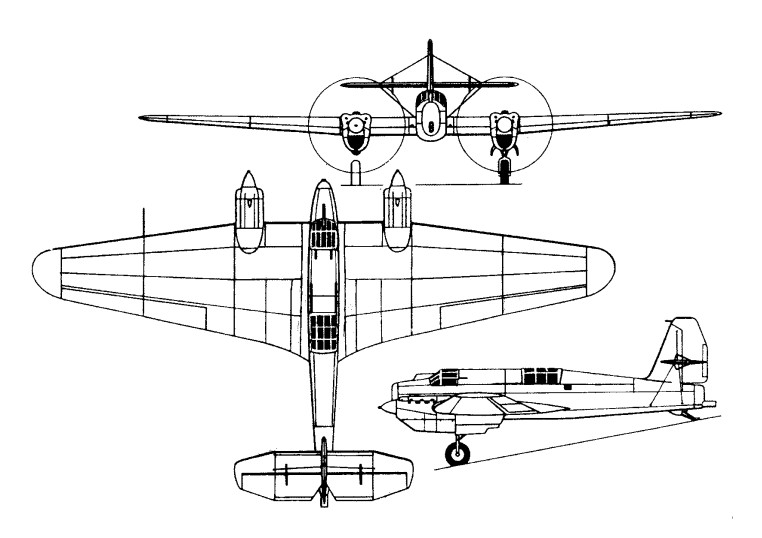
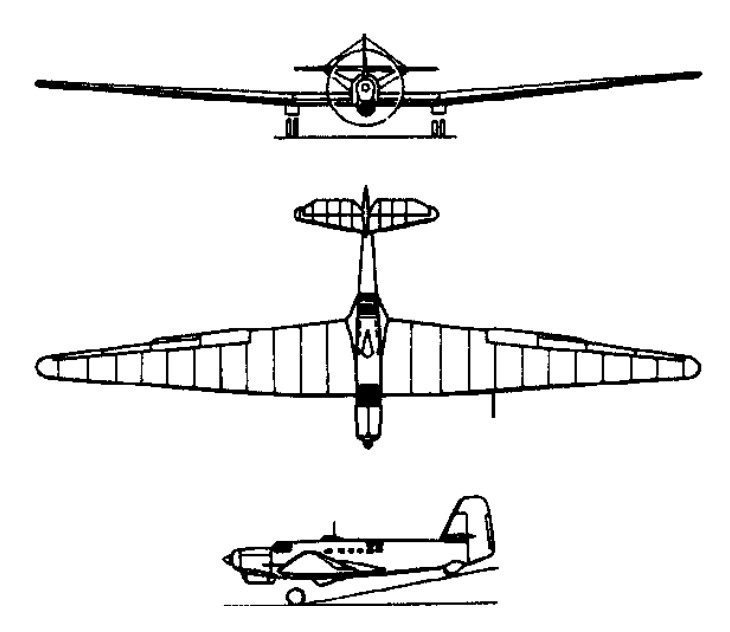
The two ANT-40 light bomber prototypes of Andrei N. Tupolev’s design bureau first flew in October 1934. The all-metal construction, enclosed cockpit and retractable landing gear were then comparatively novel features. The ANT-40’s maximum speed of 325km/h at operating height was faster than the biplane interceptor fighters that equipped most of the peacetime air forces.

Tupolev SB-2 Article

Entering production in 1936, the initial production version as selected for export and service with the V-VS was based on the second prototype, and was known as the Tupolev SB-2 (skorostnoi bombardirovshchik, or fast bomber). The engines were two 830 hp / 619kW licence-built Hispano-Suiza 12Ybr, termed M-34 by Soviet industry, and initially they were fitted with two-bladed fixed-pitch propellers.

An aircraft of this type secured an official FAI record in 1937 for carrying a 1000 kg / 2200 lb payload to an altitude of 40,177 ft.

The first SB-2s were passed to the V-VS’s bomber aviation regiments in February 1936, and in October of that year the first of 210 were transferred with Soviet crews to Spain to fight on the side of the Republican air force against the insurgent Nationalists.
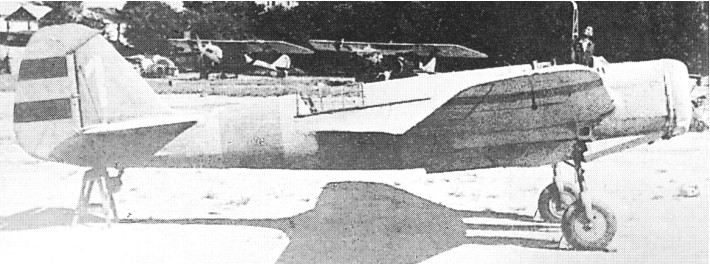
The SB-2 was the first Soviet warplane delivered to the Republicans, arriving from October 1936 in an effort to provide an offensive type which could take the air war to the advancing Nationalists. The variant delivered was the initial SB-2 production model powered by M-100 or 641 kW (860-hp) M-100A inlines driving fixed or variable pitch propellers respectively. Estimates for the number of SB-2s delivered vary from 93 to 210, and these aircraft were amongst the best fielded by the Republicans: their performance and defensive firepower allowed most Nationalist fighters to be outrun or outfought. Some 19 operational SB-2 bombers fell into Nationalist hands at the end of the war, and claims on the type amounted to 14 by the Nationalists, a similar number by the Germans, and 48 by the Italians.

Over Spain the performance of the SB-2 caused considerable concern to the Nationalist fighter units which were equipped with Heinkel He-51 and Fiat CR.32 biplanes, and the urgent call went out for fighters of better speed and climb properties.
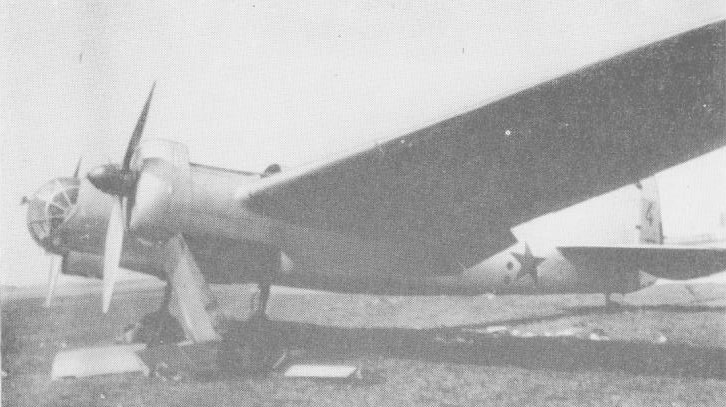
Tupolev SB-2 in Spain

Tupolev SB-2

The production of the SB-2 bomber and the conversion of the units required the development of a training model that would facilitate the preparation of the crews. This need was solved in 1937 with the installation of a second flight control in the navigator’s position in an SB-2M-100A, but the results of the tests showed that this decision made the navigator’s work more complex and worsened the aerodynamics of the model.

At the time SB-2s were passed to the Chinese Nationalist air force to fight aganst the Japanese, and to Czechoslovakia, where the type went into licensed manufacture as the B.71 bomber.

1934 Avia development was helped engineer A. A. Archangelskij from the ANT 40.2 SB – 2 (Skorostnyj Bombardirovščik). The Czechoslovak Air Force had 60 of these aircraft and one at a research institute. Because all three Aeroplane Works within a range of German bombers were, a new plant was built at the village of Kunovice in South Moravia. Two batches of the B-71 bomber – 40 and 26 machines respectively. 30 SB-2s were purchased by the Czechoslovak Republic from the Soviet Union and in 1936 also their licence. Serial production started at Avia and by the German occupation not a single was finished, the unfinished aircraft were completed by the Germans. Avia Works built forty-five that were used by Luftwaffe or sent to Bulgaria. The B-71 Katyushkas were powered by Czech-made 680 Avia-Hispano Suiza engines and were able to accommodate the bombload of 600 kg under their wings.

The Avia-built B-71 were fitted with a new tubular radiators and gained 15 kph. The idea was copied by the Soviets and brought into use in the SB-3. After the German occupation the B-71s were converted to target towing configuration.
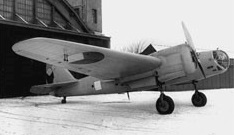
Avia B-71

In general the SB-2 performed well until faced with sterner fighter opposition, which occurred over Spain in 1938 and in particular over Finland during the Winter War of 1939-40, when many were shot down. Steps were taken to improve performance by installing the 641kW M-100A engine with variable-pitch propellers. Increased fuel capacity and two 716kW M-103 engines were installed in the Tupolev SB-2bis, the performance of which was improved by three-bladed VISh-22 propellers.

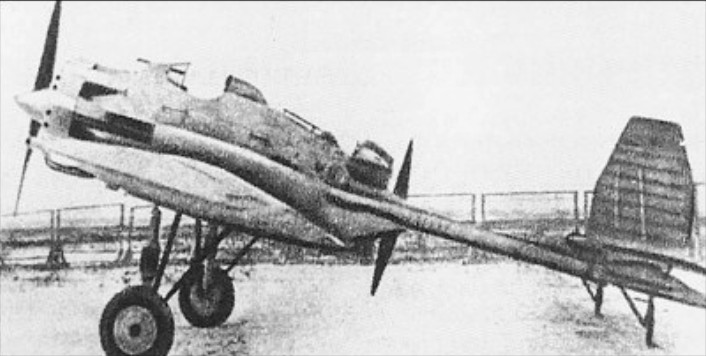
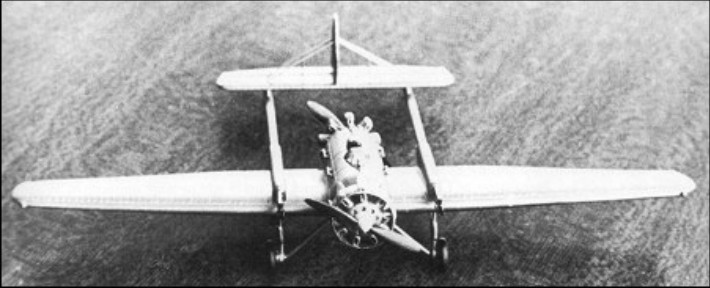
The study of the 3-wheeled undercarriage on a twin-engined aircraft, nicknamed “pterodactyl”, was carried out in 1940. Using a special frame under the center section the pilot, Mark Galley, repeatedly landed the aircraft with a vertical speed of up to 4.8 m / s. The landing gear was fully tested. For study of the “shimmy” phenomenon the ran over a log put across the runway. The original size of the front wheel was 470×210 mm, but changed to 600×250 mm.
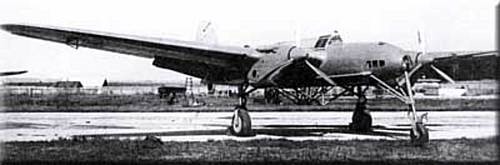
SB “Pterodactyl”

The front wheel was 4.65 m from the center of gravity and the main struts moved back beyond the center of gravity 520 mm, the wheels remained the same – 900×300 mm.
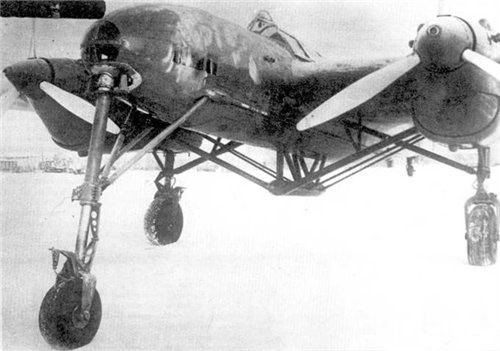
SB “Pterodactyl”

A frame was used to rearrange the main undercarriage in order to determine their optimal location. The aircraft was tested with a flight weight of 6000 kg, the wing load was 106 kg/sq.m and flight speeds up to 220 – 230 km/hr. Landing speed with flaps was 140 – 150 km / h, without flaps 190 km/h.
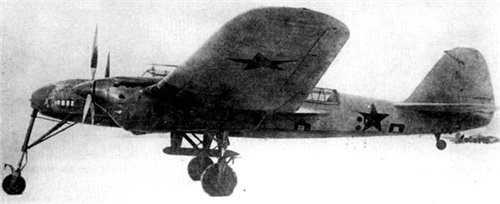
SB “Pterodactyl”

Tests were summarized and published in February 1941, turned out to be very popular. It is believed that the research results were useful in developing a new generation of Soviet aircraft with a front support wheel.

The PS-41 was a transport variant with a ‘solid’ nose and gun positions eliminated.

In addition to the PS-40 and PS-41 transport versions the SB-RK (Arkhangelskii Ar-2) was a modified SB-2bis dive-bomber with reduced wing area and powered by two supercharged M-105R engines. The SB-2’s record as a day bomber came to an abrupt end during the fierce fighting following the German invasion of the USSR on 22 June 1941. Those that were not destroyed on the ground ventured into the air on numerous missions over the front line, and paid a heavy price to the Luftwaffe’s Messerschmitt Bf 109F fighters. Thereafter the SB-2 and SB-2bis bombers were relegated to night work with the V-VS and the Soviet naval air arm.

Production amounted to 6,967 of all marks.

Variant:
Tupolev SB-RK / Arjanguelsky Ar-2
Arjanguelsky SB-B
Arjanguelsky USB

Gallery

SB-2
Three-seat light/medium bomber
Span: 20.33m (66ft 8.5 in)
Length: 12.57m (41ft 2.75in)
Powerplant: 2 x Klimov M-100, 559kW (750 hp)
Armament: 4×7.62-mm (0.3-in) mg
Bombload: 1000 kg (2,205 lb)
Max T/O weight: 5628 kg (12,407 lb)
Max speed: 244 mph at 17,060 ft
Operational range: 777 miles

SB-2bis
Engine: 2 x M-100
Max take-off weight: 5732 kg / 12637 lb
Empty weight: 4060 kg / 8951 lb
Wingspan: 20.3 m / 67 ft 7 in
Length: 12.7 m / 42 ft 8 in
Wing area: 52.0 sq.m / 559.72 sq ft
Max. speed: 420 km/h / 261 mph
Cruise speed: 360 km/h / 224 mph
Ceiling: 6600 m / 21650 ft
Range: 1600 km / 994 miles
Range w/max.payload: 1000 km / 621 miles
Crew: 3
Armament: 4 x 12.7mm machine-guns
Bombload: 1500kg

SB-2bis
Engine: 2 x M-103, 990 hp
Wingspan: 70 ft 6 in
Length: 41 ft 6 in
Max take-off weight: 14,330 lb
Empty weight: 9436 lb
Max. speed: 280 mph at 16,400 ft
Cruise speed: 360 km/h / 224 mph
Service ceiling: 27,890 ft
Range: 1430 miles
Crew: 3
Armament: 4 x 7.62mm machine-guns
Bombload: 1320 lb
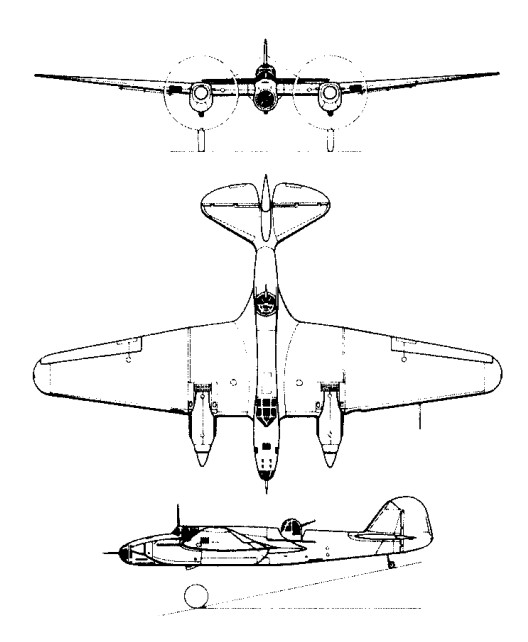
Tupolev ANT-40 / SB-2

Tupolev ANT-37 / DB-2

Developed from the uncompleted Tupolev ANT-36 (DB-1), a single-engined long-range bomber based on the ANT-25, the Tupolev ANT-37 (DB-2) long-range bomber was developed by Sukhoi’s design brigade under Tupolev’s overall control.

The Tupolev DB-2 (ANT-37) long-range bomber, designed in the autumn of 1934, could carry a 2,200 lb bomb load over a range of 3,100 miles at a speed of 155 m.p.h.

The prototype flew on 16 June 1935, powered by two 597kW Gnome-Rhone 14Kdrs engines, broke up in mid-air in August 1935 owing to buffeting of the tail unit. Test pilot K. Popov and the flight engineer managed to bale out, but a third crew member did not survive the crash.

The second prototype, powered by licence built Gnome-Rhone M-85s, was tested and refined throughout 1936. It was then transferred to the Nauchno Issledovatelsky Institut Voyenno-Vozdushnykh Sil (NII V-VS – Scientific Research Institute of the Air Force) for State tests, which continued until mid-1937. It was admitted that the DB-2 was inferior to Ilyushin’s DB-3 bomber in several respects, particularly maximum speed (200 m.p.h. and 248 m.p.h. respectively), so further development was abandoned.

When the second DB-2 prototype had completed its State tests it was proposed that it be handed over to the Tsentralniy Aero-Gidrodinarnicheskiy Institut (TsAGI, the Central AeroHydrodynamic institute) for further refinement and additional flight tests. Another DB-2 was completed and handed over to a Soviet Air Force (V-VS) unit for training personnel in endurance and long-range flying.

Having undergone modification, the second prototype was provided for the long-distance flight to be undertaken by Grizodubova, Raskova and Osipenko. it was completely stripped of armament, fitted with additional fuel tanks to ensure a maximum range of 4,350 miles and given new flight instruments and 950 h.p. licence-built Gnome-Rhone M-86 engines.

The DB-2D was followed in turn by the DB-2B or ANT-37bis, of which only three were built as record breakers/research aircraft after rejection of the design in favour of the llyushin DB-3.

Once the crew had been trained they started preparing for the non-stop flight. On August 18, 1938, they took off from the Central Airfield at Moscow for another training flight, but at a height of 165ft the aeroplane suddenly jerked down and almost went out of control. After a difficult landing, it became clear that the shortcomings of the first prototype had not been completely rectified. The tail unit had distorted disastrously during takeoff at maximum weight, and the aircraft was no longer airworthy. The technical team therefore began urgent preparation of the third prototype, the last of the three serviceable machines.

The aircraft’s replacement caused deferment of the flight, which in turn led to concern over a successful outcome. Autumn had already set in and weather conditions along the planned route across the Urals and Siberia were deteriorating with each passing day.

The first DB-2B, named Rodina (motherland) was flown to a long-distance women’s record by an all-female crew, covering 5908km on 24/25 September 1938 before making an emergency landing.

Examples survived well into the wartime period, flying for Aeroflot or on research projects.

DB-2bis
Engine: 2 x M-86
Max take-off weight: 12500 kg / 27558 lb
Empty weight: 5855 kg / 12908 lb
Wingspan: 31.0 m / 102 ft 8 in
Length: 15.0 m / 49 ft 3 in
Wing area: 85.0 sq.m / 914.93 sq ft
Max. speed: 300 km/h / 186 mph
Ceiling: 8000 m / 26250 ft
Range w/max.fuel: 7000 km / 4350 miles
Crew: 3

Tupolev ANT-37 / DB-2

Tupolev ANT-36 / DB-1

The ANT-36 was a redesigned ANT-25, and the twenty aircraft built for the Soviet Air Force under the military designation DB-1 were actually ANT-36s. This has caused some confusion as the sometimes reported production figures of the ANT-25 are quoted as two (the correct figure) and twenty-two, the total which includes both the -25 and the -36.

The major differences between the two Sukhoi-led programmes was armaments: on two aircraft, the Mikulin M-34R of the ANT-25 was changed for a Junkers Jumo 4 diesel and, later, the Soviet-built AN-1 diesel. But these engines left the DB-1 underpowered and slow, and its limited armaments, low service ceiling and large wing meant it was very vulnerable to fighters, so the planned production of fifty was cut to twenty which were never to see service in the role for which they were intended.

By spring 1936, these twenty had been delivered to the Air Force base at Ismailova, near Moscow. Two of these were fitted with diesel engines, and flight tests indicated that this version could achieve a range of 25,000km. It was planned to circumnavigate the world on the 57°N line of latitude, but the build-up to the Second World War caused the plans to be put aside. The remaining thirty aircraft were not built.

The aircraft was not a military success. Labelled the DB-1, the Air Force soon realised that the almost five years it took to develop had left the aircraft too slow, and that against contemporary fighters it was outclassed and virtually defenceless. But the twenty military aircraft went on to further flight trials; two were fitted with Junkers Jumo diesel engines, as has already been mentioned. Most of the others were used by the TsAGFs BOK, a department headed by Vladimir Chizhevski which was developing pressurised cabins for high-altitude test flights. In 1936, Chizhevski had worked in Kharkov developing pressurised cabins for high-altitude balloons. He lightened the airframe and shortened the span for his first version, the BOK-1. The engine chosen was the M-34RN with a turbocharger fitted to permit a ceiling of 10,000m to be attained. In early trials Piotr Stefanovski reached 10,700m; later, after further lightening of the aircraft, he brought it up to 14,100m. In June 1937, the engine was replaced by the new M-34RNV, fitted with two turbochargers. With some lightening, the aircraft reached heights of over 12,000m.

In 1938, Chizhevski modified another ANT-36 to BOK-7 standard. He substantially modified the cabin, so now the two crew sat with their heads in small doubleglazed domes which rose above the line of the fuselage. It was powered by a M-34FRN and had two superchargers. With this, the Soviet Air Force set its plans for a non-stop round the world flight approximately on the 53° North line of latitude. The programme was headed by Aleksander Filin, one of Chkalov’s crew, and targeted for 1939 or 1940. But Filin was arrested in Stalin’s purge, and executed in 1940. This and the war ended the project.

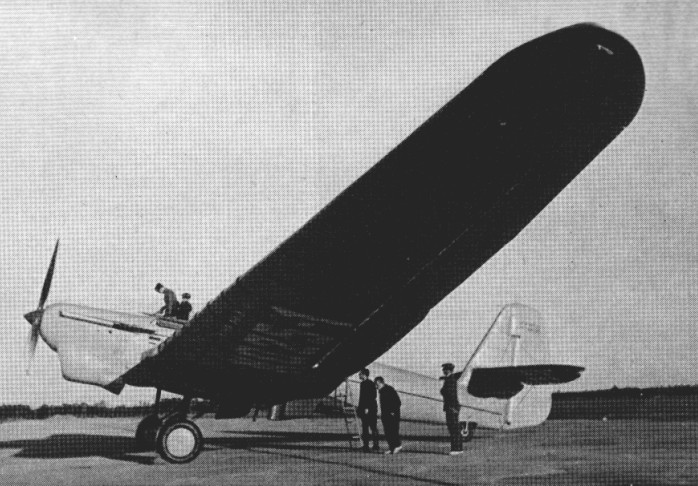
Tupolev ANT-35 / PS-35

The Tupolev ANT-35 all-metal light passenger transport prototype was based on the SB-2 bomber, and was flown initially on 20 August 1936. Of low-wing configuration with retractable main landing gear units, it was powered by two 597kW Gnome-Rhone 14K radials, later replaced by Soviet M-85s; its near circular-section fuselage accommodated a crew of two or three and 10 passengers. The improved ANT-35bis prototype was followed by nine series aircraft powered by 746kW M-62IR engines, and the type entered service with Aeroflot as the PS-35, delivered from 1937 to 1939. After June 1941 several were used for liaison and VIP transport, this 20.80m span aircraft having a maximum speed of 372km/h and a range of 1640km.

PS-35
Engines: 2 x M-85
Max take-off weight: 6620 kg / 14595 lb
Wingspan: 20.8 m / 68 ft 3 in
Length: 15.0 m / 49 ft 3 in
Height: 5.9 m / 19 ft 4 in
Wing area: 58.0 sq.m / 624.31 sq ft
Max. speed: 376 km/h / 234 mph
Cruise speed: 350 km/h / 217 mph
Ceiling: 7200 m / 23600 ft
Range: 1600 km / 994 miles
Crew: 2
Passengers: 10

Tupolev ANT-35 / PS-35

Tupolev ANT-31 / I-14

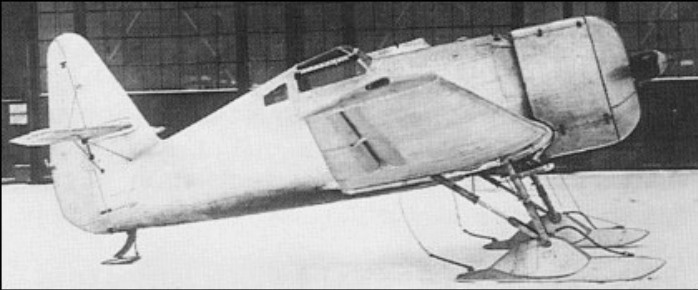
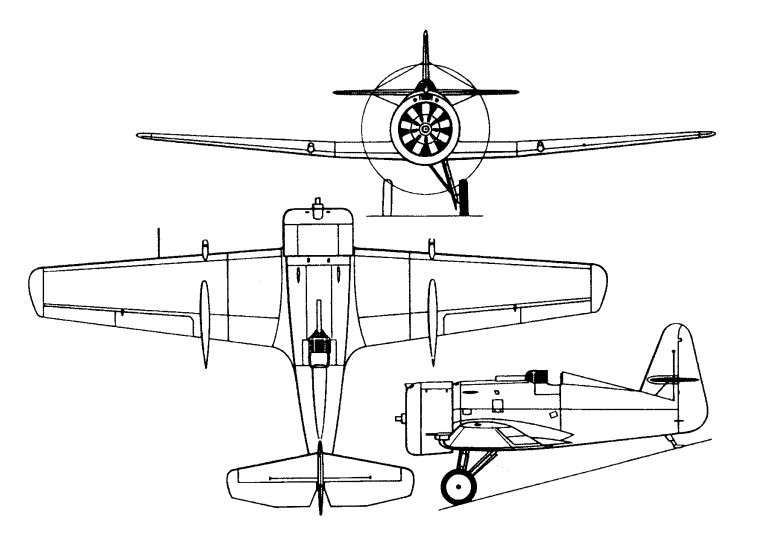
Possessing the distinction of being the world’s first all-metal single-seat cantilever monoplane fighter to be graced with a retractable main undercarriage and an enclosed cockpit, the ANT-31 was designed at the KOSOS TsAGI by Pavel O Sukhoi’s brigade. Featuring a smooth, stressed-skin fuselage with corrugated skinning for the wing, tailplane and rudder, the first prototype was powered by a 580hp nine-cylinder Bristol Mercury VIS2 radial, and had a manually-operated inwards-retracting undercarriage and an aft-hinging cockpit canopy incorporating the windscreen. This aircraft entered flight test with a fixed-ski undercarriage early in May 1933, by which time major redesign was being undertaken and work had begun on a second prototype, the ANT-31bis.

Fitted with a 712hp Wright Cyclone SGR-1820-F2, the ANT-31bis featured a new, narrow-track undercarriage retracting outwards and a narrower canopy which, sliding fore and aft on runners, still incorporated the windscreen. This aircraft, too, was initially flown with fixed skis, in March 1934, and, equipped with an armament of two 37mm Kurchevski APK-11 recoilless guns installed immediately outboard of the wing centre section and one fuselage-mounted 7.62mm machine gun, then underwent State testing from the following October.

The decision was taken to initiate series production of the ANT-31bis as the I-14bis, with smooth metal skinning overall, an open cockpit with fixed windscreen, the 700hp M-25 licence-built version of the Cyclone and armament of two 20mm cannon and two 7.62mm machine guns. Orders were placed for 55 I-14bis fighters, the intention being to install the 730hp M-25A engine at an early stage. The spin recovery characteristics of the I-14bis were not entirely satisfactory and difficulties were experienced with the narrow-track undercarriage. In consequence, the similarly-powered I-16 Tip 4 having meanwhile demonstrated generally superior characteristics, production was terminated in December 1936 with the 18th aircraft, the remaining 37 fighters of this type then under construction being scrapped.

Max take-off weight: 1540 kg / 3395 lb
Empty weight: 1170 kg / 2579 lb
Wingspan: 11.20 m / 37 ft 9 in
Length: 6.10 m / 20 ft 0 in
Wing area: 16.90 sq.m / 181.91 sq ft
Max. speed: 440 km/h / 273 mph

Tupolev ANT-31 (I-14)

Tupolev ANT-29 DIP

A progressive development of the basic ANT-21bis design, the ANT-29 was a DIP (Dvukhmotorny istrebitel pushechny, or twin-engined cannon fighter) designed by Aleksandr Arkhangelski’s brigade. Of flush-riveted all-metal construction and powered by two 760hp Hispano-Suiza 12Ybrs 12-cylinder liquid-cooled engines, the ANT-29 carried a 102mm Kurchevski DRP, a recoilless gun of 4.00m length, the exhaust gases of which were discharged through a steel tube projecting from the rear of the fuselage. This weapon was hand-loaded by the second crew member. In addition, one 20mm cannon was mounted in each wing root and provision was made for a dorsally-mounted 7.62mm machine gun. Priority assigned to other programmes delayed completion, and flight testing of the ANT-29 did not begin until the end of 1935, although the prototype had been rolled out in the previous February. State acceptance testing was scheduled for the first half of 1936, but, in the event, never took place as numerous problems were revealed by factory testing, including serious longitudinal instability. The project was abandoned after a loss of interest in Kurchevski’s recoilless guns for which the ANT-29 had been designed. These had suffered repeated failures leading to Kurchevski’s arrest and subsequent disappearance.

Engines: two 760hp Hispano-Suiza 12Ybrs 12-cylinder
Max take-off weight: 5300 kg / 11685 lb
Empty weight: 3900 kg / 8598 lb
Wingspan: 19.19 m / 63 ft 0 in
Length: 11.65 m / 38 ft 3 in
Max. speed: 352 km/h / 219 mph

Tupolev ANT-29 DIP

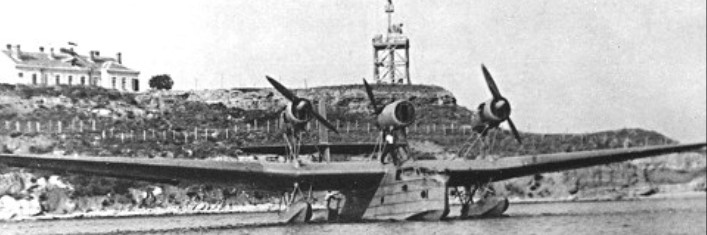
Tupolev ANT-27 / MDR-4 / MTB-1

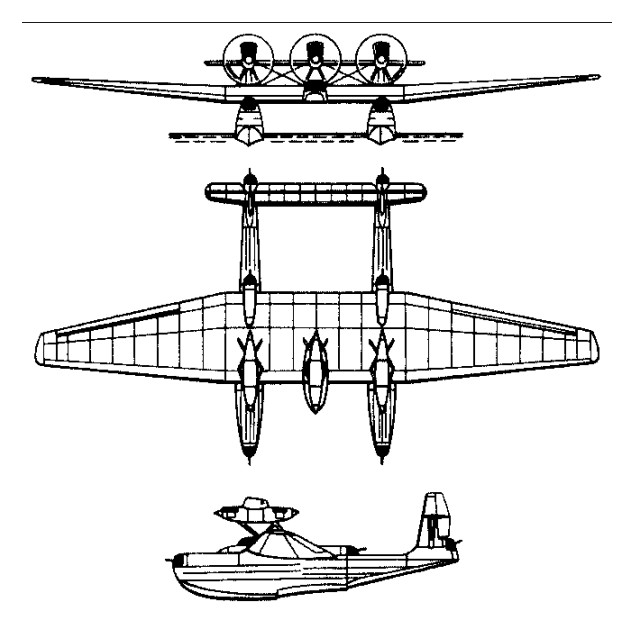
Naval, long-range, reconnaissance, heavy bomber, flying boat with three M-34RN engines. 15 April 1934 crashed at take-off during factory tests.

The ANT-27bis was a naval torpedo carrier, bomber/flying boat, in small serial production.

ANT-27bis
Engines: 3 x AM-34R, 610hp
Max take-off weight: 16250 kg / 35825 lb
Empty weight: 10521 kg / 23195 lb
Wingspan: 39.4 m / 129 ft 3 in
Length: 21.9 m / 72 ft 10 in
Height: 8.6 m / 28 ft 3 in
Wing area: 177.5 sq.m / 1910.59 sq ft
Max. speed: 225 km/h / 140 mph
Ceiling: 4470 m / 14650 ft
Range: 2000 km / 1243 miles
Crew: 5

Tupolev ANT-27 / MDR-4, MTB-1

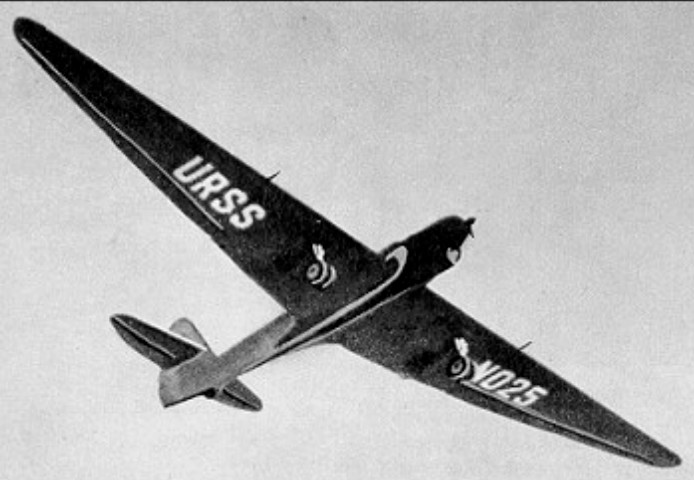
Tupolev ANT-25

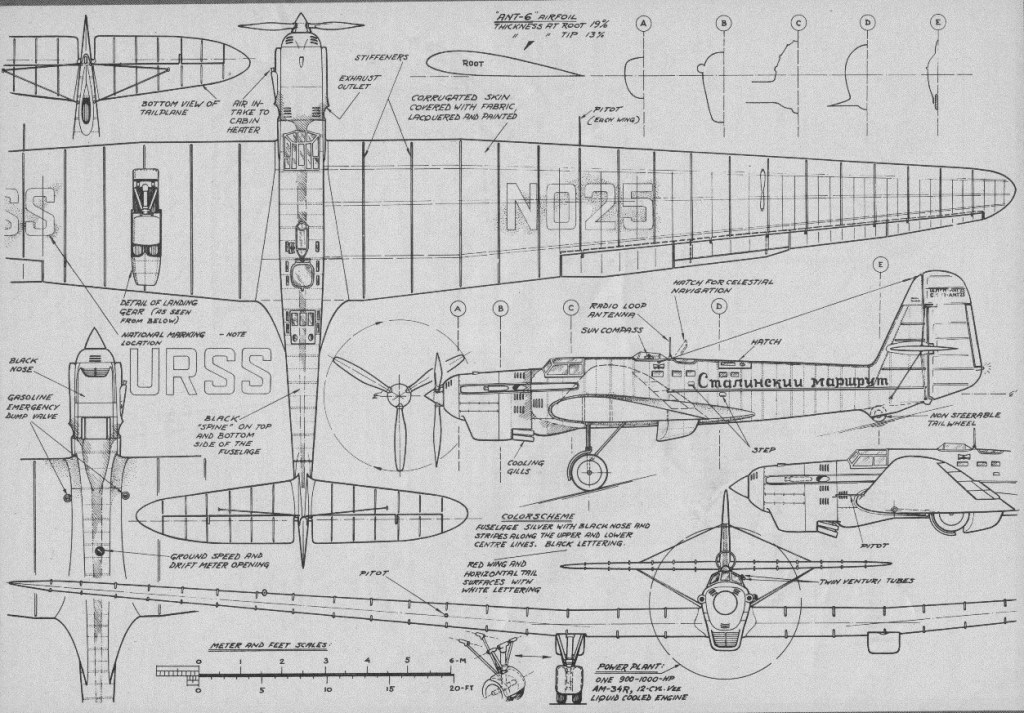
In 1924, Pavel Sukhoi joined the Central Aero and Hydrodynamic Institute, or TsAGI, collaborating in the design of the ANT 25. Design teams headed by P O Sukhoi and A A Arkhangelski but under Tupolev’s general direction, were responsible before the second World War for a series of high¬ speed and long range bombers, including the ANT 25 (RD).

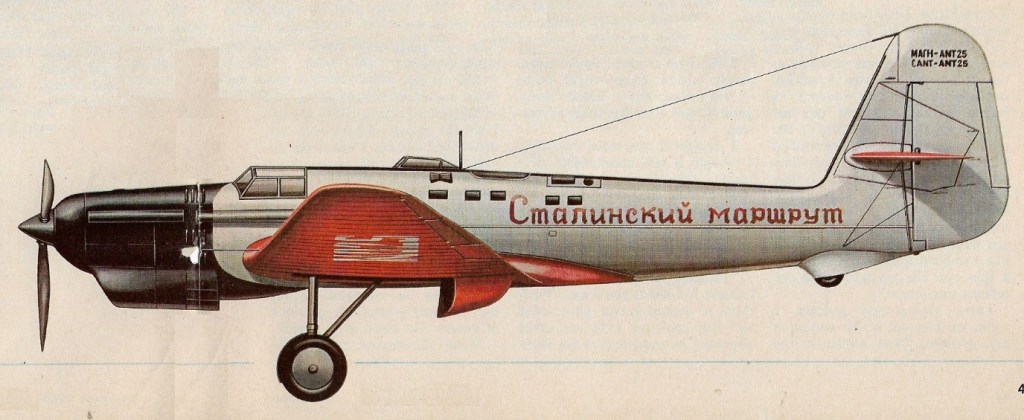
The ANT-25 was of conventiomal all-metal construction with additional fabric covering on the wings, lacquered and highly polished for maximum efficiency. The wing had a 10:1 aspect ratio and external chordwise ribbing. Engine was 900-1000 hp AM-3R liquid cooled V-12 with cooling system specialy modified for best cold weather operation. The narrow fuselage had cockpit fitted with blind flying instruments, but no autopilot. Next aft was a bunk, then navigator’s station, then second cockpit with full controls. Complete navigation and radio gear was carried. Cabin heat was supplied from exhaust system heat exchanger. Crew had oxygen system and emergency equipment including three inflatable floatation bags in wing and nose, inflatable rubber raft, electrically heated floatation suits and a month’s rations stowed in wing leading edge compartments.

The first prototype flew on June 22, 1933.

On June 18-20, 1937 RD piloted by Chkalov, Baidukov and Beljakov flew non-stop from Moscow to Portland (USA), covering 9130km in 63 hours and 25 minutes.

On July 12-14, 1937 RD piloted by Gromov, Yumashev and Danilin flew non-stop from Moscow via the North Pole to San Jacinto (USA), covering 11500km in 62 hours and 17 minutes.

A total of 2 aircraft were built, followed by 20 ANT-36s.

ANT-25
Engine: 1 x M-34
Max take-off weight: 11500 kg / 25353 lb
Empty weight: 4200 kg / 9259 lb
Wingspan: 34.0 m / 112 ft 7 in
Length: 13.9 m / 46 ft 7 in
Height: 5.5 m / 18 ft 1 in
Wing area: 87.9 sq.m / 946.15 sq ft
Max. speed: 210 km/h / 130 mph
Cruise speed: 165 km/h / 103 mph
Ceiling: 7000 m / 22950 ft
Range w/max.fuel: 13000 km / 8078 miles
Crew: 3

Tupolev ANT-25 / RD

Tupolev ANT-23 / I-12

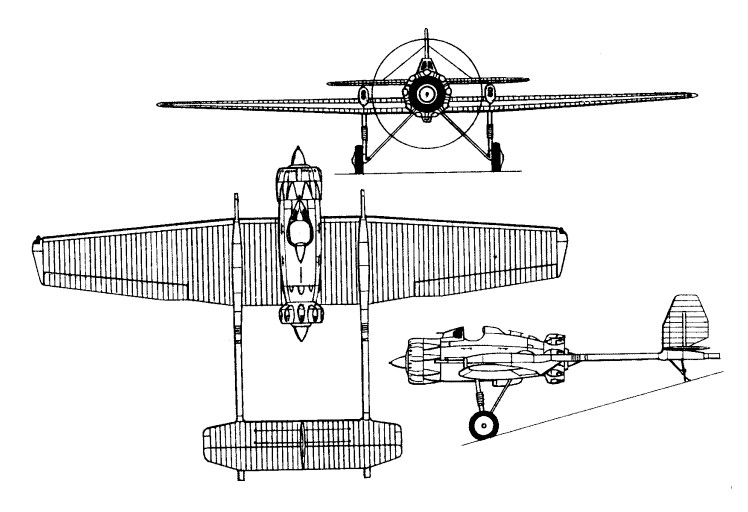
Of unconventional design in employing a tandem fore-and-aft engine arrangement and twin tailbooms embodying recoilless gun tubes as integral, but non-load-carrying, structural components, the ANT-23 single-seat fighter was conceived at the AGOS TsAGI by Viktor N Chernyshov, one of Tupolev’s brigade leaders. Of all-metal construction with smooth stressed skinning for the fuselage and wing – the latter and the tail surfaces being strengthened by externally-attached inverted “U” strips – and tail covering, the fighter was powered by two 525hp Gnome-Rhone 9AK nine-cylinder air-cooled radial engines.

Armament consisted of two 76mm Kurchevski APK-4 recoilless weapons which were embodied in the tailbooms, the gun gases being discharged from their tails. Known unofficially as the Baumanskii Komsomolyets – in memory of the pre-revolutionary Communist after whom the district in which the TsAGI was situated was named – and officially as the I-12, the ANT-23 was first flown in late December 1931. Flight testing continued through early 1932, but, on 19 May, the port gun exploded, the tail-boom collapsing on touchdown. The aircraft was overweight and suffered substantially higher drag than had been calculated. Chernyshov and his team were developing a means of jettisoning the aft propeller to afford safe escape for the pilot in an emergency, but, at the beginning of 1933, the ANT-23 was abandoned.

Engines: two 525hp Gnome-Rhone 9AK nine-cylinder air-cooled radial.
Max take-off weight: 2400 kg / 5291 lb
Wingspan: 15.60 m / 51 ft 2 in
Length: 9.50 m / 31 ft 2 in
Wing area: 30.00 sq.m / 322.92 sq ft
Max. speed: 300 km/h / 186 mph
Armament: two 76mm Kurchevski APK-4 recoilless

Tupolev ANT-23 (I-12)

Tupolev ANT-22 / MK-1

The Tupolev ANT-22 or MK-1 with six 619kW M-34R engines was a long-range bomber reconnaissance flying-boat, with a twin-hull. Test flown for the first time on 8 August 1934, it established several weight-to-height world records in December 1936, but was abandoned soon afterwards.

Armament comprised eight 7.7mm ShKAS machine-guns, one 20mm cannon and a bombload of up to 6000kg.

ANT-22
Engines: 6 x AM-34R
Max take-off weight: 33560 kg / 73988 lb
Wingspan: 51.0 m / 167 ft 4 in
Length: 24.1 m / 79 ft 1 in
Height: 6.4 m / 21 ft 0 in
Max. speed: 223 km/h
Ceiling: 3500 m / 11500 ft
Armament: 2 x 20mm cannons, 6 x 12.7mm machine-guns
Bombload: 6000kg
Crew: 3

Tupolev ANT-22 / MK-1