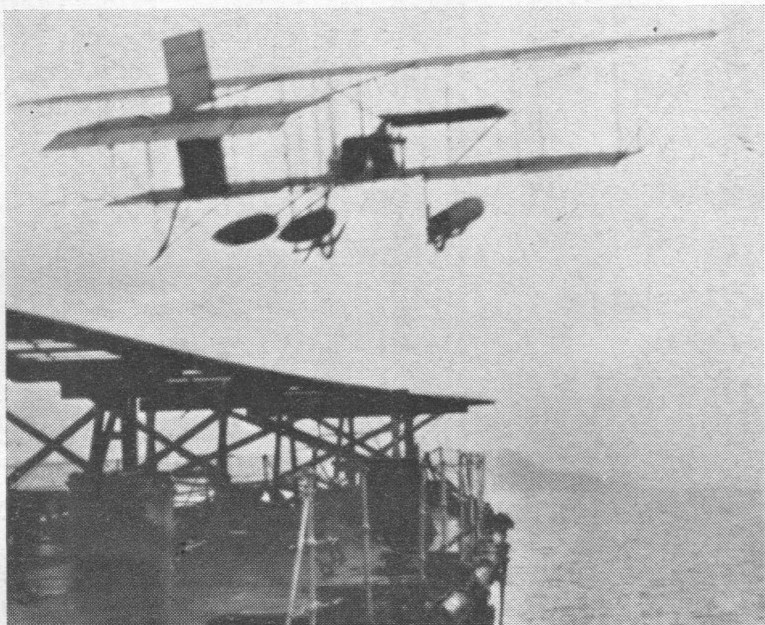
In 1912 Cdr. Samson made the first flight from a moving ship in a Shorts S.38. The S.38 was fitted with air-bags so that it could alight on the water, if necessary.
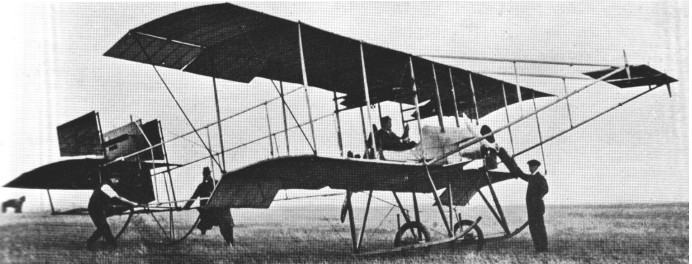
Cdr. C.R. Samson flew a Short biplane from a platform on HMS Africa in 1912
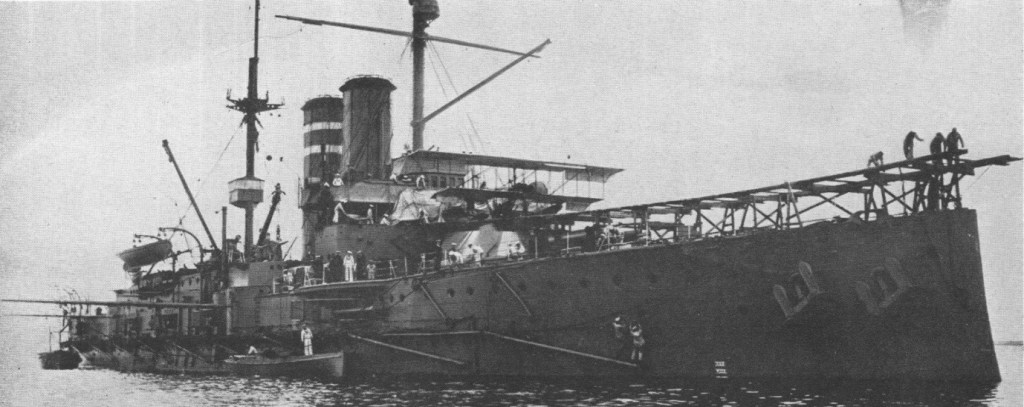
The Admiralty erected a runway on HMS Hibernia in 1912 and Cdr. Samson made the first flight from a moving vessel while steaming at 10.5 knots.
Cdr. Samson on HMS Hibernia in 1912
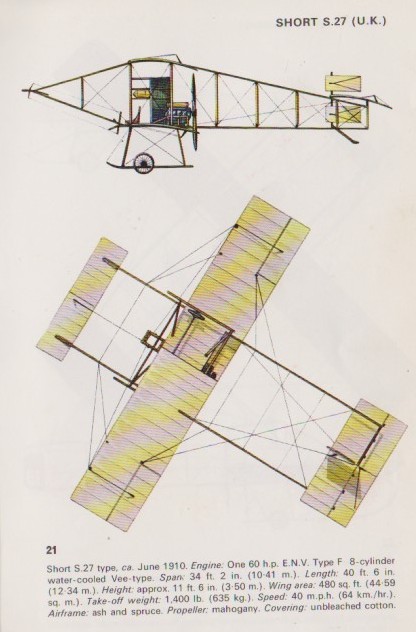
The S.27 was fitted with air-bags so it could land on water, if necessary. Samson landed ashore at Lodmoor.
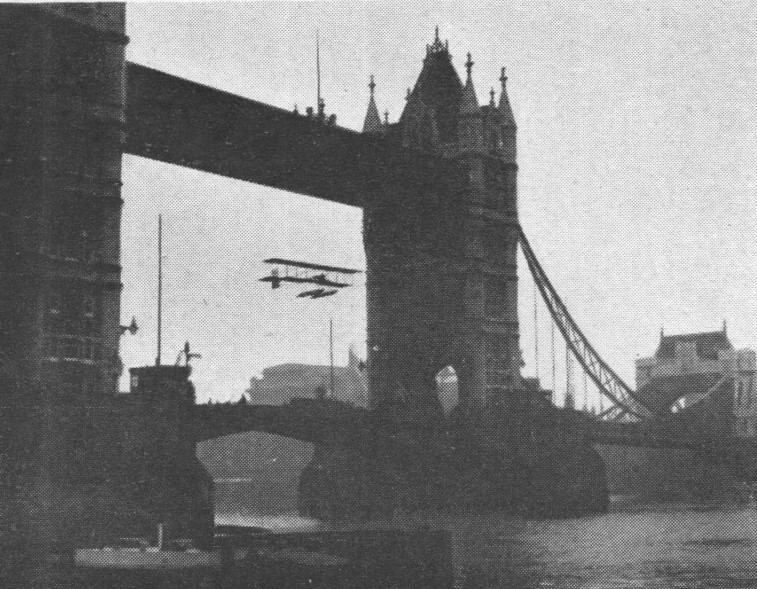
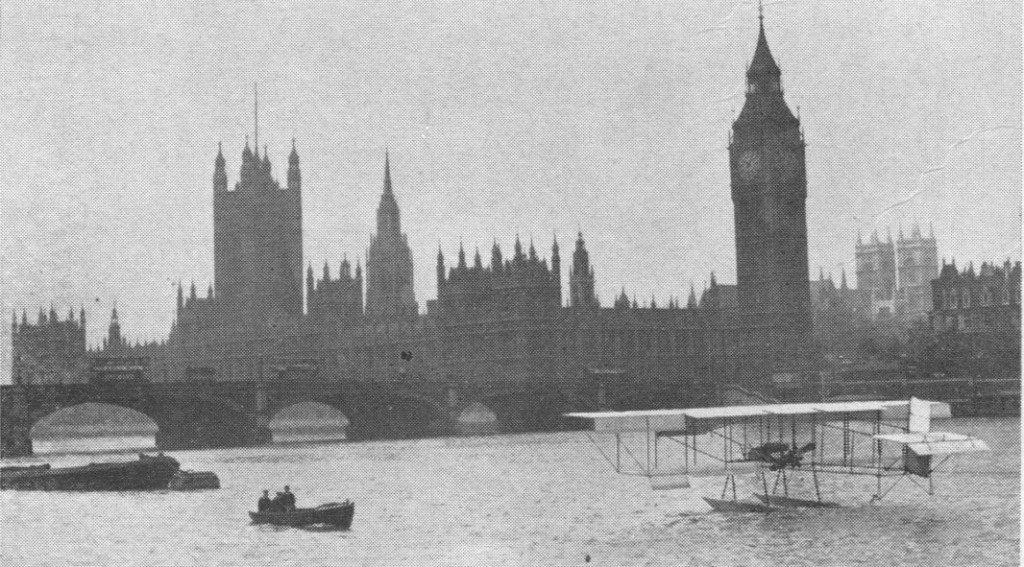
Frank McClean caused a sensation on 10 August 1912 by flying his Short biplane through the Tower Bridge, and then hopping and taxying under the remaining bridges to Westminster, where he alighted. Reprimanded by the Police, he promised not to leave the water again until he had taxied down-river, past Tower Bridge. When he attempted to take off, he crashed.
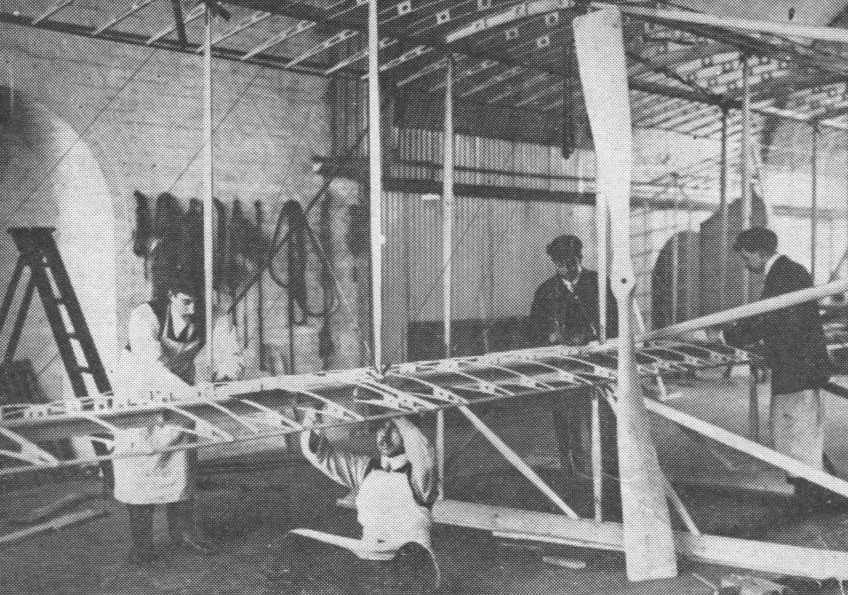
At Leysdown, Isle of Sheppey, completed first biplane glider, construction of which had begun at Battersea, London, in 1909. It was designed by Horace Short from photographs of the Wright Flyer.
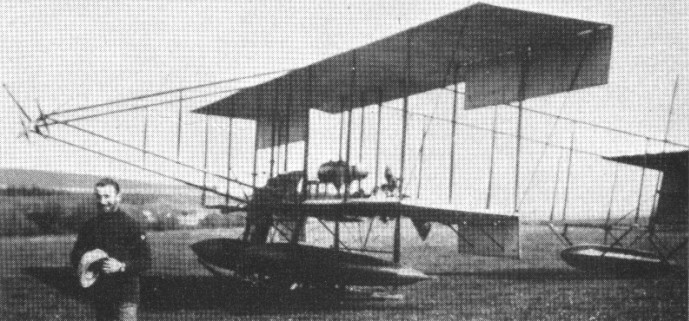
The Short Brothers moved their factory from Battersea to Leysdown in 1909 and completed a tailess biplane of their own design. The biplane was for Frank McClean. The No.2 resembled the Wright biplane but had improved controls and a 60 hp Green engine.
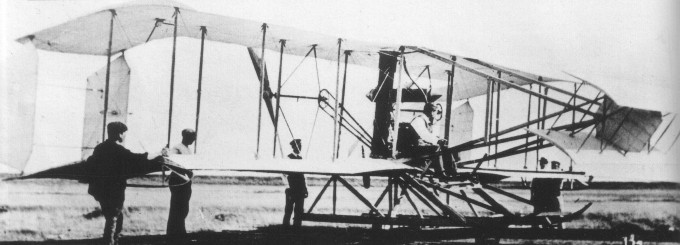
The biplane No. 2 flew for the first time in 1909.
1909 Short No. 2 biplane
It was with this plane Moore-Brabazon won the Daily Mail prize for a circular flight of 1 mile.
The Herring-Burgess airplane was sold to Joseph C. Shoemaker sometime in 1910 or early 1911. Shoemaker, along with Fred C. Chanonhouse, modified the Herring-Burgess design by eliminating the fins on the upper wing and removing the forward elevator. The landing gear was also rebuilt.
Shoemaker soloed his modified Herring-Burgess Model A on June 3, 1911, and by August the airplane was capable of executing basic flight manoeuvres, including circles and figure 8s, in addition to achieving distances up to 14.5 km (9 mi), altitudes up to 30 m (100 ft), and flight durations of ten minutes.
After a crash on September 2, 1911, which resulted in slight damage, the airplane does not appear to have been flown again. The Herring-Burgess biplane was donated to the Smithsonian Institution by the Shoemaker estate in February 1961.
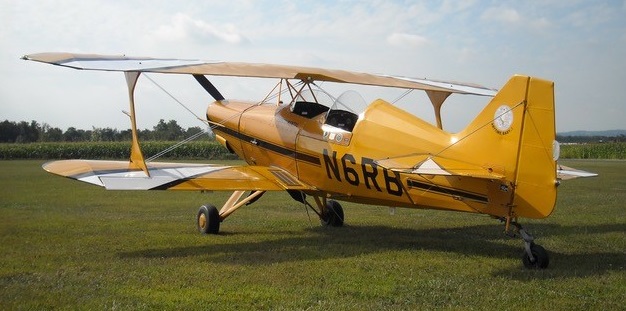
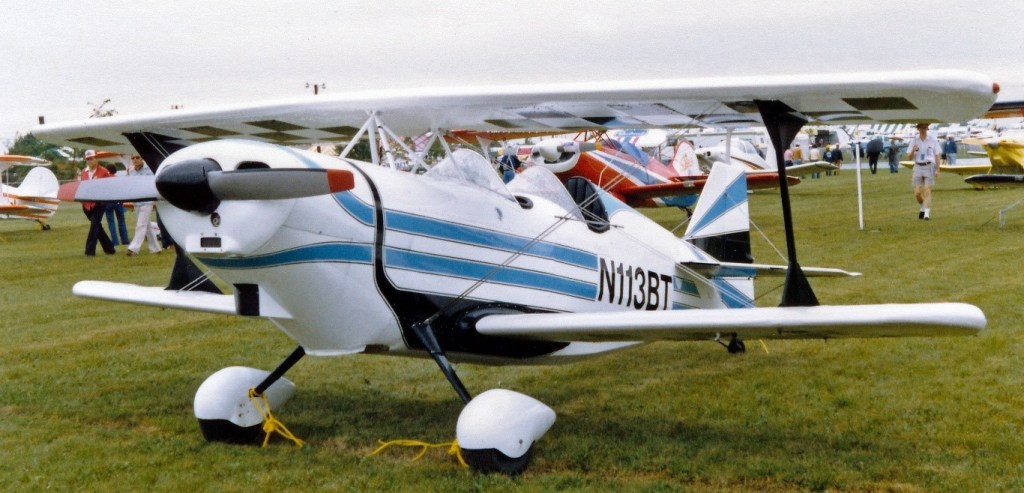
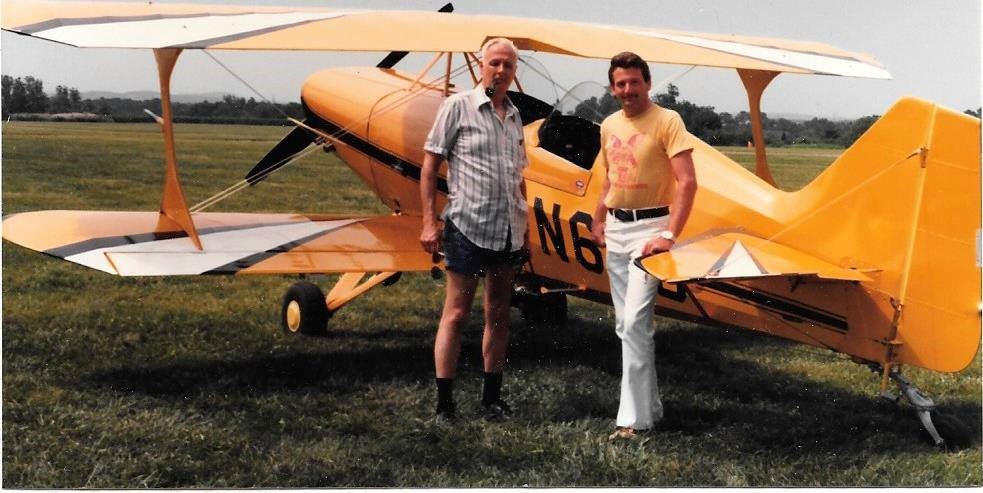
The Shober Willie II is an American two-seat sporting or aerobatic aircraft designed and built by Shober Aircraft Enterprises.
The Willie II is a braced single-bay biplane with a fabric covered welded steel fuselage. The two-spar wooden wings are fabric covered with wide-span ailerons on the lower wing and a fabric covered wired-braced welded steel tail unit. The prototype is powered by a 180 hp (134 kW) Lycoming O-360-A3A engine. It has two open cockpits in tandem and a fixed conventional landing gear with a tailwheel.
First flying in 1971, the aircraft was designed to be sold as plans for amateur construction.
Suited for engines in the 150 to 200 hp range, at least four further aircraft were completed. Further development was halted in 1976 when the type was withdrawn from the market.
The Willie II has the M-6 airfoil and two ailerons. The Skybolt Biplane with symmetrical airfoils and four ailerons came out shortly after the Willie II, possibly that is why the Willie II plans were withdrawn from the market.
There appears to have been five Willie II biplanes built;
N7919 – the prototype built by William Shober
N113BT
N113BT Lycoming O-360 engine
N—- built by Richard Fox in Frederick Maryland.
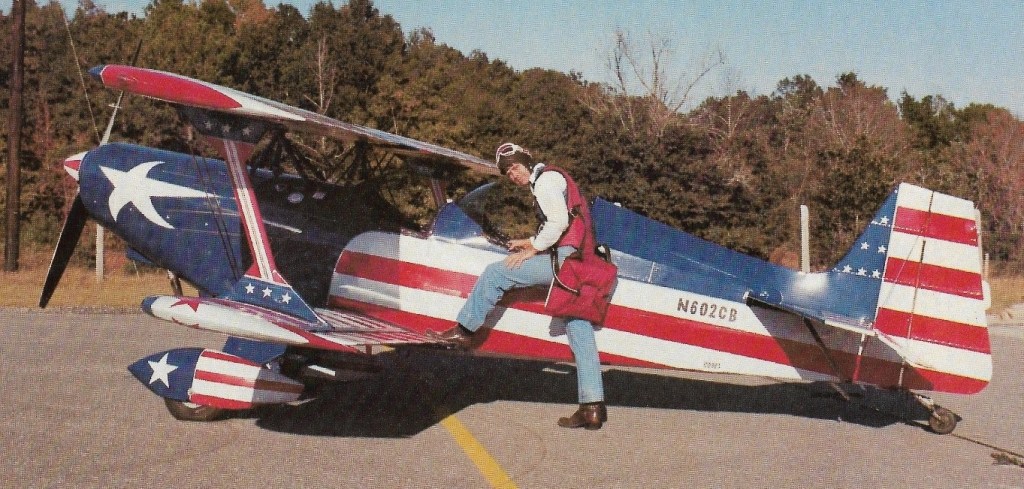
N602CB
N6RB
N5RB
Willie II Prototype N7919 Engine: 1 × Lycoming O-360-A3A, 180 hp (134 kW) Wingspan: 6.10 m (20 ft 0 in) Wing area: 13.75 sq.m (148 sq ft) Length: 5.79 m (19 ft 0 in) Empty weight: 388 kg (856 lb) Gross weight: 612 kg (1,350 lb) Cruise speed: 241 km/h (150 mph, 130 kn) Stall speed: 96 km/h (60 mph, 52 kn) Range: 603 km (375 mi, 326 nmi) Service ceiling: 4,570 m (15,000 ft) g limits: +9 -9g Rate of climb: 15 m/s (3,000 ft/min) Seats: 2
Willie II N602CB Engine: 1 × Lycoming O-320 150 hp Wingspan: 6.10 m (20 ft 0 in) Wing area: 13.75 sq.m (148 sq ft) Gross weight: 1276 lb Empty weight: 907 lb g limits: +6 -5g
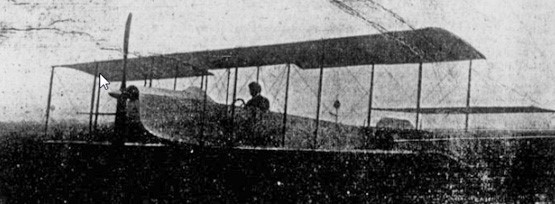
The 1909 Shneider I and II were direct copies of Wright A for exhibition work. The were two-place, open biplanes powered by a 30hp 3-cyl Eldbridge with two chain-driven pusher propellers.
The Model I was destroyed in a crash on 12 July 1909. Following the subsequent crash of Model II, Shneider concentrated on building Curtiss pushers.
This machine was designed by Fred P Shneider of New York City, who built several Curtiss-inspired types, and piloted by Josef Richter. It was intended for use by the pupils of the Shneider School of Aviation at Hempstead Plains Field, Garden City.
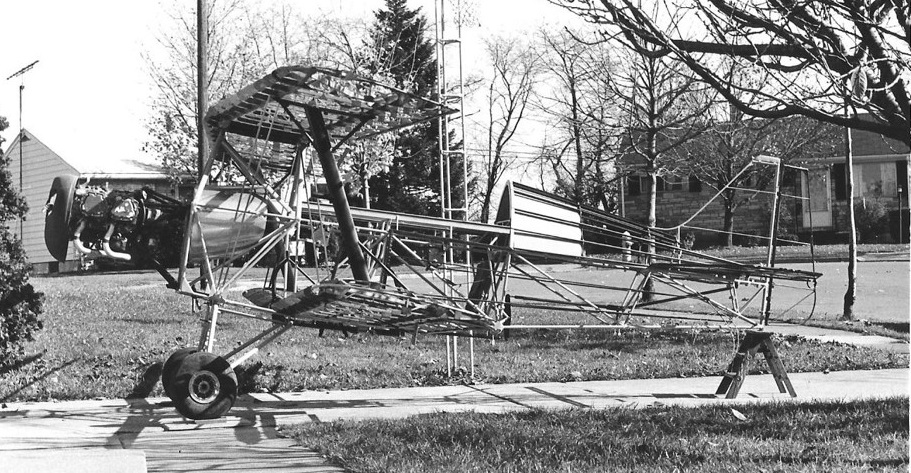
The Big Cootie is a modernized version of the Powell PH Racer biplane for homebuilt construction. The aircraft is a single seat biplane with conventional landing gear, designed for mild aerobatics. The fuselage is welded steel tube construction with aircraft fabric covering. The cowling is fiberglass. The ailerons are controlled with push-pull tubes. The wings use wooden spars with plywood leading edges.
The prototype, N84Z, survived an in-flight impact with powerlines during its initial testing. It was rebuilt at the Piedmont Aerospace Institute at Smith Reynolds Airport in Winston-Salem, North Carolina. A Continental A-80 80 hp (60 kW) engine replaced the Lycoming O-145 65 hp (48 kW) engine installed in the prototype.
The kits included all premolded composite parts. All metal parts and fuselage are welded. The wings and tail are attached like a glider and a removed in 5 minutes.
Shirlen Big Cootie Engine: 1 × Lycoming O-145, 65 hp (48 kW) Propeller: 2-bladed Length: 15 ft 9 in (4.80 m) Wingspan: 15 ft (4.6 m) Airfoil: RAF 15 Empty weight: 467 lb (212 kg) Gross weight: 750 lb (340 kg) Fuel capacity: 12 U.S. gallons (45 L; 10.0 imp gal) Maximum speed: 122 kn; 225 km/h (140 mph) Cruise speed: 104 kn; 193 km/h (120 mph) Stall speed: 55 kn; 101 km/h (63 mph) G limits: -4g Crew: 1
Gross Wt. 750 lb Empty Wt. 467 lb Fuel capacity 12 USG Wingspan 18’9” Length 14’ Top speed 140 mph Cruise 120 mph Stall 63 mph Takeoff run 500 ft Landing roll 500 ft Range 300 sm
Engine: Rotax 912, 80 hp HP range: 80-120 Height: 6.4 ft Length: 20.4 ft Wing span: 29.4 ft Wing area: 113.8 sq.ft Empty weight: 550 lb Gross weight: 1200 lb Fuel capacity: 18 USG Top speed: 190 mph Cruise: 160 mph Stall: 40 mph Range: 690 sm Rate of climb: 1600 fpm Takeoff dist: 230 ft Landing dist: 230 ft Seats: 2 Landing gear: nose or tailwheel
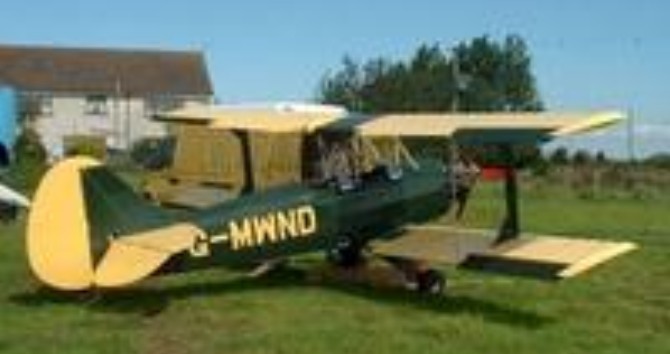
The Sherwood Ranger is a lightweight two seat open cockpit biplane, designed to reduce the cost of owning and operating your own aeroplane to the absolute minimum. One of its major features is that the wings can be folded and the aeroplane loaded onto a trailer in less than three minutes, thus eliminating hangarage costs by allowing the aeroplane to be stored at home. The performance and handling characteristics allow safe operation from unprepared grass fields as short as 250yds.
The Ranger XP was first flown in 1991, and the LW in 1994.
TCD Ltd, UK, markets kits for the Sherwood Ranger ST single- or tandem two-seat biplane.
Engine: Rotax 532, 64 hp HP range: 50-100 Height: 7.33 ft Length: 20 ft Wing span: 23 ft Wing area: 140 sq.ft Weight empty: 495 lb Gross: 1000 lb Fuel cap: 12 USG Speed max: 95 mph Cruise: 85 mph Range: 210 sm Stall: 38 mph ROC: 1600 fpm Take-off dist: 100 ft Landing dist: 200 ft Service ceiling: 14,000 ft Seats: 1-2 Landing gear: tail wheel
The Little Aeroplane Co Sherwood Ranger Stall: 56 kt / 65 mph / 105 kmh Cruise: 78 kt / 90 mph / 145 kmh MTOW Weight: 450 kg / 992 lbs Climb Ratio: 1000 ft/min / 5 m/s Take-off distance (50ft obstacle): 700 ft / 213 m Landing distance (50ft obstacle): 800 ft / 244 m
Sherwood Ranger LW Engine: Rotax 532, 64 hp HP range: 50-100 Height: 7.3 ft Length: 20 ft Wing span: 26 ft Wing area: 168 sq.ft Empty weight: 400 lb Gross weight: 860 lb Fuel capacity: 6-12 USG Top speed: 85 mph Cruise: 70 mph Stall: 38 mph Range: 140 sm Rate of climb: 1000 fpm Takeoff dist: 100 ft Landing dist: 200 ft Service ceiling: 14,000 ft Seats: 2 Landing gear: tailwheel
Sherwood Ranger XP Engine: Rotax 618, 75 hp HP range: 65-100 Height: 7.3 ft Length: 20 ft Wing span: 23 ft Wing area: 140 sq.ft Empty weight: 500 lb Gross weight: 1000 lb Fuel capacity: 12 USG Top speed: 95 mph Cruise: 85 mph Stall: 38 mph Range: 210 sm Rate of climb: 1300 fpm Takeoff dist: 100 ft Landing dist: 200 ft Service ceiling: 14,000 ft Seats: 2 Landing gear: tailwheel
TCD Sherwood Ranger Engine: Rotax 582, 64 hp Wing span: 7.92 m Wing area: 15.70 sq.m MAUW: 390 kg Empty weight: 200 kg Max speed: 150 kph Cruise speed: 115 kph Minimum speed: 65 kph Climb rate: 4 m/s Certification: PFA Seats: 2 Fuel consumption: 16 lt/hr Kit price (1998): £10,516


 All Aero