In October 1914 Siemens started design of four-engined aircraft similar to that of Sikorsky in Russia. As entirely new venture company sponsored designs by two Steffen brothers leading to giants R.I-VII of 1915-1917.
Biplane
Siemen Schkukert R.I
In October 1914 Siemens started design of four-engined aircraft similar to that of Sikorsky in Russia. As entirely new venture company sponsored designs by two Steffen brothers leading to giants R.I-VII of 1915-1917.
Siemen Schkukert D-IV
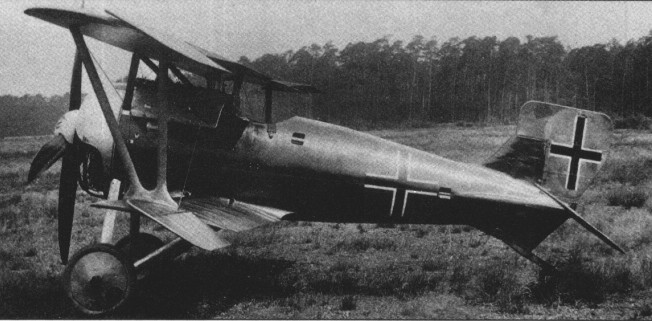
The D III was followed by the D IV, which introduced much aerodynamic refinement for slightly higher speed and still better climb rate. A total of 280 were ordered, but less than 140 D IVs were completed, most entering service after August 1918.
D IV
Engine: l x Siemens-Halske Sh.IIIa, 119kW (l60hp)
Span: 8.35m (27ft 4.75in)
Length: 5.7m (18ft 8.5 in)
Max TO weight: 735 kg (1,620 lb)
Max speed: 119 mph
Operational endurance: 2 hr
Armament: 2 x 7.92-mm (0.312-in) LMG 08/15 mg
Siemen Schkukert D-II / D-III
Via the D II prototype Siemens-Schuckert then moved to a completely German design, ordered late in 1917 as the D III equal-span biplane with the 119-kW (160-hp) Siemens-Halske Sh.III rotary engine whose diameter dictated the circular section of the compact fuselage that tapered sharply into the empennage with its large tailplane and angular vertical surfaces. After the teething problems of this engine had been cured, the 50 D IIIs matured as extremely fast-climbing interceptors whose other performance figures were low.
Siemen Schkukert D-1
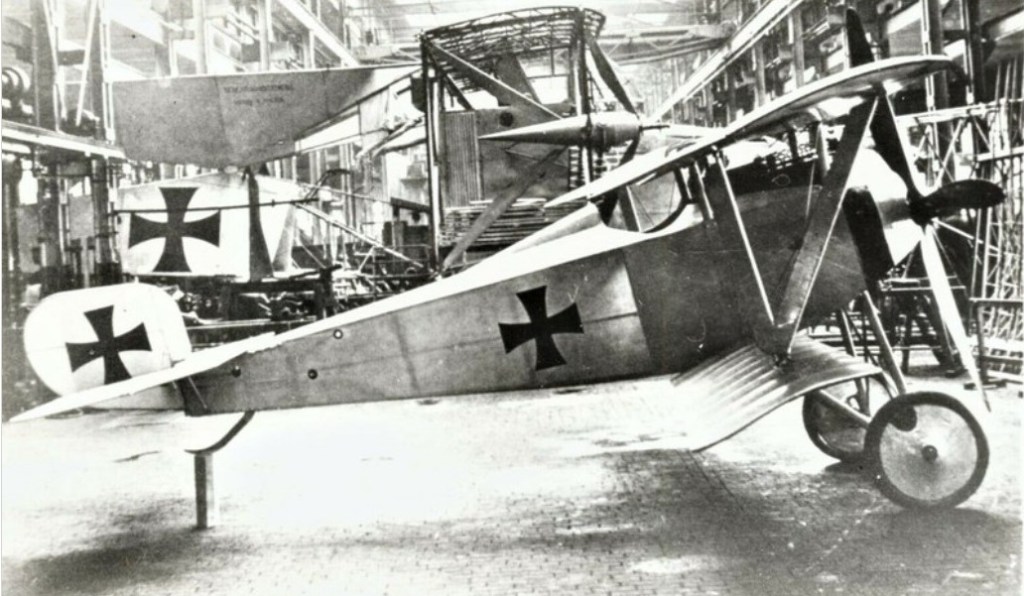
A German copy of the Nieuport 11. Some 150 were ordered into production of which only 94 became operational due to improved aircraft coming into service by mid-1917.
Replica Ultralight:
Circa Reproductions Siemens Schukert
Engine: Siemens-Halske, 110 hp
Siedek KS 3

The Siedek KS 3 was built by Diplom-Ingenieur Richard Siedek in Vienna, Austria. The powerplant was an 80 hp two-stroke aircraft engine, developed by Ingenieur Kraus and Siedek.”
Span: 22 ft 11.6 in (7.00 m)
Length: 16 ft 8.8 in (5.10 m)
Height: 6 ft 6.7 in (2.00 m)
Wing area: 172 sq.ft (16.00 sq.m)
Takeoff weight: 882 lb (400 kg)
Cruise speed: 75 mph (120 kmh)
Siddeley S.R.2 Siskin
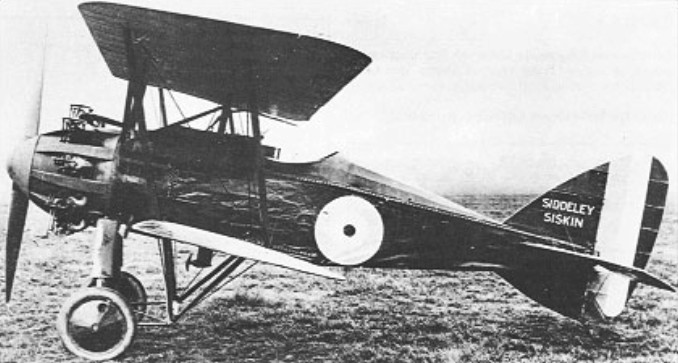
When, in January 1917, Capt F M Green became chief aeronautical engineer of the Siddeley-Deasy Motor Car Company, he began the design of a single-seat fighter, the S.R.2. A compact single-bay sesquiplane predominantly of wooden construction with fabric skinning, the S.R.2 was powered by a 320hp A.B.C. Dragonfly nine-cylinder radial engine. Armament comprised two synchronised 7.7mm machine guns.
A contract for six prototypes was reduced to three in mid 1918, the first of these flying in April 1919, by which time the fighter had been officially named Siskin. The first prototype Siskin was subsequently re-engined with an Armstrong Siddeley Jaguar, development in this form continuing after Siddeley Deasy acquired in 1921 the name and goodwill of Sir W G Armstrong Whitworth & Co Ltd, and the Armstrong Whitworth Siskin II emerging in 1922.
Max take-off weight: 989 kg / 2180 lb
Empty weight: 664 kg / 1464 lb
Wingspan: 8.38 m / 27 ft 6 in
Length: 6.48 m / 21 ft 3 in
Height: 2.97 m / 9 ft 9 in
Wing area: 22.95 sq.m / 247.03 sq ft
Max. speed: 233 km/h / 145 mph
Ceiling: 7255 m / 23800 ft
Siddeley R.T.1
The R.T.1 of 1917-1918 was a redesigned R.E.8
Sibnia / Chaplygin TVS-2
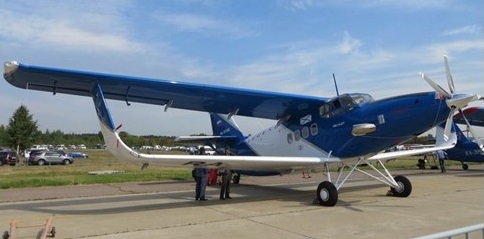
Another organization working on a “better” An-2 is SibNIA (Siberian Aeronautical Research Institute) in Novosibirsk, Russia. In this version, the An-2MS (An-2MC in Russian) and later usually referred to as the TVS-2MS), the radial engine was replaced by a 1,100 hp Honeywell TPE331-12UHR turbine, driving a five-bladed Hartzell propeller. The first An-2MS/TVS-2MS was first flown on September 5, 2011 and by 2015 well over fifteen examples had been delivered by SibNIA and Rusaviaprom JSC, all built, from existing An-2 airframes retaining the An-2 wings and tail feathers.
SibNIA went a step further and also developed an upgraded An-2 with an entirely new composite construction high-lift, high-aspect-ratio wing. This new wing was first tested on an An-2MS which flew as a high wing monoplane. The aircraft, designated TVS-2-DT, first flew in December 2014 and had the TPE331 engine and old style tail. It then received curved wingtips on the upper wing and a new lower wing with wingtips acting as interconnecting struts. In this guise it flew on June 10, 2015, initially also with the old tail, but this was soon replaced by a new design larger and squared vertical tail as shown in the photo.
Shriver-Dietz 1910 Biplane
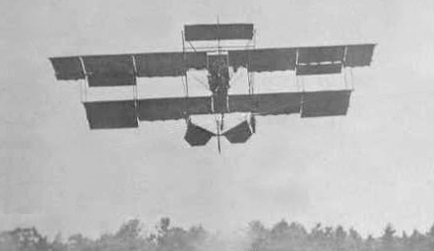
A single place, open biplane was constructed by Tod Shriver & (?) Dietz at Mineola NY., USA, circa 1910. There is a possible, but unresolved, connection with Dietz Paraplane in design or construction.
Shriver-02.jpg
 All Aero