Sikorsky S-5

The S-3, S-4, and S-5 followed in quick succession, each a refinement of its predecessor, and each adding to Sikorskys’ piloting experience.

Finally, by the summer of 1911, in an S-5 with a 50-horsepower engine, Sikorsky was able to remain in the air for more than an hour, attain altitudes of 1,500 feet (450 metres), and make short cross-country flights. This success earned him International Pilot’s License Number 64.

Span: top 39’4″ bottom 29’6″ or 27’11”
Length: 27’11” or 26’3″
Weight loaded: 970 lb
Speed: 78 mph

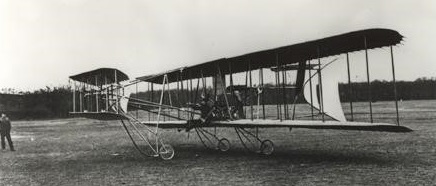
Sikorsky S-1 / S-2

S-2

For the time being Sikorsky decided to enter the field of fixed-wing design and began construction of his first airplane. His S-1 biplane was tested early in 1910, and, although its 15-horsepower engine proved inadequate, a redesigned airframe with a larger engine (S-2) carried him on his first short flight. On 16 June 1910 it flew about 800 ft at 2 to 3 feet altitude. It crashed a few days later after a 49 second flight.

S-2
Engine: Anzani, 25 hp
Top speed: 50 mph

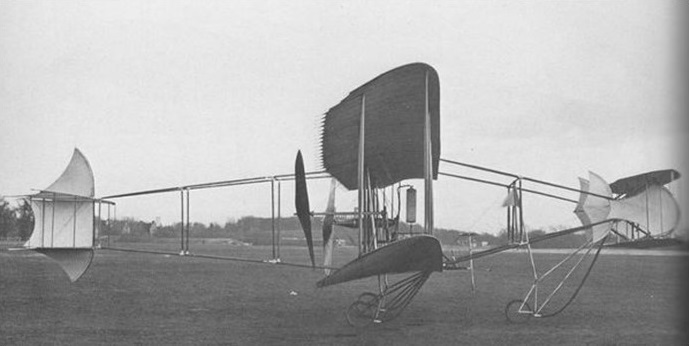
Siemen Schkukert Bourcart Biplane

A 5-seater Siemens-Schuckert Werkes biplane designed by Max Bourcart with a combination steel tubing and wood construction, powered by a 50 hp Argus engine, and chain-driven to the two propellers. First flown on 9 march 1910, a 1000 m straight-line flight piloted by Bourcart. The second, and last flight, was made on March 11, piloted by Bourcart with two passengers, ending in a crash landing. Bourcart had patented such a construction on September 9, 1902 [German Patent 145547 – Flugmaschine mit zwei Luftschrauben, deren Flügel ineinandergreifen].

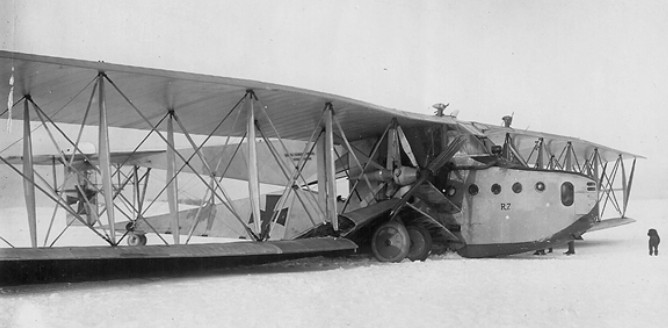
Siemen Schkukert R.VII

In October 1914 Siemens started design of four-engined aircraft similar to that of Sikorsky in Russia. As entirely new venture company sponsored designs by two Steffen brothers leading to giants R.I-VII of 1915-1917.

The then relatively low engine power required lightest construction. This in turn required precision and caution, especially when landing – where such giant wooden aircraft were extra-sensitive. Many crashed.

Siemens Schuckert R 7