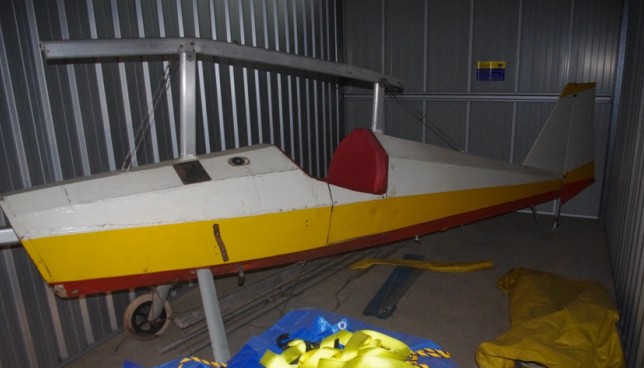
Skroback Road-plane

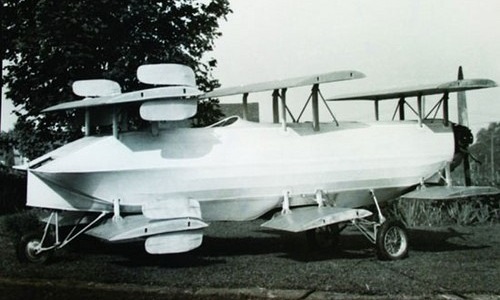
In 1934, electrician and hobbyist Frank Skroback built the first airplane that could be driven on a road. Or the first car that could be flown. It has six wings and an overall width of seven feet, so it can fit inside a lane. The plane was to be auctioned at Red Baron’s Antiques in Atlanta circa 2003.

Simpson Midwest Ultralights Little Bi

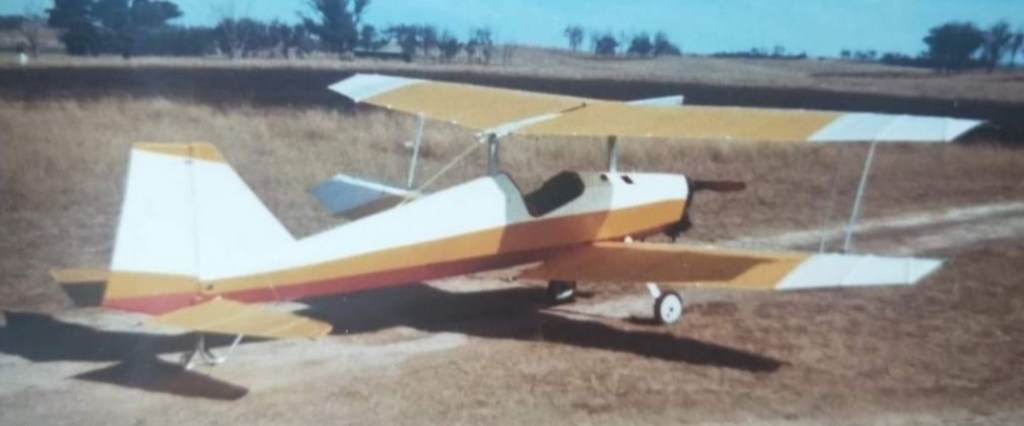
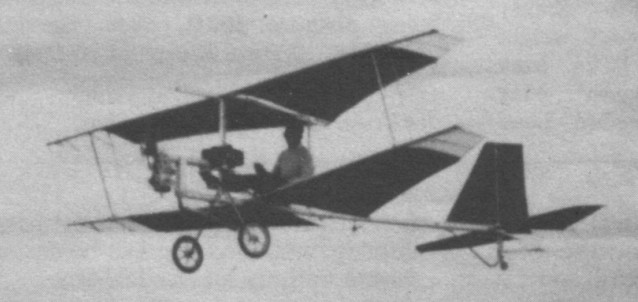
Single seat single engined biplane with con¬ventional three axis control. Wing has un¬swept leading and trailing edges, and constant chord; cruciform tail. Pitch control by fully flying tail; yaw control by fully flying rudder, with additional fin; control inputs through stick for pitch/roll and pedals for yaw. Wings braced by struts and trans¬verse X cables; wing profile; double¬surface. Undercarriage has three wheels in tricycle formation; glass fibre suspension on nosewheel and suspension on main wheels. Push right go right nosewheel steering. Aluminium tube framework, without pod. Engine mounted level with top wing driving tractor propeller.

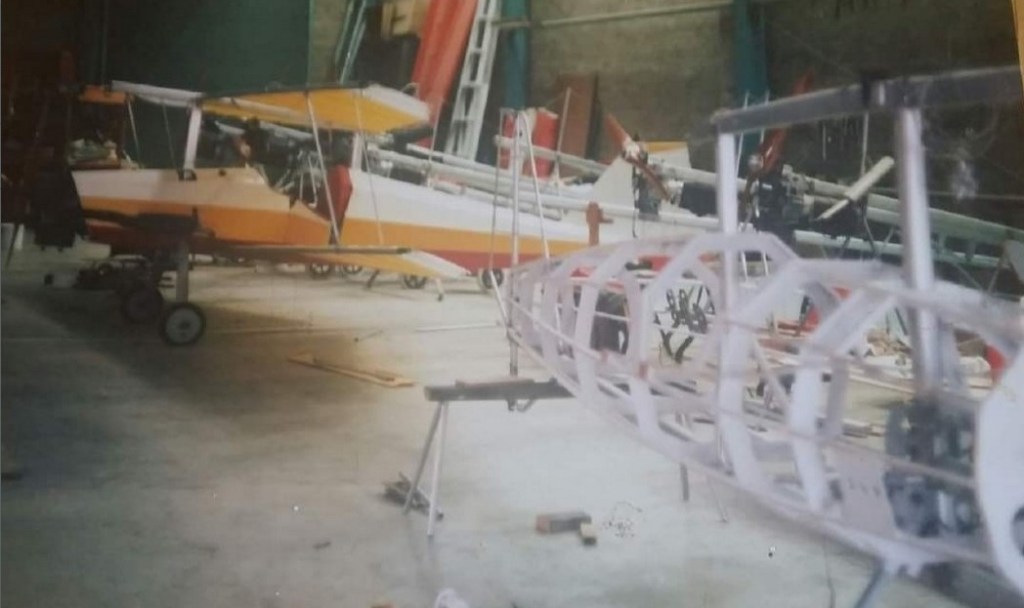
The aim of the Little Bi is to provide a simple lightweight fun biplane, rather than a machine with pretensions to high performance. Its framework is con¬structed of aluminium tubing, while the wings are made from styrofoam with glass fibre ribs and non porous Dacron covering.

Though initially flown with a Yamaha KT100S engine, the aircraft was sold as an engineless kit and it is up to the builder to supply a power plant. The 215 cc Cuyuna 215R with 20hp driving a 54 inch (1.37m) propeller is recommended, but a 22hp Zenoah or the Yamaha are listed as alterna¬tives, each working through a reduction drive.

Two kits are offered, neither of which involves any tube bending or welding: the fast build kit for $2845 (50 60 h) or an economy kit for $1825 (100 120 h) in 1982, the latter requiring the builder to purchase some basic materials locally. Neither kit covers anything more than the structure of the aircraft, items like seat and fuel tank being extras, for $49.95 and $65 respectively. For the builder who wants to spread the construction cost over a period, five part kits were available.

Engine: Yamaha KT100S, 15 hp
Propeller diameter 48 inch, 1.22m
Belt reduction
Max static thrust 75 lb, 34 kg
Power per unit area 0.08 hp/sq.ft, 0.9hp/sq.m
Fuel capacity 4.3 US gal, 3.5 Imp gal, 16.1 lt
Upper wing span 24.0 ft, 7.32 m
Lower wing span 20.0 ft, 6. 10 m
Sweepback 0 deg
Total wing area 178sq.ft, 16.5 sq.m
Empty weight 190 lb, 86kg
Max take off weight 430 lb, 195kg
Payload 240 lb, 109kg
Max wing loading 2.42 lb/sq.ft, 11.8 kg/sq.m
Max power loading 28.7 lb/hp, 13.0kg/hp
Max level speed 50mph, 80kph
Cruising speed 40mph, 64 kph
Stalling speed 20 mph, 32 kph
Take¬off distance 125 ft, 38 m
Simplex Aircraft Corp R-2-D Red Arrow Dual Plane / Simplex Racer

The 1929 Simplex R-2-D Red Arrow Dual Plane was a convertible monoplane/biplane. The top shoulder wing was permanent, and 24’0″ lower wings could be easily added for increased lift and load-carrying.

The one built, NR43M, was flown as monoplane Simplex Racer with a 225hp Wright engine in the 1929 Nationals events with clocked pylon speeds of more than 220mph. It was piloted by Dick Myhres.

Monoplane
Engine: 165hp Wright J-6
Wingspan: 32’9″
Length: 21’0″
Useful load: 700 lb
Max speed: 140 mph
Cruise: 125 mph
Stall: 50 mph
Range: 600 mi
Seats: 1

Monoplane
Engine: 225hp Wright J-6
Wingspan: 32’9″
Length: 21’0″
Max speed: 165 mph
Cruise: 150 mph
Stall: 50 mi
Range: 550 mi
Seats: 1

Biplane
Engine: 225hp Wright J-6
Wingspan: 32’9″
Length: 21’0″
Max speed: 150 mph
Cruise: 135 mph
Stall: 45 mph
Range: 650 mi
Seats: 1

Simmonds Spartan Arrow

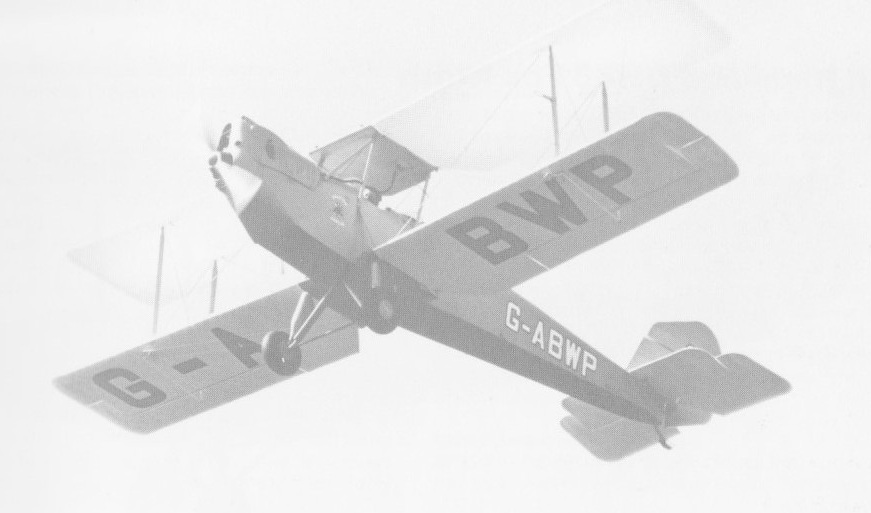
Early in 1930 Spartan Aircraft Ltd. Simmonds altered a version of the Simmonds Spartan into the Spartan Arrow. First flown in May 1930, the prototypes G-AAWY and G-AAWZ were powered by 100 hp Gipsy I engines but the production aircraft that followed had 120 hp Gipsy IIs or 105 hp Hermes II with the exception of Arrow G-ABST which was experimentally fitted with a 160 hp Napier Javelin III.

Simmonds Spartan Arrow Article

Engine: 105 hp Cirrus Hermes II
Wingspan: 30 ft 7 in
Length: 25 ft
AUW: 1850 lb
Max speed: 105 mph

Simmonds Spartan

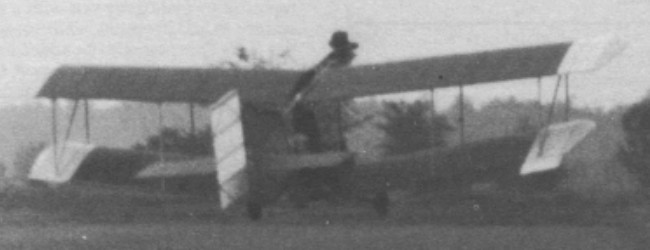
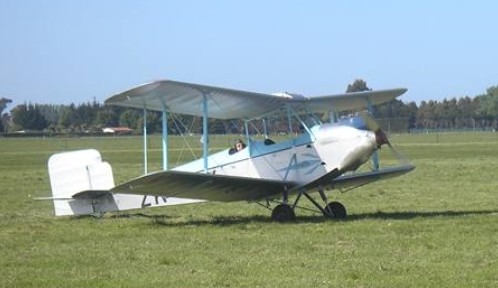
In 1928 O. E. (later Sir Oliver) Simmonds designed and built the Spartan two-seat biplane. Outwardly conventional, but planned for “Spartan” economy (e.g. interchangeable wings and ailerons, and rudder interchangeable with elevator). At Southampton, Hampshire, produced 49 examples, mostly for export, but some for National Flying Services Ltd. One made many Arctic flights.

Simmonds Spartan Article

The first (of seven) Spartan II was completed in September 1932.

Gallery

Spartan
Engine: ADC Cirrus III, 95 hp
Seats: 2

Spartan Srs II
Engine: Cirrus Hermes IV

Silverston Vacu-Aerial / Flying Machine No. 2 / Milwaukee Flying Machine No. 2

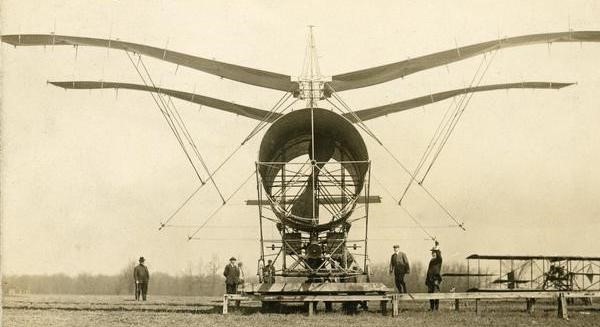
Silverston Vacu-Aerial” Flying Machine No. 2 of 1912 was also known as Dr. Rudolph Silverston’s Milwaukee Flying Machine No. 2. The photo caption reads “Pendulum system 120hp engine.”

According to historical reports, the good doctor had a school of aviation in Milwaukee, and persuaded a number of local investors to support construction of a machine of his devising, which seems to have been an early ducted fan type. The first was a failure; the second (shown) likewise refused to fly, whereupon Dr. Silverston left town with no forwarding address.