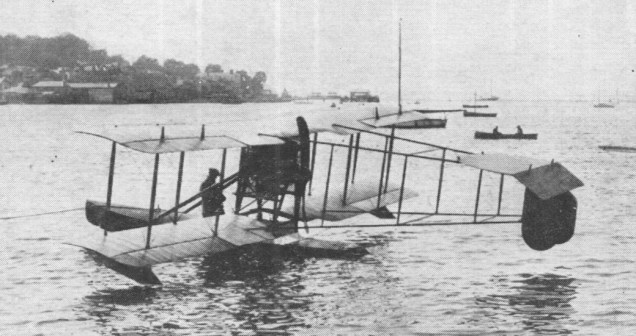
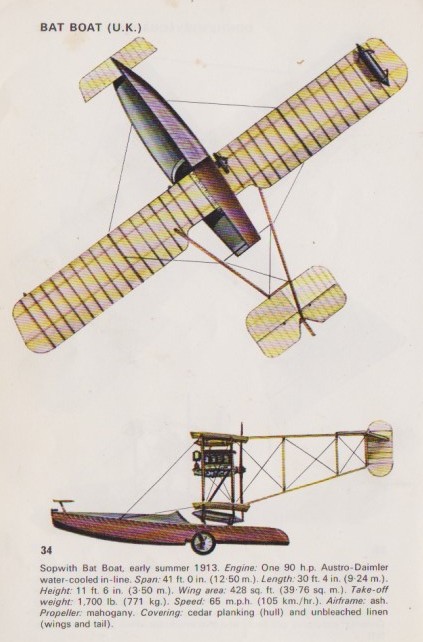
The first amphibian built in Europe circa 1913. A reconnaissance flying boat.
One Bat Boat and two Three-seaters were bought by Winston Churchill for the Naval Wing of the RFC.
Bat Boats Type 1
1913 Sopwith Bat Boats Type 1 amphibian version
1913 Bat Boats Type 1 BB1 Span: 41′ Length: 30’4″ Weight: 1540 lb allup Speed: 60-65 mph
Bat Boat Type 1 BB2 and BB3 amphibian Span: 41′ Length: 32′ dihedral 3 deg
Sopwith Bat Boat II Engine: Salmson, 197 hp Length: 35.302 ft / 10.76 m Height: 11.909 ft / 3.63 m Wingspan: 54.987 ft / 16.76 m Wing area: 599.985 sqft / 55.74 sq.m Max take off weight: 3184.0 lb / 1444.0 kg Weight empty: 2302.0 lb / 1044.0 kg Max. weight carried: 882.0 lbs / 400.0 kg Max. speed: 61 kts / 113 km/h Wing loading: 5.33 lbs/sq.ft / 26.00 kg/sq.m Crew: 2
The 1912 Somerville Biplane was an exhibition and sightseeing ship for Earl S Daughery, who relocated to Long Beach CA and founded its municipal airport.
Somerville Biplane with Daugherty at the helm
Coal City’s Illinois Aero Construction Co (IAC) initials were on the plane and 51; most likely when it was used as a trainer at IAC’s flying school.
The “Hoch-Tief-Doppeldecker” built by the “Deutsche Sommer Flugzeugwerke GmbH” at Frankfurt-Rebstock in 1912. This machine was designed by Robert Sommer and had a circular fuselage, was powered by a 70 hp Hoffmann “Rotor” 7-cylinder engine. The lower wings were attached direct to the landing gear, therefore there was some space between wings and body.
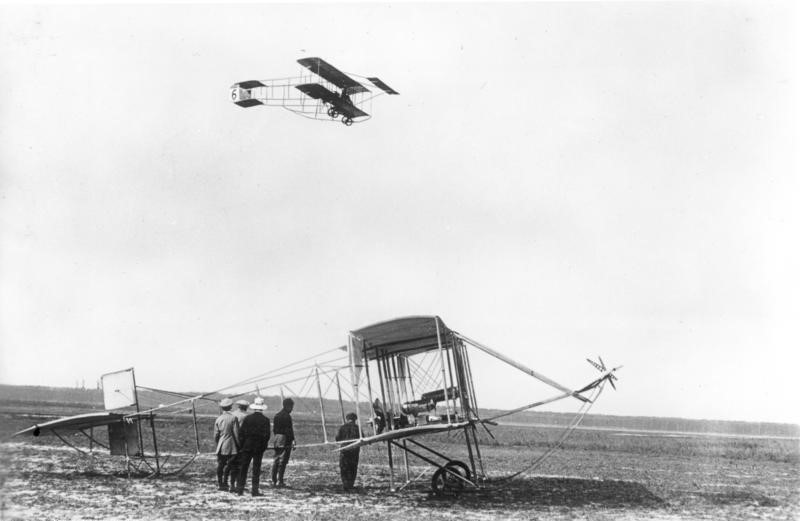
The Sommer 1910 Biplane was designed by Roger Sommer. It was a pusher configuration biplane resembling the successful Farman III, and was built in large numbers for the time. One was owned by Charles Rolls.
In May 1909 Sommer bought a Farman III aircraft, and on 7 August 1909 he gained fame in this by breaking the endurance record held by Wilbur Wright, making a flight lasting 2 hr 27 min 15 sec. Later that year he made a successful appearance at the Doncaster flight meeting, winning the prize for the greatest distance flown during the meeting. Meanwhile, he had started building an aircraft of his own design at Mouzon in the Ardennes, where his family had a felt-making business.
The design of the Sommer biplane was derived from that of the Farman III, the aircraft being a pusher configuration equal-span biplane powered by a 50 hp (37 kW) Gnome Omega. Lateral control was effected by D-shaped ailerons on the upper wing. A single elevator was mounted in front of the wings: behind the wings wire-braced wooden booms carried a horizontal surface which was operated independently of the front elevator and was used to adjust the aircraft’s trim rather than for control purposes. Early examples has a single large rudder mounted below this: this was later changed to four smaller rudders, two above it and two below, and subsequently changed again to one above and one below. The twin skids of the undercarriage were extended forwards to form part of the supporting structure for the elevator, and a single pair of wheels were mounted on an axle between the skids. A two-seat “Military” version with an extended upper wing was produced later.
The prototype was first flown by Sommer on 4 January 1910 at Mouzon, when he managed three flights of over 4 km (2.5 mi) This first machine was sold to a M. Viateaux within two weeks, and by the end of February he had built a replacement and established a flying school at Mouzon. A large number of examples were built: by spring 1910 Sommer had sixty aircraft on order. Sommer had established flying school at Douzy using his machines.
One example was bought by Charles Rolls, and was exhibited on the Royal Aero Society stand at the 1910 Aero Show at Olympia
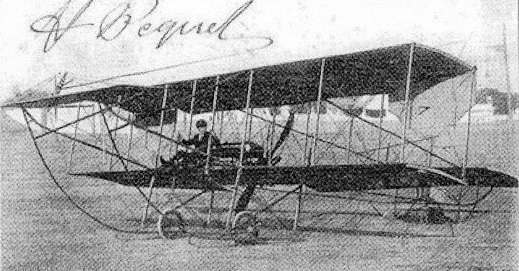
A small number of license-built copies of the Sommer biplane were built in England by Humber. These were of mixed steel and wood construction, and one was used to carry out the world’s first official mail-carrying flight, when 6,500 letters were flown by Henri Pequet from the United Provinces Exhibition at Allahabad to Naini. The letters bore an official frank “First Aerial Post, U.P. Exhibition, Allahabad, 1911”, the text surrounding a drawing of the aircraft.
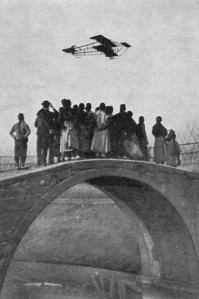
The first aeroplane flight in China was most likely on February 21, 1911, with René Vallon and his Sommer biplane flying over Shanghai. Like other entrepreneurial aviators, he was hoping to sell the concept to onlookers.
René Vallon and his Sommer above Shanghai.
Powerplant: 1 × Gnome Omega 7, 37 kW (50 hp) Wingspan: 10.36 m (34 ft 0 in) Wing area: 36 m2 (390 sq ft) Length: 12.5 m (41 ft 0 in) Crew: 1 Capacity: 1
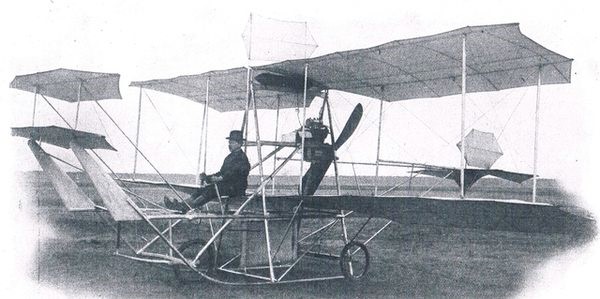
German flight-technician Emil Sohn seated on his doppeldecker during one of his trials at Johannisthal 1909. Sohn’s machine was a Wright-like biplane with a Haake motor. The engine didn’t work and Sohn was left without enough money to purchase a better one.
Societe D’etudes Et De Constructions D’avions Detourisme was established in 1938, produced the RG-60 single-seat biplane, RG-75 two-seat cabin monoplane, and S.5 two-seat high-wing cantilever monoplane. Production ended at outbreak of Second World War.
The 1927 S.R.A.P. T.7, also known as the Béchereau S.R.A.P. T.7 or Salmson-Béchereau S.R.A.P. T.7, was a two-bay biplane. Nine were built, powered by a 520 hp Salmson 18CMb radial engine, with a 16.90 m wingspan.
S.I.A.7 and 9 series of two-seat reconnaissance- bomber biplanes, dating from 1917, were designed by Umberto Savoia and Rodolfo Verduzio. Structural weakness attributed to both, and Type 9 was rejected by Italian Army on this account, though accepted by Navy.


 All Aero