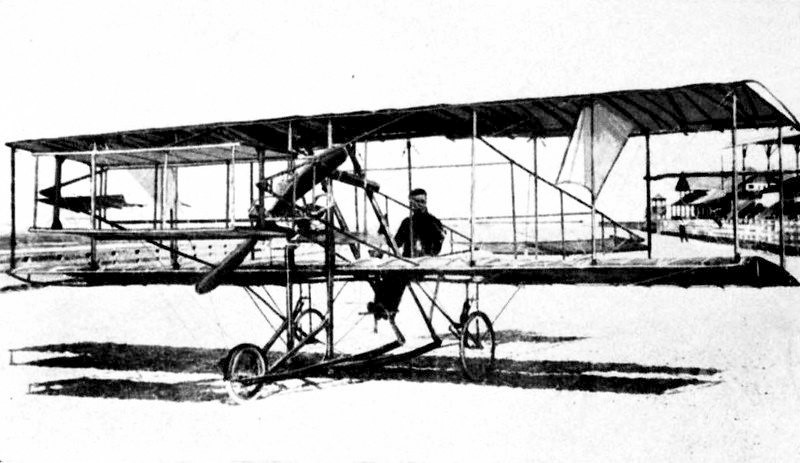
The Templeton-McMullen biplane was the first flying machine to have been built and flown in Vancouver, Canada. It was was built by William McMullen and William Templeton, assisted by Winston Templeton, brother of William . It was completed in April, 1911, and initial trials were made at Minoru Park race-track, Lulu Island. In April and May of 1911, it managed to make a few short hops – the longest being 260 feet – but it was limited by its under-powered 35 hp 3-cylinder Humber engine. The machine eventually came to grief by crashing into the railing of the race-track. It was intended to rebuild it and fit it with pontoons, but the plane was unfortunately destroyed by a factory fire.
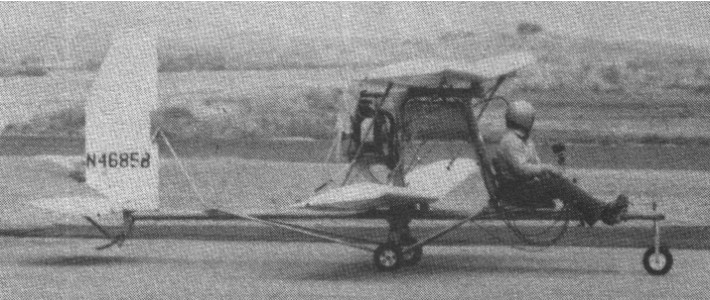
The one-dimensional fuselage structure is 6061-16 x .090 wall aluminum tubing, three inches in diameter and bolted together with gussets. “All-flying” empennage surfaces and four ailerons are conventionally controlled with yoke and rudder bar. Tricycle landing gear features a steerable nosewheel. The Onan engine swings a 46 x 26-inch pitch prop at about 3200 rpm. The wings are a modified Clark Y of fiberglass and epoxy.
In 1909 Mr. George Taylor, secretary of the Aerial League, took a biplane,18ft long, with 4ft planes, and box-kite tail balance, to Narrabeen, NSW, Australian-built glider. The trials at gliding were held, Mr. Taylor himself acting as demonstrator. The scene of the flights was at Narrabeen Heads, in the presence of about one hundred visitors, the wide stretch of sand rendering any possible fall a matter of some safety. At the beginning of the experiments the wind came from the south-east at 10 miles an hour. The machine was carried to a sand knoll, and brought face on to the wind. Messrs. Schultz, Le Clerc, and Gibbons, of Narrabeen, required all their strength to hold it down. For the preliminary flights the corners were held by guide ropes 15ft in length to prevent the machine from getting out of control before the experimentor was properly tuned to automatic balancing.
At the commencement of the latest flights the wind came from the north-east at a pace of only three knots, hardly sufficient to give the necessary lift to the machine. A few attempts were made, but they wore too short and too close to the ground. The wind, however, increased in volume, and at 6 o’clock a 15-knot breeze was coming from the north-east. As the machine was wheeled face on, it shot up with Mr. Taylor to a height of 25ft, and soared the full length of the course. The demonstrator, by means of the-elevating plane, brought the machine rather sharply to the ground at the water’s edge. Tho second flight was even more successful, the machine during its course actually poising for about 10 seconds, owing to its being tilted at an angle that for a short time allowed the wind to counterbalance the soaring tendency.
At the signal to let go the machine was well lifted by the wind, and by careful manipulation on the part of Mr. Taylor it shot towards the ocean 98 yards away in a series of curves from 3ft to 15ft above the ground, dragging its guides, who, however, pulled it to the ground at the water’s edge. Twenty-nine successful flights were made by Mr. Taylor and Mr. Hallstrom, an enthusiastic member of the Aerial League. As the afternoon wore on the flights improved on account of the wind freshening to 15 miles an hour, and coming directly from the east so much so that the last flight of the day was notable.
At “let go” the wind immediately lifted the machine to the full length of the guide ropes, and dragged the operators so fast to the ocean that two let go; the machine now soared to-wards the ocean, and at the water’s edge the remaining guide ropes were loosened, the machine making a leap upwards. Mr. Taylor by careful manoeuvring, kept the machine well under control, and dived it in the sea some little distance from the heads. The machine will be fitted with steering gear and other improvements for further flights. Mr. Taylor’s monoplane is now having its powerful engine fitted to it at Gibson and Son’s motor works at Balmain, and he hopes to have it in the air during Christmas week. If the flights are as successful as anticipated the machine will be placed at the disposal of the military authorities during the Kitchener camp and review.
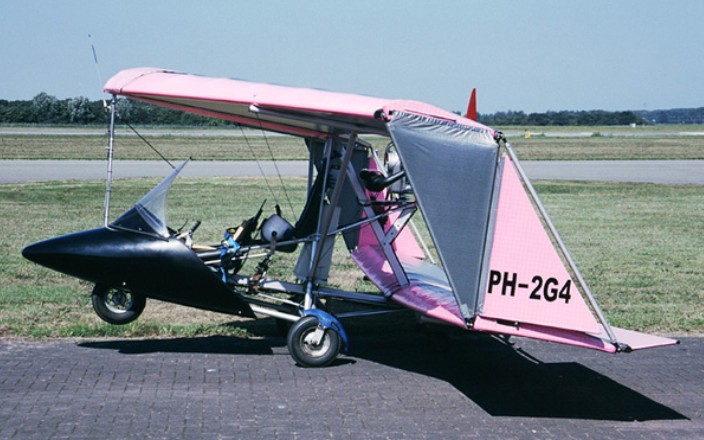
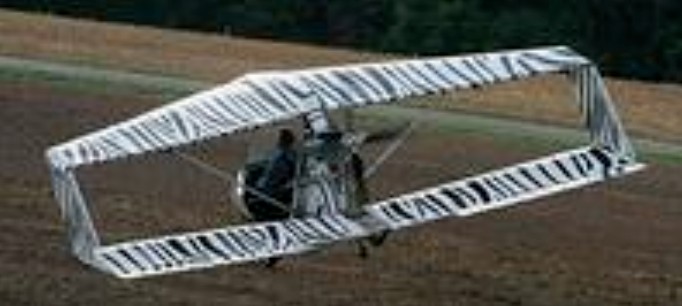
The Sunny is a tube and fabric design ultralight aircraft that was designed by Dieter Schulz. The aircraft complies with the Fédération Aéronautique Internationale microlight category rules. It features an unusual diamond-shaped biplane, strut-braced closed wing layout, a two-seats-in-tandem enclosed or open cockpit, fixed tricycle landing gear and a single engine in pusher configuration. The upper wing is swept back, while the lower wing is straight, but mounted further aft. The two wings are joined by swept tip rudders. The elevons are mounted to the lower wing only.
The aircraft is made from bolted-together aluminum tubing, with its flying surfaces covered in Dacron sailcloth. Standard engines available include many models of Hirth, Rotax, BMW and Verner 133M powerplants, ranging from 65 to 80 hp (48 to 60 kW).
A side by side trainer, production of the Sunny Sport UL-biplane was started by Dieter Schulzs company, Tandem Aircraft KG of Saulgau, Germany, in 1989. In the first year 25 Sunnies were sold, however the sale figures of the Sunny went down over the years. About 150 examples between 1989 and 1999. Finally in 1999 Tandem Aircraft KG became bankrupt.
Alexander Dewald bought the rights in 1999 and it was then produced by Dewald Leichtflugzeugbau Gmbh of Bad Schönborn, Germany and more recently by Airkraft Gmbh Leichtflugzeugbau of Beringen, Switzerland, who seem to have gone out of business in about 2011 and production ended after 250 were built.
Originally supplied ready-to-fly, later the aircraft was supplied as a kit for amateur construction or as a complete ready-to-fly-aircraft. Both the tandem-seat Sunny Sport and the side-by-side versions were produced by Dewald. Both versions feature a number of small, but significant, design changes.
The price in 2009 was €13499, and €21,000 (assembled, 2011).
Variants:
Sunny Light Version with open cockpit Engine: 1 × Rotax 582, 48 kW (64 hp) Wingspan: 7 m (23 ft 0 in) Wing area: 17 sq.m (180 sq ft) Empty weight: 220 kg (485 lb) Gross weight: 450 kg (992 lb) Fuel capacity: 44 litres (9.7 imp gal; 12 US gal) Optional fuel capacity: 80 litres (18 imp gal; 21 US gal) Maximum speed: 145 km/h (90 mph; 78 kn) Cruise speed: 100 km/h (62 mph; 54 kn) Stall speed: 55 km/h (34 mph; 30 kn) Rate of climb: 4 m/s (790 ft/min) Seats: 2
Sunny Sport Two seat tandem version with enclosed or semi-enclosed cockpit
Sunny Side-By-Side Version with side-by-side configuration seats
Sunny Targa Fully enclosed version.
Sunny Amphibian Version with amphibious floats
Engine: Rotax 582, 65 hp HP range: 50-90 Height: 6.42 ft Length: 12 ft Wing span: 23 ft Wing area: 184 sq.ft Fuel cap: 14 USG Weight empty: 396 lbs Gross: 816 lbs VNE: 76 kt / 87 mph / 140 kmh Speed max: 80 mph Cruise: 62 mph Range: 220 sm Stall: 31 mph ROC: 1180 fpm Take-off dist: 130 ft Seats: 2 Landing gear: nose wheel
Engine: Hirth 2706, 65 hp Wing span: 7 m Wing area: 17 sq.m MAUW: 450 kg Empty weight: 170 kg Fuel capacity: 50 lt Max speed: 150 kph Cruise speed: 120 kph Minimum speed: 65 kph Climb rate: 5 m/s Certification: VZ Seats: 2 Fuel consumption: 12 lt/hr Price (1998): 37,000 DM
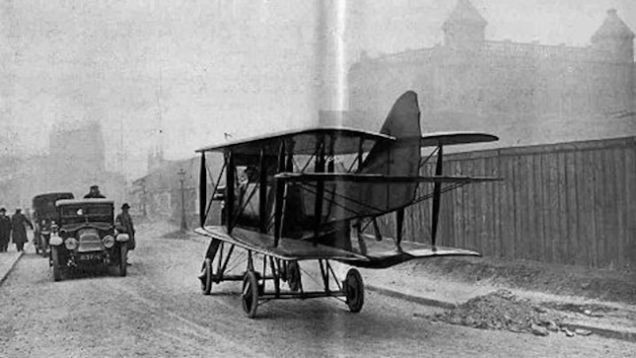
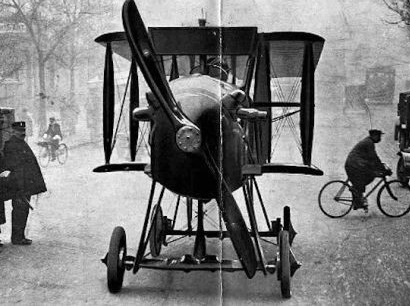
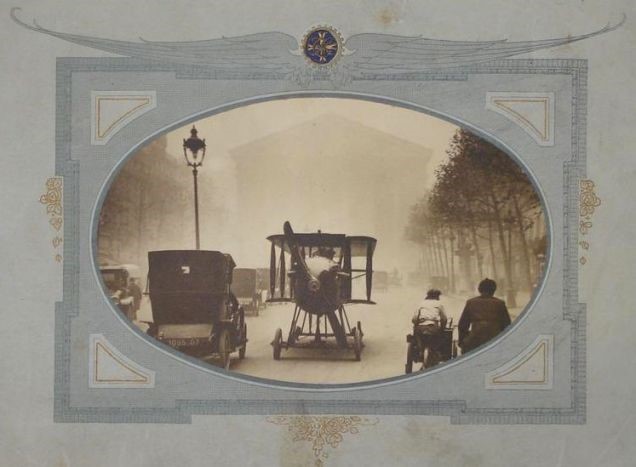
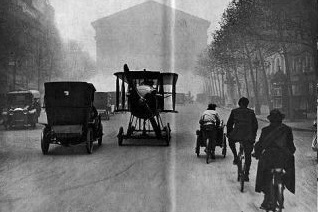
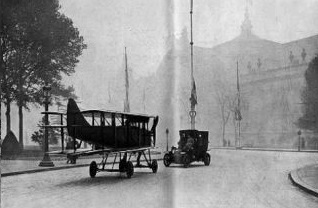
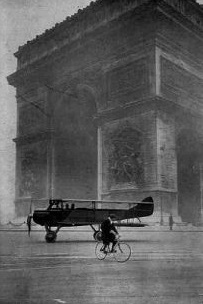
Frenchman Rene Tampier started up again after World War I and successfully built a four-wheeled bi-plane with foldable wings. Tampier first drove his Avion-Automobile in October 1921 and exhibited it at the 1921 Paris Salon, after a two-hour drive in the city. It flew two weeks later.
Tampier opted for two separate powerplants: a small four cylinder motor driving the vehicle’s rear axle, and a 300 hp Hispano Suiza V 12 aero engine to get it airborne. The biplane wings folded back alongside the fuselage for motoring. The pilot sat facing the tail when driving.
Between 1922 and 1925 Tampier built several different versions of the Avion Automobile, all of which he drove and flew, but as a vehicle it was cumbersome and awkward and the idea was never adopted commercially.
In 1928, the National Aviation Shops produced two sesquiplanes to the designs of Brig Gen Juan F Azcarate, who had assumed command of Mexican Army Aviation, these, the Azearate OE 1 light bomber and recon-naissance aircraft and the Azearate E trainer, both entering limited production at Balbuena, three of the former and 10 of the latter being built in 1929.
The National Aviation Shops, direction of which had been taken over by Angel Lascurain y Osio, continued to produce small series of aeroplanes of indigenous design, among which was the Toloche parasol fighter monoplane powered by a Gnome rotary, the Quetzalcoatl with a BMW engine, the Mexico parasol trainer and the Sonora low wing training monoplane. The Avro 504K Mk II trainer was built in series as the Anahuac. More than 50 Anahuac trainers were manufactured by the Balbuena factory, these remaining the principal equipment of the Military Aviation School until 1930.
The Serie A aircraft were followed from the National Aviation Shops by the improved Serie B, the single seat Serie C Microplano with an Hispano Suiza engine and the two seat Serie H parasol.
As a result of the revolution that ensued with the fall of the Carranza regime, the Mexican Army’s air component found itself reduced to a dozen airworthy aircraft in September 1920.

 All Aero