Thornhill TS 1

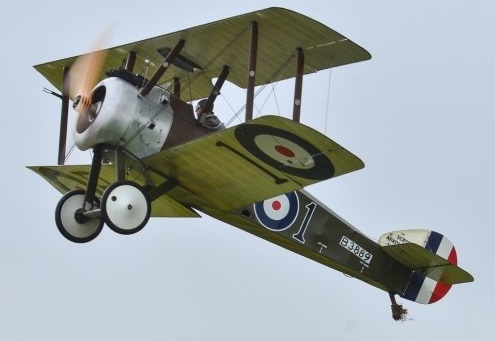
An authentic full-scale Sopwith Camel replica constructed by Gerald Thornhill of Hampshire, Illinois, USA, assembled in June 1985. A full size reproduction utilising a number of original parts including the engine.

It was imported to New Zealand in 1997 as ZK-JMU by film maker Peter Jackson and features a number of original components, including a 160 hp Gnome rotary engine, wicker seat and instruments.
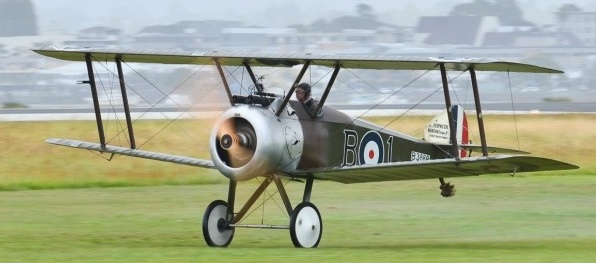
The aircraft is painted as B3889 (coded B1) as used by Blenheim-born Capt Clive Collett of 70 Squadron RFC. This was the second of four Camels in which Collett was successful in combat and he achieved five of his twelve aerial victories flying it between August 13 and 25, 1918.

This Camel made its public debut at the Classic Fighters Air Show at Omaka during Easter 2001 where it spectacularly shed its cowling in mid-display. Flown by American pilot Gene de Marco saw it successfully return to earth.

Engine: Le Rhone rotary, 160 hp
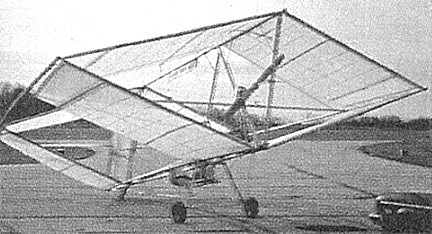
Thompson Aircraft Co Boxmoth

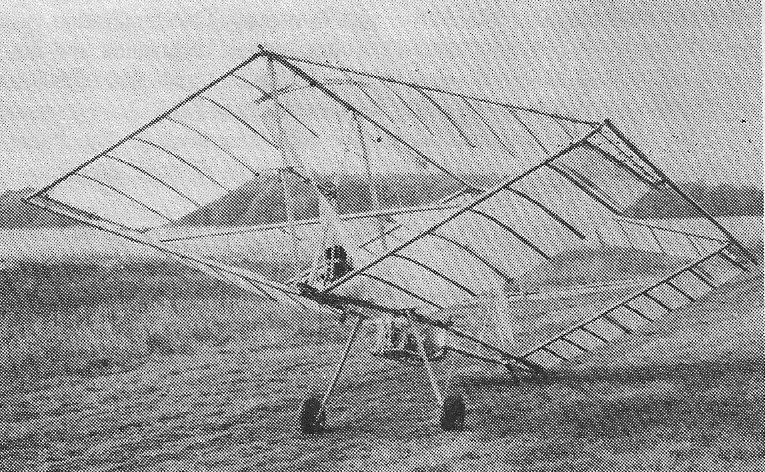
Thompson expanded his experiment in powering a boxkite with a model airplane engine into full-size reality with twin vinyl-covered aluminum-tube frames and a 55hp snowmobile motor and a prop in 1972. A two-place tandem “flying box-kite” a test pilot, reported in his own words, “Great stability. I was 35 feet off the ground before I realized I had taken off!”

FAA registration N64492 was issued on 30 March 1973, seen as still valid in mid-2007. Marketed plans for $75.

Thomas-Morse TM-24

Thomas-Morse TM-24

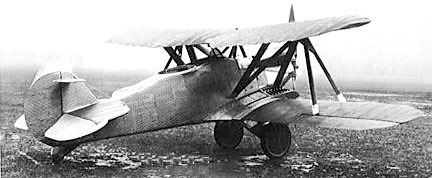
The Thomas-Morse TM-24 of 1924 was an all-metal, corrugated-skin pursuit improvement over the TM-23, but still had enough design problems to result in rejection by the Army after McCook Field tests (as P-380).

With bridge-truss struts and biplane tail, the sole example built was dismantled and stored away.

Engine: 440hp Curtiss D-12
Wingspan: (upper) 25’0″ (lower) 30’1″
Length: 20’5″
Useful load: 1500 lb
Max speed: 143
Cruise speed: 114 mph
Stall: 63 mph
Wing chord: 63″ upper, 52″ lower
Seats: 2

Thomas-Morse TM-23

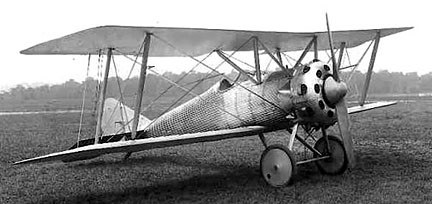
The one Thomas-Morse M-23 built, in 1923, for Army evaluation was a single place open cockpit biplane. All-metal, corrugated-skin pursuit design, it had inherent design and cooling problems despite several modifications. It was evaluated at McCook Field but rejected for its flight characteristics and high landing speed. It was dismantled in 1926.

Engine: Curtiss D-12, 440 hp
Wingspan: 19’6″ (later 23’0″)
Length: 16’8″ (later 17’6″)
Useful load: 788 lb
Max speed: 167 mph
Cruise speed 125 mph
Stall: 80 mph
Range: 280 mi
Ceiling: 20,150′
Seats: 1

Thomas-Morse SH-4

The 1915 Thomas-Morse SH-4 was a USN float version of the Thomas T-2 with a single main pontoon and wingtip floats, larger tail, three-bay wings, and various engines including the Curtiss OX-5 and Hisso A.

The first design for Thomas-Morse by B D Thomas, it incorporated much of the same look as his Curtiss J, and sold for $7,575.

Fifteen were built; A134 to 136, and A395 to 406.

Wingspan: 44’0″
Length: 29’9″
Useful load: 897 lb
Speed: 83 mph

Thomas-Morse S-9

The 1923 Thomas-Morse S-9 Army trainer was a widened side-by-side cockpit in an all-metal corrugated fuselage, with wings from S-6 and tail from S-4C.

Only one was built but during Army flight tests at Kelly Field TX, it showed structural problems and the pilot bailed out; however, the plane reportedly glided to an “almost-successful landing” except for losing its wings when it went between two trees. It was sent back to Thomas-Morse, but never repaired.

Engine: 200hp Lawrance J-1
Max speed: 140 mph
Stall: 40 mph
Seats: 2