In 1929, as White 25, with a 25hp Henderson De Luxe engine, was built by L J White, Pasadena CA. USA.
Not even the “De Luxe” addition helped very much. The aircraft would hardly fly.
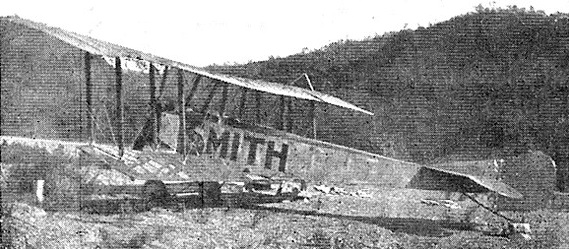
Elmer L Smith bought it, increased the span of the upper wing, mounted the more powerful engine and flew it successfully as N10684.
After WW2 it was acquired by Hobart Sorrell in Rochester WA, who refitted a 65hp Continental, reregistered it as N4940V, and renamed it Peer Gynt. It was active at least into the 1970s.
White 25 Engine: 25hp Henderson De Luxe Wingspan: 22’5″ Length: 15’6″ Seats: 1
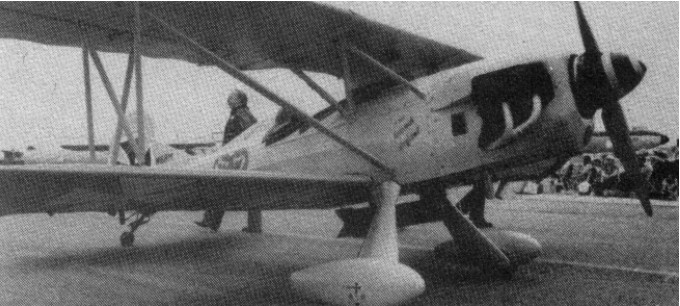
Designed by Lou Stolp & Marshall White, though modeled after World War I fighters, the Der Jager is not a replica. Its builder, Marshall White, patterned the wing shape after that of the German Albatross, the tail assembly after that of the Fokker D-7 and the gear after that of the Focke-Wulf “Strosser”. The frameworks of the fuselage and the tail group are of welded steel tube, fabric covered. The wings are wood with no flaps. The pro¬totype was fitted with a 115-hp Lycoming, but the airplane is so light that anything down to the Volkswagen 1600 engine will fly it nicely.
The prototype, N3610, first flew on 7 September 1968.
Engine: Lycoming O-235-C1, 115hp Wingspan (upper): 20 ft 0 in Wingspan (lower): 16 ft 0 in Length: 17 ft Gross Wt: 888 lb Empty Wt: 534 lb Fuel capacity: 24 USG Top speed: 145 mph Cruise: 133 mph Stall: 54 mph Climb rate: 2000 fpm Takeoff run: 175 ft Landing roll: 250 ft Range: 532 mi Seats: 1
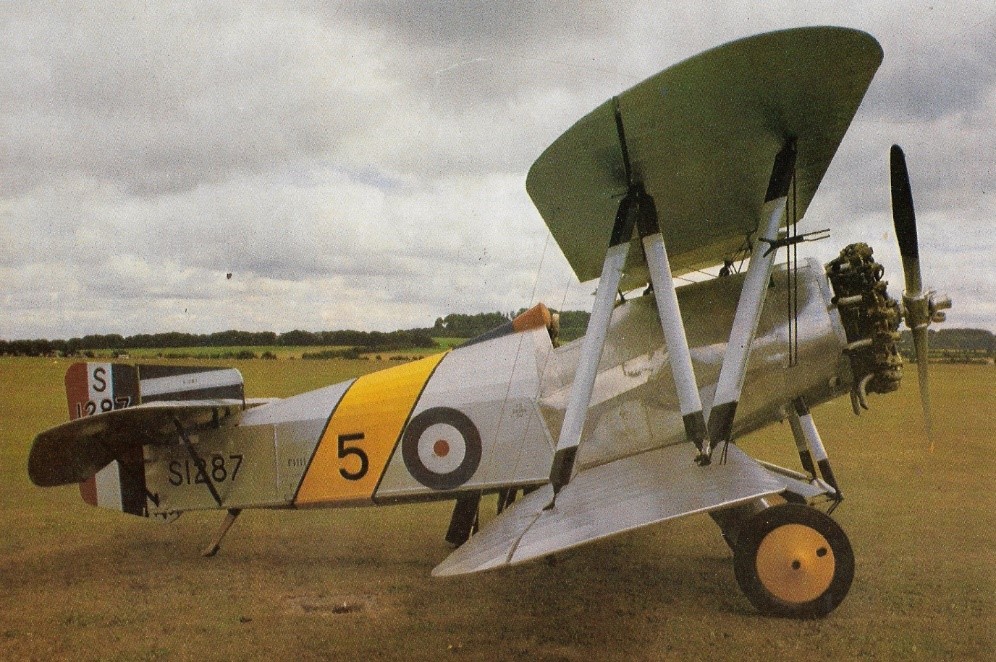
In January 1977 construction of Fairey Flycatcher replica S1287 was started by Robinson Aircraft at Blackbushe, later transferred to Rod Bellamy, whereas the CAA Aircraft Register states Westward Airways, Lands End, England as the manufacturer
On 17 July 1977 it was registered as G-BEYB to John Fairey, and powered by a Pratt & Whitney R-985-AN-14B engine, making its first flight, at Middle Wallop, on 23 July 1979. The first public display was at the Middle Wallop Air Show on 28 July 1979.
It was damaged following a take-off accident on 4 October 1980, flying again following repair on 23 July 1981.
On 01 September 1995 it was flown to Lee-on-Solent for a static role at the Fleet Air Arm Officers Association reunion, the last public function before sale to FAAM.
On 05 June 1996 it was flown to RNAS Yeovilton by John Fairey and put into 12 hanger (FSAIU).
In July 1996 it moved into the FAAM and onto public display.
By 2012 it was in the Reserve Collection at Cobham Hall Store.
Built by Gordon W. Westphal, the Rose Parakeet replica N16N sn GW-100 was first registered on 23 February 1976. Classified as an amateur built experimental, it was powered by a Lycoming O-290 engine.
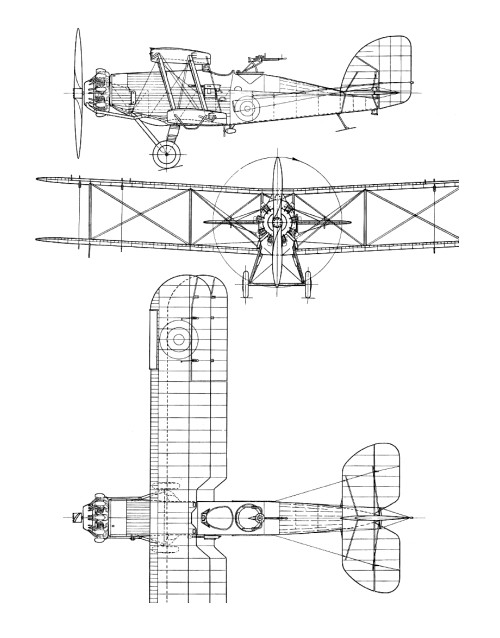
The Wapiti was a two-seat general-purpose biplane incorporating in its design several de Havilland D.H.9A component parts including wings as requested by the Air Ministry. The prototype first flew in March 1927 and the initial order for 25 production Mk I included one specially modified aircraft with a more luxurious rear cockpit for the Prince of Wales to fly in.
Mk I were powered by 313kW Bristol Jupiter VI engines, but subsequent Mk II and Mk IIA had 343kW Jupiter VI and 391.2kW Jupiter VIIIF or similar engines respectively.
The Mk.II switched to metal construction.
Small numbers of lengthened Wapiti V and unarmed Mk VI trainers brought total production for the RAF to 501; while the type was also adopted by Australia, South Africa (also built under licence), Canada, India and China.
An initial order for 38 for the RAAF was placed in October 1928 to replace DH.9s and DH.9As. These were delivered between April 1929 and March 1931. A further six ex-RAF Wapitis were purchased in 1937.
RAAF Wapiti
Wapiti Mk I Engine: 313kW Bristol Jupiter VI
Wapiti Mk II Engine: 343kW / 460 hp Jupiter VI
Wapiti Mk IIA Engine: 391.2kW Jupiter VIIIF Wingspan: 14.15 m / 46 ft 5 in Length: 9.65 m / 32 ft 8 in Height: 3.61 m / 12 ft 10 in Wing area: 43.48 sq.m / 468.01 sq ft Max take-off weight: 2449 kg / 5399 lb Empty weight: 1728 kg / 3810 lb Max. speed: 225 km/h / 140 mph Cruising speed: 96 kts / 177 km/h Service ceiling: 20600 ft / 6280 m Range: 853 km / 530 miles Armament: 2 x .303in / 7.7mm machine-guns Bombload: 263kg
Specification 4/24 issued by the Air Ministry during 1924 called for the design of a heavily armed, twin-engined, night defence fighter, although the precise nature of the planned armament was not made known to the two companies that successfully tendered for prototype contracts, Westland and Bristol (with the Bagshot). Two prototypes of the Westland submission were ordered in 1925, and only late in that year was the armament specified as two 37mm Coventry Ordnance Works (COW) cannon, to be disposed in front and dorsal positions, plus a 7.7mm Lewis gun firing through a ventral hatch in the rear fuselage. Powered by a pair of uncowled 450hp Bristol Jupiter VI nine-cylinder radial engines, the Westbury – as the Westland fighter was duly named – was a three-bay biplane of mixed construction, combining a wooden wing with a fuselage of composite steel and wood, duralumin wing spars being introduced in the second prototype. Open cockpits were provided for the two gunners and the pilot, who was located ahead of the upper wing, which attached directly to the deep fuselage. The nose COW gun was on a rotating mounting, and that in the aft cockpit fired forwards and upwards (aimed by the pilot). A second cockpit, to the rear, carried a 7.7mm Lewis gun on a Scarff ring, and the rear gunner also had the use of a second Lewis gun fired downwards through the entrance hatch. Flight testing of the Westbury began in September 1926, and the COW gun was successfully fired from both cockpits during later trials with the second aircraft, but no requirement was found for production of this category of fighter. The second prototype, as the Westbury II, was fitted with 480hp Jupiter VIII engines and had a rounded, rather than blunt, nose profile and aft-extended nacelle tails, features that were also introduced later on the first aircraft.
Max take-off weight: 3573 kg / 7877 lb Empty weight: 2198 kg / 4846 lb Wingspan: 20.73 m / 68 ft 0 in Length: 13.23 m / 43 ft 5 in Height: 4.19 m / 14 ft 9 in Wing area: 79.89 sq.m / 859.93 sq ft Max. speed: 201 km/h / 125 mph Ceiling: 6400 m / 21000 ft







 All Aero