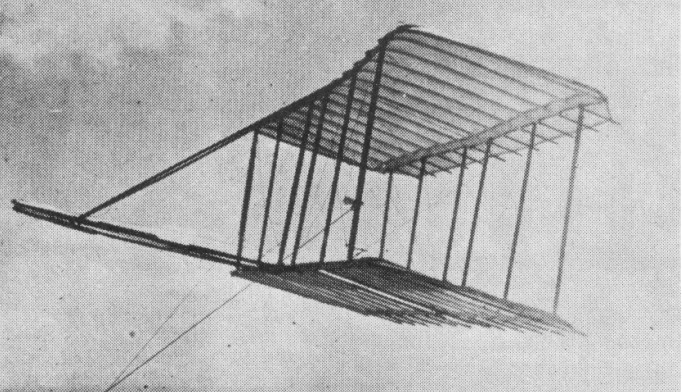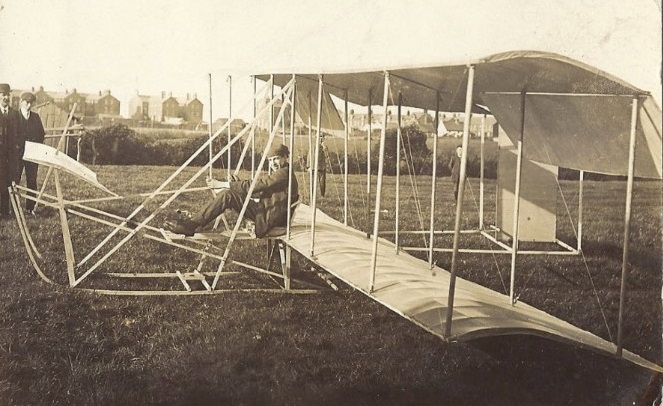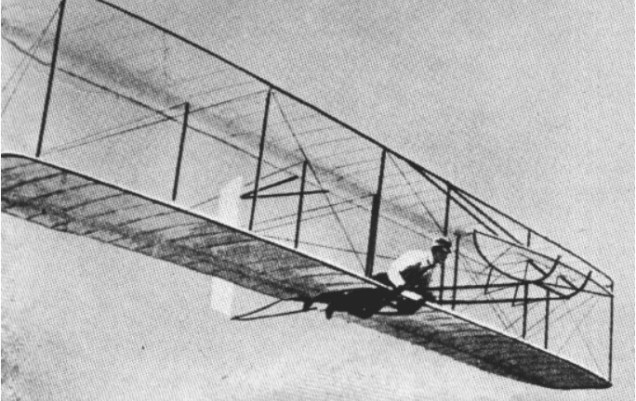
Wright 1902 Glider 3 / Dart Aircraft Wright 1902 Glider

In the summer of 1902 the Wright brothers journeyed back to Kitty Hawk, this time with a huge machine that measured 32 feet in span and 303 square feet in wing area. Besides the warp and the front elevator, the new glider also sported fixed rear fins. Now they made good glides – some of over 500 feet – but were plagued by an odd tendency: about one time in 50, the airplane would turn up sideways and slide to the ground, despite full warp to lift the dropped wing. The Wrights called this “well-digging”; they had discovered the incipient spin. The solution was to install a movable tail fin, linked to work in opposition to the warp mechanism to correct the warp drag that corresponds to aileron drag in our modern airplanes. Thus they had achieved three-axis aerodynamic control. By the time of their return to Dayton that winter, they had made several hundred glides, at least one of more than 600 feet and nearly half a minute’s endurance.
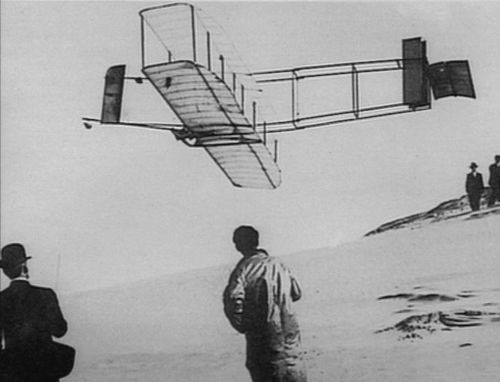
The initial twin fixed fins were later replaced with a single rudder linked to the wing warping – the Glider 3B.
The Wrights made almost a thousand glides with this third biplane. They flew for up to 26 seconds and for distances of up to 622 feet-for a total airborne gliding time for that year of nearly five hours. They had begun to solve the problems of control in the air and to establish a definitive design.
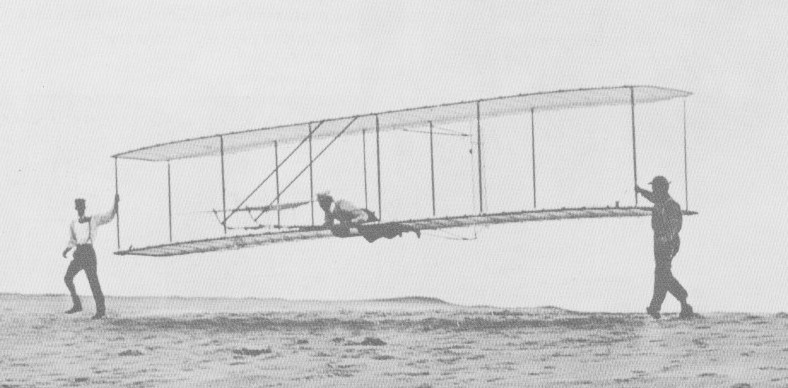
While making preparations to test the 1903 powered aircraft, they continued to practice piloting with their 1902 glider and to establish new endurance records of more than one minute.
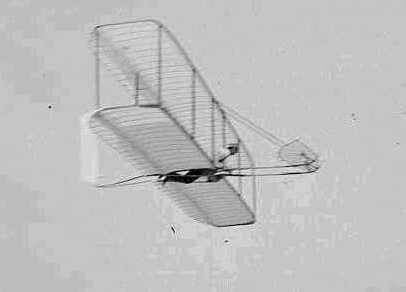
And from that 1902 glider came the first powered “Flyer” of 1903.
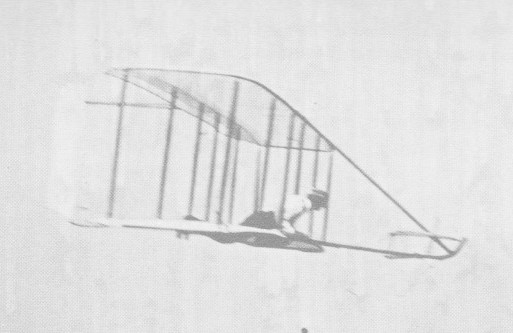
For Alexanda Korda’s film production, Conquest of the Air, Dart Aircraft produced a replica Wright 1902 biplane glider in 1935. The first tests were at Denham during that summer. Weyl flew the aircraft and reported that the controls worked well, though they lacked feel. It was only possible to fly the glide in a straight line owing to the interconnection between the wing warping and the rudder. The rudder was not a control but was used to counteract the yawing moment due to wing warping. Wingtip skids were fitted during the trials and normal turnbuckles were later adopted. In the end the film was never completed.

Glider 3
Wing span: 32 ft 1 in
Wing area: 305 sq.ft
Flying wt approx: 260 lb
No. of flights approx: 1000+
Total flying time approx: 4 hr

Glider 3B
Wing span: 32 ft 1 in
Wing area: 305 sq.ft
Flying wt approx: 280 lb
No. of flights approx: 60
Total flying time approx: 34 min

Wright 1901 Glider 2

In 1901, the Wright brothers began a program of research, testing wing forms by mounting them on a spar projecting ahead of a bicycle; they also assessed them in homemade wind tunnels, their first was constructed from an old starch box. Soon it became obvious that almost all the published information on aerodynamics, and particularly the tables of force measurements, were simply wrong. They re-turned to Kitty Hawk with a still-bigger glider, its wing-warping controlled by the prone pilot rocking his hips in a body cradle, and achieved a glide they measured at 389 feet.
The second manned glider, of 1901, larger and heavier was rather less successful, chiefly because it was “less manageable than our smaller machine of last year … the trouble seems in the travel of the centre of pressure”. It had no tail surfaces. But the 1901 machine was generally un-manageable, and the lift of its wing less than the previous glider’s.

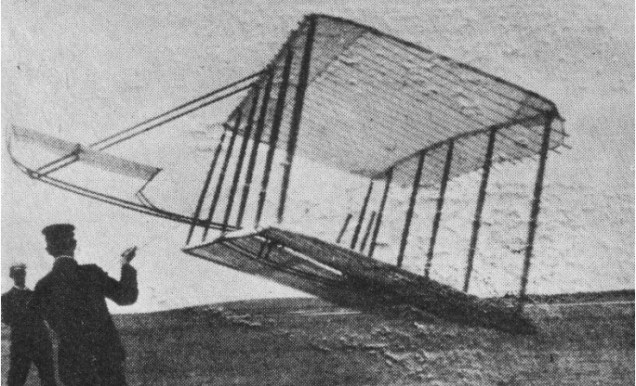
Wilbur just after landing the 1901 glider. Kitty Hawk, North Carolina.

Wing span: 22 ft 0 in
Wing area: 290 sq.ft
Flying wt approx: 243 lb
No of flights approx: 60
Total flying time approx: 2 min

Wright 1900 Glider 1

The first model was flown as a kite and led to the development from it of their first full-scale glider of October 1900, with a span of 17ft 5in. It, too, was first flown as a kite at Kitty Hawk in October 1900, and, then, for twelve manned glides for a total duration of two minutes.

The glider embodyed wing-warping and a movable front elevator but with no vertical stabilizer. They chose the Carolina coastal sandhills, far indeed from Dayton, as a testing ground, thinking that the strong prevailing winds, even slopes and soft sand in which to fall might make an ideal place to learn about flying. Kill Devil Hills was the spot selected, near the Kitty Hawk telegraph station.

Like all their early machines, their first glider was unstable – a fundamentally different approach from that of earlier experimenters. They flew it mostly as a kite but also made a handful of free glides, some with one of them aboard, lying on the lower wing.

Wing span: 15 ft 5 in
Wing area: 165 sq.ft
Flying wt approx: 197 lb
Total flying time approx: 2 min

Woodson Transport 4-B

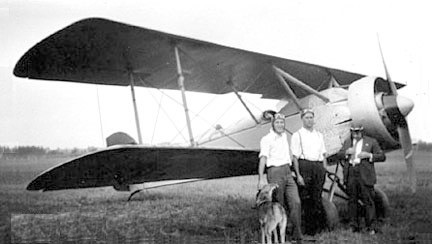
The Woodson Aircraft Corp Transport 4-B of circa 1927 was a 5-7 place open cockpit biplane featuring DH-4 wings. It was advertised as not a regular production airplane, available only on special order, for $2,000. One is known to have been built.

Engine: Salmson 2A, 230 hp
Wingspan (upper): 39’0″
Wingspan (lower): 42’6″
Length: 28’6″
Useful load: 1620 lb
Max speed: 110 mph
Cruise speed: 92 mph
Stall: 32 mph
Range: 450 mi

Woodson Sport 3-A

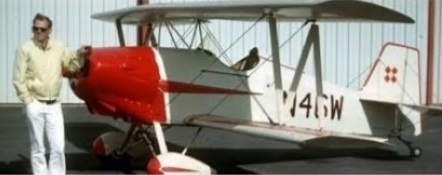
The 1926 Woodson Sport 3-A was an evolution of the Express 2-A. Selling for around $4,000, an unknown number were built with various engines. An unknown number were built, but included N7153 c/n 14 and N11193 c/n 141.

Engine: Wright, 200 hp
Wingspan: 32’1″
Length: 25’0″
Useful load: 1400 lb
Max speed: 135 mph
Stall: 45 mph
Seats: 5

Engine: Salmson 2A, 230 hp
Wingspan: 32’1″
Length: 25’0″
Seats: 5

Engine: Hisso A, 150 hp
Wingspan: 32’1″
Length: 25’0″
Max speed: 118 mph
Seats: 5

Engine: Hisso E, 180 hp
Wingspan: 32’1″
Length: 25’0″
Max speed: 122 mph
Seats: 5

Woodson Express 2-A / Express 3-A

Woodson 2-A

The 1925 Express 2-A and 3-A had plywood veneer-covered fuselage and sold for $3,500.Five or six were built as mail and cargo carriers (N2593, N2647, N5859, and other), plus an unknown number of sport versions, including N3181-N391V, N4313, and N491M.

Express 2-A, 3-A
Engine: Salmson 2A-2, 260 hp
Wingspan: 32’1″
Length: 25’0″
Useful load: 600-1195 lb
Max speed: 138 mph
Stall: 40 mph
Seats: 1-3