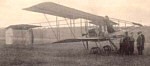
Circa 1911 Florentin Champel designed and built a biplane in France.
Circa 1911 Florentin Champel designed and built a biplane in France.
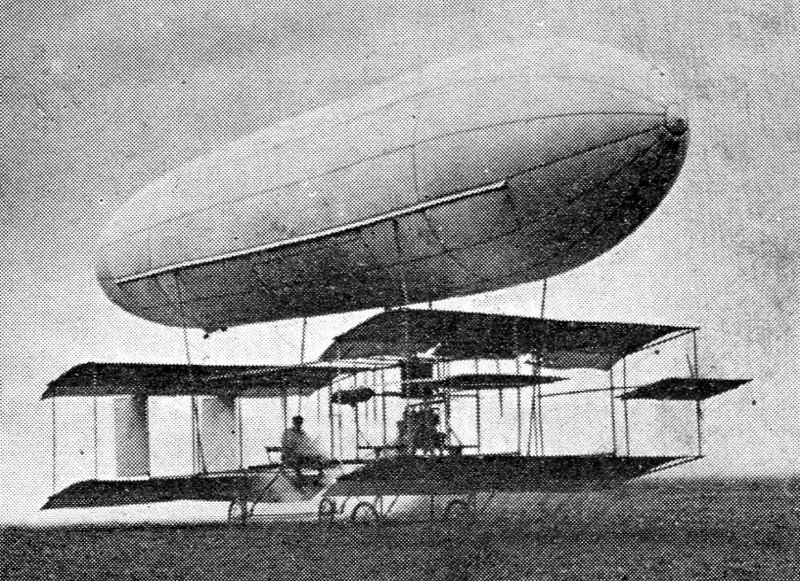
This tandem biplane design of central pusher configuration is attributed to Léopold César, but was a modification of a 1909 design of Eugène Boutaric. The Boutaric design had the same construction, but used a 25 hp Anzani which drove two propellers via chains. The propellers were placed just behind the front biplane wing in tractor configuration. There are no reports that the César tandem-wing machine left the ground, not even when fitted with a balloon on struts above it. Wing span was only six metres. It had a 50 hp Prini-Berthaud engine, mounted quite some way behind the front biplane wings on the connecting structure between the wing cells.
The Centaur Ha (C.F.2A) was a twin-engined commercial transport biplane with Beardmore engines. Two were built, equipped with seats for six/seven passengers or to carry half a ton of mail or freight.
A small biplane trainers designed by J. S. Fletcher, the company manager. Original designations were CF, later changed to Centaur.
The 1909 Cazalot et Prevot biplane was designed and built by Cazalot and Prevot in France.
The 1910 Caux et Camboulive biplane was designed and built by Caux and Camboulive in France.
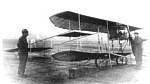
The 1910 Caudron tractor biplane Type A2-6 was designed and built by Rene Caudron in France.
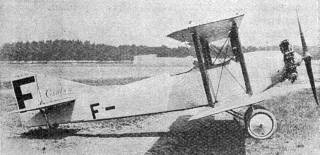
The Caudron C.161 was a lightweight French two-seat biplane designed by Caudron for sport or flight training use. A conventional biplane with a square fuselage powered by a 65 hp Salmson radial engine. It had two cockpits in tandem with dual controls in both, when not used as a trainer the controls could be removed from the rear cockpit.
A variant, the C.168, with a more powerful 70 hp Anzani radial engine was also available.
C.168
Engine: 1 × Anzani 6-cyl, 52 kW 70 hp
Wingspan: 9 m / 29 ft 6 in
Wing area: 20 sq.m / 220 sq ft
Length: 6.13 m / 20 ft 1 in
Height: 2.42 m / 7 ft 11 in
Empty weight: 342 kg / 754 lb
Gross weight: 572 kg / 1.261 lb
Power / mass: 0.0912 kW / kg / 0.0555 hp / lb
Wing loading: 28.6 kg / sq.m / 5.9 lb / sq ft
Maximum speed: 150 km / h / 93 mph / 81 kn
Crew: 2
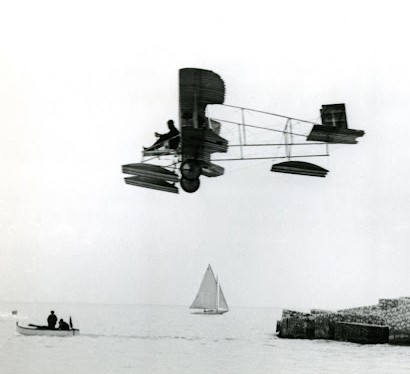
The Caudron pusher seaplane entered in the 1912 Monaco seaplane meeting featured three, big, flat-bottomed Fabre floats fitted in front of the wheels and one under the tail, a 60 hp six-cylinder Anzani engine. The pilot sat on a forward outrigger. In France it was referred to as a true “aero-amphibian” by virtue of its combined wheel-and-float undercarriage, because it could take off from and land on both land and water.
Span: 34’9″
Wing area: 35 sq.m
Length: 23’9″
Weight: 380 kg
Speed: 52 mph
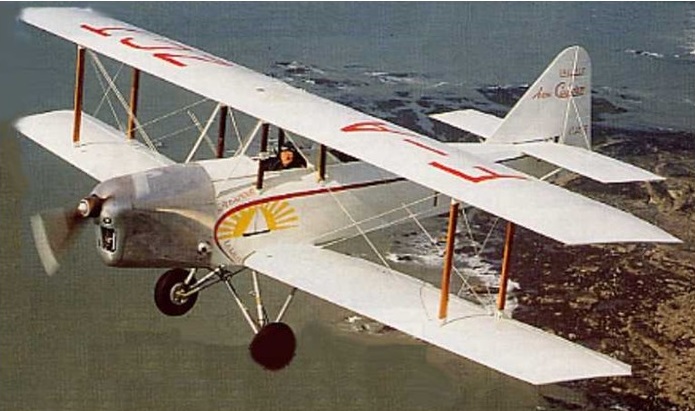
Designed by Paul Deville, the Caudron C.270 Luciole (“Firefly”) was a sporting, touring and trainer aircraft derived from the C.230.
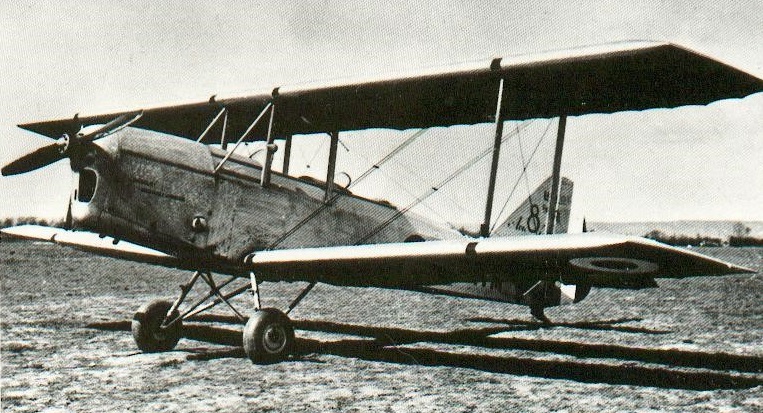
It was a conventional biplane with single-bay, unstaggered wings of equal span. The pilot and a single passenger sat in tandem open cockpits. It featured a fabric-covered fuselage in place of the C.230’s wooden one, and other refinements including revised control surfaces and undercarriage, and an improved and simplified wing-folding mechanism.
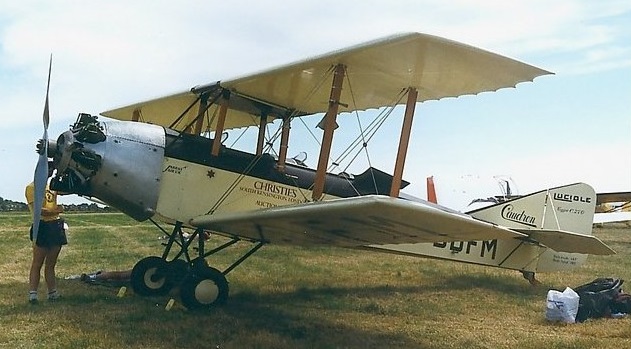
Over 700 were built in the decade leading up to World War II. Of these, 296 were purchased by the French government for its pilot training programme, the Aviation Populaire. Some were operated by the Spanish Republican Air Force. Many examples saw wartime service as liaison aircraft, and those surviving the conflict saw postwar use as glider tugs in the Ecole de l’Air.
Variants:
C.270 – first production version with Salmson 7Ac radial engine (82 built)
C.270/1 – version with Salmson 7Ac2 engine
C.271 – version with Lorraine 5Pc engine (1 built)
C.271/2 – version with Lorraine 5Pb engine
C.272 – version with Renault 4Pb inline engine (52 built)
C.272/2 – version with Renault 4Pci engine and taller, more pointed tail fin (22 built)
C.272/3 – version with Renault 4Pdi engine and wheel brakes (15 built)
C.272/4 – version with Renault 4Pei engine and wheel brakes (21 built)
C.272/5 – version with Renault 4Pgi engine(80 built)
C.273 – version with Michel 4A-14 engine (14 built)
C.274 – version with Chaise 4Ba engine for 1932 Paris Salon de l’Aéronautique (1 built)
C.275 – main production version derived from C.272/5 but without wing folding (433 built)
C.276 – version with de Havilland Gipsy III engine
C.276H – version with Hirth HM 504A-2 engine (2 re-engined from C.276)
C.277 – similar to C.272/4 with non-folding wings (9 built)
C.272R – C.275 re-engined with Renault 4Po3 after the war (1 converted)
C.278 – version with new undercarriage and Salmson 9Nc engine to compete in Challenge 1932 (1 built)
Specifications:
C.272
Engine: 1 × Renault 4Pb, 71 kW (95 hp)
Length: 7.67 m (25 ft 2 in)
Wingspan: 9.90 m (32 ft 5 in)
Height: 2.76 m (9 ft 1 in)
Wing area: 24.0 m2 (258 ft2)
Empty weight: 516 kg (1,138 lb)
Gross weight: 780 kg (1,720 lb)
Maximum speed: 158 km/h (98 mph)
Range: 500 km (311 miles)
Service ceiling: 4,000 m (13,120 ft)
Crew: One pilot
Capacity: 1 passenger
C.277 Luciole
Engine: Renault 4 Pei, 140 hp
Wing span: 32 ft 5.5 in
Wing area: 248.2 sq.ft
Length: 25 ft 2 in
Height: 9 ft
Empty weight: 1067 lb
Loaded weight: 1848 lb
Max speed: 107 mph / 93 mph at 3280 ft
Range: 388 mi
 All Aero