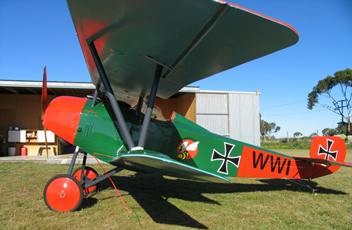
A variation of the Graham Lee designed 7/8 scale copy of the 1916 French Nieport 11 is the German copy by Seimens Schukert featuring lowered top wing and four point carbane struts. Rotax 503 powered
Gas powered Spandau MG adds to fun flying.
A variation of the Graham Lee designed 7/8 scale copy of the 1916 French Nieport 11 is the German copy by Seimens Schukert featuring lowered top wing and four point carbane struts. Rotax 503 powered
Gas powered Spandau MG adds to fun flying.
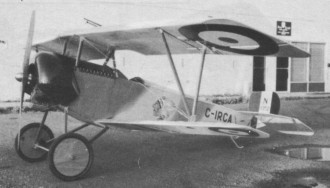
An 87% scale replica first displayed at Oshkosh in 1984 after a hurried 10 hours of serious test flying before being loaded on a trailer for the trip. Construction drawings includes more than 100 pages of dimensional drawings, assembly sketches and construction notes, in 9 x 12 format The Baby Nieuport is an outwardly accurate reproduction with handling characteristics much like the original World War I fighter. Special construc¬tion techniques make the best use of aluminum tube and sheet for a light, robust structure, capable of meeting ultralight or amateur-built criteria, powered by either a Rotax 447 or 50 hp Rotax 503. With more than 100 pages of dimensional drawings, assembly sketches and construction notes, Circa claim that the aircraft, built from alloy tube and sheet, can be put together in around 500 hours. Tubes 6061-T6 Gussets / fittings 2024 – T3
Loops, spins, Split S and a 7000ft power dive were performed on C-IRCA but aerobatics are NOT recommended.
A CIRCA Reproduction Nieuport 11/17 features 6061 tube, pop rivet construction. Average cost in 2008 was $6,000.00.
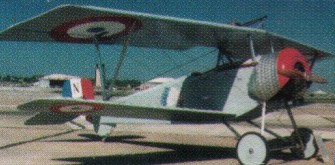
Engine: 1835cc VW 60HP
Span: 21’5″
Length: 16’5″
Empty Weight: 300 LBS
Useful Load: 300 LBS
Wing Area: 114 SQ. FT.
Seats: 1
Take Off Distance: 250 FT
Stall: 33 MPH
Cruise: 60 MPH
Rate Of Climb: 650 FPM
Nieuport 11 EXP
Engine: Rotax 503, 46 hp.
HP range: 22-50.
Reduction 258:1
Propeller (flight) 72×33
Height: 7.5 ft.
Length: 16.5 ft.
Wing span upper: 21.5 ft.
Wing span lower: 20.2 ft
Wing area: 114 sq.ft.
Chord Main Wing 3.6 ft
Chord Sub Wing 2 ft
Span Elevator 8.2 ft
Weight empty 254 to 300 lbs
Fuel Capacity 5 to 12 Gal US.
Gross: 675 lbs.
Top Speed 85 MPH
Never Exceed (Vne) 95 MPH
Cruise: 80 mph.
Range: 200 sm.
Stall: 32 mph.
ROC: 850 fpm.
Take-off dist: 125 ft.
Landing dist: 250 ft.
Service ceiling: 10,000 ft.
Seats: 1.
Landing gear: tail wheel.
Take off run 250 ft
Landing Roll 225 ft
G Factor (@ 550 lbs) +6/ – 2.8
Nieuport 11 UL
Engine: Rotax 447, 40 hp.
HP range: 22-40.
Speed max: 77 mph.
Cruise: 64 mph.
Range: 75 sm.
Stall: 27 mph.
ROC: 650 fpm.
Take-off dist: 200 ft.
Landing dist: 250 ft.
Service ceiling: 10,000 ft.
Fuel cap: 5 USG.
Weight empty: 250 lbs.
Gross: 550 lbs.
Height: 75 ft.
Length: 16 ft.
Wing span: 21.5 ft.
Wing area: 114 sq.ft.
Seats: 1.
Landing gear: tail wheel.
Engine: Rotax 503, 48 hp
Wing span: 7.16 m
Wing area: 11.6 sq.m
MAUW: 272 kg
Empty weight: 125 kg
Fuel capacity: 50 lt
Max speed: 135 kph
Cruise speed: 115 kph
Minimum speed: 48 kph
Climb rate: 3 m/s
Seats: 1
Plan price (1998): $139
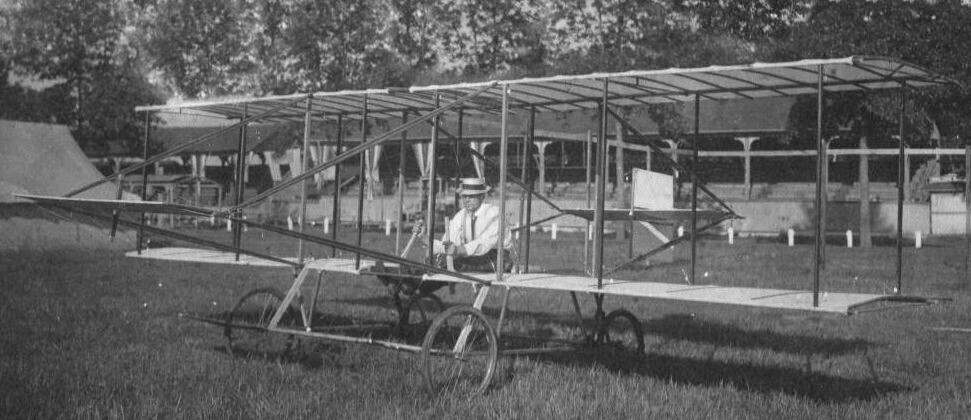
Daniel A. Kreamer was a railroad engineer from Freeport, Illinois. In 1910 he bought a glider from the Church Aeroplane Co. of Brooklyn, NY, in which he made some very successful flights, towed by an automobile and cutting loose when 75 or 80 feet high and gliding several hundred feet to the ground. He apparently considered installing an engine in the glider, but instead bought a Curtiss-type biplane built by Everette K. Barnes and Harold H. Havens of Rockford, IL. Kreamer lost his life at the Chicago Aero Club’s field on July 13th, 1911, when he lost control during a turn while trying for his pilot’s license.
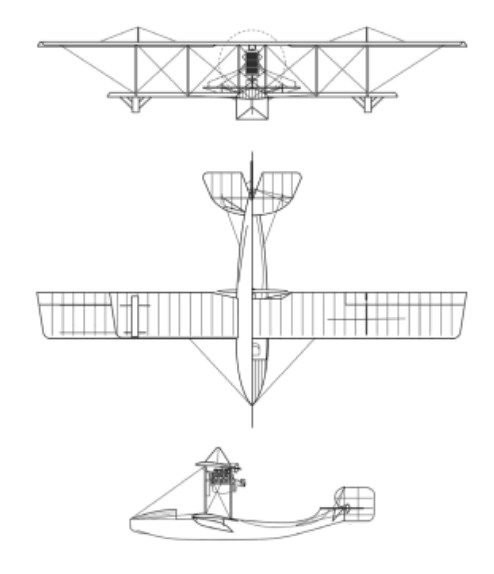
The Hydro flying boat built by Christofferson Aviation flew in 1913, and was probably designed by Alan Loughead who worked for Christofferson at the time.
A two-bay biplane, of the three or four examples known to have been completed in 1914, two were sold to explorer Roald Amundsen for a proposed Arctic flight (that never happened), and one was used by Silas Christofferson’s San Francisco-Oakland Aerial ferry in 1914. This was the second scheduled airline to operate in the US.
Another Hydro is listed as having been sold to Japan.
Engine: Hall-Scott V-8, 120 hp
Span: upper: 49′ lower 33’6″
Length: 28′
The Jaguar began in 1969 as a biplane class racing aircraft Pete Tomalesky, was interested in racing and felt that, the recently evolved biplane class would be fertile ground to explore. The project was literally shelved in early 1970 as business matters took most of Tomalesky’s time. As often happens, interests change, and he abandoned the project to design and build a two-place, side-.by-side biplane he called the Tomcat. The aircraft bare bones were purchased by Stavros Chrysostomides, a South Carolina artist/homebuilder.
This aircraft was designed for an O-290 Lycoming of 125 hp, and the mount was welded directly to the airframe to save weight. A one-piece steel spring landing gear was formed and fitted with 500 x 5 wheels and tires, which were later sold to a fellow building a Knight Twister.
The negative staggerwing configuration was selected to provide the pilot maximum visibility in pylon turns, and since the top wing root was aft of the pilot’s head, the forward sweep of the top wings was needed to locate the wing properly in relation to the CC and the lower wing.
Chrysostomides discovered. the need to adjust the angle of a forward sweep since he was using a larger O-320 Lycoming. Also included was a statically balanced elevator to reduce chances of high-speed elevator flutter. The counterweight was attached to the elevator horn, and thereby completely concealed inside the Nselage. Calculations placed the top speed near 200 mph with a cruise near 150 mph.
The Jaguar was still flying in December 1979.
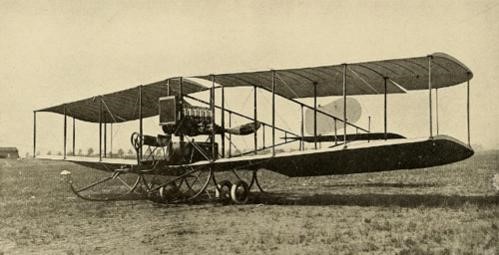
Patented biplane configuration as invented by William Whitney Christmas (U.S. Patent 957,744 Flying machine, patented May 10, 1910), constructed by the Christmas Aeroplane Co. of Washington, DC. This version was fitted with a 6-cylinder 75 hp Roberts motor, photographed after making practice flights in the hands of Clinton O. Hadley at a height of 500 feet.
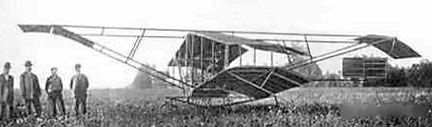
Christmas did patent, build, and fly a biplane of his own design in 1909. This aircraft, known as the Red Bird, was representative of many of his later designs and can be distinguished by its anhedral (down-sloping) upper wings and dihedral (up-sloping) lower wings. Another noteworthy tidbit about this design is that it appears to be a virtual copy of a plane built by a company named AEA that was, interestingly enough, also known as the Red Bird. In the words of one historian, “the eccentric Dr. Christmas was not above employing the ideas of others” and may well have patented another company’s design!
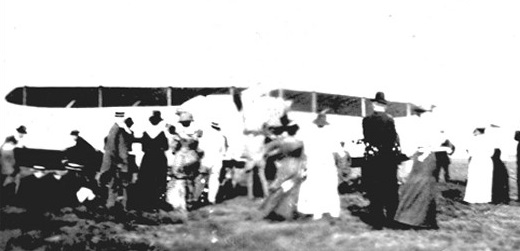
Nonetheless, the success of the first of three iterations of Red Bird and a modified Red Bird II led to the founding of the Christmas Aeroplane Company based in Washington, DC, in 1910. The company became the Durham Christmas Aeroplane Sales & Exhibition Company around 1912 and later the Cantilever Aero Company after moving to Copiague, NY, in 1918.
The Red Bird II was flown at College Park, Maryland, in 1910.
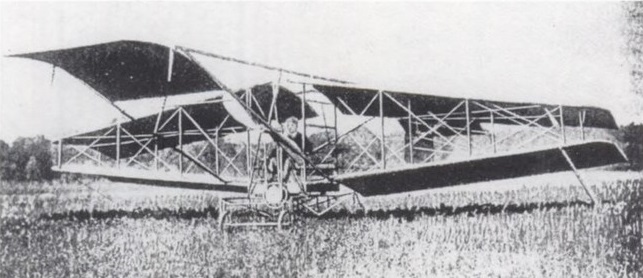
It could carry three people with a 50 hp engine.
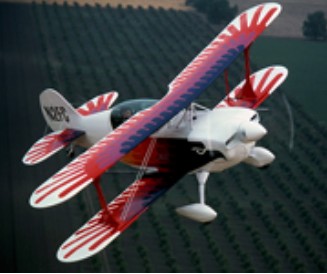
Frank Christensen says he once tried to buy the Pitts Special type certificate but was turned away by the price. That apparently bothered him, because he went out and designed his own family of kit built sport biplanes, and the results were on view for the first time at Oshkosh 1977.
The criteria were: unlimited class aerobatic performance; a two place cockpit; all the creature comforts the Pitts lacked; attractive styling; and, last but in a way most essential, that the airplane should be amateur built. To certificate and sell the airplane in the normal market would be too confining and too expensive, Christensen felt. By selling it as a kit, he could channel his expenditures where they belonged into providing materials of the highest quality instead of into justifying everything to the FAA.
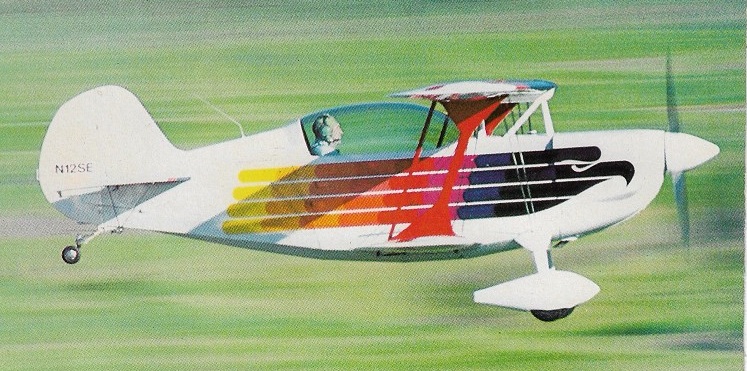
The Eagle is a biplane with a swept symmetrical wing structure of built up wooden ribs and spars. The Eagle’s bubble cano¬py, hinged oh the right side of the airplane, slides back to unlock and swings aside to ad¬mit the pilot and passenger to a long, wide tandem cockpit with a single instrument pan¬el in front and dual controls. The fuselage is built from welded steel tube and covered with metal back to the rear cockpit, then fabric the rest of the way aft. The fabric-covered wings are built with wood ribbing over spruce spars. The amateur builder has the option of buying 26 kits in sequence, starting with the ailerons, to test his dexterity.
Many parts are prefabricated or partially prefabricated, and the Ea¬gle’s steel tube structures are welded at the factory. Christen kits include everything you need to build them. Price in 1982: $41,000 (includes complete kit). Kit less engine and propeller, costs $26,000. Units delivered to June 1982: 450 started, 100 flying.
The Eagle I and I F will be the single-¬place unlimited competition version, pow¬ered by a 260 horsepower Lycoming aero¬batic engine; the F means fixed pitch. The I model will compete at 1,262 pounds and carry 1,478 pounds at gross with a wing loading of 11.82 pounds per square foot. Its empty weight power loading is 3.83 lbs. per hp. With a rate of climb of 2,640 fpm, it offers social climbers a verti¬cal penetration of 1,650 feet.
The II, by comparison, is pure luxury, featuring a spacious forward cockpit with no intruding instructor’s feet and a huge bubble canopy molded of a single hunk of clear plastic. It rides behind 200 hp Lycoming AEIO 360 AlD and a second F version, except that this time, the F means the 260 hp en¬gine of the I model. Its gross weight is 1,578 pounds, and it provides for an elec¬trical system and a radio.
Both models are stressed to +9and 6 Gs and have roll rates of 187 degrees per second and a power loading of 5.25 lbs/hp.
For a second time, Christensen turned his attention toward the Pitts factory (locat¬ed at Afton, in the middle of nowhere in Wy¬oming). This time, he was successful: Pitts Aerobatics is now part of Christen Indus¬tries, and Christensen wants the Pitts and the Eagle, formerly arch rivals in the field of competition aerobatics, to live in harmony as stablemates.
Christensen himself, of course, developed the Eagle as a refined Pitts after purchase negotiations with Curtis Pitts fell through in the mid 1970s. Although the very exis¬tence of the Eagle testifies to which airplane Christensen thinks is better, he is quick to assure the Pitts purists that their airplane has its own special place in the past and in the future.
Christensen had no plans to axe the Pitts marque, but one model, the 200¬hp two seat S 2A, will mutate to become the factory built Eagle. This is a crucial reason behind Christen Industries’ acquisition of Pitts Aerobatics. It is the most direct route to a factory built, certificated Eagle. For the purposes of certification, the factory built Eagle will actually be a Pitts S 2A modified to Eagle standards.
The Christen Eagle is very similar to the S 2A: both share the same airfoil, span, length, engine and propeller, but the Eagle has less lower wing dihedral, a further aft CG, different cowling and landing gear, modified ailerons and linkages and a more spacious and better designed interior. Christensen sees the Eagle as being almost imperceptibly different: “Like a washed car, it runs smoother.”
At the time he was developing the Eagle, Christensen was convinced that an unusual¬ly complete kit would appeal to a larger market than would comparable homebuilts or factory built airplanes. With 550 kits sold by 1975, it seems he was right.
The Eagle II is a two-seat sporting biplane that can be used for unlimited-class aerobatics as well as for advanced training. The Eagle II and II-F have a full electrical system (starter-alternator-battery). The Eagle II uses a 200-hp engine with constant-speed propeller. The Eagle II-F uses a 260-hp engine with fixed-pitch propeller. Characterized by their startling paint scheme, the Eagles feature swept symmetrical wings, a strong fuselage, and a blown canopy that covers both cockpits. With a roll rate of 187 degrees/second and a power loading of 7.89 lbs./hp, the Eagle is a strong performer. The fuselage is finished in metal from the cowling back to the rear cockpit. The midsection, all the way to the empennage, is covered in fabric. The fabric-covered wings are built with aluminum ribbing over spruce spars. The amateur builder has the option of buying 25 kits in sequence, starting with the ailerons, to test his or her dexterity.
The Eagle II, first offered in kit form in 1977, was still available in 1998 at US$55,000.
Eagle
Engine: Lycoming AEIO-360-A1D, 200 hp.
Propeller: Hartzell® HC-C2YK-4/C7666A Constant Speed
Speed max: 184 mph.
Never Exceeded Speed: 210 mph
Cruise: 165 mph.
Range: 380 sm.
Stall: 58 mph.
ROC: 2100 fpm.
Take-off dist: 1450 ft.
Landing dist: 2100 ft.
Service ceiling: 22,000 ft.
Wing Loading: 12.62 lb/sqft
Power Loading: g 5.13 lb/sqft
Length: 17 feet 11 inches
Height: 6 feet 6 inches
Wing Span : 19 feet 11 inches
Wing area: 125 sq.ft.
Gross Weight: 1578 pounds
Competition Weight: 1290 pounds (with 190 pound pilot)
Empty Weight: 1025 pounds
Useful Load: 553 pounds
Roll Rate: 187 Degrees/second
Baggage Allowance: 30 pounds
Fuel Capacity: 25 U.S. Gallons (24 Usable)
Structural Limits: +6g, -4g Operational
Seats: 2.
Landing gear: tail wheel.
Aviat Eagle II
Engine: Lycoming IO-360A1D, 200 hp.
Length: 18.5 ft.
Wing span: 19.9 ft.
Wingarea: 125 sq.ft.
Empty wt: 1125 lbs.
Mtow: 1578 lbs.
Fuel cap: 25 USG.
Seats: 2.
Undercarriage: Tail wheel.
Cruise: 165 mph.
Stall: 58 mph.
Range: 440 sm.
ROC: 2100 fpm.
To dist: 1450 ft.
Ldg dist: 2100 ft.
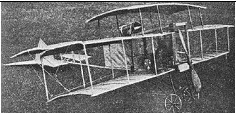
A design of Fred T. Childs of Akron, Ohio. The top wing measured 36 by 7 ft, and the lower 26 by 7 ft, the surface being 578 ft. It had two side surfaces measuring 6 by 7 ft ft, set at a dihedral angle, the idea being that these will maintain equilibrium during flight on the theory that a tip to one side or the other will cause an increased resistance on the side tipping over, with a resultant righting of the machine. The total weight of the machine, without the engine, was given as 250 lbs.
For exhibiting the machine at a county fair, a 2-cylinder, 7 hp Waterman engine was installed, but the motor intended to drive the machine was a 35 hp air-cooled, promised not to weigh more than 150 lbs including the magneto and accessories. The two 7-foot propellers were driven by cable, but it was intended to try chains and sprockets.
 All Aero