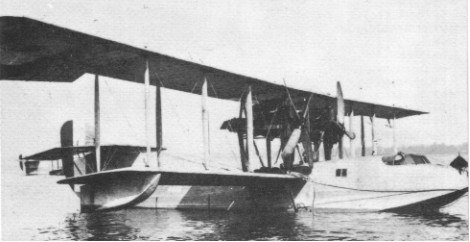
By July 1916 first examples of a larger Curtiss flying boat design began arriving in England. Designated H.8, these were quickly modified to accept more powerful twin 250 hp Rolls Royce engines, and redesignated Curtiss H.12s, or ‘Large Americas’. Although the lightly constructed hull was easily damaged in rough seas, the Large America was extensively used by the R.N.A.S. for anti submarine, anti Zeppelin and general reconnaissance duties.
Engines: 2 x 345 h.p. Rolls Royce Eagle. Length 46.1 ft (14.03 m) Wingspan 95 ft (28.96 m) Weight empty 7,360 lb (3,340 kg) Crew: 4 Armament: Five or six machine guns Bomb load: 4 x 230 lb (100 kg). Max speed: 100 mph (160 kph) Ceiling: 12,500 ft (3,800 m) fully loaded
The two-engine Curtiss flying boat America was built in 1914 for an attempted flight across the North Atlantic. Before it could be completed Britain was at war with Germany. John Porte, the intended pilot, returned to the Navy, closely followed by the America, which became the forerunner of all the large Curtiss flying boats. By July 1916 first examples of a larger Curtiss flying boat design began arriving in England. Designated H.8, these were quickly modified to accept more powerful twin 250 hp Rolls Royce engines, and redesignated Curtiss H.12s, or ‘Large Americas’. 20 similar models that were either modified or manufactured in England, marking the beginning of England’s flying-boat industry. The aircraft were used extensively for antisubmarine patrol.
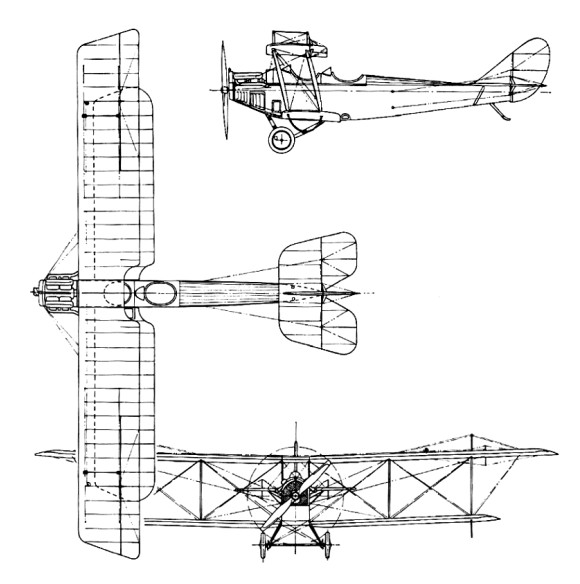
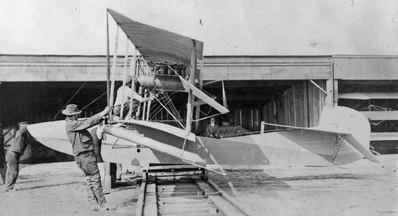
The 1914 Model N was a two-seat biplane similar to the Model J, differing in the airfoil and placement of the ailerons, which were mounted between the wings. It was powered by a 90-100 hp Curtiss OX inline engine. Due to legal issues with the Wright brothers over the use of ailerons, the sole Model N was modified by locking the ailerons and increasing dihedral to seven degrees in an effort to prove that aircraft could be flown without ailerons or wing warping. The Curtiss N Army trainer featured tandem “bathtub” cockpits, trailing interplane ailerons, and cost $7,500. One was delivered on 11 December 1914 (AS35) for Army evaluation but was judged very unstable despite added dihedral. A design merger with the Model J led to the famed JN-4 “Jenny.”
Four 1916 N-8 (Model 1D) variant with 41’9″ wing and standard ailerons were built; AS60-AS63.
The first flight of the Model N took place in 1915. The United States Army purchased the aircraft for evaluation, but Curtiss repossessed it due to legal issues with the Wright brothers.
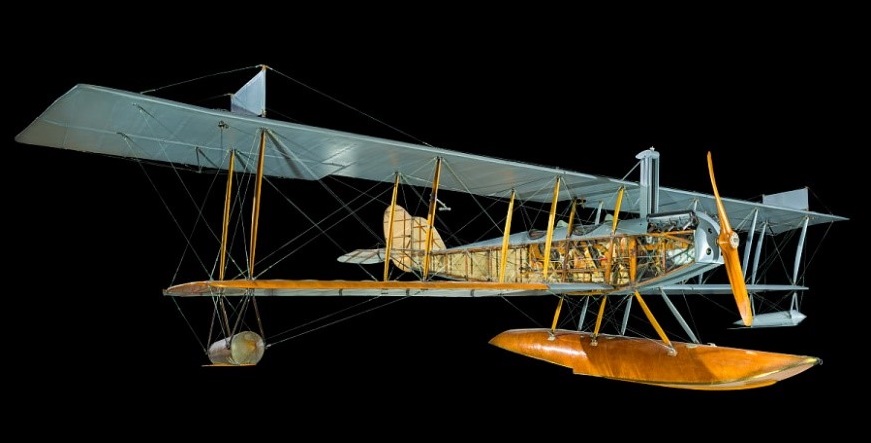
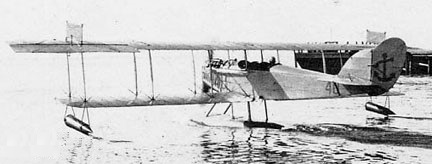
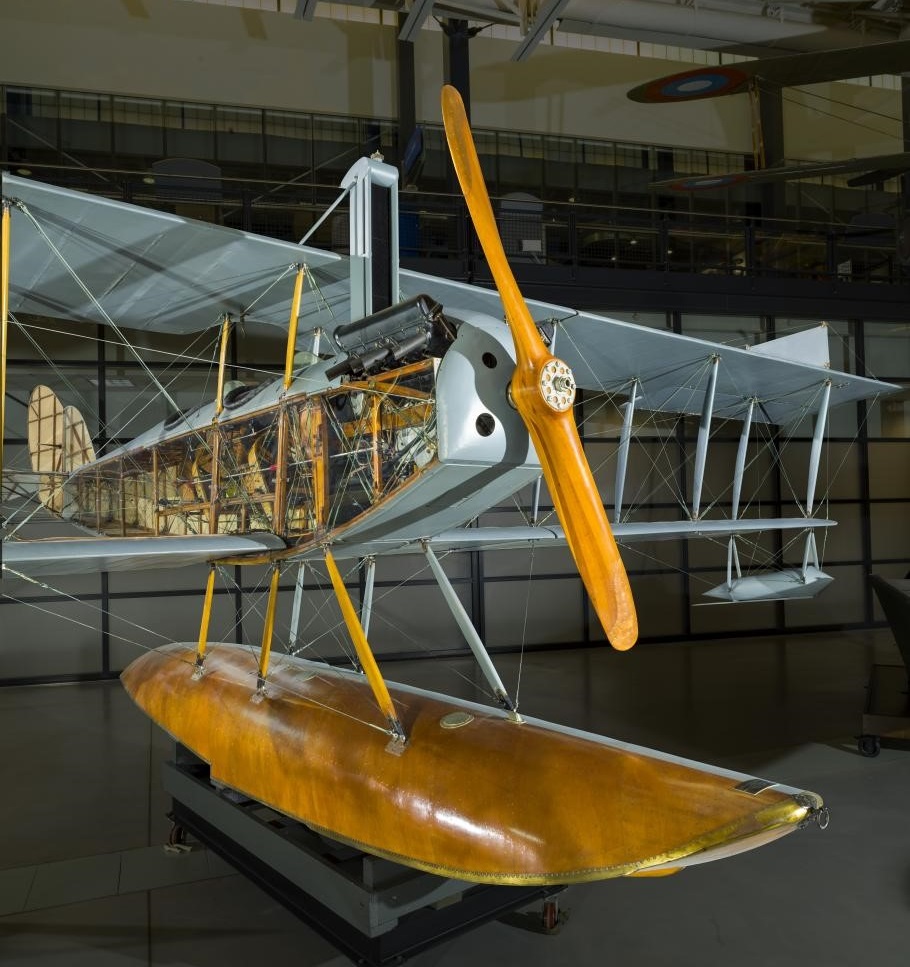
Developed in late 1916, the N-9 (Model 5) enlarged N was the seaplane version of the JN Jenny. To make the conversion, a single large central pontoon was mounted below the fuselage, with a small float fitted under each wingtip. It had a heavier engine than the Jenny to compensate for the extra weight of the floats and an upper wing that was some 10 feet (3 meters) longer than the lower one. Further modifications to the standard Curtiss JN-4 design were required to cope with stability problems that emerged in the N-9. They included lengthening the fuselage, increasing the area of the tail surfaces, and installing stabilizing fins on the top of the upper wing. The N-9 was initially powered by a 100-horsepower Curtiss OXX-6 engine. The U.S. Navy made use of wind tunnel data developed at the Massachusetts Institute of Technology in its redesign the JN-4. The N-9 was the first U.S. Naval aircraft to incorporate wind tunnel data directly into its design.
N-9H
The one model N built for US Army was later rebuilt as Model O with side-by side seating.
The Curtiss Aeroplane and Motor Company of Garden City, N.Y., received a Navy contract for thirty N-9s in August 1916. Another fourteen were ordered by the U.S. Army, as it was also conducting seaplane operations at that time. The 100-horsepower N-9 was satisfactory for pilot training, but it lacked the performance needed for bombing operations and gunnery training. To meet these requirements, Curtiss replaced the OXX-6 with a 150-horsepower Hispano-Suiza, then being manufactured under license in the United States by the Simplex Division of the Wright-Martin Company, and later by Wright Aeronautical Corporation. This improved model was designated N-9H.
Curtiss N-9
A total of 731 were built; 122 by Curtiss (A60-A65, A85-A90, A96-A125, A201-A234, A294-A301, A342-A373, A2285-A2290), plus 681 subcontracted to Burgess Company of Marblehead, Massachusetts and also seen as Burgess N-9 (A409-A438, A999-A1028, A2351-A2572, A2574-A2650), and 50 by NAS Pensacola (A6528-A6542, A6618-A6632, A6733-A6742, A7091-A7100) from spare components and engines.
Although the consensus in early 1917 among aviators and even the N-9’s manufacturer was that the N-9 could not be looped, the pioneering early United States Marine Corps aviator Francis Thomas Evans, Sr., believed it was possible. On 13 February 1917, he flew an N-9 over the Gulf of Mexico off Pensacola, Florida, and began attempts to loop it. He succeeded on his fourth try, becoming one of the first persons ever to loop a seaplane (first pilot to loop a seaplane was Polish aviator Jan Nagórski on 17 September 1916 in Grigorovich M-9 flying boat). Lacking witnesses, he flew over Naval Air Station Pensacola and repeated the feat. In 1936, he received the Distinguished Flying Cross for this achievement. More important, however, were the stall and spin recovery techniques he discovered while flying the N-9 that day. During his first three loop attempts, the N-9 stalled before he reached the apex of the loop and fell into a spin. He found that by releasing back-pressure on the stick and aggressively applying opposite rudder to the direction of the spin he could change the spin into a normal dive and recover, something previously thought impossible in an N-9.
During the war, 2,500 Navy pilots were trained on the N-9. In addition to training a generation of Navy pilots, the N-9 was used to develop tactics for ship-borne aircraft operations in 1916 and 1917, using catapults mounted on armored cruisers. After the war, the N-9 was again employed to successfully demonstrate a compressed air turntable catapult. This type of catapult was later installed on battleships, replacing turret-mounted platforms for launching aircraft. In July 1917, several N-9s were acquired by the Sperry Gyroscope Company and were used as test vehicles for aerial torpedo experiments conducted for the Navy’s Bureau of Ordnance. The N-9 was withdrawn from the U.S. Navy inventory in 1927 after ten years of service.
The Brazilian Naval Aviation also operated the N-9H.
The Murray-Carnes was an all-steel development of the Curtiss N-9 requested by secretary Daniels of the Navy Department in 1918 from the J.W. Murray Mfg. Co. of Detroit.
The Hewitt-Sperry Automatic Airplane was a project undertaken during World War I to develop a flying bomb, or pilotless aircraft capable of carrying explosives to its target. Elmer Sperry, succeeded in arousing the US Navy’s interest.
After the US declaration of war on Germany, Sperry began urging the Navy to revisit the idea. The Naval Consulting Board supported him, and formally requested the Secretary of Navy to apportion $50,000 for the work. The government thus included the development of the flying bomb or aerial torpedo in its war preparations. The Senate went so far as to establish two classes for the type weapon, one for wireless control, the other for completely automatic operation. Final approval came on May 17, 1917, and the Navy agreed to provide five (later upped to seven) Curtiss N-9 seaplanes and to purchase six sets of the Sperry automatic control gear. Navy Secretary Josephus Daniels agreed to spend $200,000 on the project, with the money to be administered by the Bureau of Ordnance, the Bureau of Construction and Repair and the Bureau of Engineering. The operation was established at Copiague, Long Island.
In 1913, the Navy provided a flying boat to test and evaluate the gyro-based autopilot. Sperry’s son Lawrence served as an engineer during the test phase. In 1914, Lawrence Sperry was in Europe and observed the developing techniques of aerial warfare, including the use of aircraft. In 1915, the New-York Tribune broke the news of the project. In 1916, the two Sperrys joined Peter Hewitt, an early inventor of radio-related devices, to develop an explosive-laden pilotless airplane.
The system consisted of a gyroscopic stabilizer, a directive gyroscope, an aneroid barometer to regulate height, servo-motors for control of rudders and ailerons, and a device for distance gearing. These all could be installed in an airplane which could be catapulted or flown from the water, and would climb to a predetermined altitude, fly a pre-set course, and after traveling a pre-set distance, drop its bombs or dive to the ground. Wilkinson reported that the weapon did not possess a degree of accuracy sufficient to hit a ship, but, because of its range of 50 to 100 miles (80 to 161 km), it might be of interest to the Army.
The autopilot equipment was already designed, but the radio control system hadn’t been fully developed, so while the hangars were being built at Copiague, Sperry turned his attention to this aspect, purchasing rights to a number of patented radio-related inventions. Ultimately, though, the radio control systems were not used on the Hewitt-Sperry Automatic Airplane. Later, in 1922, the system was installed on several Verville-designed planes along with gear for the Army Air Services engineering division. These aircraft successfully hit their targets from ranges of 30, 60 and 90 miles (140 km).
The first test flights of an autopilot-equipped aircraft was in September, 1917, and took place with a human pilot on board to fly the takeoff. By November, the system successfully flew the aircraft to its intended target at a 30-mile (48 km) range, where the distance-measuring gear would drop a bag of sand. Accuracy was within two miles (3 km) of target.
When the N-9 flight test program got started, it became apparent that a more efficient airframe was needed. Because war production deliveries could not be diverted, a special, rush order was placed with Curtiss in October, 1917, for six planes of unique design, with an empty weight of 500 lb (230 kg), top speed of 90 mph (140 km/h), range of 50 miles (80 km) and the capability of carrying up to 1,000 lb (450 kg) of explosives. They became known as the Curtiss-Sperry Flying Bomb. Because this was to be a design dedicated to the remote control concept, the planes were not equipped with seats or standard pilot controls.
Only one example of the type has survived, and is now a part of the National Air and Space Museum collection. Originally on display at the Museum of Science and Industry in Chicago, Illinois, it was later transferred back to the U.S. Navy pending transport to the National Air and Space Museum. The Naval Air Engineering Laboratory in Philadelphia, Pennsylvania, fully restored it in 1966.
N / N-9C Original N-9, later known as the N-9C. Engine: Curtiss OXX-3, 100hp (75 kW) Wingspan: 38’3″ Length: 27’2″ Speed: 70 mph Seats: 2
N-8 Production version of N for US Army, Equivalent to JN-3. Engine: 90 hp (67 kW) Curtiss OX-2 Four built 1915
N9-H Engine: Wright-Hisso, 150 hp (110 kW) Propeller: 2-bladed fixed-pitch wooden Wingspan: 16.2 m (53 ft 4 in) Wing area: 496 sq ft (46.1 sq.m) Length: 9.4 m (30 ft 10 in) Height: 3.3 m (10 ft 9 in) Weight: Empty weight: 973 kg (2,140 lb) Gross weight: 1,257 kg (2,765lb) Useful load: 625 lb Maximum speed: 78 mph (126 km/h, 68 kn) Cruise speed: 70 mph Service ceiling: 6,600 ft (2,000 m) Time to 3,240 ft (990 m): 10 minutes Range: 180 mi Seats: 2
In 1914 Curtiss lured B. Douglas Thomas from Sopwith to design the Model J trainer, which lead to the JN-4. The JN-4 was developed from the JN-2, via the interim JN-3 which had featured unequal-span wings with ailerons on the upper wing only and introduced a wheel-type aileron control system. Redesigned vertical tail surfaces had a fin and rudder assembly with contours which were to be largely retained in the JN-4. The UK bought 91 JN-3s and the US Army two. Several JN-2s were converted subsequently to JN-3 standard by the incorporation of JN-3 wings and vertical tail surfaces and by installation of the 75kW Curtiss OXX engine. Total production was no more than 100, a dozen built at a newly-built Toronto factory.
The JN-4 in its original form closely resembled the JN-3, retaining the same unequal-span two-bay wing and cross-axle landing gear. It first appeared in July 1916 when 105 were sold to the UK and 21 to the US Army. Others were purchased by private owners and a number were operated by the Curtiss company’s flying schools. As a result of British experience with the JN-3 and JN-4 the Curtiss company developed the JN-4A (retro-designated Model 1 in 1935), which incorporated a number of improvements (larger tailplane and engine downthrust). A total of 781 was completed, 87 of them at the Curtiss Canadian factory. The US Army bought 601, the US Navy five and the rest were exported to the UK. The JN-4B (Model 1A) appeared in late 1916, just before the JN-4A. It differed in several design details (it introduced-the larger tailplane and used the OX-2 engine), and found a number of private purchasers and flying schools as customers, added to which the US Army bought 76 and the US Navy nine. Two examples of the experimental JN-4C were followed by the very successful JN-4 Can and JN-4D (Model 1C). The JN-4 Can had been developed from the JN-3 by the Curtiss company’s Canadian associate, Canadian Aeroplanes Limited, and soon became known as the Canuck. Production totalled 1,260 of which 680 went to the US Army while the bulk of the remainder became the standard Canadian primary trainer. The JN-4 Can served with the Royal Canadian Air Force until 1924, while privately owned aircraft remained in use into the 1930s. John Ericson, chief engineer of Canadian Aeroplanes Ltd, assembled 127 aircraft in 1927, most of them reconditioned aircraft incorporating many parts which had been held in stock. Some had a third cockpit and were known under the designation Ericson Special Three.
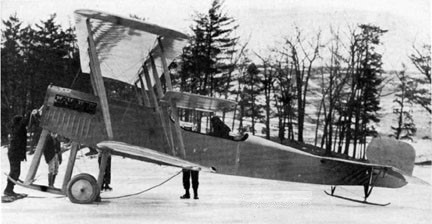
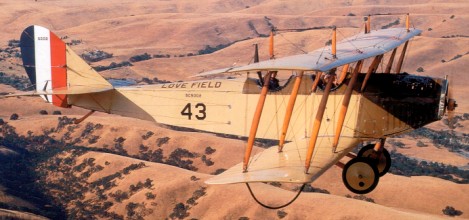
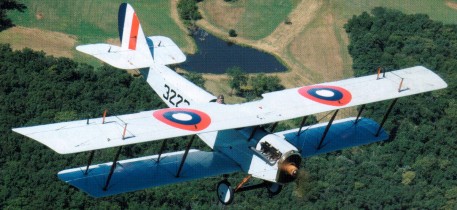
The Curtiss JN-4 two-seat biplane soon acquired the nickname ‘Jenny’ which was used widely during the inter-war years. It was one of the most significant American aircraft of its time. From April 1917 when the USA entered World War I it was built in large numbers and used to train some 95% of all American and Canadian pilots. It achieved renewed fame from 1919 until the late 1920s, when thousands were flown in the barnstorming era, thrilling spectators at travelling aerial pageants and shows throughout the United States.
JN-4H
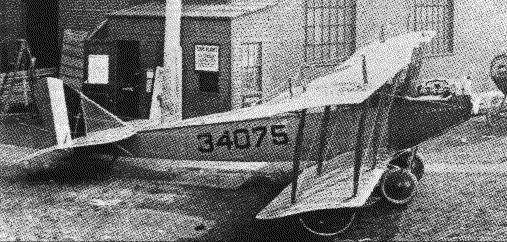
The JN-4D appeared in June 1917 and went into large-scale production, 2,812 being built between November 1917 and January 1919. With an urgent need for efficient trainers in wartime conditions the production involved six other US manufacturers.
The St. Louis Aircraft Corporation became one of six across the country to produce the Curtiss JN 4D Jenny with first deliveries in 1918. The first order was for 200 planes, the company delivered 30 aircraft per month, and 57 JN 4D October 1918. The St. Louis Car went on to manufacture 450 JN-4D Jenny trainers for the U.S. Army.
JN-4D Army trainer set up for publicity photos outside St. Louis Aircraft plant in 1918
As well as several new features, the JN-4D combined the more successful elements of both the JN-4 Can and JN-4A designs (stick control of the former, in place of the Deperdussin system, and the lines and engine downthrust of the latter). The end of World War I led to cancellation of contracts for 1,100 examples of a JN-4D-2 version, which had a number of modifications requested by the US Army. In the event, only the prototype was delivered to the military authorities, although several were sold to civil operators in 1919. In a bid to provide an advanced trainer to meet urgent wartime needs, the JN-4D was re-engined with the more powerful 112kW (150-hp) Hispano-Suiza built by the Wright company. The resulting JN-4H (Model 1E) was in production from the end of 1917 to the November 1918 armistice, 929 being delivered to the US Army. The JN-4H was completed also in dual-control (JN-4HT), combing (JIM-4HB) and gunnery trainer (JN-4HG) versions. The one-off JN-5H advanced trainer was built to a US Army requirement, but was rejected in favour of the Vought VE-7. It was developed into the JN-6H (Model 1F) which had a strengthened aileron control structure. The US Army purchased 1,035 JN-6Hs, subsequently passing five examples to the US Navy. The aircraft delivered to the US Army were built in sub-variants specialised for various training functions. (JN-6HB single-control bomber trainer, JN-6HG-1 dual-control trainer, JN-6HG-2 single-control gunnery trainer, JN-6HO single-control observation trainer and JN-6HP single-control pursuit [fighter] trainer). With the armistice the production was stopped, after more than 6000 were produced, mostly of the “D” model. As part of the post-war economy drive the US Army was forced to modernize the ‘Jenny’ rather than purchase new designs. This task was allocated to US Army Service Depots, which upgraded many of the earlier versions until 1926. The revised aircraft all used Wright-built 134kW Hispano-Suiza engines and were redesignated JNS (standing for JN Standardized). Between 200 and 300 JNS trainers were completed. The US Army used JN-4As, JN-4Ds and JN-4 Can primary trainers until 1919. The higher powered JN-4Hs and JN-6Hs remained in service until they were phased out in favour of new types in the mid-1920s, the last Jennies being withdrawn from US Army service in 1927.
Tallman & Mantz Jenny movie line-up in Navy markings
From 1919 onwards Jennies had been sold to private owners, many who used their aircraft as stunt pilots in travelling circus or barnstorming. The Jenny also featured in many Hollywood films of the 1920s and early 1930s. A considerable number of Jennies survive in museums and several in private ownership are maintained in flying condition in the USA.
Curtiss JN-4D Engine: 1 x 67kW, 90 hp Curtiss OX-5 inline piston Max take-off weight: 871 kg / 1920 lb Empty weight: 630 kg / 1389 lb Wingspan: 13.30 m / 43 ft 8 in Length: 8.33 m / 27 ft 4 in Height: 3.01 m / 9 ft 11 in Wing area: 32.70 sq.m / 351.98 sq ft Max. speed: 121 km/h / 75 mph Cruise speed: 97 km/h / 60 mph Ceiling: 1980 m / 6500 ft Range 200 miles / 320 km Seats: 2
The definitive 1913 Model F was of wooden construction, the two-bay biplane had inter-plane ailerons on each side, fabric-covered wings and tail unit, and a carefully contoured single-step plywood-covered hull which accommodated two side-by-side in a cockpit location just forward of the wings. Power was a 56kW Curtiss O engine driving a pusher propeller. The engine being mounted on struts just below the upper wing centre-section.
The Curtiss F two-seat biplane flying boat became the Army’s first flying boat. This basic design was ordered by the US Navy, and after the United States entered World War I on 6 April 1917 it was adapted as the service’s standard primary training flying-boat, 144 more being ordered. During the war, Curtiss received so many orders for flying boats that he hired Boeing and Loughead (later renamed “Lockheed”) to build them to his specifications.
Alexandria was contracted Curtiss F-boats for USN, as the Alexandria 10, circa 1917. Thirteen were built; A2651 to 2653, A5024, and A5247 to 5256 The F was also sold to several civil owners. The 1914 version of the Model F had rounded wingtips, a tougher hull and increased strut support for the engine to prevent it collapsing on the crew in the event of a crash. The 1917-18 version of the Model F eliminated the original shoulder-yoke type aileron control in favour of a more conventional arrangement; and some aircraft had the ailerons transferred to the upper wing from the interplane position, span of the upper wing being extended. Several ambulance conversions flew with provision for a stretcher patient to be carried above the hull behind the cockpit. The more powerful Curtiss OXX-3 engine was fitted from 1917 onwards. The Model F, particularly in its earlier versions, was sold to a number of foreign navies. Russia obtained a considerable number for operation in the Baltic and Black Seas. The Italians also flew the Model F and eight examples were licence-built by the Zari company at Bovisio.
Engine: 1 x 75kW Curtiss OXX-3 inline piston Take-off weight: 1116 kg / 2460 lb Empty weight: 844 kg / 1861 lb Wingspan: 13.75 m / 45 ft 1 in Length: 8.48 m / 27 ft 10 in Height: 3.42 m / 11 ft 3 in Wing area: 35.95 sq.m / 386.96 sq ft Max. speed: 110 km/h / 68 mph Range: 1370 km / 851 miles
The Curtiss Flying Boat was an early “hydro-aeroplane” or seaplane that was first concept tested by well-known aviator Glenn Curtiss in January 1912 in San Diego. By the end of the same year, Curtiss had built his first successful flying boat at Hammondsport, NY and succeeded in selling the aircraft to the Navy. The Navy first acquired five Curtiss Flying Boats, then an additional 144 for training before the original F type model was supplanted by the MF in 1918.
The C-1, the Navy’s first flying boat, was tested at Hammondsport, N.Y., by Lieutenant T. G. Ellyson on 30 November 1912. Its performance, as informally reported by Ellyson, was: “Circular climb, only one complete circle, 1,575 feet in 14 minutes 30 seconds fully loaded. On glide approximately 5.3 to 1. Speed, eight runs over measured mile, 59.4 miles per hour fully loaded. The endurance test was not made, owing to the fact that the weather has not been favorable, and I did not like to delay any longer.”
The Curtiss C-1 (changed to AB-1 in 1914) made the first catapult launch by a flying boat in December 1912.
On 27 March 1914 the original designations of aircraft were changed to two letters and a number of which the first letter denoted class, the second type within a class, and the number the order in which aircraft within class were acquired. Four classes were set up; A for all heavier-than-air craft, D for airships or dirigibles, B for balloons and K for Kites. Within the A Class, the letters L, H, B, X and C represented land machines, hydroaeroplanes, flying boats, combination land and water machines, and convertibles respectively. Thus the third hydroaeroplane, formerly A-3, became AH-3, and the first flying boat, formerly C-1, became AB-1.
The first Curtiss Flying Boat acquired by the Navy was designated C-1, before it was changed to AB-1 (A for Curtiss and B for flying boat) as the Navy began to procure aircraft from other corporations. The C-1 was based at the Navy Yard in Washington, D.C. in 1912 before moving to Guantanamo Bay, Cuba.
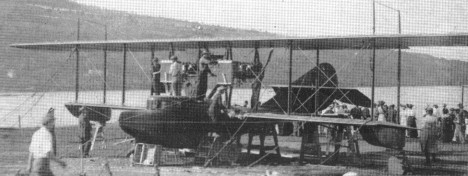
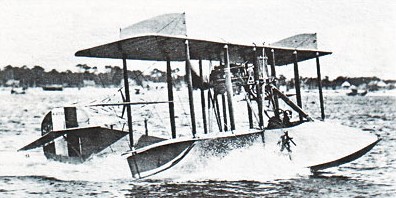
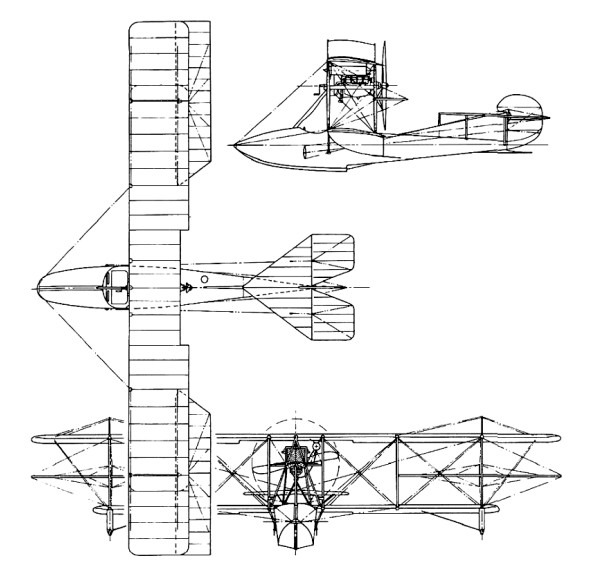
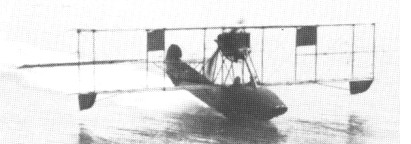
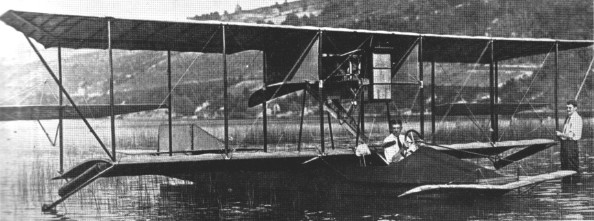
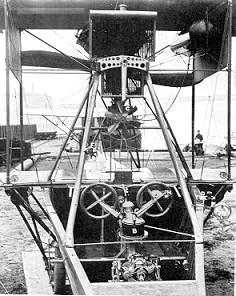
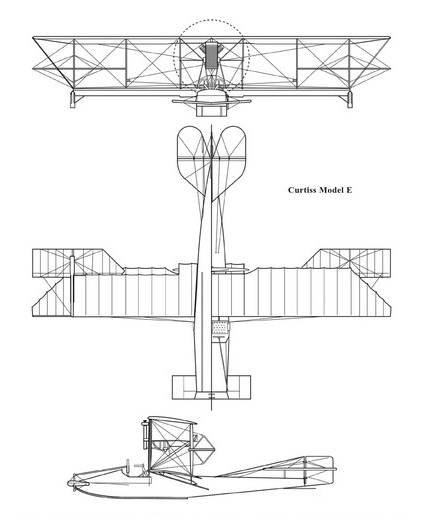
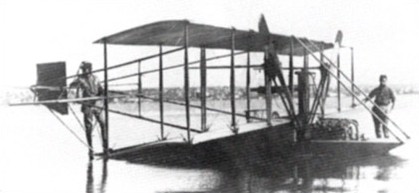
Curtiss left San Diego in the spring of 1912 to return to Hammondsport, where he commenced work on Flying Boat No.2 during the spring of 1912, which, in its original configuration, utilised standard components of the 1911 model E land and hydro (float) plane, including twenty-eight foot, eight inch single surface, equal span wings and a pusher mounted 75 hp Curtiss O V-8 engine. Its flat-bottomed, scow-type hull, unlike Boat No.1, extended all the way aft to support an empennage consisting of a long-chord fin and rudder with cruciform horizontal surfaces. To reduce the danger of sinking after hard landings, the hull was constructed with six watertight compartments.
Initial trials were not successful, as Flying Boat No.2 could not be made to unstick from the water at takeoff speed. After observing numerous attempts, Curtiss modified the hull to incorporate a step just behind the centre of gravity. The step produced a reduction in hydrodynamic drag by lifting almost half of the hull free of the water and increased lift by permitting the nose of the aircraft to be rotated up to a positive angle of attack. Other changes made included standpipes that bled air into the cavity behind the step, a secondary canard elevator on the nose (later removed due to control problems), and triangular extensions to the upper wing to increase lift.
Flown by Glenn Curtiss on 26 January, 1911, the first practical seaplane. By the fall of 1912 Curtiss had made sufficient progress with the design to sell the Navy its first boat-hulled aircraft, entering service in late November as the C-1 (changed to AB-1 in 1914). This aircraft made the first catapult launch by a flying boat in December 1912.
The first E boat mid-1912 with front stabiliser
The first seaplane was maneuverable, light, and relatively fast, and was the most widely built type of plane in the United States before World War I.
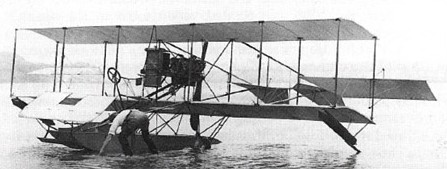
The Army’s S.C.15 in 1913. This aircraft is thought to have F-type wings but is identified as an E boat.
Later model E flying boats featured deepened, V-bottom hulls with a more pronounced step, as well as more powerful engines, a larger rudder, and a diagonal strut in front of the motor mount to prevent the engine from leavin its mounts in hard landings. Besides the Navy’s C-1, a number of E boats were built for the Army and the Curtiss Flying School, plus two or three more to civilian purchasers, one of which was used by Lawrence Sperry during 1944 to conduct the first experiments of an airborne gyroscope.
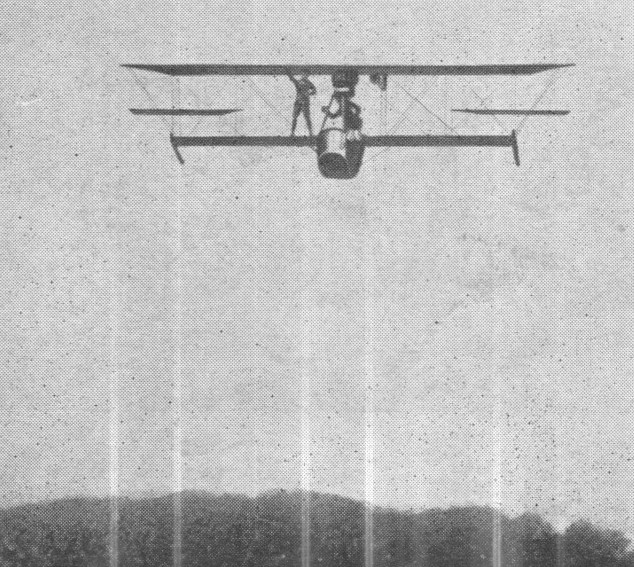
Lawrence Sperry flew his Curtiss over Paris in 1914 with his hands off the controls and his passenger standing on the wing to prove the efficiency of its automatic pilot.
Lawrence Sperry over Paris in 1914
Sperry-Curtiss E
Model E Engine: 1 x 75-100 hp Curtiss OX Prop: 2 blade fixed pitch wood Empty weight: 1490 lb Take-off weight: 2500 lb Wingspan: 37 ft 9 in or 40 ft 0 in Length: 27 ft 2 in Wing area: 350 sq.ft
The first Curtiss flying-boat, tried at San Diego on 10 January, 1912, was more a hydro than a true boat. A wide flat-bottomed hull, only slightly longer than the standard Curtiss pontoon, was attached under the lower wing of the de-engined airframe of the tractor seaplane with Type D wings and tailplane. A single 60hp engine was mounted in the hull and drove two tractor propellers through chains in Curtiss’s only deliberate adaptation of a Wright brothers’ feature. There were two side-by-side seats in a cockpit behind the wing. Although No.1 was unable to take off, the experiment did indicate that the flying-boat concept was practicable. Subsequent developments were made at Hammondsport.
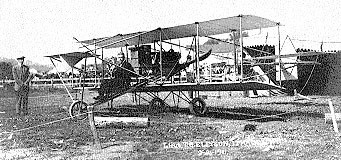
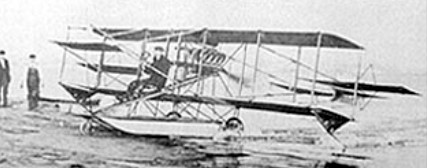
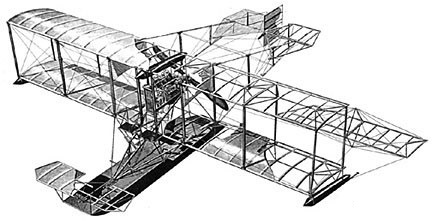
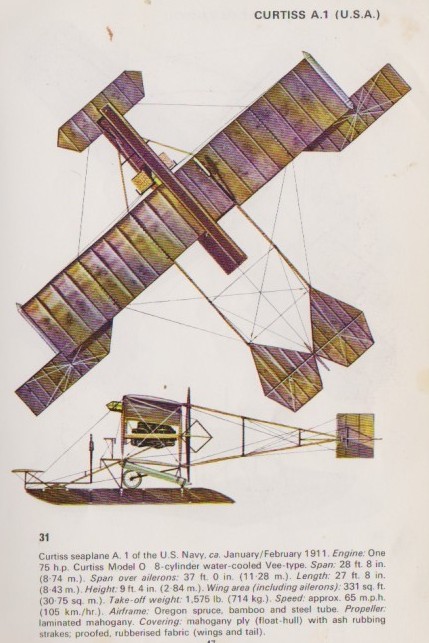
In February 1911, Curtiss introduced the Triad seaplane, which had both wheels and floats.
The Triad A-1 first flew on July 1, 1911, piloted by Curtiss, for a five minute flight at 25′ AGL, and was the US Navy’s first airplane (later being designated AH-1) for $4,400.
The A-1 was used in a variety of aerial “firsts”—first cross-country flight, 112 miles in 122 minutes; first (albeit unsuccessful) catapult launch (On 31 April 1912); first night landing on water without lights. It also set a world seaplane altitude record of 900′, and completed 285 flights.
Curtiss A-1 USN Lt T S Ellyson
The Triad was sold to the British, Russian, German and Japanese navies in 1912. The Japanese naval aviation was founded with the purchase of three Curtiss Triads. In 1912, Curtiss won the Robert Collier Trophy for his development of the seaplane.
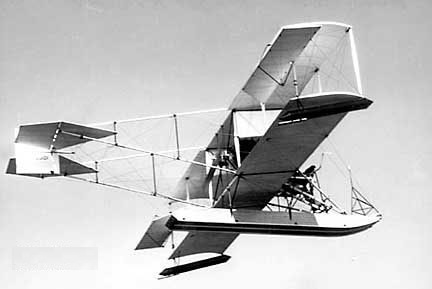
A faithful replica was built by a group of fans in San Diego c.1956.
Curtiss A-1 Replica
Reconstruction during take off
A-1 Engine: 1 x 75 hp Curtiss V-8 Max Take-off weight: 715 kg / 1576 lb Empty weight: 420 kg / 926 lb Wingspan: 11.28 m / 37 ft 0 in Length: 8.71 m / 28 ft 7 in Height: 2.69 m / 8 ft 10 in Wing area: 26.57 sq.m / 286.00 sq ft Max speed: 97 km/h / 60 mph Cruise: 40 mph Range: 112 mi Seats: 2



 All Aero