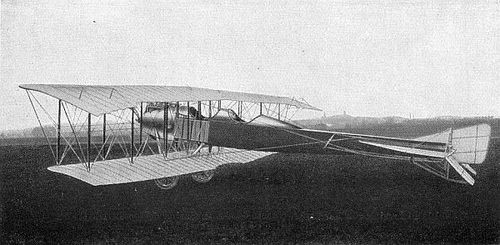
Grahame-White New Baby

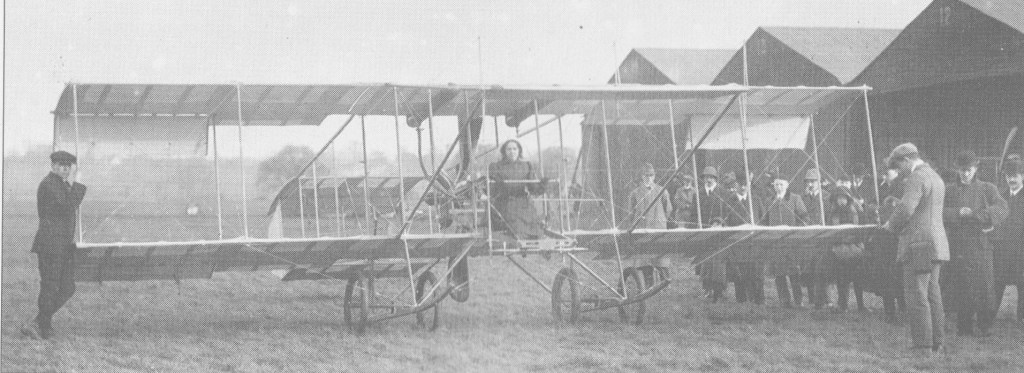
Mrs J.V.Martin at Hendon April 1911

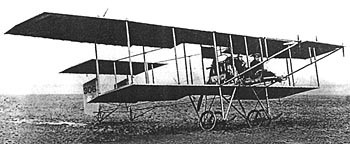
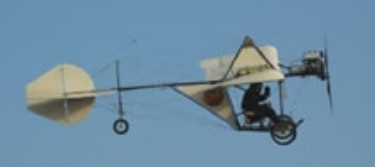
The 1911 New Baby was developed from the Baby and built by Grahame-White. Contrary to the Baby, it had no rigid enclosure.

Both the Baby and New Baby appeared on the racing circuit at the same time, being variously piloted by Grahame-White or other pilots.
The New Baby was later modified with a single rudder that was split on either side of the elevator.

Grahame-White Baby / Burgess Model E

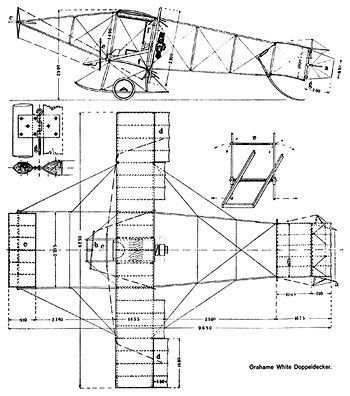
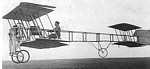
The Grahame White Baby was a single-seat biplane pusher, of the then orthodox “Farman” layout, with a frontal elevator and a rear-mounted empennage consisting of a biplane horizontal stabilisers with single elevator mounted on the top surface and a single central rudder. As the name suggests, it was considerably smaller than most contemporary aircraft of a similar layout, having a wingspan of only 27 ft (8.2 m). In comparison, the wingspan of a standard Bristol Boxkite was 34 ft 6 in (10.5 m). An unusual feature of the aircraft was the mounting for the 50 hp (37 kW) Gnome rotary engine, which was mounted on a pair of angled beams so that the engine was midway between the upper and lower wings.

It was built by Burgess to Grahame-White’s order and never produced in the United States. The Burgess Company in the United States purchased a licence to build it as the Model E.

First flying in 1911, about six were built in total.

Engine: 1 × Gnome, 50 hp (37 kW)
Wingspan: 27 ft 1 in (8.25 m)
Length: 31 ft 9 in (9.68 m)
Height: 8 ft 6 in (2.59 m)
Gross weight: 655 lb
Maximum speed: 55 mph
Endurance: 4 hours
Capacity: 1

Burgess E Baby
Span: 36’10”
Length: 31’8″
Seats: 1-2

Grade 1909 Monoplane

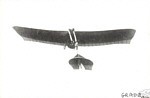
Designed by Grade in 1909 to get the Lanz-Prize, which was to be given to the first aviator in Germany who flew 2,5km around two poles. Grade did accomplish this in November 1909 in Berlin-Johannisthal.
Hans Grade competed at Nice in 1910 with a monoplane of his own design.

Gallery

Engine : Grade, 24 hp
Length : 24.606 ft / 7.5 m
Height : 6.562 ft / 2.0 m
Wingspan : 32.808 ft / 10.0 m
Max take off weight : 419.0 lb / 190.0 kg
Max. speed : 38 kts / 70 km/h
Service ceiling : 1312 ft / 400 m
Crew : 1

Goupy 1912 Hydroaéroplane

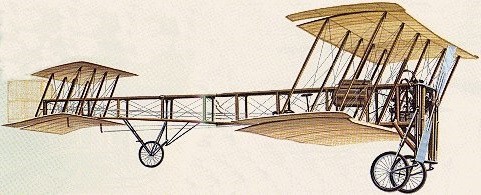
The 1912 Goupy “hydroaéroplane” was just a land plane set on floats with wheels and all, no further alterations. Typical was the fuselage “hung” between the wings and the sesquiplane construction with the struts somewhat at an angle. The construction at the nose looks like radiators, but are unlikely that as this design was fitted with a 100 hp Gnome rotary. Maybe a streamlined construction to get the engine neatly into the ‘square’ fuselage.

Goupy 1914-B

The three-passenger Goupy biplane, type 1914-B, resembled in general construction other machines of this firm. The cell is composed of two staggered planes of unequal length: chord 1.6 m. top plane 19.75 m. long, lower one 10.35 m. long.
The cell is rigid and lateral balance is obtained by powerful conjoined ailerons. The fuselage is of quadrangular section. The monoplane tail is slightly lifting and approximately rectangular, terminated by a flap 3.1 by .7 m. serving as an elevator.
The quadrangular rudder, above the tail, is partly balanced and in front of it is a small vertical fin. The 100 hp Gnome supported between two bearings turns a 2.8 m. propeller, the axis being 1.8 m. above the ground. The chassis is of the usual type, skids and wheels: the wheels are far enough forward to prevent “capotage.” The skids, however, do not seem sufficient to protect the propeller in a bad landing on rough ground.

Goupy 1914-B