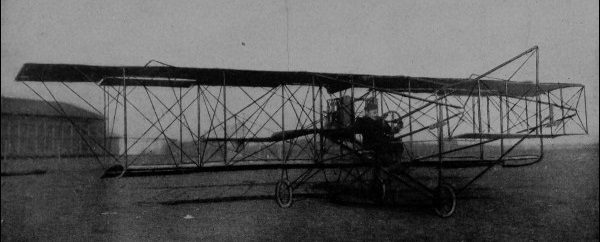
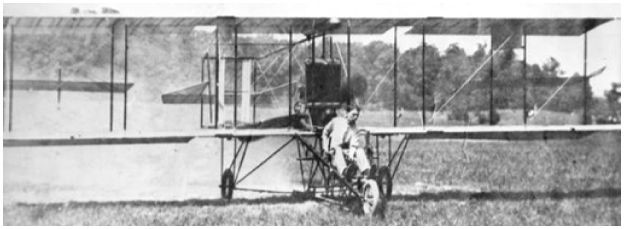
Marcel Penot in the Mohawk Biplane Mineola to Hicksville, L. I. 26 miles cross-country in 30 minutes (50 hp. Harriman Engine)
The Mohawk biplane employs a powerful Harriman four Cylinder water cooled engine
Marcel Penot the French aviator announced that he would start from the Guttenberg race track at about 9 am Monday morning Jan. 2, and attempt to make a Landing in Manhattan somewhere in the Vicinity of Columbus Cycle. Penot will drive a Mohawk by plane which has been used successfully by George Byrnes and himself. The Mohawk biplane employs a powerful Harriman four Cylinder water cooled engine made especially for Penot it closely resembles the Farman biplane. Penot is 82 years old and has been in America several years. He was born at Rheims France and previous to coming to America was employed in the famous wine cellars there.
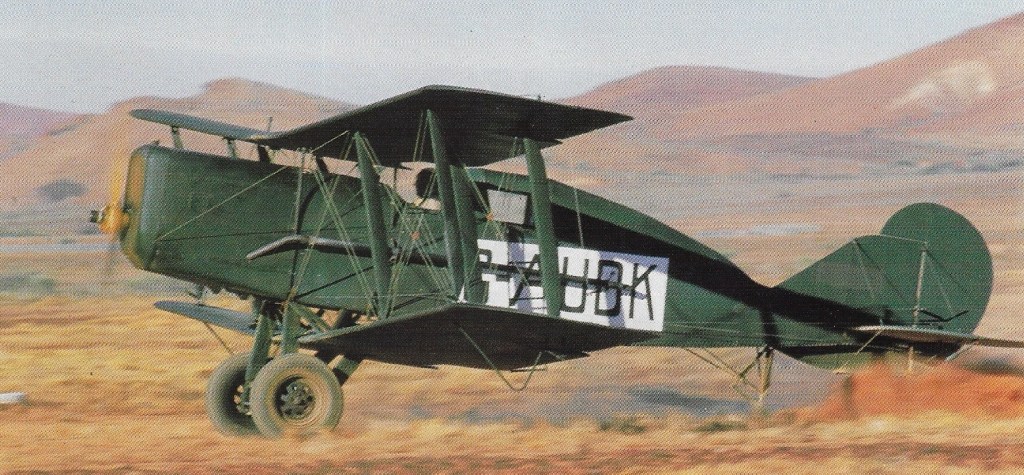
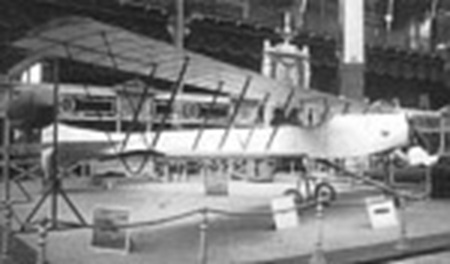
Three Bristol Tourer replicas were built in Australia. A static display replica was built over 18 months during 1980-1981 as a project by the Civil Aviation Historical Society (WA Division) by Ansett WA carpenter Frank Matthews, under supervision of Ansett engineer Billy Tilly, with help of Frank Colquhoun, a former West Australian Airways mechanic/engineer. It was built for display at the Ansett terminal at Perth Airport (now Terminal 3) and was unveiled in the terminal on 5 December 1981, painted to represet G-AUDK. The Ansett terminal was expanded in the mid-1980s, so in 1986 this replica was donated to the RAAF Association Aviation Heritage Museum at Bull Creek, WA, where it is displayed with part of the fuselage and wing unskinned to reveal the structure.
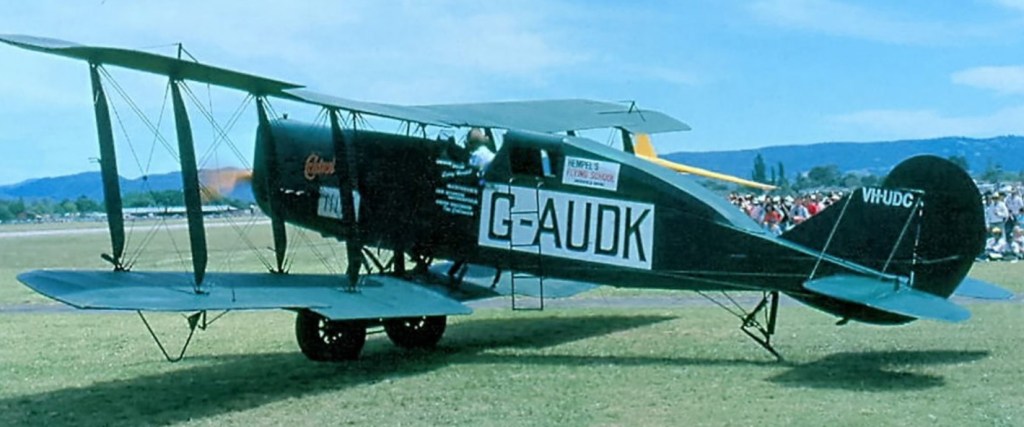
In 1984-1985 an Australian company called A Thousand Skies Ltd had two airworthy Bristol Tourer replicas built in Brisbane, QLD by Air Charter Pty Ltd for a television mini-series “A Thousand Skies”, a story on the life of Sir Charles Kingsford Smith. They were registered as Air Charter Bristol F.2b Tourers, VH-UDC (c/n QA-32-1, painted as G-AUDK) and VH-UDR (c/n QA-32-2, painted as G-AUDJ). These aircraft were powered by 172 kw (230 hp) Continental IO-520 six-cylinder engines, the fuselages being of steel tube construction and the wings of wood, with fabric covering overall. These aircraft were later seen at a number of aviation events but suffered their share of problems.
On 1 June 1992 VH-UDC (painted as G-AUDK) was on a 70-year commemorative flight by owner/pilot Barry Hempel when it suffered engine trouble and was damaged in a forced landing on North West Coastal Highway, 100 km (62 miles) north of Geraldton, WA. The aircraft was restored by Mid West Aero Club and the Shire of Greenough donated it to the Western Australian Museum at Geraldton, where it is now displayed suspended from the ceiling. This is a fitting location, given that the first scheduled air service in Australia by Bristol Tourers of West Australian Airways began at Geraldton Airport on 5 December 1921.
Bristol Tourer replica VH-UDC / G-AUDK at Richmond, VIC in 1988
The second aircraft VH-UDR (painted as G-AUDJ) was registered in March 1985 and was withdrawn from service in March 1986. It was converted to a Bristol Fighter F.2b configuration, painted in military markings to represent C-4623, and was placed on display at the Army Aviation Museum at Oakey, QLD.
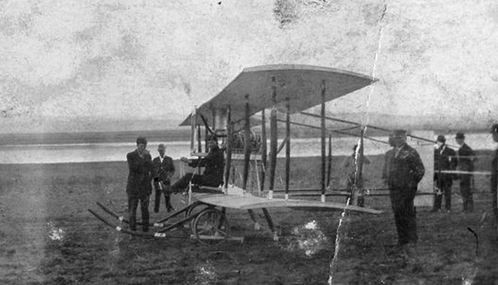
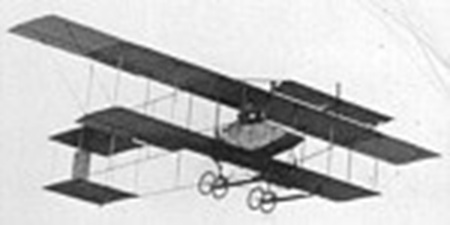
A tractor biplane with diagonal stabilizing surfaces between the wings, which had marked dihedral. It was built by Charles A. Zornes and tested at Walla-Walla, Washington, USA, about 1910-1911.
Charles A. Zornes seems to have started aircraft construction in Walla Walla, Washington, USA, in 1909. After they trained at the Benoist Aviation school in St. Louis, he and Johnny Ludwig together with some associates set up a company in 1912 in Pasco, Washington to manufacture aeroplanes. He also ran a flying school there, with the 1912 headless pusher and at least two others. Zornes crashed on April 19 1912, with injuries that did not seem to be life threatening. He appears in some lists of aviation casualties after the accident, but it appears he might have survived and lived until 1954.
According to the Wisconsin Historical Society the photo is from a July 2, 1909 test flight of the biplane invented by Ray Zorn of Dayton, Ohio, who later resided in Waukesha, Wisconsin. The Curtiss-inspired pusher plane looks like it is of later vintage, though, and other sources talk of a 1911 Zorn biplane.
In 1933, the command of the Yugoslav Royal Air Force (YRAF) decided to replace outdated planes with modern school aircraft, for transitional training from basic training to combat.
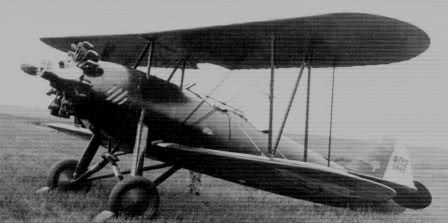
The designers, R. Fizir and D. Stankov, opted for a biplane concept, although the YRAF preferred a low wing (due to the development of modern combat aircraft). The Zmaj Factory designed a prototype Fizir FP-1, in 1993, but it did not satisfy all the requirements set by the YRAF. As a result, Rudolf Fizir and Dusan Stankov, made adjustments to the Fizir FP-1 and so the plane became the Fizir FP-2. In the end, the concept accepted.
A prototype Fizir FP-2 (Fizir Prelazni) with a Gnome-Rhone K-7 engine of 308 kW power was completed and test flown at the end of 1933. More test flights followed, and by 1934 the plane showed good results.
The Zmaj modified the FP-2 during 1934 using a Walter Pollux 2 engine of 235 kW power, but the results were not satisfactory.
Engine: 1 × Gnome-Rhone K7, 313 kW (420 hp) Propeller: 2-blade Wingspan: 10.80 m (35 ft 5 in) Wing area: 28.80 sq.m (310.0 sq ft) Length: 7.90 m (25 ft 11 in) Height: 2.90 m (9 ft 6 in) Empty weight: 740 kg (1,631 lb) Gross weight: 1,450 kg (3,197 lb) Maximum speed: 200 km/h (120 mph; 110 kn) 238 km/h at sea level Range: 580 km (360 mi; 313 nmi) Service ceiling: 6,800 m (22,310 ft) Crew: 2


 All Aero