Hansa-Brandenburg W.19

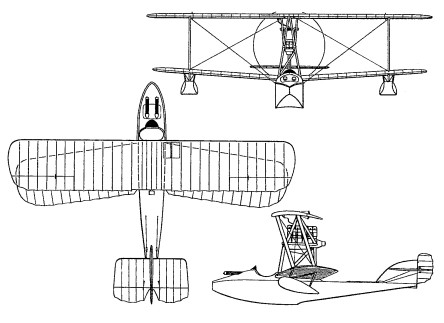
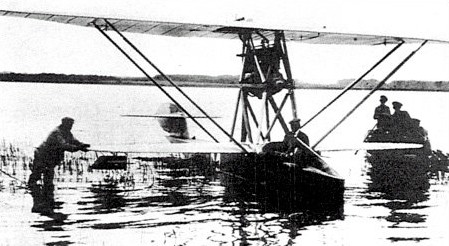
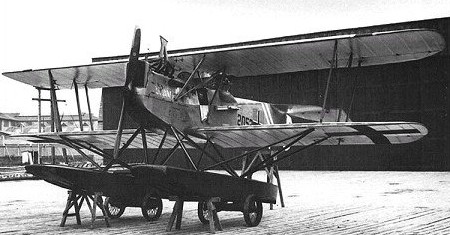
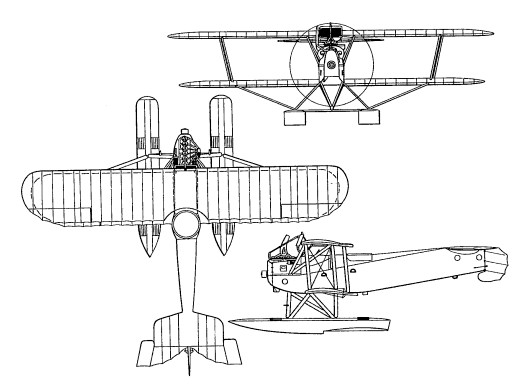
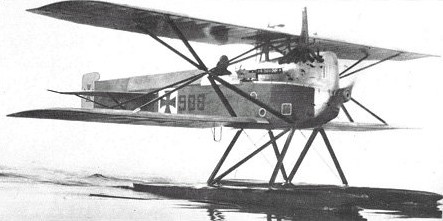
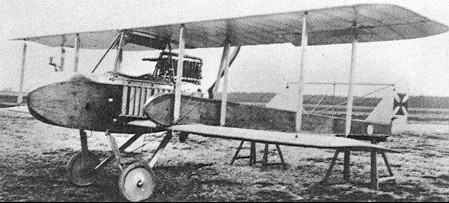
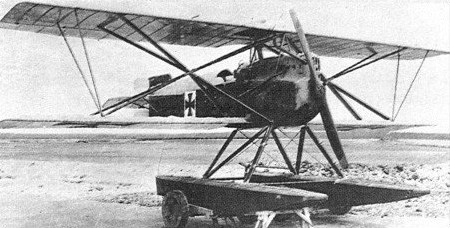
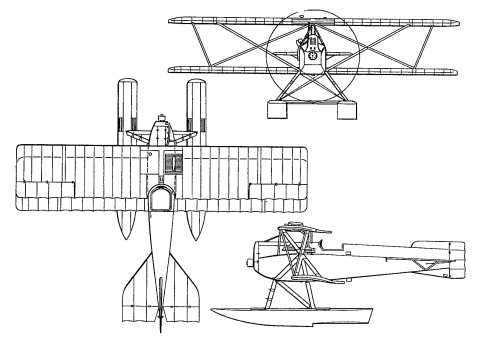
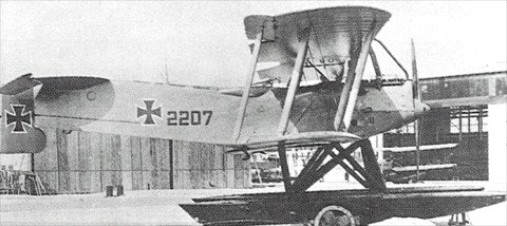
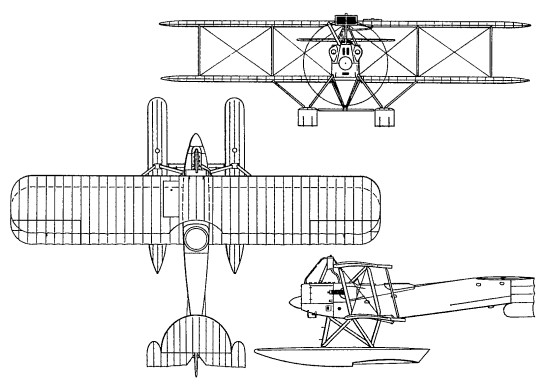
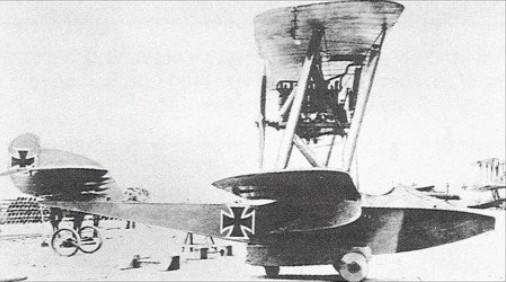
An enlarged W.12 developed to meet a demand for a two-seat fighter seaplane with greater endurance, the W.19 was first committed to operations in January 1918. Appreciably larger than the W.12, the W.19 was of similar construction with fabric-covered wings and plywood- covered fuselage and floats, and was powered by a 260hp Maybach Mb IVa six-cylinder water-cooled engine. The substantial increase in span necessitated the adoption of a two-bay arrangement, and, apart from the three prototypes, all W.19s carried an armament of two 7.92mm LMG 08/15 synchronised machine guns and a single Parabellum of similar calibre on a flexible mount in the rear cockpit. One W.19 was experimentally fitted with a 20mm Becker cannon for trials. A total of 53 production W.19s was completed (one being retained for static tests).

W.19
Crew: 2
Engine: 1 x 260hp Maybach Mb.IV
Max take-off weight: 2005 kg / 4420 lb
Empty weight: 1435 kg / 3164 lb
Wingspan: 13.80 m / 45 ft 3 in
Length: 10.65 m / 35 ft 11 in
Height: 4.10 m / 13 ft 5 in
Wing area: 57.80 sq.m / 622.15 sq ft
Max. speed: 151 km/h / 94 mph
Cruise speed: 143 km/h / 89 mph
Ceiling: 5000 m / 16400 ft
Rate of climb: 156 m/min / 500 ft/min
Armament: 2 x 7.92
Hansa-Brandenburg W.18

The W.18 single-seat fighter flying boat was, like the CC that it supplanted, intended primarily for the Austro- Hungarian Navy. The prototype was flown early in 1917 with a 150hp Benz Bz III six-cylinder water-cooled engine, and production with a 200hp Hiero engine was undertaken on behalf of the Austro-Hungarian Navy, a total of 47 being delivered between September 1917 and May 1918. Armament normally comprised two fixed forward-firing 8mm Schwarzlose machine guns, and the W.18 was employed for both station defence and fighter patrol tasks. One Benz-engined example was delivered to the German Navy in December 1917.

Max take-off weight: 1145 kg / 2524 lb
Empty weight: 875 kg / 1929 lb
Wingspan: 10.70 m / 35 ft 1 in
Length: 8.15 m / 27 ft 9 in
Height: 3.45 m / 11 ft 4 in
Wing area: 34.38 sq.m / 370.06 sq ft
Max. speed: 170 km/h / 106 mph

Hansa-Brandenburg W.17 / A 49

A single-seat fighter flying boat developed for the Austro- Hungarian Navy, the prototype of the W.17 (also designated A 49/I) was a biplane with a cantilever lower wing and was tested at Pola in July 1917. K.u.k. Linienschiffsleutnant Gottfried Banfield, responsible for the evaluation of the W.17, felt that the cantilever lower wing was unsuited for marine use and that the flying boat possessed inadequate manoeuvrability. Armament of the W.17 comprised two 8mm Schwarzlose machine guns and the initial aircraft was allegedly lost when the upper wing broke away in flight. A second aircraft (the A 49/II) was completed as an equispan triplane with interplane bracing struts. This is believed to have been submitted to the Austro-Hungarian Navy for evaluation in July 1917.

Hansa-Brandenburg W.16

Intended primarily as a successor to the KDW in the station defence fighter role, but also to investigate the potentialities of the application of rotary engines to seaplanes, the W.16 was designed by Ernst Heinkel in 1916, and was a conventional twin-float single-seat fighter floatplane of wood and fabric construction with ply-skinned fuselage and floats. Like Heinkel’s earlier “star strutter” fighters, the W.16 lacked bracing wires, these being rendered unnecessary by single struts extending from the base of the inclined Vee-type interplane struts to the top of the forward fuselage mainframe. Power was provided by a 160hp Oberursel U III rotary engine and armament comprised two synchronised LMG 08/15 machine guns. Three prototypes were ordered, the first of these being tested in February 1917, and the third example was sent to Adlershof for static tests. No further development was undertaken as the German Navy had lost interest in single-seat fighter floatplanes.

Max take-off weight: 896 kg / 1975 lb
Empty weight: 636 kg / 1402 lb
Wingspan: 9.25 m / 30 ft 4 in
Length: 7.35 m / 24 ft 1 in
Height: 2.92 m / 10 ft 7 in
Wing area: 21.35 sq.m / 229.81 sq ft
Max. speed: 170 km/h / 106 mph

Hansa-Brandenburg W.12

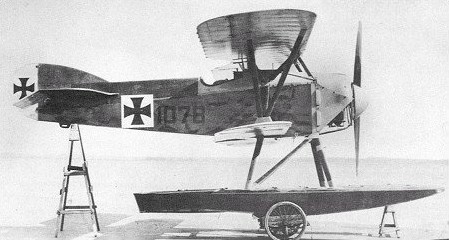
Designed and built in late 1916, the Branden¬burg W.12, first of several highly successful floatplane fighters evolved by Ernst Heinkel, had its prototype completed and flown for the first time in January 1917 with a 160hp Mercedes D III six-cylinder water-cooled engine.

Hansa-Brandenburg W.12 Article

A single-bay twin-float two-seat fighter biplane, of wooden construction with plywood fuselage skinning, the W12 was produced for the German Navy with both the 160hp Mercedes D IIIa engine and the 150hp Benz Bz III. Its first operations were conducted from the seaplane station at Zeebrugge.

Standard armament comprised one forward-firing synchronised 7.92mm LMG 08/15 machine gun and a Parabellum of similar calibre on a flexible mount in the rear cockpit, but of the 146 W.12s that had been built when production terminated in June 1918. One batch of 30 Benz-engined fighters had been delivered with a forward-firing armament of two LMGs.

The W.12 remained in first line service until the Armistice.

W.12
Engine: 1 x 160hp Mercedes D.III or 150 hp Benz Bz.III
Max take-off weight: 1454 kg / 3206 lb
Empty weight: 997 kg / 2198 lb
Wingspan: 11.20 m
Length: 9.60 m
Height: 3.30 m / 11 ft 10 in
Wing area: 36.20 sq.m / 389.65 sq ft
Max. speed: 161 km/h / 100 mph
Cruise speed: 146 km/h / 91 mph
Ceiling: 5000 m / 16400 ft
Armament: 3 x 7.92mm
Crew: 2

Hansa-Brandenburg W.11

A heavier and more powerful derivative of the KDW, the 1917 W.11 single-seat twin-float fighter biplane was powered by a 220hp Benz Bz IVa water-cooled engine and retained the “star” interplane bracing arrangement of its predecessor. Armament consisted of two synchronised LMG 08/15 machine guns, and two prototypes were completed during February-March 1917. No series production was undertaken.

Max take-off weight: 1233 kg / 2718 lb
Empty weight: 935 kg / 2061 lb
Wingspan: 10.10 m / 33 ft 2 in
Length: 8.10 m / 27 ft 7 in
Height: 3.32 m / 11 ft 11 in
Wing area: 31.42 sq.m / 338.20 sq ft
Max. speed: 176 km/h / 109 mph
Range: 350 km / 217 miles

Hansa-Brandenburg L.16

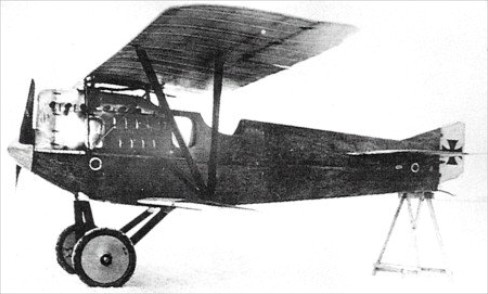
A 1917 single-seat equi-span fighter triplane, developed for the Austro-Hungarian K.u.k. Luftfahrttruppen, with aerofoil-section I-type interplane bracing struts, the L.16 was powered by a 185hp Austro-Daimler six-cylinder water-cooled engine and was intended to carry an armament of two synchronised machine guns. Various coolant radiator arrangements were evaluated on the single prototype built, but the fighter offered insufficient promise to warrant series production and development was abandoned.

Max take-off weight: 935 kg / 2061 lb
Empty weight: 740 kg / 1631 lb
Wingspan: 9.00 m / 30 ft 6 in
Length: 7.21 m / 24 ft 8 in
Height: 3.70 m / 12 ft 2 in
Wing area: 33.5 sq.m / 360.59 sq ft
Max. speed: 190 km/h / 118 mph

Hansa-Brandenburg L.14

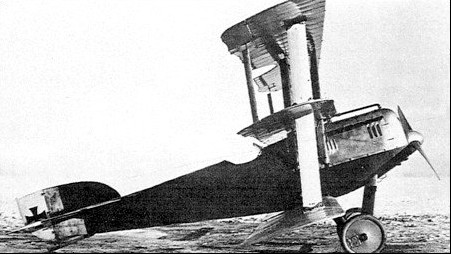
A derivative of the KD (D.I) with larger overall dimensions, simplified interplane bracing and a 200hp Hiero six-cylinder water-cooled engine, the L.14 single-seat fighter was evaluated by the Austro-Hungarian air arm in 1917, but was not accepted for series production. Two prototypes were built and flown, these differing primarily in the arrangement of the interplane bracing struts employed, and intended armament was twin 8mm Schwarzlose synchronised machine guns.

Max take-off weight: 940 kg / 2072 lb
Empty weight: 740 kg / 1631 lb
Wingspan: 10.20 m / 33 ft 6 in
Length: 7.05 m / 23 ft 2 in
Max. speed: 180 km/h / 112 mph

Hansa-Brandenburg KF

The first fighter to be designed by Ernst Heinkel as chief designer for the Hansa- und Brandenburgische Flugzeug-Werke, the KF two-seater appeared early in 1916, and was a two-bay, twin-boom biplane powered by a 150hp Benz Bz III six-cylinder water-cooled engine installed as a pusher and driving a two-bladed pro-peller between the tailbooms. The KF was of wooden construction with plywood-covered fuselage nacelle and tailbooms, and armament was intended to consist of a single 7.92mm Parabellum machine gun on a flexible mounting in the forward cockpit. Work on the KF was discontinued as it offered no advance in performance over the similarly-configured Ago C.I which served in the reconnaissance role.

Max take-off weight: 1290 kg / 2844 lb
Empty weight: 760 kg / 1676 lb
Wingspan: 11.60 m / 38 ft 1 in
Length: 8.48 m / 28 ft 10 in
Wing area: 38.6 sq.m / 415.49 sq ft
Max. speed: 140 km/h / 87 mph

Hansa-Brandenburg KDW

The KDW twin-float single-seat fighter seaplane was essentially a 1916 conversion of the land-based KD (D.I) to provide an interim aircraft for floatplane station defence. The only major change introduced on the prototype apart from provision of a twin-float chassis was some slight extension of the wings, but the fin area was later increased to compensate for the increased keel area resulting from the addition of the floats.
The prototypes were fitted with the 150hp Benz Bz III six-cylinder water-cooled engine, but apart from a preproduction batch of 10 similarly-powered aircraft, all subsequent examples of the KDW had the 160hp Maybach Mb III six-cylinder water-cooled engine.
The first production series was armed with a single synchronised 7.92mm LMG 08/15 machine gun mounted on the starboard side of the nose, but the final batch of 20 delivered between October 1917 and February 1918 had a gun mounted on each side of the cockpit and additional Vee-type interplane bracing struts.
A total of 58 KDW float fighters was delivered.

KDW
Engine: 1 x 160hp Maybach Mb.III
Max take-off weight: 1039 kg / 2291 lb
Empty weight: 759 kg / 1673 lb
Wingspan: 9.30 m / 31 ft 6 in
Length: 7.86 m / 26 ft 9 in
Height: 3.35 m / 11 ft 0 in
Wing area: 29.15sq.m / 313.77 sq ft
Max. speed: 171 km/h / 106 mph
Cruise speed: 154 km/h / 96 mph
Ceiling: 3500 m / 11500 ft
Rate of climb: 145 m/min / 500 ft/min
Armament: 2 x 7.92mm
Crew: 1