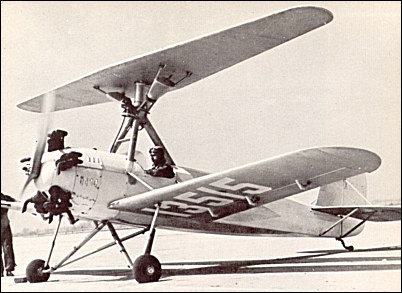
The Convertoplane, cross between an airplane and a rotorplane, was developed in the United States in the 1930s by the Gerard P. Herrick, aided by Ralph H. McClarren of Philadelphia’s Franklin Institute. Basically, the design was a biplane with an upper wing that could function either as a lifting surface or as a two-bladed teetering rotor. Flown by test pilot George Townsend in 1937, the aircraft demonstrated successful conversions in flight from a biplane to a rotorplane. Herrick was striving for an aircraft that could achieve speed as an airplane while possessing ability to convert to rotating-wing configuration for landing and take-off in tight areas.
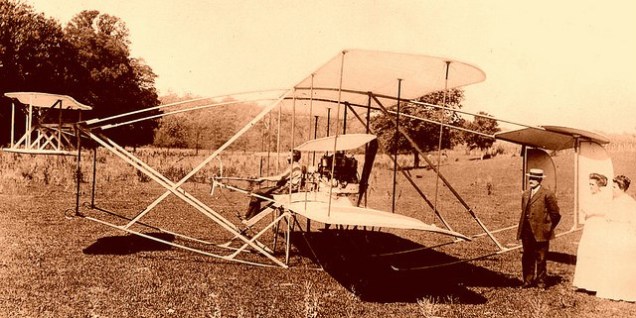
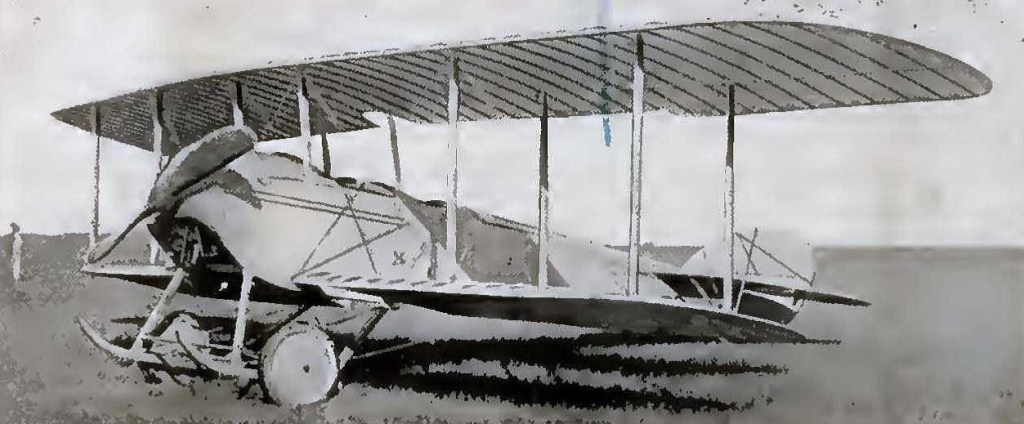
This somewhat Wright-like machine was constructed in Anderson, Indiana, USA, by Charles H. Hensley, a 40-year-old man who enjoyed building and flying box kites, and Levi Calvin Lambert, who was a 33-year-old plant manager and a member of the family that owned the Lambert Gas and Gasoline Engine Co., also of Anderson, which probably provided the engine. A grandson of Hensley stated that the plane flew around in a circle, for how long or at what height is unknown. He was told the plane was dismantled after its only flight.
Spurred on by Ernst Udet’s enthusiastic reports on what he’d seen during his tour of the United States, the Luftfahrtkomissariat’s C AMT let design contracts to Fiesler and Henschel for prototypes of Sturzkampffleugzeugen, or dive bomber.
In February 1934, a requirement was published for the aircraft and tenders were awarded to Hamburger Flugzeugbau GmbH, Fieseler Aircraft GmbH and Henschel Aircraft GmbH.
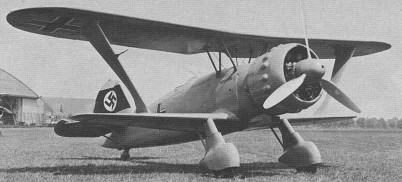
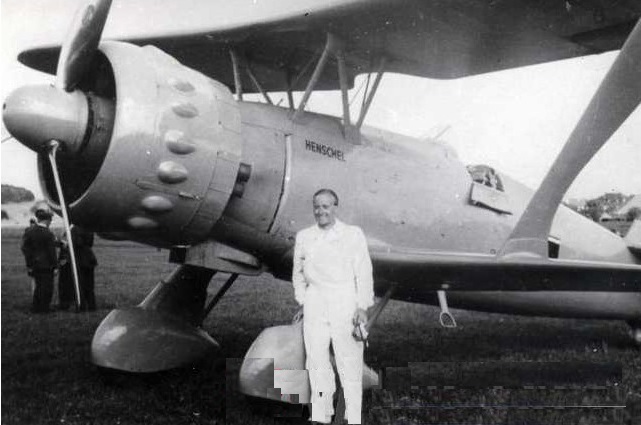
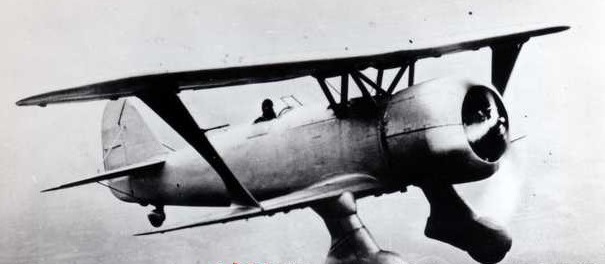
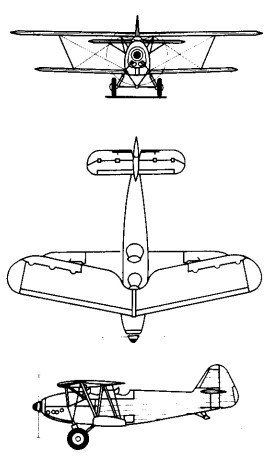
Henschel chief designer Friedrich Nicolaus developed a sesquiplane with an open cockpit and fixed landing gear of all-metal construction. The power was a BMW 132 enclosed in a NACA ring. The wings had the usual control surfaces and they were partially covered with fabric. The control surfaces were all covered with fabric.
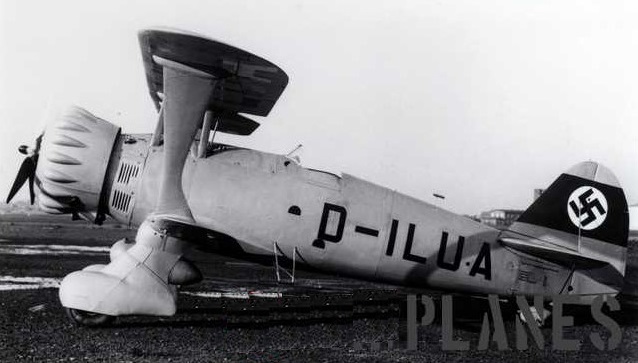
The construction of the prototype progressed rapidly and on 1 April 1935, the Hs 123 V1 was completed. Maiden flight was on April 5, 1935 and Hs 123 V1 had the registration D-ILUA. The V2 was tested with a Wright Cyclone R-1820 F52, starting with 770 hp power. This machine suffered from a landing accident and later was adapted to use the BMW 132 A and in this configuration was designated as Hs 123 V8.
The testing of the three machines from different manufacturers was held at Rechlin from June 1935 up to January 1936. Henschel’s Hs 123, flown by Udet himself, comfortably beat out its competition, the Fi 98, but two prototypes were lost in quick succession once flight testing had begun at Erprobungsstelle Rechlin. Examination of the wreckage and static testing of the surviving ariplane pointed to weakness in the top wing’s center-section, the design being modified accordingly. The Henschel Hs 123 was found as most suitable from all proposed aircraft and production began in 1936 at Kassel. The Hs 123 V5 was presented in 1937 at the International Air Meeting in Dübendorf.
The very first production block was Hs 123A-0, delivered to units in 1936 and the main purpose for these machines was operational testing by the Luftwaffe. The first series-manufacture example was the Hs 123A-1 and these had minor differences compared with the previous pre-production block. The aircraft was equipped with pilot armor. The main offensive armament was four SC50 bombs mounted on the bottom wing racks with optional SC250 bomb mounted beneath the fuselage. On the fuselage central position it was also possible to mount a droppable fuel tank. Two MG 17 machine guns, caliber 7.92 mm, were mounted in the top nose and they were synchronized to fire through the propeller arc.
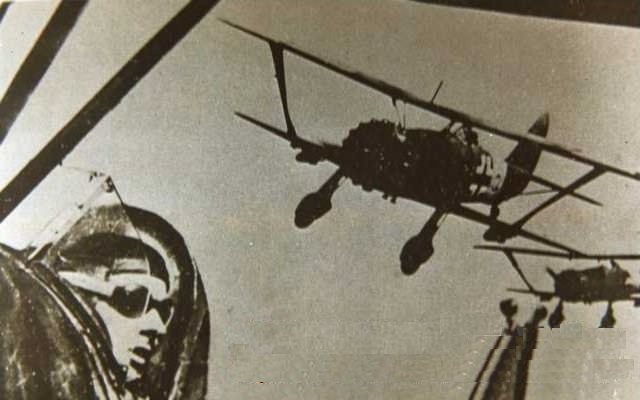
Hs 123A 1s first entered service with Stukagruppe I/162 Immelmann, examples soon being sent off to Spain where they were flown by “volunteers” from the Legion Condor, proving their worth by providing close support for Nationalist ground forces. The Spanish Air Force later received the remaining Hs 123 A-1. These Hs 123 were based in Seville and during the combat evaluation Hs 123 performed at a high efficiency in the close-support missions, and at the same time performed as a safe combat platform for its pilots.
By 1939, despite its success in Spain, the Luftwaffe considered the Hs 123 obsolete and most of the Schlachtgeschwader equipped with the type had been disbanded and only II.(Schl)/LG2 remained operational with the Hs 123. Sole operational II. (Schl)/LG 2 had 39 machines which were engaged in combat missions during the Polish Campaign. This single unit proved to be particularly effective and this is greatly dedicated to the sound of the engine which had a psychological effect on ground forces. It was also true that the Hs 123 could take considerable punishment and stay flyable. One of the benefits was use from unprepared airfields.
After this good combat record, the Hs 123 was put into the combat missions over the Low Countries and France. At this time the Luftwaffe had two operational combat aircraft, the Junkers Ju 87 was a dive bomber and the only machine that could give close support was the Hs 123, previously declared by the Luftwaffe as ’obsolete’. After the campaign in France some number of machines was sent to 10.(Schl)/LG 2. and they were seriously considered to be used during Operation Barbarossa. In the begining of Operation Barbarossa, the single Gruppe of the Luftwaffe that was providing ground support was II.(Schl)/LG 2, equipped with 38 Bf 109Es and 22 Hs 123s. During the operations the Bf109 was shown vulnerable during operations with weak landing gear as well as a sensitive engine to ground fire and Hs 123 again showed some advantage as a close support aircraft. The Escuadrilla Azul, volunteers from Spain flew the type during this time. Bitter experience came in the winter 1941/42 since the open cockpit was not good accommodation for pilots in harsh winter climate. From January 1942, the unit was re-designated as SchlG 1 and Hs 123 became a part of 7./SchlG 1. SchlG 1 took part in the operations in Crimea, Battle of Kharkov and in the Battle of Stalingrad. The Hs 123 was then being replaced with modern aircraft. The remaining machines were sent to the trainer units as well as in non-operational occupied zones.
China imported 12 Hs 123 A-0 from Germany before the war, those aircraft only saw limited actions in the Chinese air force, after new aircraft from the Soviets arrived in China after 1938, those survived German war planes were transferred to reserve. Germany stopped military supply to China in May 1938 and the Hs 123s suffered from shortages of spare parts and they saw limited service. Operated by 15th Sq of the Chinese air force, the few Hs 123 were used in the dive bombing role against Japanese shipping on the Yangtze River in 1938.
Although scheduled to be phased out in favor of Junker’s Ju 87 the Hs 123 did its ground attack job so well that General Wolfram von Richthofen recommended, in 1943, that it be put back into production. Whatever the idea’s worth it could not be followed up on, since all tooling and jigs had been broken up for scrap three years earlier.
Last samples of the Henschel Hs 123 remained operational until the spring 1944 when 7./SG 1 replaced their last Hs 123s with the Ju 87. By 1945, the Hs 123s that remained serviceable were reassigned to secondary duties such as supply dropping and glider towing.
During its service the Hs 123 had just a few operational camouflage patterns. First one was splinter with RLM 61, 62 and 63 at the topside and RLM 65 at the bottom. There were two variations of this scheme used. During the later service this camouflage pattern was still used no matter that it was officially discarded and during overpainting the aircraft got single colour of RLM 71 or 70 at the topside.
Hs 123A-1 Engine: 1 x BMW 132Dc, 656kW Max take-off weight: 2215 kg / 4883 lb Empty weight: 1500 kg / 3307 lb Wingspan: 10.5/8.0 m / 34 ft 5 in / 26 ft 3 in Length: 8.33 m / 27 ft 4 in Height: 3.2 m / 10 ft 6 in Wing area: 24.85 sq.m / 267.48 sq ft Ceiling: 9000 m / 29550 ft Range: 855 km / 531 miles Armament: 2 x 7.92mm machine-guns, 450kg of bombs Crew: 1
An American-designed and -built, two-seater mono-biplane, so called because it could be fitted with interchangeable wings and could be flown as either a biplane or a monoplane. It was the 1912 work of the Heinrich Brothers of Baldwin, Long Island, and was a conventional monoplane design, but had many original construction features.
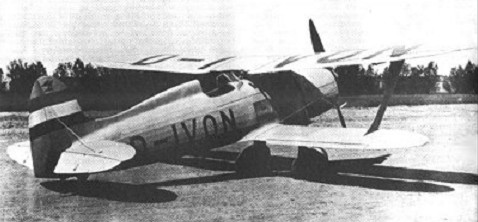
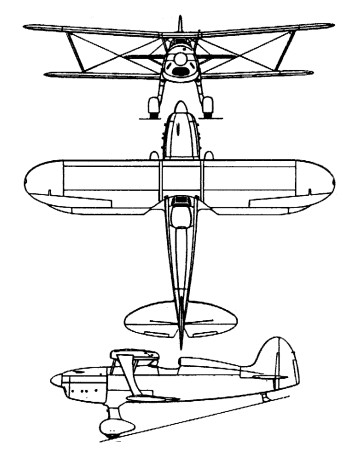
Scaled-down version of the He 51 biplane, intended as an advanced trainer and home defence fighter. The Fw 56 was selected for this requirement. Only three were built.
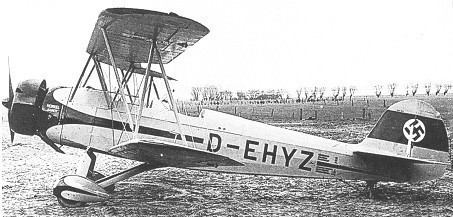
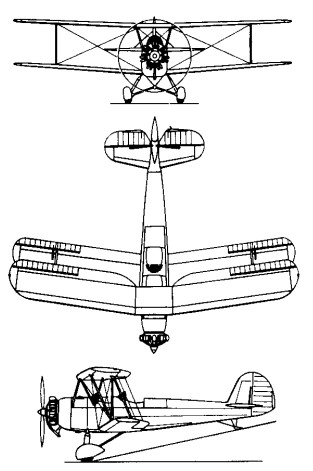
The Kadett (cadet) was a thoroughly conventional fabric-covered biplane trainer and liaison aeroplane of its period, and first flew in 1933 with the As 8B engine and nicely spatted main landing gear units. The type entered official service first with the training schools of the National Socialist Flying Corps, and then with the Luftwaffe. Comparatively large numbers were built, the production variants being the He 72A with the 104-kW (140-hp) Argus As 8B or later the 112-kW (150-hp) As 85 inlines, the He 72B major variant with a radial engine, and the He 72BW twin-float seaplane. Some 30 civil aircraft were built with the designation He 72B-2 Edelkadett (honour cadet), and there was a single He 172 with a NACA-cowled engine. Some aircraft were supplied to Slovakia during World War II, and these were even used as tactical reconnaissance machines during 1945.
He 72A Engine: Argus As 8B or As 8R, 104-kW (140-hp) or 112-kW (150-hp).
He 72B Engine: 1 x Siemens Sh 14A, 119kW / 160 hp Wingspan: 9.0 m / 29 ft 6 in Length: 7.50 m / 24 ft 7 in Height: 2.70 m / 8 ft 10 in Wing area: 20.70 sq.m / 222.81 sq ft Max take-off weight: 865 kg / 1907 lb Empty weight: 540 kg / 1191 lb Max. payload weight: 130.1 lb / 59.0 kg Fuel capacity: 27 gal / 101 lt Wing loading: 8.82 lb/sq.ft / 43.00 kg/sq.m Max. speed: 100 kts / 185 km/h / 115 mph Landing speed: 43 kts / 80 kph Cruising speed: 85 kts / 158 kph Take off distance: 591 ft / 180 m Service ceiling: 13780 ft / 4200 m Initial climb rate: 826.77 ft/min / 4.2 m/s Operational range: 295 miles / 475 km Maximum range: 443 nm / 820 km Armament: none. Seats: 2
The first prototype flew in 1932. There were two variants: the land based He-63L and the float plane He-63W.
He-63 Engine: 1 x As-10Ca, 160kW Wingspan: 10.8/8.0 m / 35 ft 5 in / 26 ft 3 in Length: 8.2 m / 26 ft 11 in Height: 2.7 m / 8 ft 10 in Wing area: 24.4 sq.m / 262.64 sq ft Max. Speed: 200 km/h / 124 mph Cruise speed: 190 km/h / 118 mph Ceiling: 3900 m / 12800 ft Range w/max.fuel: 1100 km / 684 miles Armament: 1 machine-gun Crew: 2
The prototype He 60a (D 2325) first flew in 1933. It was designed by Reinhold Mewes, who had also been responsible for the He 59. The prototype was fitted with a 492kW / 660 hp BMW VI V type engine and a twin float undercarriage, and was used primarily for testing the floats. A second prototype, the He 60b, was powered by an uprated 750 hp engine, but this proved to be little more effective than the previous powerplant and the 660 hp version was reinstated in the third prototype and all subsequent production aircraft. The third prototype, the He 60c, was used for shipboard catapult launching trials and was the first post 1919 aircraft to be delivered to the German navy. In April 1933 the first of the initial pre-production batch of 21 He 60A machines was flown. They were to be used as land based trainers, but two were later modified with the addition of catapult equipment. Still considered by the Heinkel company capable of carrying greater weights if given a more powerful engine, one He 60 was fitted with a 900 hp Daimler Benz DB 600, which increased the top speed by 45 km/h (28 mph), and was given the designation He 60B 3. Many trials were made with this aircraft but production never materialized. The main He 60C series were delivered to the German navy from late 1934 onwards. They were fitted with catapult hooks and armed with one movable 7.9 mm (0.311 in) MG 15 machine¬gun in the observer’s rear cockpit. Two were kept by Heinkel as test aircraft and eventually went to a training school. The D series which followed were fitted with improved radio and a forward firing 7.9 mm (0.311 in) MG 17 gun, but were later converted to unarmed trainers. All production C and D series (totalling 200 aircraft) were built by the Arado and Weser companies. Following Heinkel practice the airframe was of steel tube and wood construction with fabric covering. Floats and engine cowling were of aluminium. A crew of two was carried in tandem open cockpits. Before the Second World War, He 60s were deployed aboard every major warship of the German navy, but by 1939 had been replaced in the shipboard role by the Arado Ar 196. They were retained in shore based service in the North Sea, Baltic and Eastern Mediterranean until as late as 1943, and were eventually used for communication and training.
He-60 Engine: 2 x BMW VI 6.0 ZU, 485kW Span: 12.9 m / 42ft 3.75 in Length: 11.5 m / 37 ft 8.75 in Max take-off weight: 3400 kg / 7496 lb Empty weight: 2730 kg / 6019 lb Max. speed: 225 km/h / 140 mph Cruise speed: 215 km/h / 134 mph Ceiling: 5000 m / 16400 ft Range w/max.fuel: 900 km / 559 miles Crew: 2 Armament: 1 x 7.92mm machine-guns
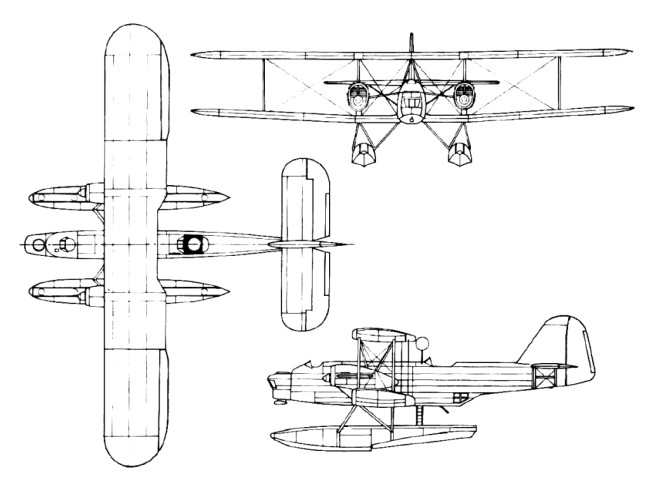
The design project for this large fuselage torpedo bomber/reconnaissance biplane was begun in 1930 by Reinhold Mewes of the Heinkel company, and was the largest of the company’s designs up to that time. The first prototype to fly, the He 59A (D 2215), was of sturdy appearance with a faired in wheeled undercarriage and was powered by two 492kW / 660 hp BMW VI liquid cooled engines. The airframe comprised a welded steel tube fuselage, with wooden frame wings, all of which were fabric covered.
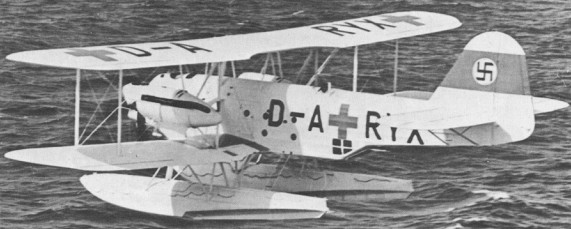
As its intended role was for overwater reconnaissance, all production models and the He 59B first prototype (which was the second example to fly) were fitted with twin float undercarriages. After service trials of the He 59A, production began in spring 1932 with a pre series batch of 16 armed He 59B-1s. It is fairly certain that these were built by Heinkel, but the next production orders, for 140 He 59B 2s and B 3s, were executed by the Arado Flugzeugwerke. The B series differed basically in internal equipment only. The B 1s were equipped with a 7.9 mm (0.311 in) ring mounted MG 15 machine gun in the extreme nose. Two additional MG 15s were fitted on the He 5913 2, in the dorsal and ventral positions. A crew of four was carried. A long range reconnaissance version, the He 59B 3, carried extra fuel in place of one of the guns.
In 1936 10 He 59B 2s were sent to Spain to join the Legion Condor, their floats prompting the nickname “Zapatones,” or “Big Shoes,” three of the planes being transferred to Franco when the Germans returned home. The He 59C-1, used for training, had additional maritime navigation equipment installed and all armament deleted. The He 59C 2 was used for air sea rescue duties and it too was unarmed, carrying instead six dinghies plus additional radio equipment. Other variants included the He 59D 1 for air sea rescue and training, with a rounded, all metal ‘solid’ nose; the He 59E 1 torpedo trainer; and the He 59E 2 photographic reconnaissance trainer model. All of the C, D and E models were converted for their various roles from He 59B aircraft of the original order by the Walter Bachmann Flugzeugbau. The He 59N was a Bachmann conversion from the He 59D 1 for specialized navigation training duties, and was equipped to carry a practice torpedo plus smoke bombs. Although more or less obsolescent when it entered service with the Luftwaffe in 1934, the He 59 was to remain in production for four more years and in service for about a decade, not disappearing finally from active duty until the middle of the Second World War. Its long service was due chiefly to the versatility of its roomy fuselage, virtually all of which was available for crew and payload since fuel was carried in the floats. In the maritime bomber role, this meant the ability to carry two 500 kg (1100 lb), four 250 kg (550 lb) or 12 50 kg (110 lb) bombs internally; or, alternatively, one or two 700 kg (1540 lb) or 1000 kg (2200 lb) externally slung torpedoes. The He 59 was ‘blooded’ in the latter part of 1936 in the Spanish Civil War as part of the Luftwaffe’s Legion Kondor, operating both in the maritime role and as a night bomber. Some examples were fitted with a 20 mm (0.79 in) MG FF cannon for attacks on shipping. At the start of the Second World War there were still about 30 He 59s on the strength of the Kustenfliegergruppe (coastal aviation group) covering the North Sea area. In addition to the majority by then employed in various training roles, the He 59 continued in Luftwaffe service until as late as 1943 on air sea rescue, mine-laying, convoy-shadowing and coastal reconnaissance duties, latterly in the somewhat less dangerous waters of the Mediterranean, Aegean and Black Seas. It was important as an electronic-warfare platform and as a special trials aircraft.
He 59B 2 Engine: 2 x BMW VI 6.0 ZU, 485kW Max take-off weight: 9100 kg / 20,100 lb Empty weight: 5440 kg / 11993 lb Wingspan: 23.7 m / 77 ft 9 in Length: 17.4 m / 57 ft 1 in Height: 7.1 m / 23 ft 4 in Wing area: 153.4 sq.m / 1651.18 sq ft Max. speed: 240 km/h / 149 mph Cruise speed: 205 km/h / 127 mph Range w/max.fuel: 800 km / 497 miles Crew: 4 Armament: 1-2 7.92mm machine-guns 15 or 1 x 20mm machine-guns FF cannon





 All Aero