Huff-Daland XLB-1

Keystone Aircraft Corpora¬tion built a total of 220 aircraft in the US Army Air Corps LB (light bombardment) category, venturing briefly also into the B (bombardment) and HB (heavy bombardment) classifications. All except ten of the LBs were twin engined aircraft, but had their origins in the single–engined XLB 1 prototype and nine pre series LB 1 biplanes produced in 1925 by Key¬stone’s predecessor company, Huff Daland and Co Inc of Ogdensburg, New York, which became Keystone in March 1927.

The XLB-1 three-seat, single-engine light bomber was tested in 1923, mount¬ing an 800 hp Packard and was developed as the twin-engined XLB-3, with a crew of five. The basic LB 1 airframe was redesigned by Keystone in 1927 as the twin engined XLB¬3A.

Howland H-2 Honey-Bee / Classic Aero H-2 Honey-Bee

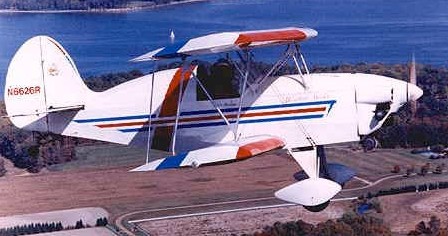
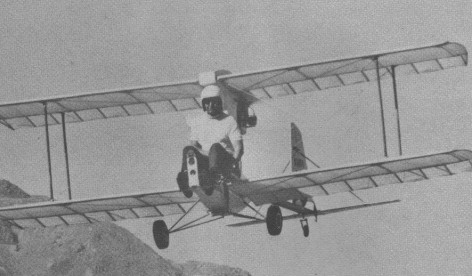
The H-2 Honey Bee is a lightweight aerobatic biplane first flown in 1986. With the H-2, designer Bert Howland introduced the technique of TIG-welding the fuselage from square 6061-T6 aluminum tubing, yielding a strong and rugged fuselage frame that weighs only 24 pounds. The airfoil on the 4 equal span wings is 6-1/2” thick and features 7 aluminum-capped foam ribs per panel with a D-cell leading edge spar and a C-section rear spar. Design load factor is +8g to -6g.
The prototype and early versions used engines in the 40-46 horsepower range, but the designer later moved up to an engine of 65 horsepower as standard. The plans provide a two or four aileron option for those who wish a more responsive roll rate. When that option is selected, together with an engine in the 85 horsepower range or better (such as the Hirth F-30), and with an inverted fuel system, the H-2A is suitable for use in competition aerobatics up to the International Aerobatic Club’s “intermediate level.”
In 1992, an H-2A Honey Bee was named “Best” in the combined Ultralight/Lightplane category during the EAA East Coast Fly-In at Wilmington, Delaware.
The aircraft has been powered with engines from 40 to 95 hp. Homebuilder plans cost $250 in 2009 and consist of 40 engineering drawings and designer construction notes.

Classic Aero H-2A Honey Bee

Speed max: 68-80 mph.
Cruise: 55-68 mph.
Stall: 25-35 mph.
ROC: 400-850 fpm.
Take-off dist: 125-200 ft.
Landing dist: 150-275 ft.
Service ceiling: 8,000 ft.
Engine: Hirth 2705, 65 hp.
HP range: 40-95
Prop: 60-69in.
Fuel cap: 7.5-12 USG.
Weight empty: 335-496 lbs.
Gross: 550-725 lbs.
Length: 15.75 ft.
Wing span: 19 ft.
Wing area: 140 sq.ft.
Seats: 1.
Landing gear: tail wheel.
Design load at 550 lbs: +8,-6g.

Classic Aero H-2A Honey Bee
Engine: Hirth 2706, 65 hp
Wing span: 5.8 m
Wing area: 13 sq.m
Empty weight: 150 kg
MAUW: 270 kg
Fuel capacity: 40 lt
Max speed: 130 kph
Cruise speed: 108 kph
Minimum speed: 48 kph
Climb rate: 6 m/s
Fuel consumption: 12 lt/hr
Seats: 1
Plan price (1998): US$250

Howard Hughes Engineering PR Bipe / ALW Bipe

PR Bipe

Designed and manufactured by Australian LightWing as a kit aircraft, the first PR-Bipe was test flown on Sat 10 July 2004. The aircraft was completed by Eddie Sieve in Sydney’s Northern suburbs, the aircraft was flown at Cessnock NSW.
The Bipe is a pleasure to fly with ultra responsive controls and is ideally suited to positive G aerobatics the second seat can carry up to an 85 kg passenger or baggage. The aircraft shown above is powered by the Jabiru 4 Cyl 4 stroke engine. The PR-Bipe is a derivative of the PR-582, this superb aircraft can be fitted with either the Rotax 582, the 912 or the 912-s.
The ALW Bipe Wing span is reduced to 6m. The aircraft can be built with a fully enclosed cockpit seating two. An open configuration Bipe can be made to order. The aircraft is available as a kit or a quick build kit and is suitable for either AUF or Experimental registration where aerobatics are approved by the manufacturer.

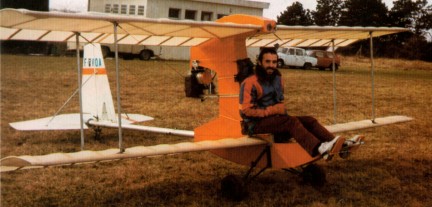
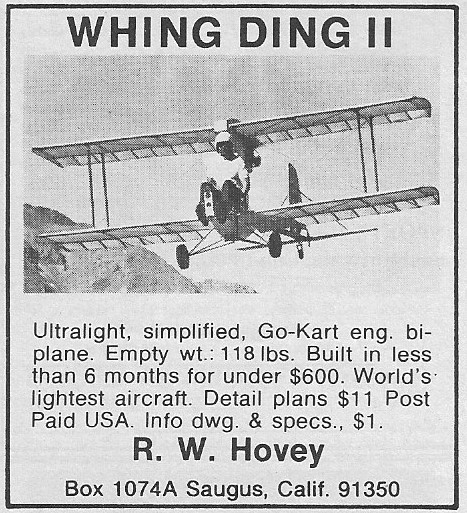
Hovey Whing-Ding

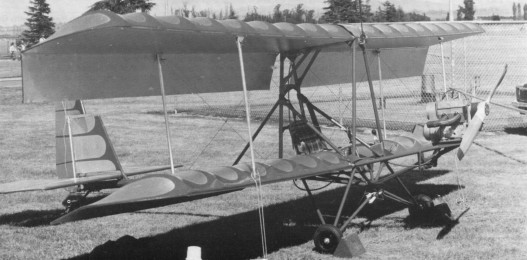
Single seat single engined biplane with conventional three axis control. Wings have un¬swept leading and trailing edges, and constant chord, conventional tail. Pitch control by elevator on tail; yaw control by fin mounted rudder; roll control by full span ailerons on each wing; control inputs through stick for pitch/roll and bar for yaw. Wing braced by struts, and transverse X cables; wing profile Hovey 10; double surface. Tail surfaces of plywood-reinforced foam core. Undercarriage has three wheels in tail dragger formation. Fiberglass-covered laminated fir suspension on main wheels. Push right go right tailwheel steering connected to yaw control. Mahogany plywood closed-box fuselage, without pod, 3” aluminum tube tail boom foam filled for stiffness. Fuselage accommodates seat, rudder bar, standard controls and wing spar sockets. Engine mounted between wings driving pusher propeller.
Bob Hovey started to design the Whing Ding in October 1970 and at the same time he started to build the prototype. The result was that it accomplished its first flight in February 1971, only five months later.

Hovey Whing-Ding Article

Bob’s objective was to design a single seater which was easy to build in minimum time, offering the qualities of a STOL aircraft (short take off and landing), and quickly demountable to fit on to its specially designed road trailer. This 15-hp, 300-pound gross-weight biplane is the ultimate in lightness and simplicity. The tail surfaces are constructed from ½-inch thick Styrofoam art-board faced with high strength kraft paper on both sides, with the critical areas reinforced with 1/8-inch plywood gussets. The tail boom is a 3-inch aluminum pipe filled with foam to resist buckling. The fuselage is basically a 6-inch wide box of plywood filled with foam that serves as an engine mount and a mast support for the wings. The prop is belt-driven from a 15-hp McCulloch two-cycle go-kart engine. The wings have two spars and are fabric covered. The prototype established a record for light aircraft, with an empty weight of less than 121 lb (55 kg), but its designer had to abandon the original design of the tail structure which was made from polyurethane foam covered in kraft paper.
The wing section is an in house design, the Hovey 10, and the two wings are of equal span, staggered by 4O and having 1 O of dihedral. Their structure is a twin spar design in wood, using tubular metal ribs and with a polyurethane foam leading edge, the covering being fabric. The fuselage has a pine frame with mahogany plywood cladding and is filled with polyurethane foam. The pilot sits in front in the open air and leans back on a pylon which joins the two wings and also carries engine. The wings on each side are joined by two straight struts and rigged with two flying and landing wires in an X configuration on each half wing. Construction of the Ding requires around 400 hr.

Dec 73 – Feb 74

Engine: McCulloch MC-¬101AA, 12.5 hp at 8000 rpm.
Propeller diameter 48 inch, 1.22m.
No reduction.
Power per unit area 0.13 hp/sq.ft, 1.4 hp/sq.m.
Fuel capacity 0.5 US gal, 0.4 Imp gal, 2.0 litre.
Length overall 13.0 ft, 3.96 m.
Height overall 5.33ft, 1.62m.
Wing span 17.0ft, 5.18m.
Dihedral 1 deg.
Sweepback 0 deg.
Total wing area 98 sq.ft, 9.1sq.m.
Wing aspect ratio 2.9/1.
Empty weight 122 lb, 55kg.
Max take off weight 310 lb, 140kg.
Payload 188 lb, 85kg.
Max wing loading 3.16 lb/sq.ft, 15.4kg/sq.m.
Max power loading 24.8 lb/hp, 11.2kg/hp.
Max level speed 50mph, 80kph.
Never exceed speed 60mph, 97 kph.
Max cruising speed 40 mph, 64 kph.
Stalling speed 26 mph, 42 kph.
Max climb rate at sea level 100ft/min, 0.5m/s.
Take off distance 250 ft, 75 m.
Landing distance 150 ft, 45 m.
Service ceiling 4000 ft, 1220 m.
Range at average cruising speed 20 mile, 32 km.

Hp range: 8-15
Length: 13 ft
Wingspan: 17 ft
Wingarea: 98 sq.ft
Empty weight: 122 lb
Gross weight; 310 lb
Fuel capacity: 1 USG
Top speed: 45 mph
Cruise: 35 mph
Stall: 28 mph
Range: 28 nm
ROC: 200 fpm
TO dist: 250 ft
Landing dist: 100 ft
Service ceiling: 2000 ft
Seats: 1
Landing gear: tailwheel

Engine: McCulloch, 12 hp
Hp range: 8-15
Length: 13 ft
Wingspan: 17 ft
Wingarea: 98 sq.ft
Empty weight: 123 lb
Gross weight: 310 lb
Fuel capacity: 3 USG
Cruise: 35 mph
Stall: 24 mph
ROC: 200 fpm
TO dist: 250 ft
Landing dist: 100 ft
Seats: 1
Landing gear: tailwheel
LSA: yes

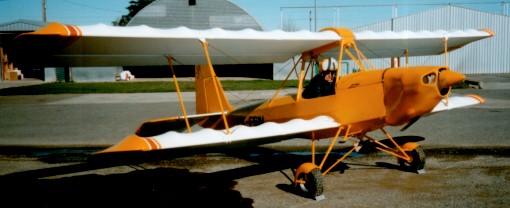
Hovey Delta Hawk

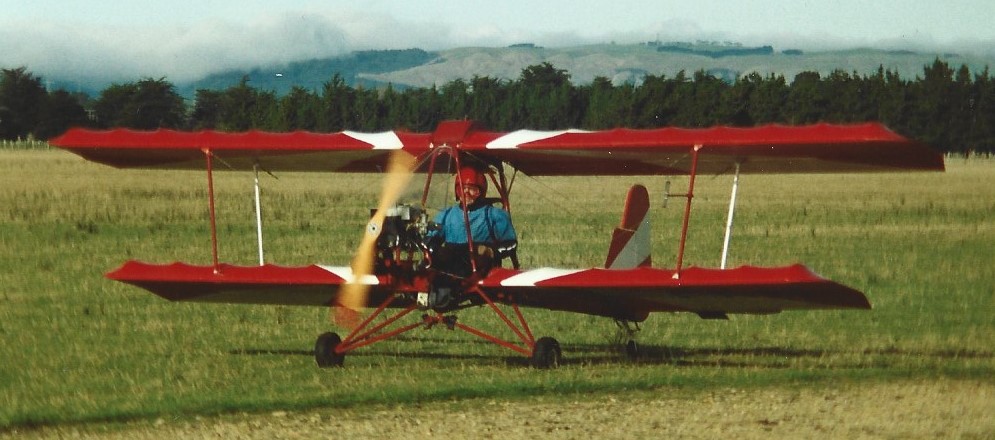
The Delta Hawk is all pop-riveted aluminum tube construction covered with light weight dacron. Full span aileron with three-axis controls.

In 1984 the 40 hp Hovey Delta Hawk was sold as plans, $80, plans plus material kit, or fully assembled for $9250.

Gallery

Gross Wt. 446 lb.
Empty Wt. 248 lb.
Fuel capaci¬ty 3 USG.
Wingspan 24ft.
Engine Kawasaki 440
Reduction 2.25/1.
Cruise 45 mph.
Stall 27 mph.
Climb rate 700 ft

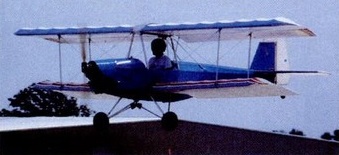
Hovey Delta Bird

Single seat single engined biplane with conventional three axis control. Wing has unswept leading and trailing edges, and constant chord; conventional tall. Pitch control by elevator on tail; yaw control by fin mounted rudder; roll control by full span ailerons on upper wing; control inputs through stick for pitch/roll and pedals for yaw. Wing braced by struts and transverse X cables; wing profile; double surface. Undercarriage has three wheels in tail dragger formation. Push right go right tailwheel steering connected to yaw control. Aluminium tube framework, without pod. Engine mounted between wings driving tractor propeller. Tubing from 6061T6 aluminium; galvanised steel rigging; Dacron wing covering.

This three axis machine is a biplane which was revealed to the public at the EAA convention for amateur constructors, Oshkosh, in August 1982, where it was hailed as a modernised version of the Whing Ding II with a simpler structure and more power. The adoption of an aluminium tubular structure allowed Aircraft Specialties to offer the Delta Bird in plan form, as with the other two aircraft, but also as a kit requiring around 200 h for assembly. In place of the pusher common to the Beta Bird and the Whing Ding II, the motor is mounted as a tractor on a triangular framework at the front of the main framework. The exhaust pipe passes under this triangular section and finishes by the junction of the two triangular frameworks which support the main wheels, an arrangement designed to allow all terrain use. The machine retains conventional controls with ailerons on the trailing edges of the two top wings, a rudder hinging from the fin and the elevators from the horizontal stabiliser; they are all of generous proportions.

Engine: Cuyuna 430R, 30 hp at 5500 rpm.
Propeller diameter and pitch 54 x 27 inch, 1.37 x 0.69 m.
Belt reduction, ratio 2.0/1.
Power per unit area 0.20 hp/sq.ft, 2.1 hp/sq.m.
Fuel capacity 3.5 US gal, 2.9 Imp gal, 13.2 litre.
Length overall 15.0 ft, 4.57 m.
Height overall 6.0ft, 1.83m.
Wing span 24.0ft, 7.31m.
Constant chord 3.5 ft, 1.07 m.
Sweepback 0 deg.
Tailplane span 8.0 ft, 2.44 m.
Fin height 3.7 ft, 1.13 m.
Total wing area 152 sq.ft, 14.1 sq.m.
Fin area 9.0 sq.ft, 0.84sq.m .
Tailplane area 20.0 sq.ft, 1.86 sq.m.
Wing aspect ratio 6.9/1.
Wheel track 6.3ft, 1.92 m.
Main wheels diameter overall 15 inch, 39 cm.
Empty weight 218 lb, 99kg.
Max take off weight 450 lb, 204kg.
Payload 232 lb, 105 kg.
Max wing loading 2.96 lb/sq.ft, 14.5 kg/sq.m.
Max power loading 15.0 lb/hp, 6.8kg/hp.
Load factors +3.5, 3.5 design; +5.3, 5.3 ulti¬mate.
Max level speed 60mph, 97kph.
Never exceed speed 60mph, 97kph.
Max cruising speed 45mph, 72kph.
Stalling speed 26 mph, 42 kph.
Max climb rate at sea level 400 ft/min, 2.0 m/s.
Best glide ratio with power off 6/1.
Take off distance 250 ft, 75 m.
Landing distance 250 ft, 75 m.
Range at average cruising speed 50 mile, 80km.

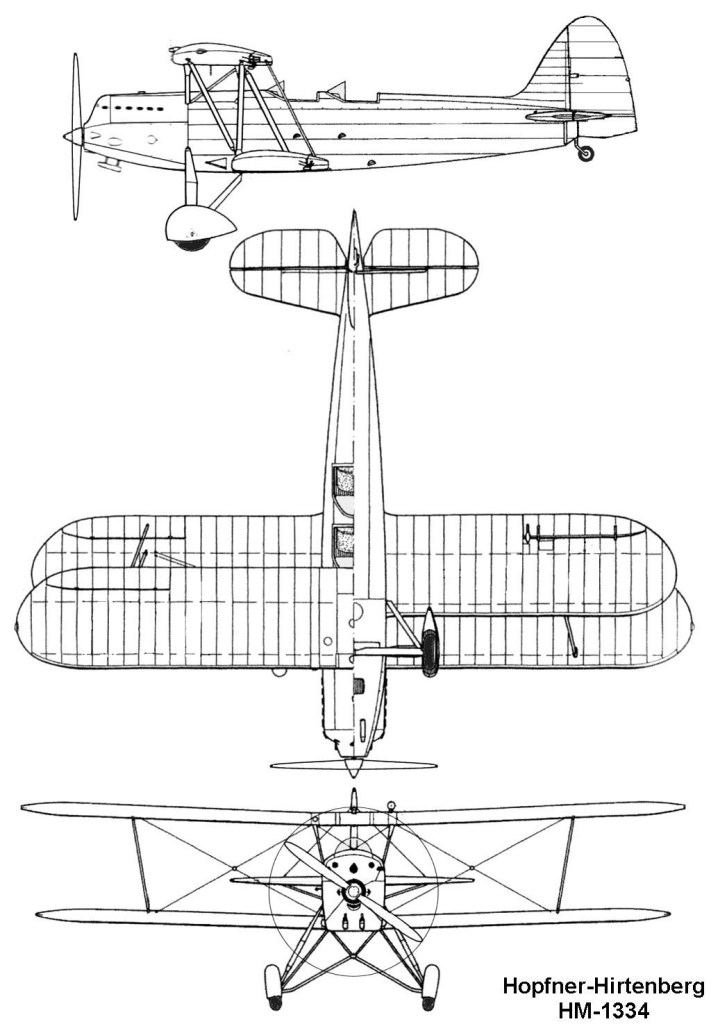
Hopfner HM-1334 / HM.13/34 / Hirtenberg HM-1334 / HM.13/34

In 1934 Flugzeugbau Hopfner GmbH began building the Hopfner HM.1334 (HM.13/34). This was done on a purely private basis because there was no corresponding request from the Austrian Air Force.

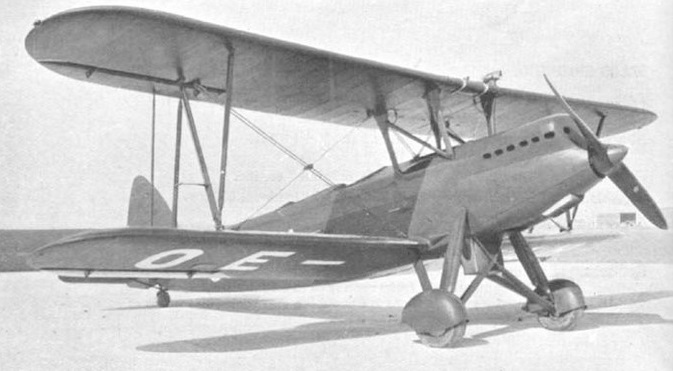
The machine was a two-seat, single-engine biplane in mixed construction with fixed tail wheel gear and normal tail. The fuselage consisted of a tubular steel structure covered with plywood and fabric around the stern. Only in the engine area were light metal sheets used.

The two open pilot seats were arranged one behind the other and had sloped windshields. As engine only a BMW VI with 750 HP was to be used, but there were procurement problems, so that Lampich had to resort to available Fiat A-20 series engines. As armament was a 7.9 mm machine gun Hotchkiss provided, installed in the upper wing and firing over the propeller circle. The biplane wings and the tail were wooden structures covered with plywood and fabric. All control surfaces were cloth-covered. The upper wing had a short wing center piece, which rested on each of two V-struts above the fuselage. The upper and lower wings were each connected by an N-strut and additionally with cables. The tailplane was supported by a strut to the fuselage. The undercarriage was on the engine frame of the fuselage and also backwards to the fuselage and the hull bottom. The wheel arches were aerodynamically shaped.

With the takeover of Hopfner by the Hirtenberger Patronen-, Zündhütchen- and Metallwarenfabrik AG in Hirtenberg, the semi-finished aircraft was brought to Hirtenberg, where it was completed in 1935 and received the designation HM.13/34 or HM.1334.

The first flight took place on June 6, 1935 and during the following flight testing there were no noteworthy incidents. The machine was then presented to the Austrian Air Force, but the interest was low, since several Fw 44J had been procured from Germany for fighter pilot training.

Finally, at the beginning of 1936, three machines were ordered by the Austrian Air Force (for Verwendungsgruppe B, Beanspruchungsgruppe II), which were delivered from the summer of 1936 and received the civil identifiers OE-FAH (factory number 52), OE-FEH (factory number 53) and OE-FIH (factory number 54). After the annexation of Austria to the German Reich in 1938, the three machines, like all Austrian military machines, were taken over by the Luftwaffe and passed on to fighter pilot schools in southern Germany.

The fate of HM.13/34 is unknown.

Hopfner / Hirtenberg HM.13/34
Engine: Fiat A-20, 410 hp (302 kW) max /
Continuous power: 355 hp (282 kW) at 3,000 m
Propeller: adjustable two-bladed wood
Propeller diameter: 2.50 m
Propeller disc: 4.91 m²
Wingspan upper: 10.21 m
Wingspan lower: 9,60 m
Upper wing dihedral: 2.33°
Lower wing dihedral: 2.66°
Wing area: 27.80 m²
Aspect ratio: 6.76
Wing chord: 1.08 m
Length: 8,45 m
Height: 3,03 m
Empty weight: 1,185 kg
Normal weight: 1,585 kg
Maximum TOW: 1,695 kg
Fuel tank capacity: 345 lt
Top speed SL: 258 km / h
Top speed at 3,000 m: 272 km / h
Cruise speed at 3,000 m: 245 km / h
Landing speed: 96 km / h
Ceiling: 6,000 m
Climb rate: 7.3 m / s
Time to 1,000 m: 2,4 min
Time to 3,000 m: 9.5 min
Range normal: 450 km
Maximum range: 600 km
Endurance: 2.5 hr
Wing loading: 60.97 kg / m²
Power load: 4.13 kg / hp (5.61 kg / kW)
Wheel track: 2,54 m
Crew: 1
Armament: 1 x 7.9 mm Hotchkiss machine gun / 500 rounds
Maximum bomb load: 40 kg