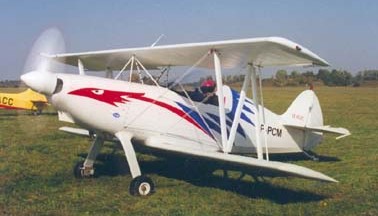
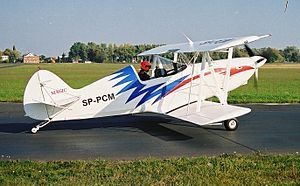
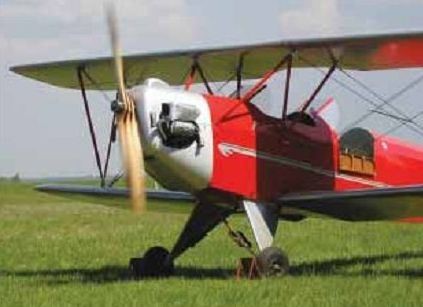
A single-seat aerobatic sports and recreation biplane, the prototype aircraft developed on order from the German Kaiser-Flugzeugbau GmbH. The construction of the prototype, strength tests and flight tests carried out in Military Aviation Plant No. 3 Deblin (later called the Military Aviation Plant No. 1 SA branch) in Dęblinie, Poland. The design work, construction of prototypes and the necessary infrastructure took from 1996 to 1998.
The team headed by Lt.-Col. MSc. Wieslaw Pochylskiego, established a composites laboratory and strength tests, and a thermal tent enabling the study of metal-composite structures at elevated temperatures. Other members included Dr. Eng. Marek Debski and M. Sc. Christopher Kotliński. Builders and MSc. Marian Jakoniuk, MSc. Witold Wiraszka, Eng. Bruno Biernacki and Dr. Eng. Daniel Debski.
Calculations and strength tests were conducted by M.Sc. Vladimir Urbaniak – load, dr. Andrew Szot, MSc. George Mularczyk – static strength tests, Dr. Eng. Wojciech Hajec, MSc. James Kulecki – model airplane spin research, Warsaw University of Technology.
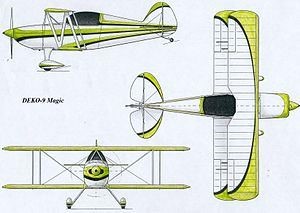
A biplane, the crew seats in tandem with a one-piece canop, and with a fixed main landing gear and tail wheel. The supporting structure of the fuselage is duralumin tube in composite nodes. The wings are double-girder construction with beams made of duralumin tubes and fixed to them duralowej pressed sheet metal ribs. The tail is welded construction made of thin-walled steel pipes. Polish made aircraft are overed with a heat-shrinkable polyester fabric, Dekonit 140 g / m².
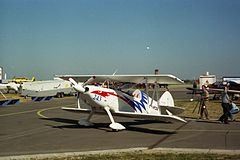
First flight of the aircraft on 30 September 2000 and flight tests were performed by test pilot, MSc. , Maciej Aksler. The aircraft was presented at exhibitions air: ILA Berlin 1998 and 2000 and Fredrichshafen AERO 1999 and 2001.
ILA Berlin 2000
The engine of six produced by PZL Rzeszow was the 200 hp PZL Franklin 6A-350C1R , suitable for inverted flight and driving a three-bladed MT-Propeller MTV-9-DC / C188-18a propeller with hydraulically controlled pitch.
Also developed of four-cylinder Franklin 4A-235B4 92 kW (125 hp) powered version with open cockpit.
Engine: PZL Franklin 6A-350C1R, 205 hp (150 kW) Span: 6.8 m Length: 6.5 m Height: 2.2 m Wing area: 15.4 m² Empty weight: 500 kg Useful load: 250 kg MAUW: 750 kg Fuel capacity: 100 lt Max speed: 220 km / h (119 kts IAS) Cruising speed: 190 km / h (103 kts IAS) Minimum speed: 90 km / h (49 kts IAS) Vne: 350 km / h (189 kts IAS) Rate of climb: 12 m / s (2362 ft / min) Ceiling: 4000 m (13123 ft) Range: 700 km (378 nm) Take-off dist: 120 m (393 ft) Landing dist: 120 m (393 ft) Load factor design: + 6 / -3 g Seats: 2
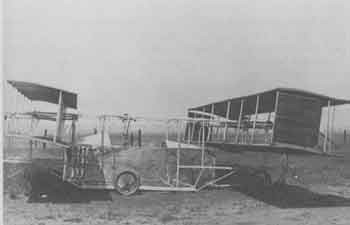
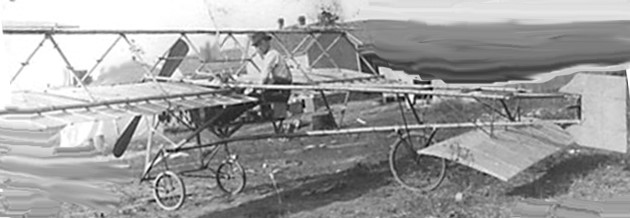
Dan Kaiser’s interesting tandem biplane, with tilting fore and aft biplane wing cells and a metal-covered fuselage enclosing aviator and engine, was tested at Cicero Flying Field, Chicago, in 1912.
In 1998 Jurkštas started the construction of the plane named JR biplane – 2, although it more often fellow aviators called it “Biukeriu” because the similarity to the German aircraft. Jurkštas does not deny the similarity, but argues that the design that the detailed drawings, were followed by five years was work.
The JR-2 is an ultra-light wooden structure biplane. The front part of the fuselage is covered with oilcloth, and the rear with canvas. The front by the engine hss duralumin coated tin. There is a technical requirement that this place is not flammable. The bonnet is formed of glass material.
Wooden structure has two wings spars. The front part of the first spar coated oilcloth. Next frame covered with canvas wings. The upper wings are connected on duraliminio pipes. The lower wings attach to the trunk connectors with 2.5 mm thick stainless steel plates. The wings are tensioned with 5.6 mm diameter steel guys.
The stabilizer and fin also has two spars. Their profile is NACA 0009. Until the first spar they are oilcloth covered, the rest is canvas. The rudder is coated with canvas. Wheels 350X135 came from a L-13 Blanik glider.
The wood was gathered in one of Silutes sawmills by R.Jurkštas. Jurkštas said that it was created by looking at a Piper Cub.
An air-cooled VW 1600 engine turns a constant pitch 1.52 m diameter propellor, which is made of laminated wood. The pitch is 0.92 m . The engine is 65 hp, maximum shaft speed of 4600 rev / min. The engine cost 250 litas.
The fuel tank is installed in the front of the fuselage. Its capacity of 23 liters. It is attached with duralumin screw bands.
The Lithuanian biplane was completed in 2003, and the first flight was on June 23, 2004, piloted by R.Jurkštas. After the first tests, it was decided that the aircraft would better suit a larger diameter and pitch propeller. That improved its flight characteristics. R.Jurkštas flew more than 60 hours.
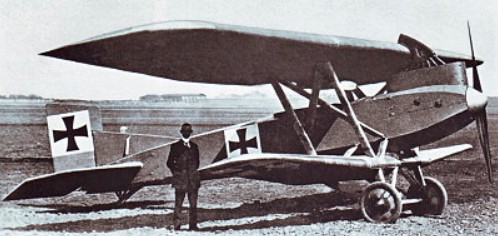
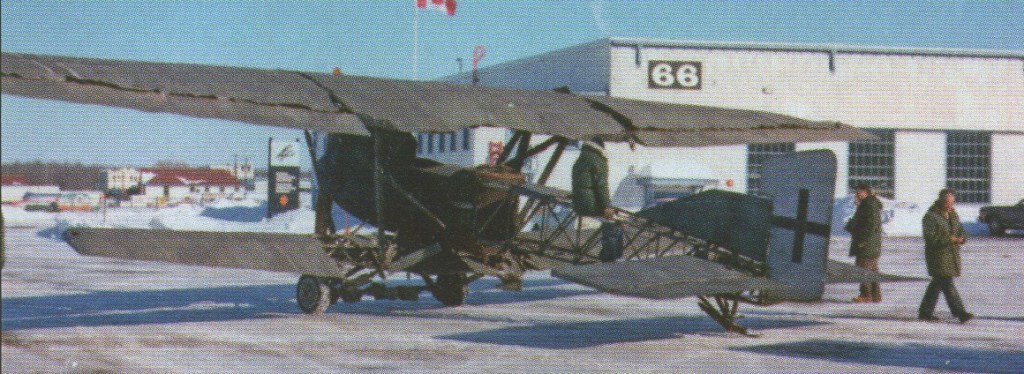
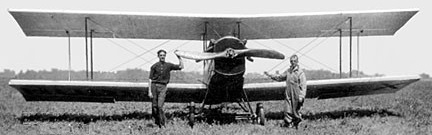
The Junkers J.IV, which flew for the first time early in 1917 and became operational at the beginning of 1918, was an all-metal biplane designed for close support and tactical reconnaissance. When ordered for the German Army, Junkers was not geared for mass production. Junkers-Fokker-Werke was formed at Dessau on October 20,1917, with equal shares held by Junkers and Anthony Fokker. Manufacture was shared between the Junkers and Fokker factories, which produced a total of 227 aircraft between them. Conflicts of personality caused Fokker and Junkers to separate in 1918, and the Junkers re-formed following April as Junkers FlugzeugwerkeAG. A ground-attach and observation machine, the crew was protected by 5mm steel plating. Instead of radio equipment, early J.IVs carried two downward-firing Parabellum machine guns, but these were deleted because of problems with accurate aim.
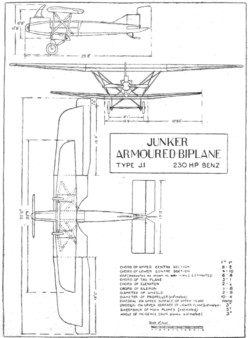
Engine: 1 x 200hp Benz Bz.IV Wingspan: 16.00 m / 52 ft 6 in Length: 9.10 m / 29 ft 10 in Height: 3.40 m / 11 ft 2 in Max. speed: 155 km/h / 96 mph Ceiling: 6000 m / 19700 ft Range: 310 km / 193 miles Armament: 3 x 7.62mm machine-guns Crew: 2
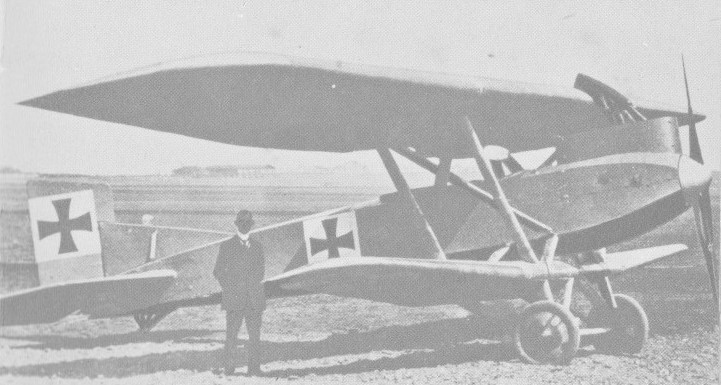
Professor Hugo Junkers (1859-1935) became convinced that all metal structure was the ultimate answer to successful aircraft design, he produced the experimental J.1 “Blechesel” (Tin Donkey) to exemplify his 1910 patent for a cantilever all-metal wing.
An all-metal semi-cantilever biplane, the multi-spar metal wings were covered with corrugated light alloy sheet. The entire forward part of the fuselage to the rear of the cockpits was made of 5 mm sheet steel armour. The front fuselage alone weighed 1030 lb. The rear fuselage was a light alloy tube structure, covered with fabric on most aircraft. Control surfaces were all metal, with ailerons on the top wing only.
The J.1 first flew on December 12, 1915, giving unexpectedly stable performance.
Altogether, 227 J.1 were built, serving from late 1917 until the end of the war.
Engine: Benz Bz.IV, 200 hp Wingspan: 52 ft 6 in Wing area: 531.5 sq.ft Length: 29 ft 10.5 in Height: 11 ft 1.75 in Empty weight: 3895 lb MTOW: 4797 lb Max speed: 97 mph at SL Endurance: 2 hr Armament: 1 x Parabellum mg
Jimmie Jones of Tulsa, Oklahoma, was an inventor by trade. He experienced a brief obsession with the prospect of human flight and began building his own version of an aeroplane. It never got off the ground and was eventually destroyed by a thunderstorm. This was reported to be in 1906, which seems very unlikely.
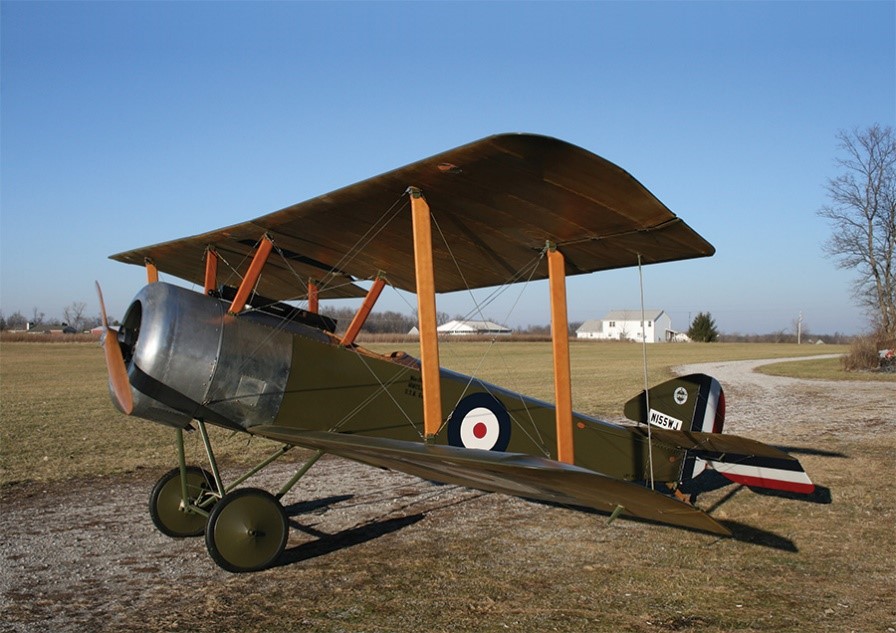
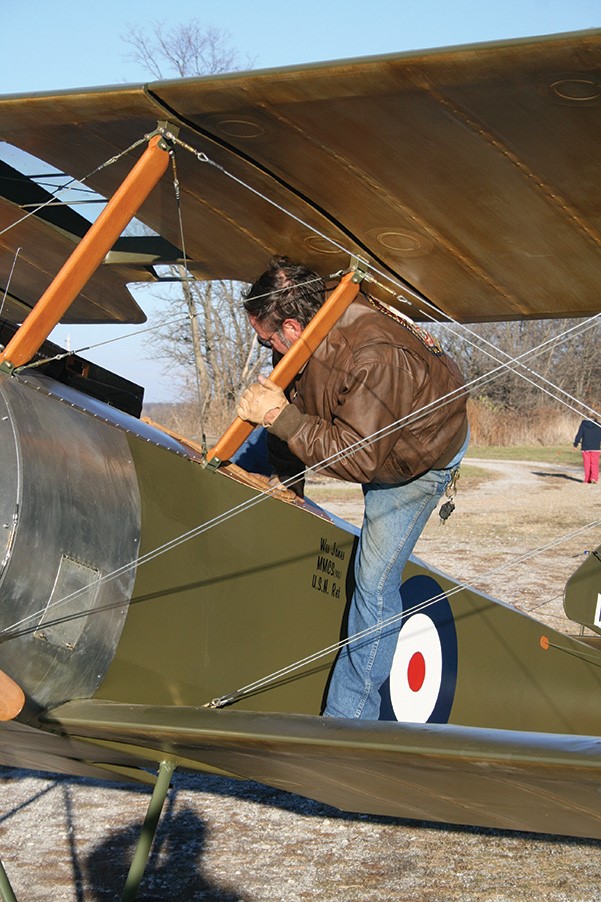
Wes Jones discussed the feasibility of building a full-scale Sopwith Pup with Robert Baslee in 2005. They drew the major components on a dinner napkin later acquiring a set of drawings from Replicraft.
Earnest construction began in December, 2005. The plan was to build a Pup that for all outward appearances would look like an original Pup. There were some mandatory considerations, bank account, settling on a VW engine, instead of a preferred Rotec Radial. The Replicraft plans were used for placement of all uprights and longerons, so the dimensions would match the originals, but the materials are more modern and fit the bank account better.
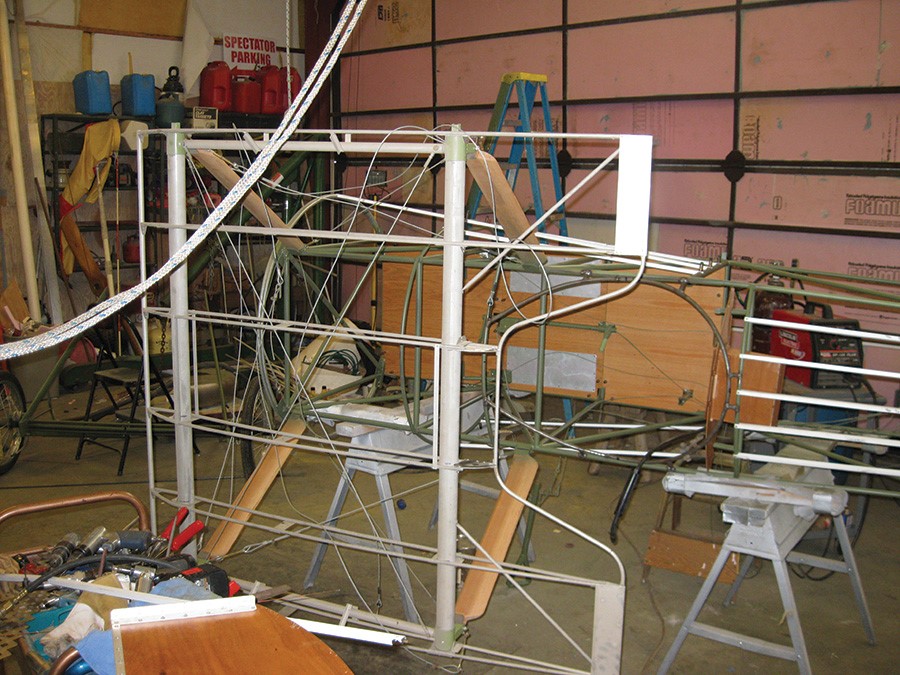
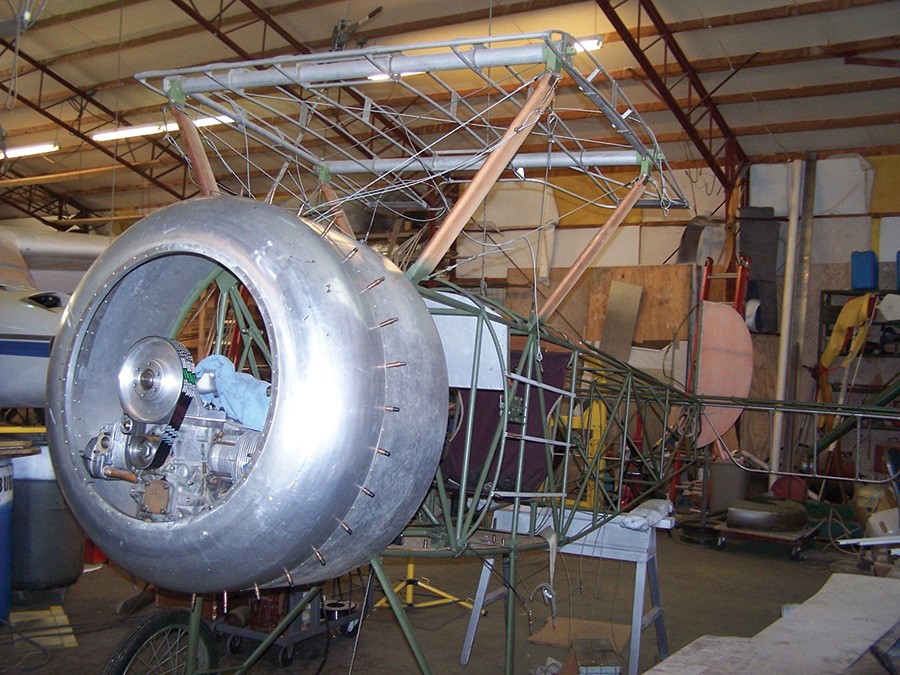
Three-quarter-inch chrome-moly is used for the forward section of the fuse and transitioned to five-eighth-inch aft of the cockpit for the longerons. TIG welding the basic fuse took about a month.
The fuselage and upper wing center section were built of tubular steel and aluminum, respectively.
The wing struts and cabanes were fashioned to the original dimensions out of straight-grain Douglas fir to fit welded fittings like Dennis Wiley’s Early Bird Jenny. The landing gear legs were fashioned from streamline tubing to exact specifications from the original 1916 prints.
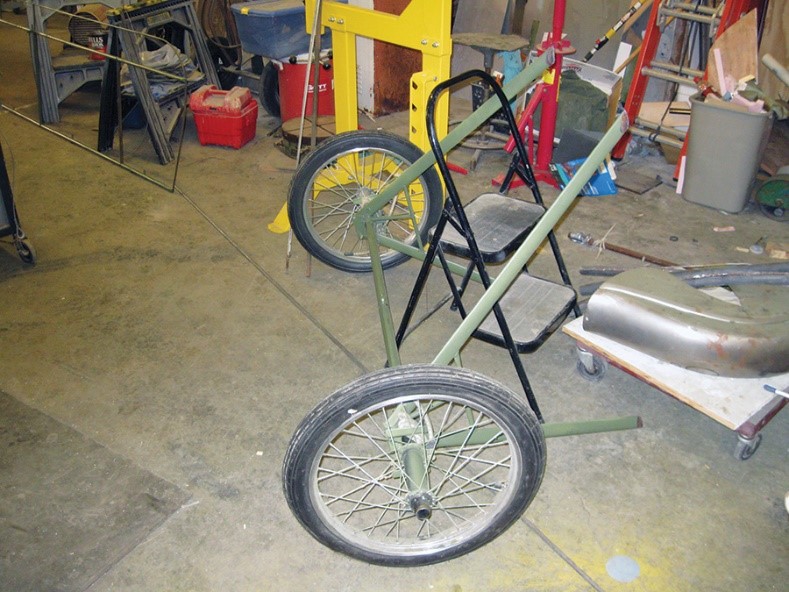
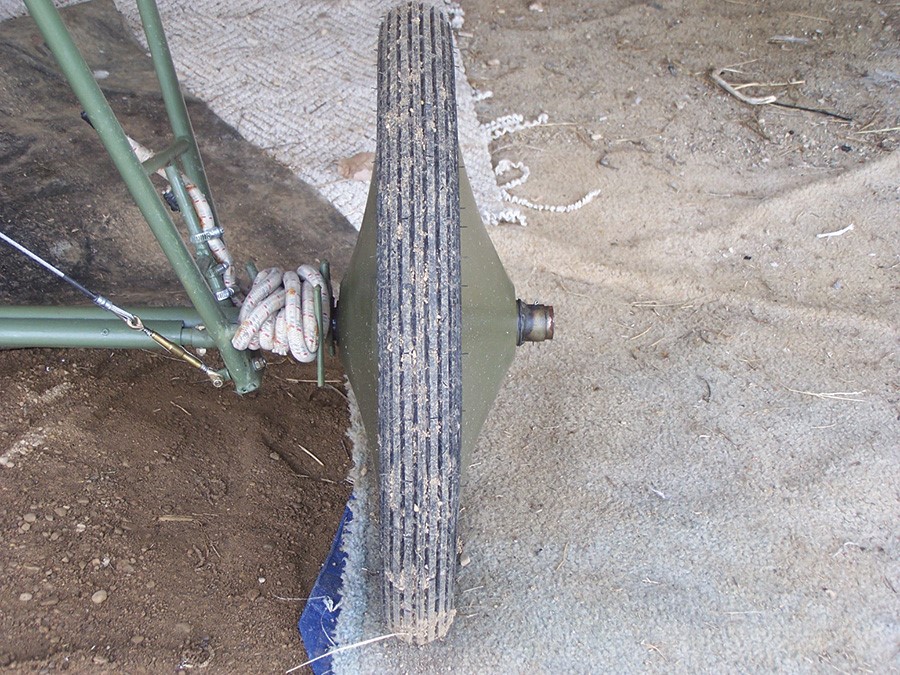
A set of horse racing cart wheels were used for rims and inner spoke attachments, and made a set of hubs on the lathe. The hubs gave 8 inches between the spokes at the axle.
By using longer spokes on the outside and shorter spokes on the inside, it got the dished look of the original wheels.
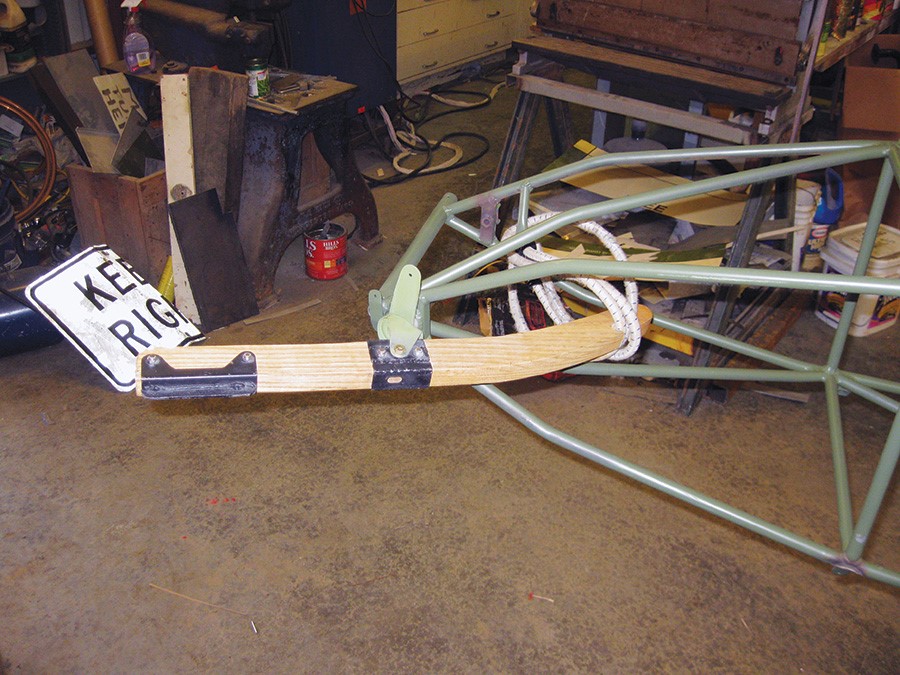
The steerable tailskid was built exactly following the plans of the original, since it was going to be out there for everyone to see. Another reason for sticking with the original skid is that, just like the original, the mains do not have brakes. This helps keep the Pup going straight down a grass field.
The original tailskid worked well until it broke on landing. It was replaced with a piece of wood with conveniently-curved grain.
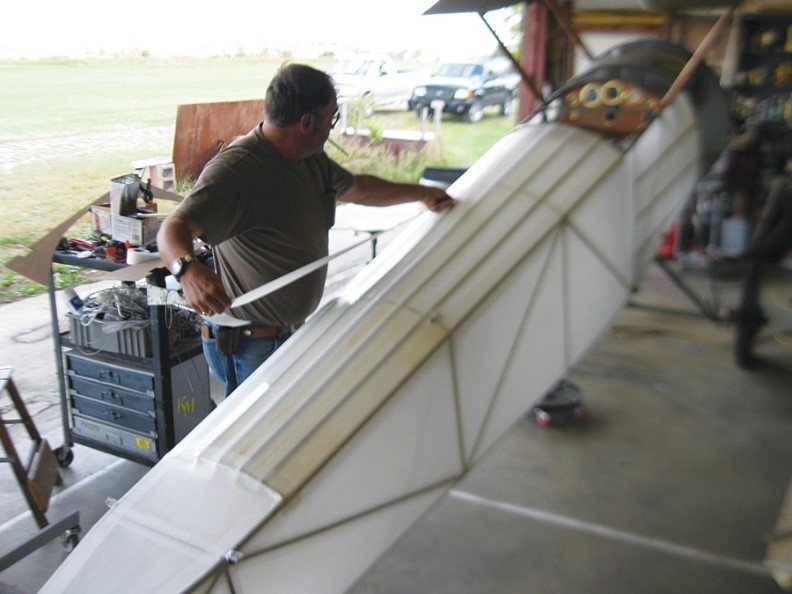
Wingspars were fashioned from 2-inch .065-wall 6061 tubing. Three-eighth-inch aluminum tubing is used to fashion the ribs la a Graham Lee design. The leading edge uses aluminum sheet metal instead of using nose ribs. Wing-root fittings were copies of the Early Bird Jenny’s root fittings, scaled up for the extra weight. Some expert assistance on rib stitching came from Dallas Shaw, Randy O’Conner and Brad Strohm.
The covering was lightweight Dacron using rhe Stits process from Aircraft Technical Support, since Jim Miller was good friend and neighbour. Since the WW-I originals were just doped on the undersides of the wings and fuse, it was decided to finish those areas using clear Poly-Brush fabric sealer, then adding some tint to the last coat to get an approximate look of old varnish brushed over doped fabric. The markings were done by hand with a brush to approximate what was done in the field back then.
A 2180cc VW engine was built from scratch, using parts obtained from several VW suppliers. It used 94mm cylinders, an 82mm stroker crank, and was set up the compression for 6.67:1 for reliability. Valley Engineering supplied the 2.5:1 propeller speed reduction unit (PSRU), as well as the 96×65-inch prop. Due to some leaning problems with the progressive Weber carb, a single-barrel 34 ICT carb fit the bill better.
A good friend and Dawn Patrol cohort, Rick Bennett, was able to find a correct-size cowling and arrange to have one delivered.
There was some help with the full-scale Vickers machine gun replica on the cowl from Willie Hill, a local expert on getting them to look realistic.
The OK to test-fly it from the local FAA representative, John Walsh, came in October of 2011 and there was only time for six or seven test flights before winter hit hard, so the rest of the time had to be flown off in the spring.
In the air the Pup flies is very stable in normal flight. The four ailerons give a solid feel in roll. Initial timing of the climb rate showed approximately 1200 feet per minute. The climb angle is like a space shuttle launch, although never actually measured.
On takeoff, the tail comes up almost immediately (50 feet) and it gets off the ground in about 150 feet. Stall is around 30 mph and cruise is around 60. The plan to obtain another prop with a 73-inch pitch as soon as funds allow, in order to (hopefully) get the cruise up to around 75-80 mph.
About July, on a normally un-eventful landing, the tailskid wood split at about the halfway mark, leaving no steering and sending the plane into another groundloop. This time, the left upper wing got a slight ding in it due to the hair-raising trip into the woods that immediately followed. Fortunately, two days worth of metal, fabric and painting work sufficed to repair the damage.
A piece of ash with the grain conveniently running along the curve of the new skid replaced it; there have been no problems since.
There has been difficulty keeping the cylinder heads at an acceptable temperature (350 F). Normally it gets about 15 minutes of flight time and temps start to creep up to around 375. Changes with the cooling fins—making extensions to direct the air more smoothly over the heads —and a larger oil cooler with a thermostatically controlled fan may get the temps better.
That old British 10/10 airfoil makes the Pup handle amazingly well.
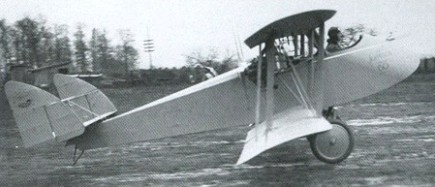
The last product of the Johnson Airplane & Supply Co (first flown December 1936) was the Twin-60, a twin-pusher-engined two-seat open-cockpit biplane with 30 hp Cherub engines.



 All Aero