The R.II was a large four-engined bomber with the engines were buried in the fuselage and geared together to drive the single 7m Garuda propeller in the nose. The propeller was geared down to 545 rpm. Only the one was flown; a second was under construction at the war’s end.
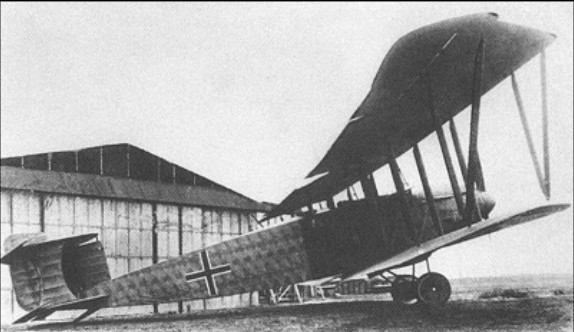
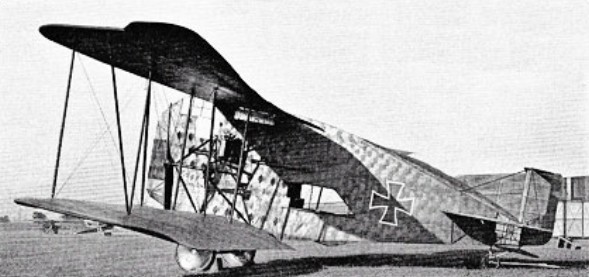
Both R.I prototypes used four 260hp Mercedes D.IVa engines, carried inside the fuselage, powering two chain-driven propellers.
The Linke-Hoffmann R.I was half covered with transparent Cellon in an attempt at partial invisibility. It achieved the opposite effect, partly because the Cellon discoloured rapidly, but mainly because it reflected the sun so strongly.
R.I serial R.8/15
The two built were R.I serial R.8/15 and the improved R.I serial R.8/16. The first was burnt out in an accident in May 1917and the second was destroyed when the pilot misjudged his height during a normal landing.
Further experimentation with unorthodox propulsion configurations would lead to the R.II.
Page acquired the rights to the New Swallow and redesigned this as the three-seater Lincoln-Page LP-3 in 1928, an attempt to catch up with developments in light aircraft design.
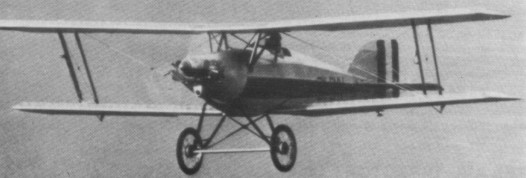
The first sport single-seater of note in the early 1920s was the Lincoln “Sport,” which was a biplane originall~ developed as a homebuilt by S.S. Swanson in 1923. It was put into limited production by the Lincoln Aircraft Co., of Lincoln, Nebraska, when Swanson became chief engineer there. The production model died for lack of a market because there were still plenty of cheap World War 1 surplus single seaters around for the sporting types. The Lincoln design was perpetuated as a homebuilt, however, when the plans were published in Modern Mechanics magazine in the early 1930s. Capable of 100 mph and fully aerobatic.
Ray A. Page established Nebraska Aircraft Corporation at Lincoln, Nebraska, during the First World War, and was a builder of the Lincoln Standard, a two-bay biplane circa 1920.
In five years between 1891 and 1896 Otto constructed seven gliders (five monoplanes and two biplanes) and made over 2000 ever-improving flights from hill sites at Stieglitz and in the Rhinow Mountains near Stöllen. He flew distances up to 400 m (1312 ft) and reached heights of 25 m (82 ft). He dis¬covered and made use of up-currents of air for soaring flight.
His first means of launching was a spring board, but this he soon abandoned in favour of hill launching. Some of his tests were made from the Rhinower Hills, near Stollen, but he also had constructed an artificial hill near Berlin.
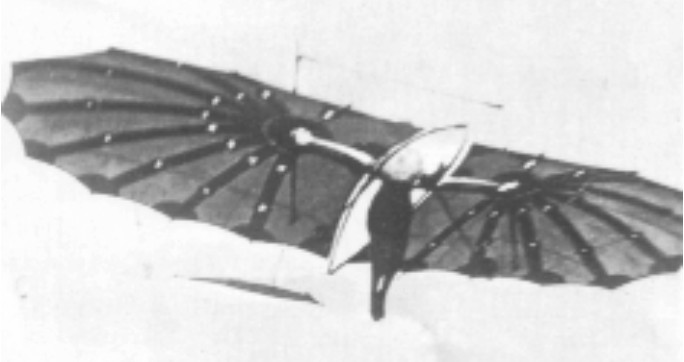
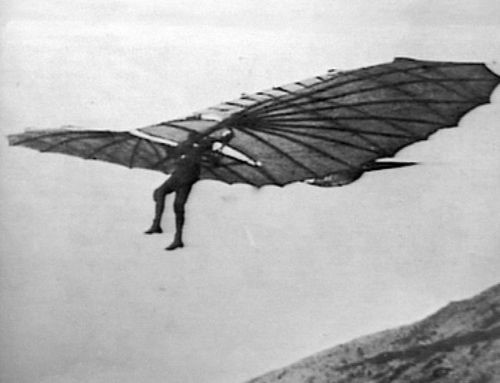
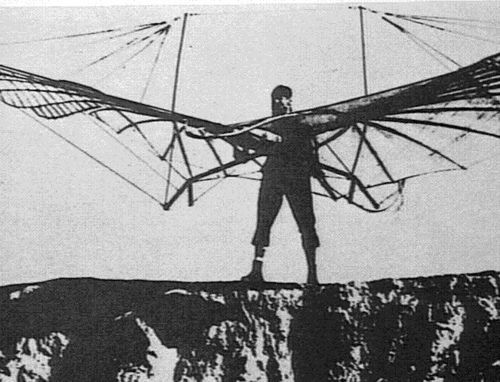
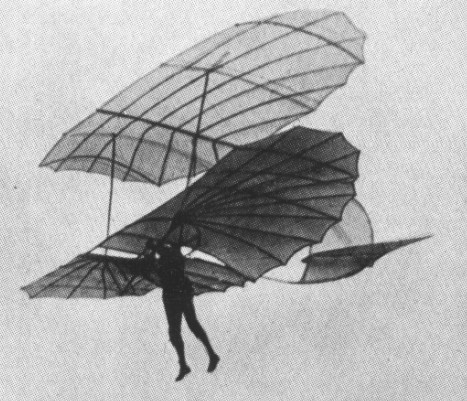
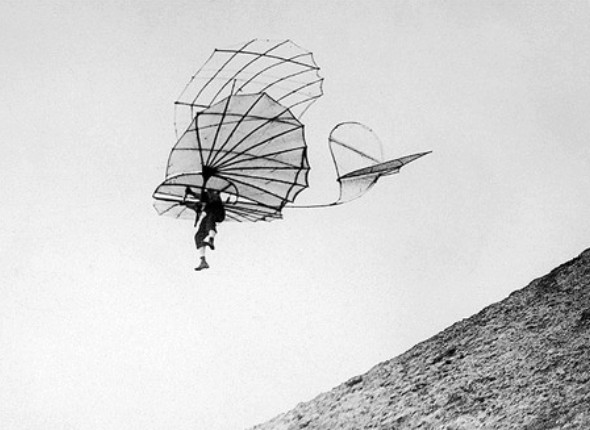
In 1891 Lilienthal completed glider no.3, a monoplane glider constructed from peeled willow wands with a covering of waxed cotton. Its wings spanned 7 m (23 ft), with Lilienthal supporting himself within its centre section on parallel bars — literally a hang-glider — and controlling his flight path by shifting his body mass and thus altering the craft’s centre of gravity.
Otto Lilienthal Segelflugzeug N°3
Lilienthal’s first tentative hops were made with the aid of a springboard launcher, but soon flew from a specially constructed 15-m (49-ft) hill on the outskirts of Berlin.
Between 1891 and 1896 Lilienthal constructed five types of monoplane glider and two biplane types (1891 and 1892).
Lilienthal supported himself in his gliders by his arms, so that after a running take off his hips and legs dangled below the aircraft, allowing him to swing his body in any desired direction to achieve stability and control. After 1893 he was achieving glides of 300-750 ft (90-230 m), with remarkable ease of control.
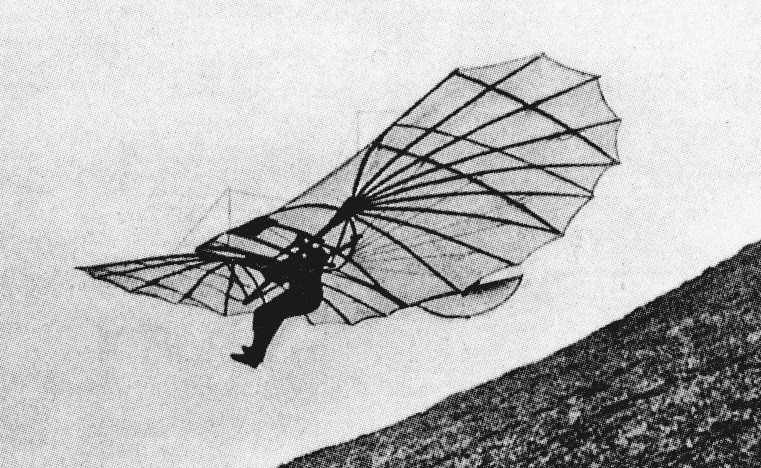
Otto Lilienthal Segelflugzeug N°11 (1894)
The 1894 monoplane hang glider was a single surface fabric covering over exposed framework. Wings fold for storage. Natural fabric finish; no sealant or paint of any kind.
1894 Glider
In 1895 he was developing a type of body harness to work a rear elevator. The purpose of this was to give better control in rising or descending by increasing the effect of the occupant swinging his body forwards or backwards and thus altering the centre of gravity. Lilienthal also tested a glider which had flapping wing tips, driven by a small carbonic acid gas engine. This system could never have equalled in efficiency the new petrol engines and propellers which were soon to come into being; but the great German inventor/ pilot was never to become aware of this, for he crashed in one of his gliders in the Rhinower Hills on 9 August 1896, and died in a Berlin clinic on the following day. His last words were ‘Opfer mussen gebracht werden’ (‘Sacrifices must be made’).
In 1895 produced his thirteenth design, a biplane. On the evening of 9 August 1896, Otto was at Stöllen testing a new kind of head-movement control arrangement when a sudden gust upturned his No. 11 monoplane glider and he crashed heavily from 15 m (49 ft) breaking his spine. He died the next day.
Otto Lilienthal (1848 1896) made approximately 2,500 successful glides in 1893 96, mostly in monoplane ‘hang gliders’ types, in which he flew distances of up to 985 ft (300 m).
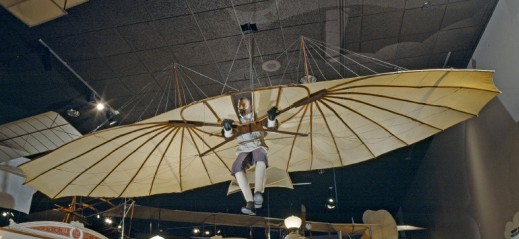
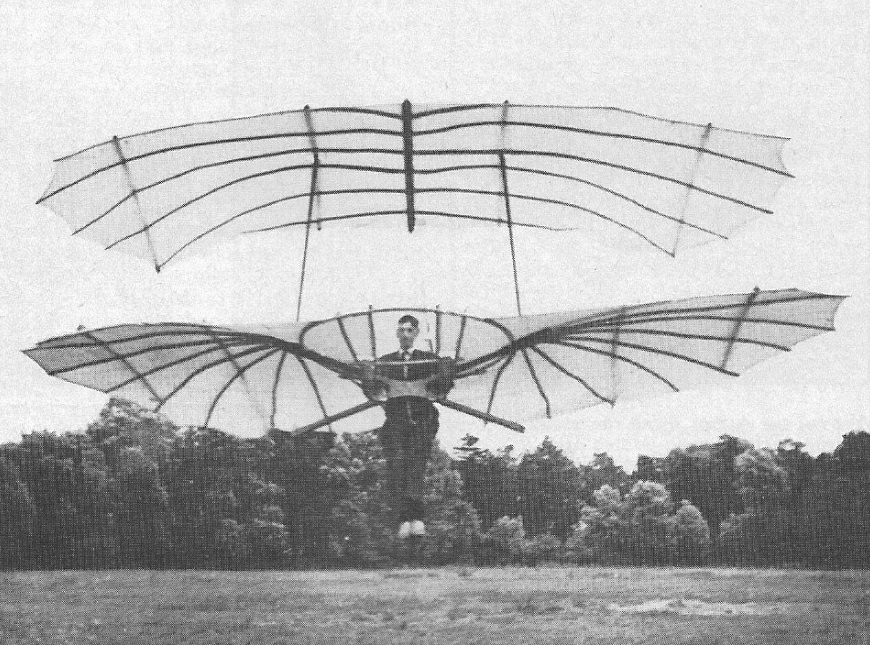
In 1937 Dart Aircraft built for Alexanda Korda’s film production, Conquest of the Air, two Lilienthal biplane glider replicas. They ‘flew’ suspended by piano wire. In the end the film was never completed.
1893 monoplane glider Wing span: 22 ft 11.5 in (7.00 m) Wing area: 150.7 sq ft (14.0 sq.m) Wing chord (max): 8 ft 21 in (2.50 m) Length: 16 ft 4.75 in (5.00 m) Weight without pilot: 44 lb (20 kg) Accommodation: Crew of 1.
1894 Glider Wingspan: 7.9 m (26 ft) Length: 4.2 m (13 ft 9 in) Height: 1.5 m (5 ft) Weight: 20 kg (44 lb) Materials: Airframe: Wood Fabric Covering: Cotton-twill
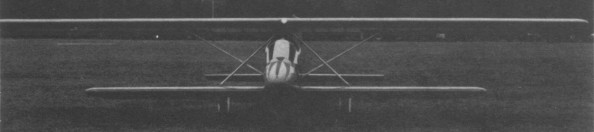
Single seat single engined biplane with con¬ventional three axis control. Wings have un¬swept leading and trailing edges, and constant chord; conventional tail. Pitch control by fully flying tail; yaw control by fin mounted rud¬der; roll control by two thirds span ailerons; control inputs through stick for pitch/roll and pedals for yaw. Wings braced by transverse struts; wing profile 100 % double surface. Undercarriage has two wheels with tailskid and nose-skid; no suspension on either wheel. No ground steering. No brakes. Wood/glass¬fibre fuselage, totally enclosed. Engine mounted between wings driving pusher prop¬eller. Instead of alumi¬nium tube, Dacron and lots of rigging wires, he prefers simple traditional wooden construction, though as a concession to moderni¬ty the Rooster 1 does have a glass fibre nose. The Rooster 1 was conceived in 1977 as a sailplane. As a sailplane it thermalled at 600 ft (185 m), was aero towed three times and made some 300 circuits. It also proved stronger than expected, landing without dam¬age across the furrows of a ploughed field. Right from the start, however, John in¬tended to power the machine, simply because he wanted to go soaring without hordes of assistants. So once he was satisfied with the aircraft’s dynamic qualities, he fitted a Chrys¬ler engine. In 1982 he was replacing this with a Valmet unit. The undercarriage design uses only two wheels but has a skid at either end. The wheel track is large enough that the aircraft does not tip up when the pilot enters, yet narrow enough to permit ground man¬oeuvring using only the rudder. There are no wheel brakes; instead the pilot simply pushes forward the stick and lets the friction gener¬ated by the nose skid slow the aircraft. There are no plans for manufacture, but depending on demand, John may produce plans for the aircraft.
Engine: Valmet, 10 hp at 6000 rpm. Propeller diameter and pitch 52x27inch, 1.32×0.69m. V belt reduction, ratio 4.0/1. Power per unit area 0.07hp/sq.ft, 0.8 hp/sq.m. Fuel capacity 6.6 US gal, 5.5 Imp gal, 25.0 litre. Empty weight 320 lb, 145kg. Max take off weight 570 lb, 259kg. Payload 250 lb, 113kg. Max wing loading: 3.99 lb/sq.ft, 19.5 kg/sq.m. Max power loading 57.0 lb/hp, 25.9kg/hp. Load factors +6.0, 4.0 design. Length overall 17.9 ft, 5.45 m. Height overall 4.9ft, 1.50m. Wing span 30.2ft, 9.20m. Constant chord 3.0ft, 0.91m (top wing). Dihedral 0 deg Sweepback 0 deg Tailplane span 10.5 ft, 3.20 m. Fin height 5.2 ft, 1.58 m. Total wing area 143 sq.ft, 13.3 sq.m. Total aileron area 13.2 sq.ft, 1.23 sq.m. Fin area 4.6 sq.ft, 0.43 sq.m. Rudder area 6.2 sq.ft, 0.58 sq.m. Total elevator area 16.8 sq.ft, 1.56 sq.m. Wing aspect ratio 10/1 (top wing). Wheel track 6.2 ft, 1.88 m. Main wheels diameter overall 11 inch, 28 cm. Max level speed 65 mph, 105 kph. Never exceed speed 75 mph, 121 kph. Max cruising speed 60 mph, 97 kph. Economic cruising speed 40 mph, 64 kph. Stalling speed 30 mph, 48 kph. Best glide ratio with power off 14/1 at 33 mph, 53 kph. Range at average cruising speed 300 mile, 483 km.
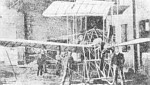
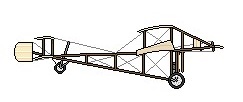
In 1910 Edmund Libański of Lwów (then under Austrian rule, presently in Ukraine) designed an aircraft that was supposed to have advantages of both mono- and biplane through use of lift areas of different size (with upper plane much smaller than the lower one).
The mono-biplane was built by Libansky and W. Rumbowicz.
During the take-off to first flight the engine exploded leading to crash. Designer dropped the idea of rebuilding the plane and instead designed a year later a much more successful two-seat airplane named Jaskółka (Swallow).
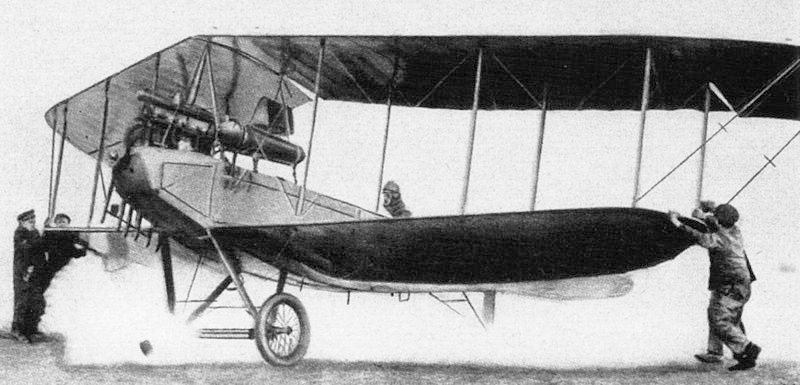
A swept wing, single engine, two seat biplane built in 1914 by the Luft-Fahrzeug-Gesellschaft in Reinickendorf (Berlin). Before the outbreak of World War I Bernard Langer flew the machine shown, equipped with a 100 hp Mercedes D.I engine and an extra tank above the fuselage in place of the passenger, on a non-stop sixteen hour flight. During WW1 at least one Pfeilflieger served with the Schutztruppe (Protection Force) in German South West Africa, now Namibia, between 1914 and 1915.

 All Aero