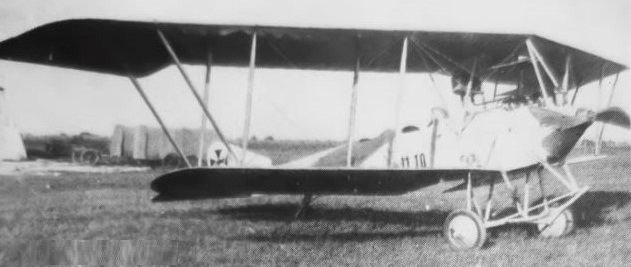
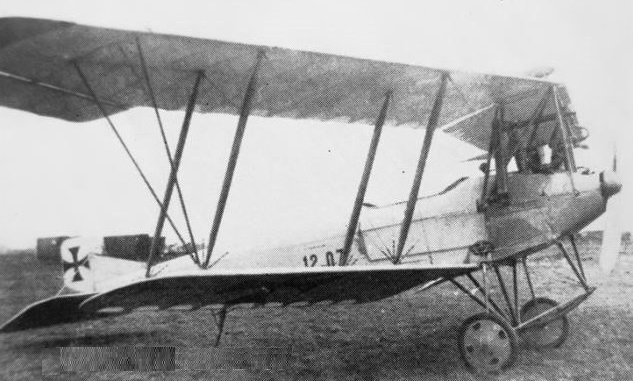
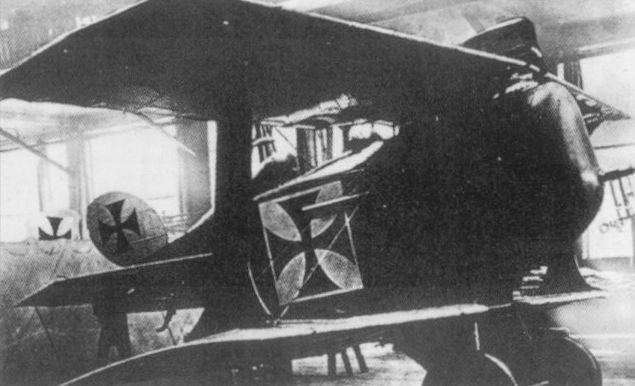
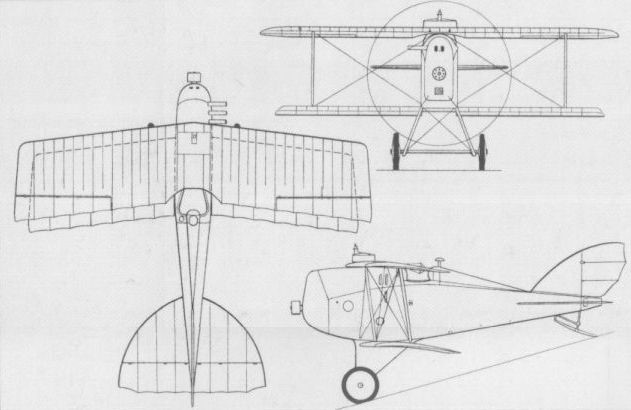
During 1916, the Lohnerwerke of Vienna received a contract from the K.u.K.Luftfahrttruppen (Imperial and Royal Air Service of the Austro-Hungarian Army) for four single-seat fighter prototypes powered by the 185 hp Austro-Daimler six-cylinder inline engine. The first of these, the Lohner 10.20, or Typ AA, appeared at Aspern on 5 September 1916. A single-bay biplane with an armament of twin synchronised Schwarzlose machine guns, the Lohner 10.20 was characterised by a singularly abbreviated and deep, slab-sided fuselage. This was suspended between the wings by a short, inverted-Vee cabane and the faired struts supported the undercarriage. The wing cellule had broad, aerofoil-section I-type struts, and the vertical tail possessed no fixed surface. Taxying trials revealed insufficient control. The rudder area was increased several times and the fuselage lengthened before the aircraft flew on 29 December 1916. The fighter demonstrated poor stability, and, after suffering severe damage in February 1917, was returned to the Lohnerwerke for repair and extensive modification. The aircraft re-emerged in the following month as the Lohner 10.20A, the lower wing having been raised to the base of the fuselage, the cabane being eliminated, a twin-strutted wing cellule being adopted, the fuselage being lengthened and the redesigned tail surfaces embodying a fixed fin. The Lohner 10.20A was destroyed in a crash on 6 June 1917.
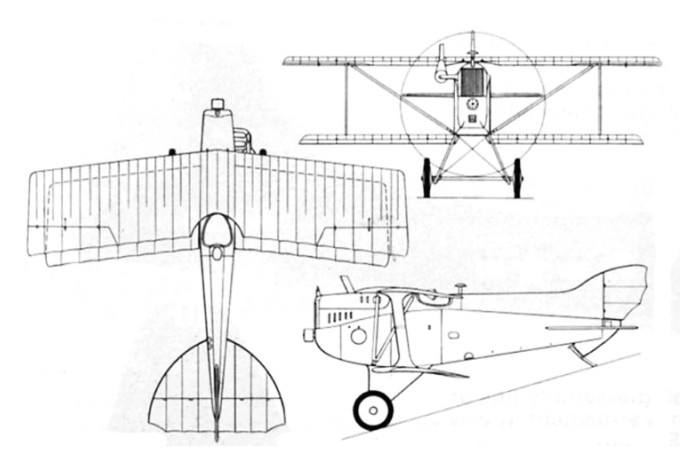
The second fighter prototype from the Lohnerwerke, the 10.20B (later redesignated 111.02), possessed essentially similar wing and tail surfaces to those of the 10.20A. It had a “wireless” wing cabane, however, which reverted to aerofoil-section I-struts supplemented by inclined Vee-struts. It also introduced a deep dorsal fin. Powered by a similar 185 hp Austro-Daimler engine to that of its predecessor and carrying a twin-Schwarzlose gun armament, the Lohner 10.20B made its initial flight at Aspern on 2 June 1917. The prototype was taken over by the K.u.K.Luftfahrttruppen in August 1917, and official trials continued through October when further development was halted. No data relating to this type are available.
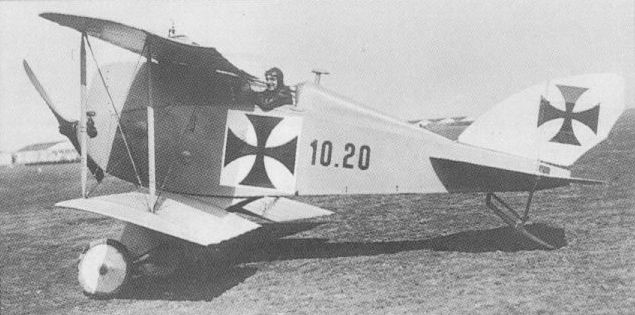
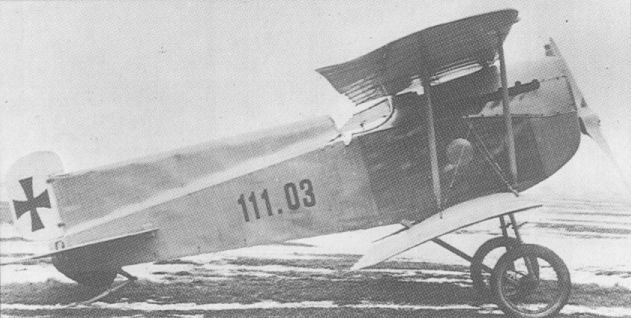
The third Typ AA series prototype produced by the Lohnerwerke, the 111.03 differed from its immediate predecessor, the 10.20B alias 111.02, in having a conventional wire-braced wing cellule, a redesigned rudder and unfaired undercarriage strutting. Retaining the 185 hp Austro-Daimler engine, the Lohner 111.03 was flown for the first time on 28 June 1917, and flight testing continued through October. At this stage, the Lohnerwerke was assigned a manufacturing licence for the Aviatik D I, and further development of the Typ AA series was ended.
Max speed, 120 mph (193 km/h).
Time to 3,280 ft (1 000 m), 2.66 min
Range, 240 mis (386 km).
Empty weight, 1,373 lb (623 kg).
Loaded weight, 2,085 lb (946 kg).
Span, 24 ft 11 1/4 in (7.60 m).
Length, 20 ft 10 in (6,35m).
Height, 9 ft 10 1/8 in (3.00 m).
Wing area, 215.28 sq ft (20.00 sq.m)
Lohner 10.20B
Engine: 1 x Austro-Daimler AD 6 series 18000, 136 kW / 185 hp
Wingspan: 7.30 m / 23 feet 11,39in
Length: 6.00 m / 19 feet 8,21in
Height: 2.95 m / 9 ft 8,14in
Wing area: 17.98 sq.m / 193.54 sq.ft
Crew: 1
The Loening S2L was one of three amphibian designs to be considered as possible replacements for conventional floatplanes aboard Navy cruisers. A design-for-purpose amphibian was viewed as potentially a better solution to the problem of periodically re-rigging floatplanes to wheeled undercarriage, then back to floats again.
Loening received a contract in 1932 to construct a single amphibian prototype as the XS2L-1. Its design followed a conventional biplane layout.
XS2L-1
Engine: 1 x Pratt & Whitney R-985-28 Wasp Junior, 400 hp
Prop: 2 blade metal, ground adjustable
Wingspan: 34 ft 6 in
Length: 30 ft 7 in
Wing area: 355 sq.ft
Empty weight: 2833 lb
Noral gross weight: 4053 lb
MTOW: 4317 lb
Max speed: 130 mph
Ceiling: 12,400 ft
Range: 633 mi
Seats: 1
Armament: 1 x .30 mg
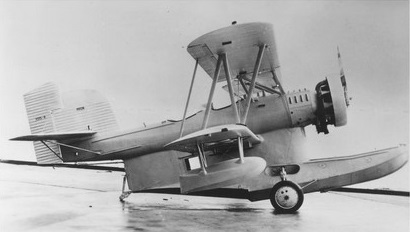
The prototypes first flight in early 1932 led to the addition of finlets on the horizontal stabilisers. But when performance and handling still fell below Navy expectations, the prototype was returned to the factory and subjected to modifications which included installation of a 550 hp R-1340D engine, lengthening the fuselage and pontoon three and a half feet, and enlarging the fin and rudder. Under the new designation XO2L-2, trials continued into late 1932, but Navy officials judged that the small performance improvement over the OL-9 did not merit production.
A biplane amphibian
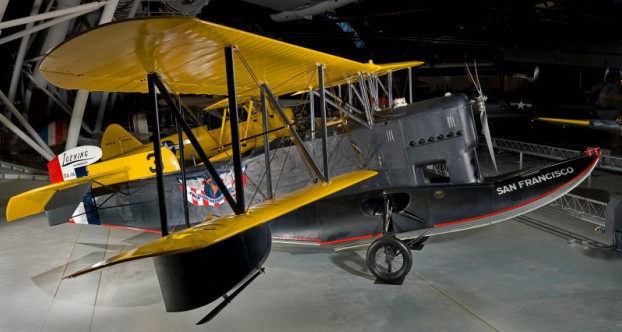
The hull is constructed of duralumin over a wooden frame, and the fuselage was built on top of the hull. The OA-lA is powered by a 420-horsepower, water-cooled Liberty V-12 engine that is mounted inverted.
The historic Pan-American Goodwill Flight of 1926 and 1927 through Mexico and Central and South America was intended to improve relations with Latin American countries, to encourage commercial aviation, and to provide valuable training for Air Corps personnel. The flight was made by ten pilots in five Loening OA-1A amphibian aircraft. To stimulate public interest, each airplane was named after a major U.S. city-the New York, the San Antonio, the San Francisco, the Detroit, and the St. Louis.
The 35,200 km (22,000 mi) flight began on December 21, 1926, from San Antonio, Texas. The journey took 59 flying days, interspersed with 74 days for scheduled maintenance and diplomatic meetings and ceremonies. The flight concluded at Bolling Field in Washington, D.C., on May 2, 1927. Within three weeks, however, the impressive achievement was eclipsed by Lindbergh’s solo trans-Atlantic flight in the Spirit of St. Louis.
Loening OA-1A San Francisco
Engine: Liberty V-12, 313 kw (420 horsepower)
Wingspan: 13.9 m (45 ft 7 in)
Length: 10.7 m (35 ft 1 in)
Height: 3.5 m (11 ft 6 in)

The original Lockheed Com¬pany built the moulded-plywood monocoque fuselage S-1 sports plane in 1916. Far ahead of its day, it could not compete with cheap war-surplus aircraft, and the company suspended manufac¬ture in 1920.
A commercial flop in spite of its innovative monocoque fuselage and folding wings.
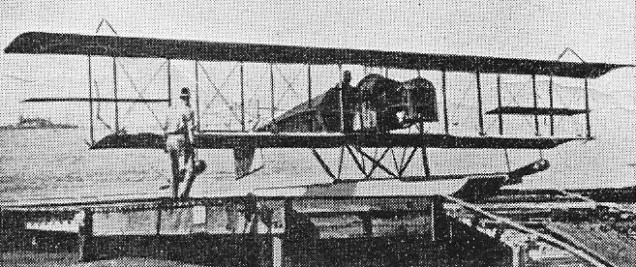
Allan and Malcolm Loughead built their first aircraft, the seaplane, in 1913. A wood and fabric covered three-seat seaplane with flat bottom floats. The aircraft featured ailerons mounted midway between the unequal-span mainplanes.
The Model G was test flown by the Loughead brothers at Santa Barbara, California.
The Model G was a main attraction at the Panama Pacific International Exposition held at San Francisco. Hundreds of visitors to the exhibition had their first experience of air travel in the Model G.
Engine: Curtiss O
Span upper: 46 ft
Span lower: 36 ft
Length: 30 ft
Height: 10 ft
AUW: 2200 lb
Useful load: 584 lb
Max speed: 63 mpg at SL
Seats: 3
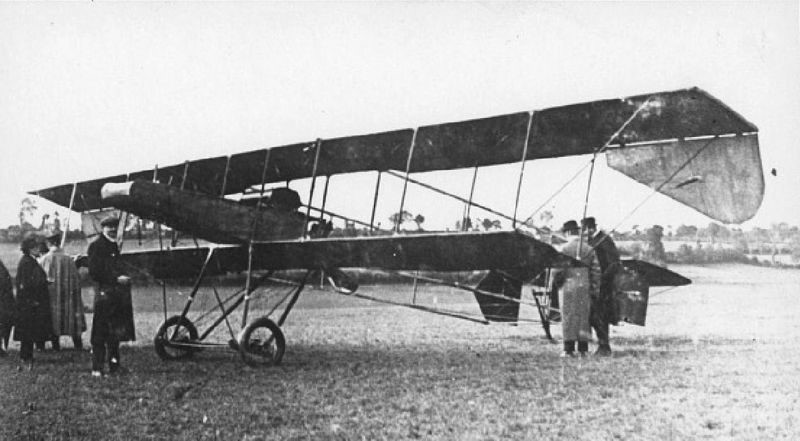
This 1912 Gnôme-engined pusher biplane was also known as the Lochner Rennzweidecker. It was built by Weyl in Germany with financing from Lochner, and was flown by Weyl.
 All Aero