Mainz 1911 Doppeldecker

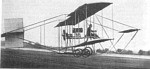
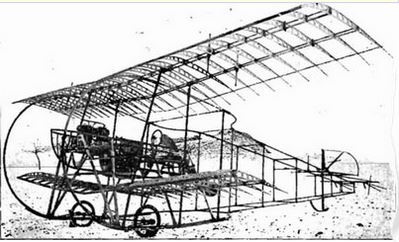
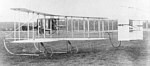
The Mainz Motor School airplane, known as the “One and a Half Decker” was built at the German Motor School at Mainz, Germany. The upper wing of this two-decker had 10 m span, the lower deck 7 m. The 50 hp Argus engine was placed in the front of the fuselage and drove the pusher propeller by means of a transmission. In the gondola-like cockpit there was space for the pilot and two passengers. Radiators were fixed on both sides of the fuselage.

Macchi M.16

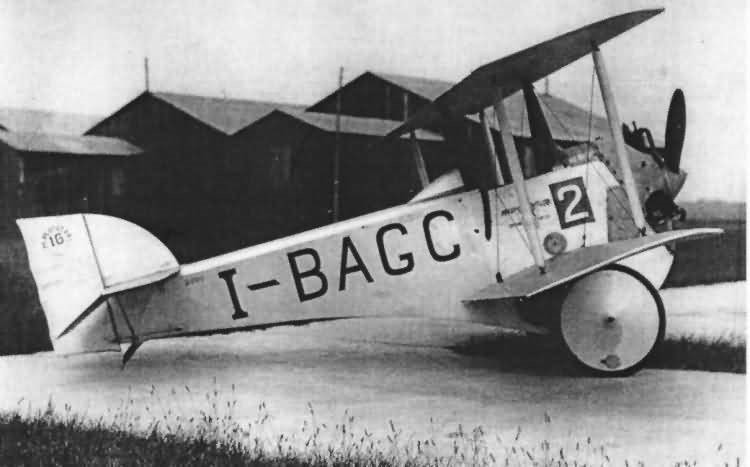
The Macchi M.16 was a light, single-seat aircraft designed by Alessandro Tonini and produced by Macchi in Italy in 1919.

It was a single-bay biplane with unstaggered wings and a largely conventional design except for an unusually deep fuselage that extended in a bulge below the lower wing. The landing gear axle being sprung directly on the bottom longerons with shock cord. The plane could also be fitted with pontoons.

The M.16 was developed in parallel with the Macchi M.20, a two-seat civil trainer aircraft which it resembled and with which it shared many common features.

The M.16 proved a successful sporting type, setting an altitude record of 3,770 m (12,370 ft) in 1920 while competing for the Coppa Mappelli (“Mapelli Cup”), and winning first prize in the competition in 1921.

The United States Navy purchased three float-equipped examples for evaluation as communication floatplanes.

Powerplant: 1 × Anzani, 22 kW (30 hp)
Wingspan: 6.00 m (19 ft 8 in)
Wing area: 11.3 m2 (122 sq ft)
Length: 4.43 m (14 ft 6 in)
Height: 2.12 m (7 ft 0 in)
Empty weight: 160 kg (350 lb)
Gross weight: 260 kg (570 lb)
Maximum speed: 165 km/h (103 mph, 90 kn)
Landing speed: 25 mph
Range: 420 km (260 mi, 230 nmi)
Crew: 1, pilot
L-W-F G / G-2 / G-3

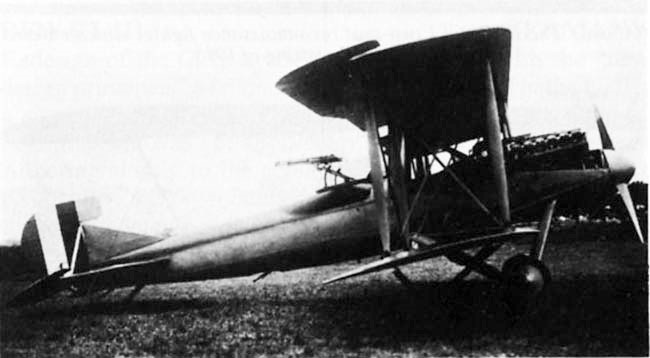
One of the first developments of LWF Engineering was a dual reconnaissance aircraft Model G, built in late 1917. During the tests the plane was destroyed and on its base in 1918 a new airplane was built- G-2, which could be used as a heavy fighter or as a scout-bomber. Equipped with a liquid-cooled engine Liberty 12 rated at 435 hp. The aircraft carried seven 7.62-mm machine guns (four of them were installed in front and synchronized for firing through the screw, two – in the rear cabin on a mobile turret-type Scarff and one at the bottom of the fuselage).

For the first time, the G-2 took off in the spring of 1918. The aircraft successfully passed the tests and the question of its serial production was considered, when on November 18, 1918 the prototype was lost as a result of the accident that occurred during the flight in the fog. This led to a complete halt of the project.

The third copy of the aircraft (G-3) was completed in 1919 as a racing aircraft for the New York-Toronto air race.

G-2
Engine: Liberty 12, 435 hp
Wing span: 12.69 m
Wing area: 47.94 sq.m
Length: 8.88 m
Height: 2.86 m
Empty weight: 1213 kg
Normal take-off weight: 1825 kg
Maximum speed: 222 km / h
Cruising speed: 196 km / h
Endurance: 4 hr
ROC: 328 m / min
Crew: 2
Armament: seven 7.62-mm machine guns