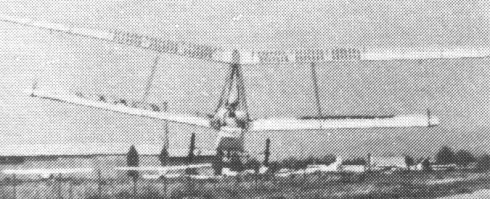
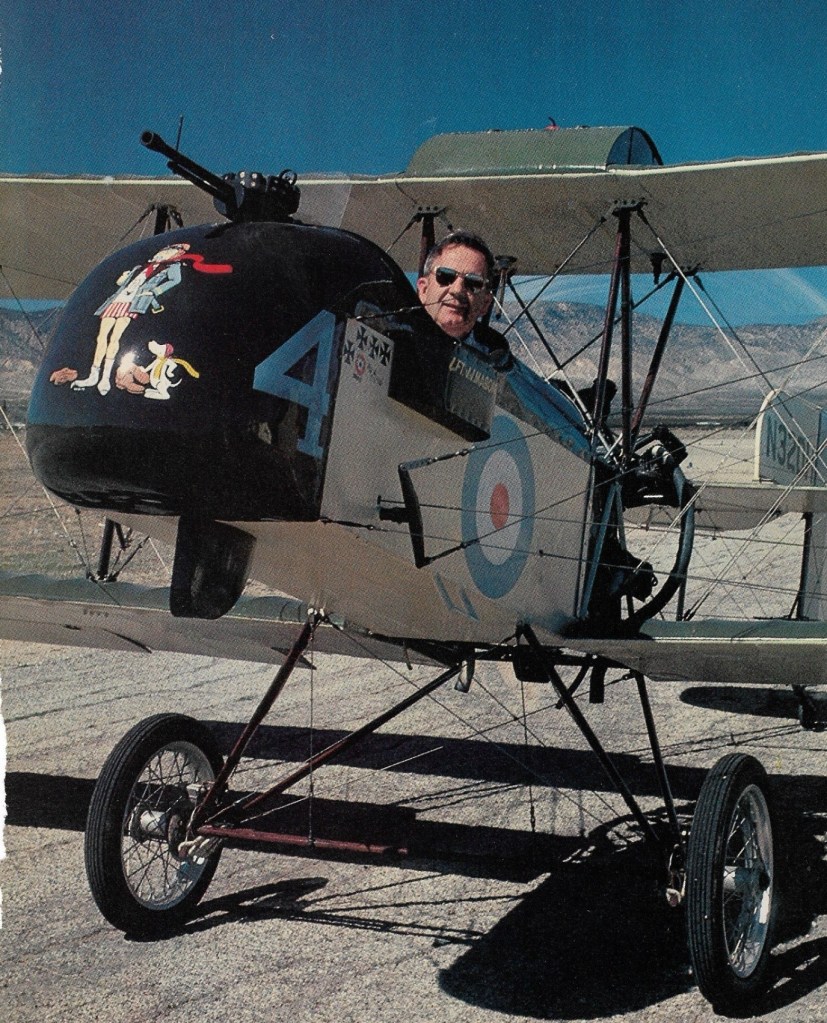
First flown in April 1979 the converted Easy Riser hang-glider is powered by 500 solar cells mounted on the top wing. The 40V, 10A output powers a 3 hp electric motor driving a 41 inch propeller. 1½ hrs of sunshine accumulated in the battery provides around 5 minutes of still air flight. The biplane was mylar covered.
Engine: Electric, 3 hp Wing span: 30 ft Empty wt: 125 lb
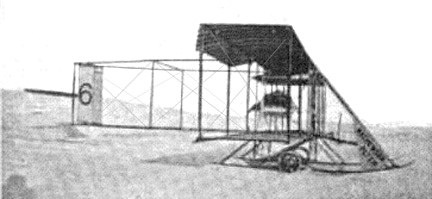
Circa 1911 several one and two place open cockpit biplane exhibition machines were produced closely following the Curtiss design at first, then diverging as knowledge was gained.
A first flight was reported on 4 January 1911 by George Van Arsdale, who flew 04m:12s around a local speedway track, powered by an Elbridge motor.
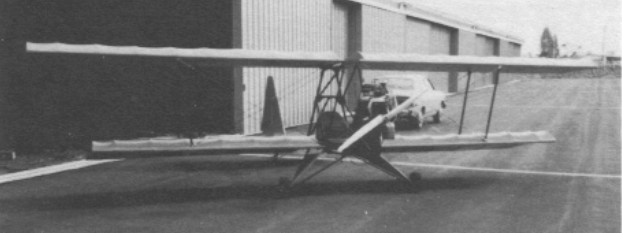
Single seat single engined biplane with three ¬axis control. Wings have unswept leading and trailing edges, and constant chord; conven¬tional tail. Wings braced by struts and transverse X cables; wing profile double ¬surface. Undercarriage has three wheels in tail dragger formation. Tailwheel steering. Aluminium tube framework. Engine mounted between wings driving tractor propeller. Like the CCC, the PUP from Lyle Mathews is only sold as a set of plans. The PUP (Perfect Ultralight Plane) is a single seater biplane with its lower wing of shorter span than the top. The top wing is supported by a tubular framework which forms the cockpit and also acts as the mount for the tractor engine fitted in the nose of the PUP and on which the two triangular main¬ gear legs are mounted. The wings are sup¬ported by interwing struts and flying and landing wires in an X configuration, in the tradition of the old biplanes. The convention¬al tail and the steerable tail wheel are carried on a rectangular section, aluminium spar of 1 x 3 inch (25 x 76 mm). For simplicity the PUP has a metal structure built with gussets and pop rivets. The prototype formed its first flight at the beginning of 1983 using a Lloyd 22hp engine which Lyle Mathews then re¬placed with a Kawasaki TA440. Plans cost $15 in the US and Canada, $20 elsewhere in 1982.
Engine: Kawasaki TA440, 38.5 hp Propeller diameter and pitch 54 x 30 inch, 1.37 x 0.76 m Power per unit area 0.26 hp/sq.ft, 2.9 hp/sq.m Empty weight 248 lb, 112kg Max take off weight 450 lb, 204kg Payload 202 lb, 92kg Wing span 24.0ft, 7.31 m Constant chord 5.0 ft, 1.52 m Sweepback 0 degs Total wing area 143 sq.ft, 13.3 sq.m Max wing loading 3.15 lb/sq.ft, 15.3 kg/sq.m Max power loading 11.7 lb/hp, 5.3kg/hp Cruising speed 40mph, 64kph Stalling speed 28mph, 45 kph Max climb rate at sea level 600 ft/min, 3.0 m/s.
Maryland Pressed Steel built two designs of Joseph Bellanca, who in 1919 developed single-seat CD biplane powered by 35 hp Anzani engine, and the CE two-seat biplane. With the conclusion of WWI, Maryland Pressed Steel’s contracts were cancelled and the company entered into receivership.
Maryland Pressed Steel built two designs of Joseph Bellanca, who in 1919 developed single-seat CD biplane powered by 35 hp Anzani engine, and the CE two-seat biplane. With the conclusion of WWI, Maryland Pressed Steel’s contracts were cancelled and the company entered into receivership.
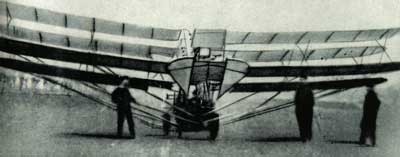
In 1905, Signor Martino, a railroad worker, along with some associates began construction of a tandem biplane in the workshops at Scalenghe Azzario (the ancestral home of the Coda family). Flight tests were carried out in 1909, but with little success. A few photographs bear witness to its construction and completion.
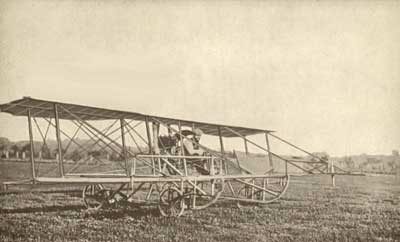
Martin Biplane “Harvard 1” of 1910 was built in Boston, Massachusetts, by S. L. Saunders and certain Harvard students of the 400-member Harvard Aeronautical Society. James V. Martin – the manager of the society – designed, patented, and piloted the machine on several 125-yard flights within Soldier’s Field in 1910, fitted with a regular Cameron 4-cylinder, air-cooled automobile engine, at a height of 8 or 10 feet.
 All Aero