Miles Marine and Structural Plastics S.E.5a

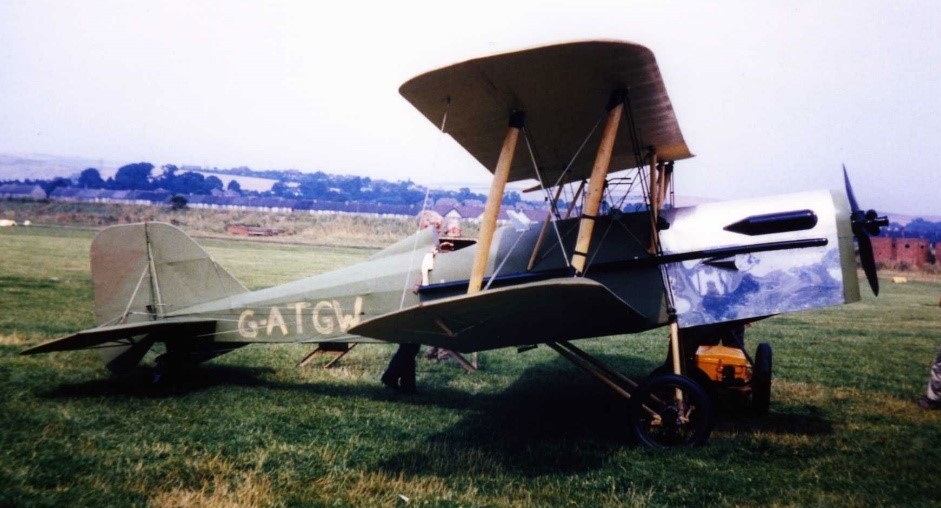
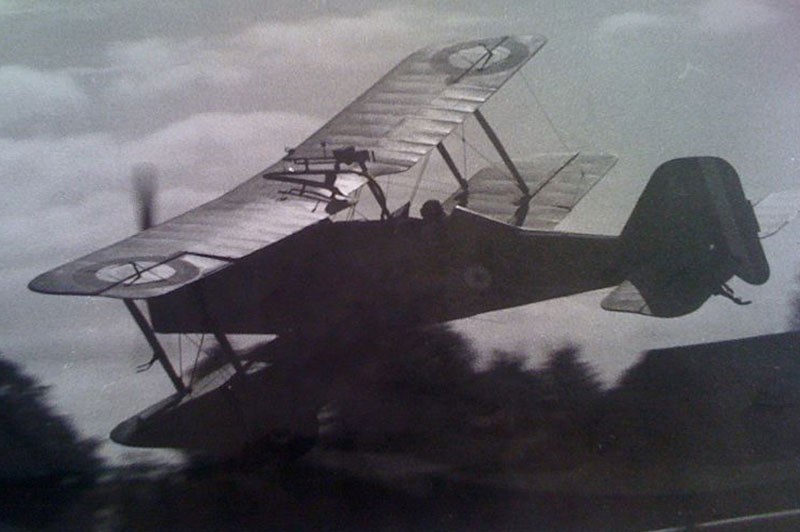
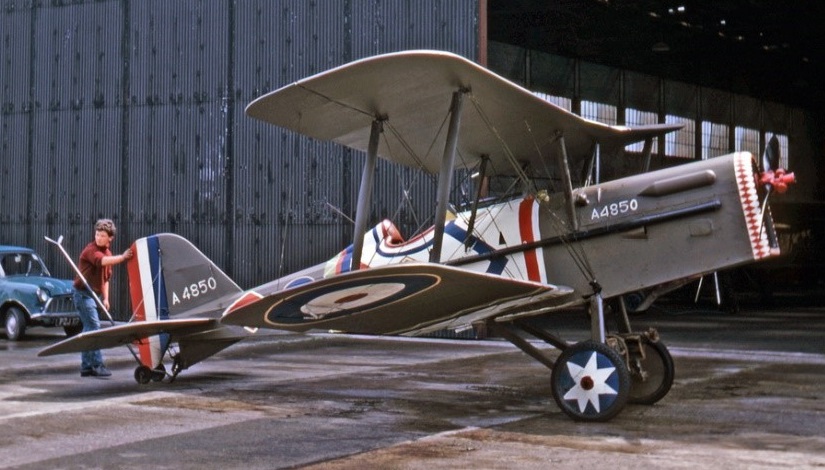
20th Century Fox purchased the film rights of Jack D Hunter’s “The Blue Max” and the film was to be a multi-million dollar production, and the stars were to be the full sized reproductions of World War I fighters constructed for the film- two Pfalz D.III biplanes, two Fokker Dr.I triplanes, two S.E.5a scouts and three Fokker D.VII biplanes.

The reproductions had to be built in a hurry to meet the time frame for shooting and were constructed in different locations. Miles Marine and Structural Plastics Ltd of Shorham, constructed the steel tube fuselage S.E.5a reproductions in 1965. With a 200 hp De Havilland Gypsy Queen 3 engine installed, they were very manoeuvrable and reportedly easy to fly.

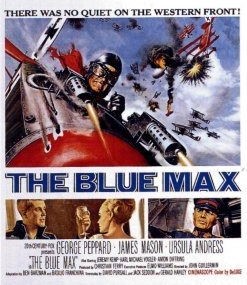
The two full-scale replica S.E.5a aircraft were transferred to the Irish civil aircraft register in 1967 while the two were employed in flying scenes for the 1966 war movie The Blue Max.

The SE.5 replicas built by Miles Marine and Structural Plastics Ltd, G-ATGV and G-ATGW, were both written off within a month of each other in 1970.

On August 18, 1970, while filming Zeppelin over the Irish Sea, SE.5 G-ATGW (shown here under construction at Shoreham) rammed the Aérospatiale Alouette II camera helicopter, the same one used to film The Blue Max. Both aircraft were destroyed and all crew members killed.

On September 15, 1970, while performing a low-level maneuver during the filming of von Richthofen and Brown at Weston, Charles Boddington struck the ground in SE.5 G-ATGV and was killed. Aircraft written off.

Gallery

Miles Bristol Boxkite

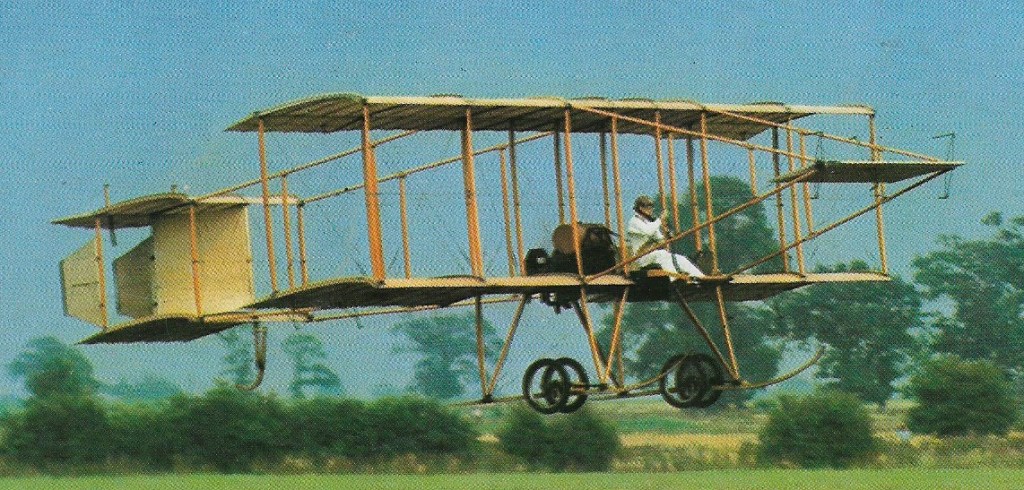
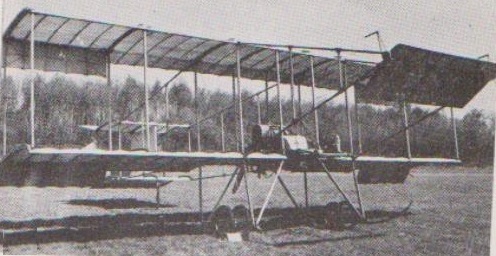
No original Bristol Boxkites aeroplanes survive today, although three authentic flyable reproductions were built by the F.G. Miles group for the film Those Magnificent Men in Their Flying Machines. Of 20 types built in 1964 at £5,000 pounds each, six could fly, flown by six stunt pilots and maintained by 14 mechanics.

The Phoenix Flyer Bristol Boxkite built by F.G. Miles Engineering Co. at Ford, Sussex, representing Curtiss biplane of 1910. Annakin had apparently expressed a desire to have a Wright Flyer in the film. The Bristol (a British derivative of the French 1909 Farman biplane) was chosen instead because it shared a common general layout with a Wright or Curtiss pusher biplane of the era, and had an excellent reputation for tractability. For the impersonation, the replica had “The Phoenix Flyer” painted on its outer rudder surfaces and was also called a “Gruber-Newton Flyer” adding the name of its primary backer to the nomenclature; although the American pilot character, Orvil Newton inaccurately describes his aircraft to Patricia Rawnsley as a “Curtiss with an Anzani engine.”

These were initially powered by a 65 hp (48 kW) Rolls-Royce Continental A65 air-cooled flat four, but this produced insufficient power, due to the shorter-stroke, higher-RPM mid-20th century engine, driving a small-diameter modern propeller, being inefficient at the low airspeed achieved by the Boxkite, which originally used the slower-revving Gnome Omega 50 hp seven-cylinder rotary engine.

Miles-built Bristol Boxkite replica ‘The Phoenix Flyer’ BAPC.2

F G Miles, chiefly responsible for its design and manufacture, built the replica Bristol Boxkite with the original standard twin rudder installation and powered the replica with a 65 hp Rolls-Royce A65. In the course of testing, Air Commodore Wheeler had a third rudder inserted between the other two (as did some original Boxkites) to improve directional control, and replaced the first engine with a Rolls-Royce C90 that barely delivered the power of the original 50 hp Gnome rotary, and provided a 45 mph top speed. The Boxkite was tractable and the scene in the story when the aircraft loses a pair of main wheels just after takeoff but lands smoothly was repeated 20 times for the cameras. In the penultimate flying scene, a stuntman was carried in the Boxkite’s undercarriage and carried out a fall and roll (the stunt had to be repeated to match the principal actor’s roll and revival). Slapstick stunts on the ground and in the air were a major element and often the directors requested repeated stunts; the stuntmen were more than accommodating – it meant more pay.

This resulted in the replacement of the 65 hp flat-four by a 90 hp (67 kW) Continental O-200-B engine. These proved flyable enough to be used for cross-country flights between filming locations. Another tribute to the soundness of the design is that the calculations made for the purpose of granting the necessary Certificates of Airworthiness found that the stressing of the design was very close to modern requirements.

Box 1
c/n BM.7279 RR/Continental A65, first flown April 1964 at Ford Re-engined with a RR/Continental C90. Flew in the film ‘The Phoenix Flyer’. Refurbished and presented to the Shuttleworth Trust in Bedfordshire, where it is still flown during flying displays when the weather permits. Allocated BAPC.2.

Box 2
c/n BM.7280 A65 then C90. Donated to Museum of Australian Army Flying in Queensland after filming.

Box 3
c/n BM.7281 Retained A65 as it was only used for studio shots and crash scenes. Refurbished after the film and donated to Bristol City Museum and Art Gallery, allocated BAPC.40.

Miles M.1 Satyr

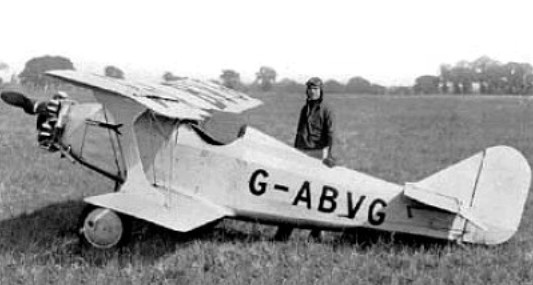
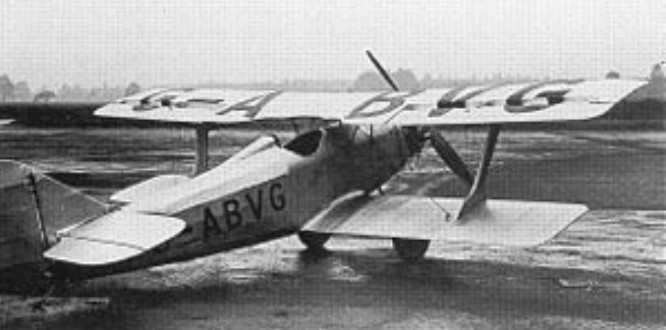
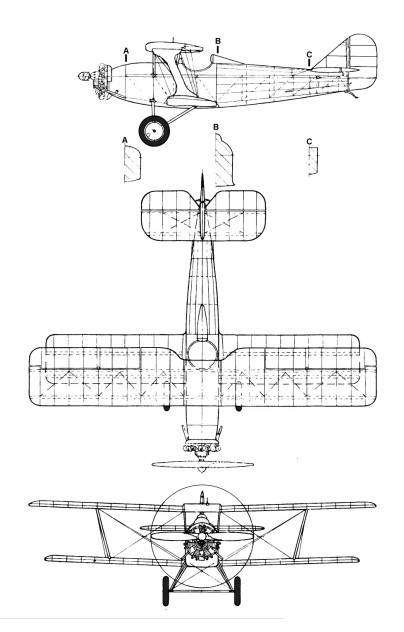
The single-seat, aerobatic, Satyr biplane was designed in 1932 by F.G. Milesat Shoreham, Sussex. It was a wooden single-seat aerobatic biplane powered by a 75 hp Pobjoy R engine. Built by Parnall at Yate, Gloucestershire, the aircraft (registered G-ABVG) first flew in August 1932. Although the aircraft flew well Miles decided to concentrate on monoplane designs and only one was built. The only Satyr crashed in August or September 1936.

In ‘Miles Aircraft since 1925’ Don Brown recounts the crash as follows:

“The end of the Satyr was unusual and dramatic. One day in September 1936 Mrs Victor Bruce was approaching to land in a small field and, at the last moment, when it was too late to take evasive action, she noticed a large mass of telephone wires dead ahead, so close that there was no time either to climb or dive under them. Thinking what bad luck it would be on all the people whose telephones would be disconnected, she sailed on gaily into the wires expecting to go straight through them. However, she had overlooked the number of wires and the low momentum of the little Satyr. Instead of passing through the wires and landing in the field, the wires stretched but did not break. In a matter of seconds the Satyr was stopped dead in the air and then catapulted backwards into the field over which it had just flown. It was all over in a flash. Mrs Victor Bruce was unhurt but it was the end of the Satyr. This must be one of the few instances in which an aeroplane has landed backwards, although not very successfully.”

The autobiography of the Hon. Mrs Victor Bruce (‘Nine Lives Plus’) deals with the circumstances of the crash (“on the green outside Stafford”) she says:

“Suddenly there was an almighty crash. I thought that I had hit one of the houses, because the noise was terrific. Then I realised that I had flown into the telephone wires. The Satyr and I must have remained hanging inthe wires for at least half a minute. Then the wires gave way and we fell fifteen feet to the ground with a bang”.
“The Satyr, of course, was badly damaged…………..” and then: “While the Satyr was being repaired I hired a Gipsy Moth to take its place in the show……….”.

So did the Satyr survive the crash and was repaired.

M.1
Engine: 1 × Pobjoy R, 75 hp (56 kW)
Wingspan: 21 ft 0 in (6.4 m)
Length: 17 ft 8 in (5.38 m)
Empty weight: 594 lb (269 kg)
Gross weight: 900 lb (408 kg)
Maximum speed: 122 mph (196 km/h)
Crew: One

Mijelson-Morschikhin U-4

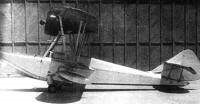
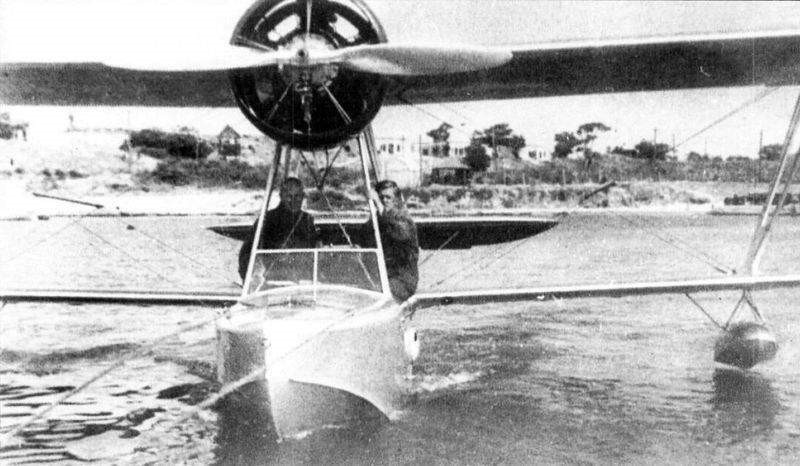
The MU-4 (Russian: Михельсон/Никитин МУ-4) amphibious flying boat was designed and built by NG Mijelson at Leningrad Factory No.23. The initials MU correspond to Morskaya Uchebnaya or Marine Trainer.

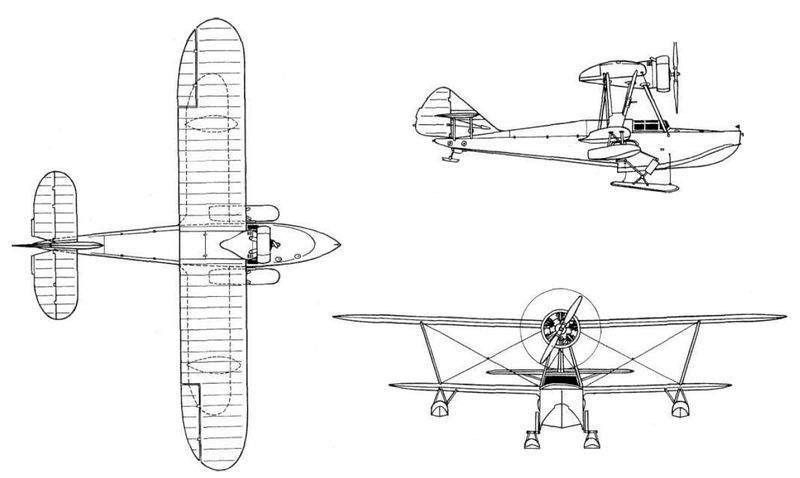
The MU-4 was designed as a flying-boat with a single hull and amphibious capacity. The hull was made entirely of wood and was made up of five watertight departments.

The wing configuration was sesquiplanar with the wing box braced by V-shaped struts made of duralumin. The wooden wing featured a double spar structure with a slim profile and constant chord. The covering was fabric. The lower plane was inserted into the fuselage, while the upper one was located high above the cabin, from where the engine supports started. The drop-shaped stabilization floats were located in the lower wing.

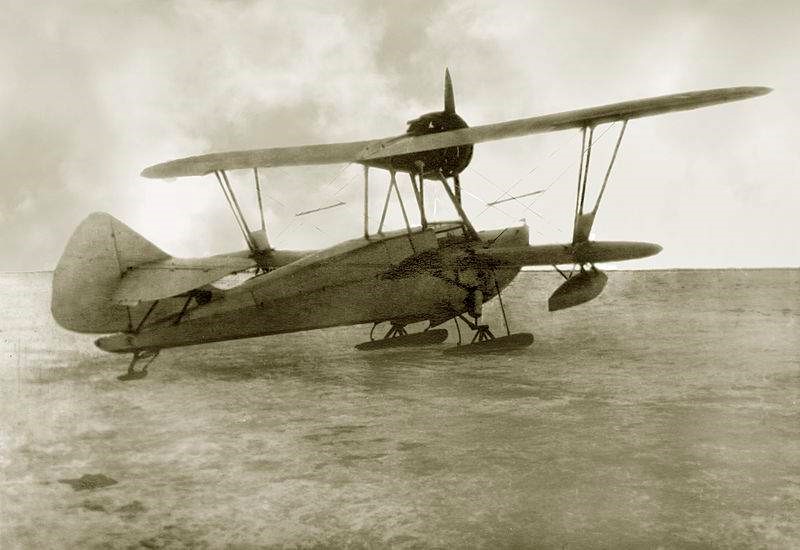
For operations on land, the MU-4 had a conventional landing gear with oleo-pneumatic shock absorbers and a tail skid. The main units retracted forward on the sides of the hull by means of a manual drive system. To allow winter operations the wheels could be replaced by skis.

The MU-4 tested with skis in the winter of 1937 – 1938.

The tail unit was of the conventional monoplane type with the stabilizers located high on the empennage and fixed by parallel struts in its lower part.

The MG-11F engine was installed on the upper wing in a tractor configuration protected by a Townend ring hood and moving a two-blade propeller. For winter, a special “winter” cowl was designed.

The MU-4 could carry two people, seated side by side in an enclosed, dual-control, glazed cabin.

The first prototype was finished in August 1937. Tests showed that the plane had good flight characteristics and could perform aerobatics. During the manufacturing tests this example was destroyed due to a construction defect. The engine fixing brackets to the gunwales were glued with a poor quality glue that ended up coming off. A short time later Mijelson would be imprisoned so the responsibility for further development passed to VV Nikitin.

Mijelson MU-4/2 at Factory No.23.

The second prototype was submitted for testing in May 1938. Model tests were carried out at the NII GVF hydrostation located in Konstantinovska Bay in Sevastopol. The flights were carried out by test pilot GI Sergueyev. The MU-4 was presented as a simple plane to fly and capable of taking off and landing in small aquatic spaces.

MU-4/2 during factory tests in 1938.

It was proposed to build a series of 30 examples at Factory No.23, but after Mijelson ‘s conviction this decision was reversed. The Shavrov Sh-2 was produced in series, covering the same needs.

MU-4
Powerplant: 1 x 190 hp MG-11F
Wingspan of upper plane: 12.00 m
Wingspan of lower plane: 9.00 m
Wing area: 33.00 m²
Length: 8.70m
Height: 3.70m
Empty weight: 989 kg
Normal takeoff weight: 1255 kg
Wing loading: 36.4 kg/m²
Power load: 4.2 kg/hp
Fuel + lubricant capacity: 80 + 20 kg
Top speed: 173km/h
Cruising speed: 154 km/h
Service ceiling: 3400 m
Accommodation: 2

Mijelson-Morschijin U-3

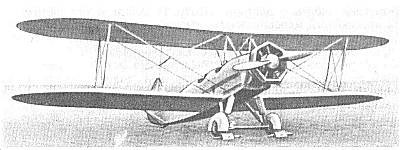
In the mid 1930’s Leningrad Factory No.23 was producing versions of the Polikarpov U-2 trainer. In parallel with the development of the serial versions U-2, AP and others, NG Mijelson and AI Morschijin proposed in 1934 the development of a version with a similar layout, but with larger dimensions and a more powerful M-48 engine of 200hp. The objective of this model was to obtain a medium training aircraft in which the students could continue after finishing the initial classes with the U-2.

Construction of the U-3 (Russian: Михельсон/Морщихин У-3) included a number of bolted duralumin aggregates. These aggregates were generally lighter. This, together with some decrease in the reserves of structural resistance, lightened the model. Other minor modifications were introduced with a view to improving performance.

The M-48 engine was protected by a hexagonal-shaped Townend cowling constructed of “Enerzh-6” stainless steel.

The U-3 was tested in 1935 but the results obtained were not much higher than those of the U-2, and the M-48 engine was not produced in series.

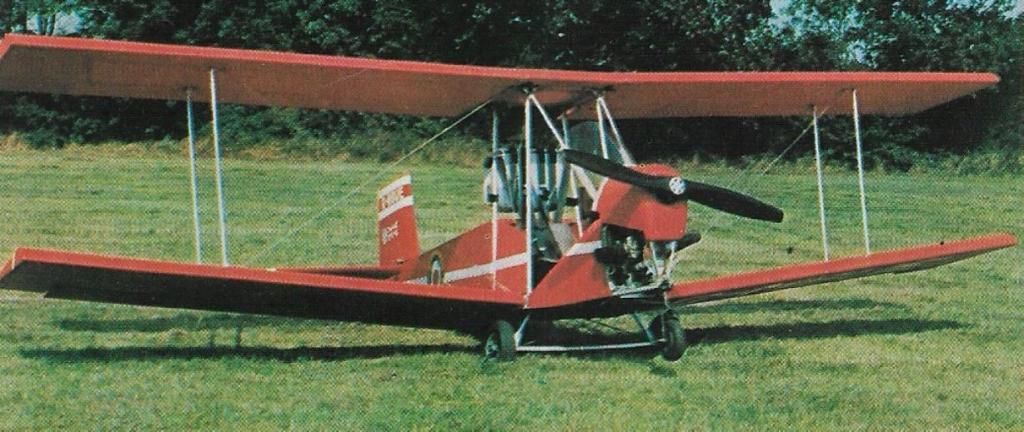
Micro Biplane Aviation Tiger Cub 440

Single seat single engined biplane with con¬ventional three axis control. Wings have un¬swept leading and trailing edges, and constant chord; conventional tail. Pitch control by fully flying tail; yaw control by fully flying rudder; roll control by full span ailerons; control inputs through stick for pitch/roll and pedals for yaw. Wings braced by struts and dupli¬cated transverse X cables; wing profile; 100% double surface. Undercarriage has three wheels in tail dragger formation; coil spring suspension on tailwheel and axle flex suspension on main wheels. Push right go-¬right tailwheel steering connected to yaw control. No brakes. Composite fuselage, partially enclosed. Engine mounted between wings driving tractor propeller. Patented composite wing structure using waterproof fabric covering with heat set backing adhe¬sive. Rigging wires of stainless steel. Airframe uses aluminium alloy seamless drawn tube and cadmium plated aircraft quality nuts and bolts.

The Super Tiger Cub 440 is the logical development of the Micro Bipe prototype, with the open framework replaced by a partially enclosed cockpit and the 250 engine discarded in favour of a 440. Wing span is increased to keep the wing loading of this heavier aircraft within the UK microlight definition. Although a nosewheel was retained for test work on the pre production prototype of the Super Tiger Cub 440, it is not fitted on production machines. Particularly noteworthy is the ease of rigging. Simply by removing three locking pins per side, the Super Tiger Cub 440 is made ready for trailer transport.

The aircraft is offered in three forms: part kits, full kits or ready to fly. Part kits are numbered one to eight and can be purchased one at a time as the builder’s finance permits, a system which also permits the manufacturer to keep costs down by producing each part kit in quantity. By 1982 over 150 of these aircraft were in the process of being built.

Gallery

Engine: Robin EC44 50hp at 7000rpm
Propeller diameter and pitch 54 x 33 inch, 1.37x 0.84 m
Toothed belt reduction, ratio 2.4/1
Max static thrust 220 lb, 100kg
Power per unit area 2.72 hp/sq.ft, 29.7 hp/sq.m
Fuel capacity 6.0 US gal, 5.0 Imp gal, 22.7 litre
Length overall 13.3 ft, 4.05 m
Height overall 5.5 ft, 1.68m
Wing span 21.0ft, 6.40m
Constant chord 3.0 ft, 0.91 m (bottom wing), 3.5 ft, 1.07 m (top wing)
Dihedral 5 deg (bottom wing), 0 deg (top wing)
Sweepback 0 deg
Tailplane span 7.0ft, 2.13m
Rudder height 2.9ft, 0.88 m
Total wing area 136 sq.ft, 12.6 sq.m
Total aileron area 13.8 sq.ft, 1.28 sq.m
Rudder area 6.3 sq.ft, 0.59 sq.m
Total elevator area 14.6 sq.ft, 1.36 sq.m
Wing aspect ratio 6.4/1
Wheel track 4.2 ft, 1. 28 m
Tailwheel dia¬meter overall 4 inch, 10cm
Main wheels diameter overall 13 inch, 33cm
Empty weight 265 lb, 120kg
Max take off weight 500 lb, 227 kg
Payload 235 lb, 107 kg
Max wing loading 3.68 lb/sq.ft, 18.0 kg/m
Max power loading 10.0 lb/hp, 4.5kg/hp
Load factors +6.0, 4.0 design; +9.0, 7.0 ulti¬mate
Max level speed 80 mph, 129 kph
Never exceed speed 85 mph, 137 kph
Max cruising speed 70 mph, 113 kph
Economic cruising speed 60 mph, 97 kph
Stalling speed 30 mph, 48 kph
Max climb rate at sea level 900 ft/min, 4.6 m/s
Min sink rate 500 ft/min at 36 mph, 2.5 m/s at 58 kph
Best glide ratio with power off 7/1 at 35 mph, 56 kph
Take off distance 60 ft, 20 m on short grass
Landing distance 80 ft, 25 m on short grass
Service ceiling 10,000 ft, 3050 m
Range at average cruising speed 115 mile, 185 km
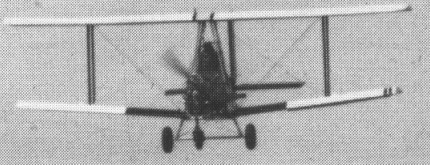
Micro Biplane Aviation Micro-bipe

Single seat single engined biplane with con¬ventional three axis control. Wings have un¬swept leading and trailing edges, and constant chord; conventional tail. Pitch control by fully flying tail; yaw control by fully flying rudder; roll control by two thirds span ailerons on lower wing; control inputs through stick for pitch/roll and pedals for yaw. Wings braced by struts and cables; wing profile; 100% double surface. Undercarriage has three wheels in tail dragger formation with additional nosewheel; coil spring suspension on tailwheel, no suspension on nosewheel, and axle flex suspension on main wheels. Push-right go right tailwheel steering connected to yaw control; castoring nosewheel. No brakes. Aluminium tube framework, without pod. Engine mounted between wings driving trac¬tor propeller. Patented composite wing struc¬ture using waterproof fabric covering with heat set backing adhesive.
First shown late in 1981, the Tom Wright designed Micro Biplane, or Micro Bipe as it quickly became known, created enormous interest after looping at the Long Marston fly in in May 1982.
Although it was offered to the public as early as March 1982, the manufacturers were at that time in no position to satisfy the enormous interest that the tiny plane evoked and in May, many frustrated would be cus¬tomers later, the decision was taken not to go into production with the Micro Bipe as it stood, but to refine it, ‘productionise’ it, and set up a company to make and market it. The aircraft developed into the Super Tiger Cub 440.

Engine: Robin EC25PS 350cc
Length overall 13.0 ft, 3.96 m
Height overall 5.0 ft, 1.53m
Wing span 18.0ft, 5.48m
Constant chord 3.0 ft, 0.91 m
Sweepback 0 degs
Total wing area 108 sq.ft, 10.0 sq.m
Wing aspect ratio 6.0/1
Empty weight 165 lb, 75 kg
Max take off weight 375 lb, 170kg
Payload 210 lb, 95 kg
Max wing loading 3.47 lb/sq.ft, 17.0 kg/sq.m
Load factors; >+6.0, > 4.0 ultimate (with wing relief allowance)
Never exceed speed 75 mph, 121 kph
Max cruising speed 55 mph, 88 kph
Stalling speed 30 mph, 48 kph
Max climb rate at sea level 350ft/min, 1.8m/s
Take off distance 150ft, 45m on tarmac