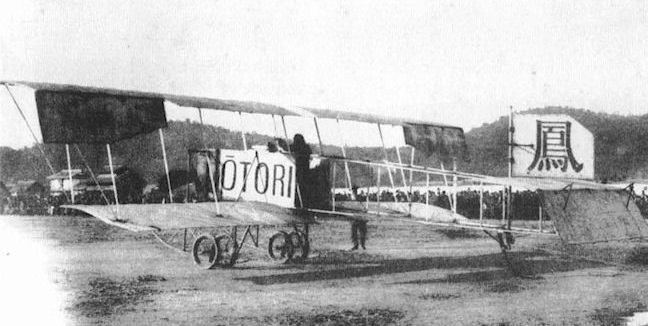
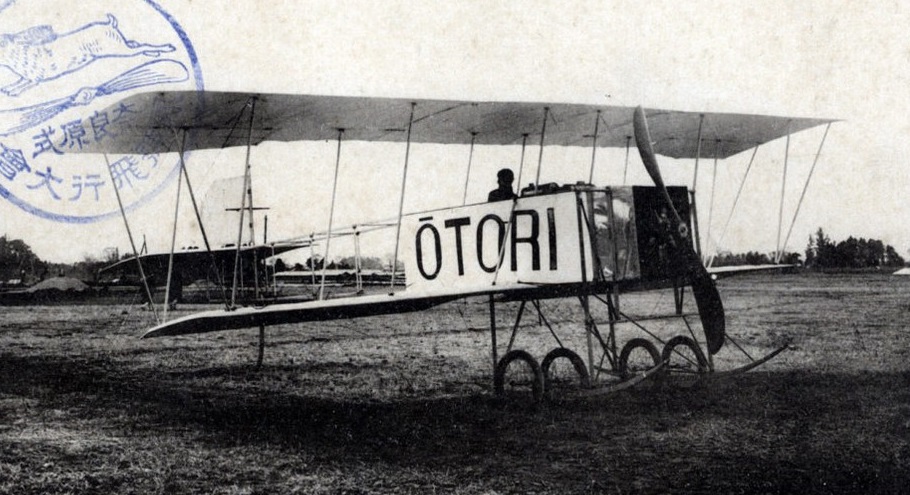
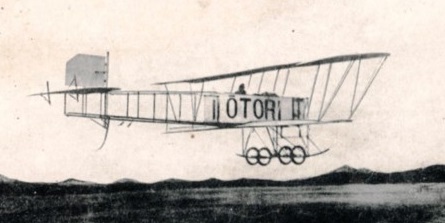
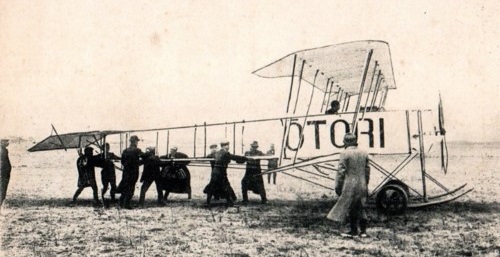
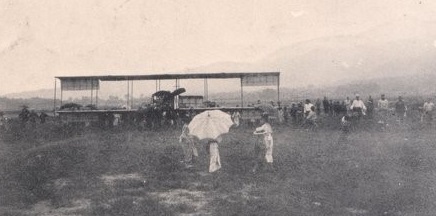
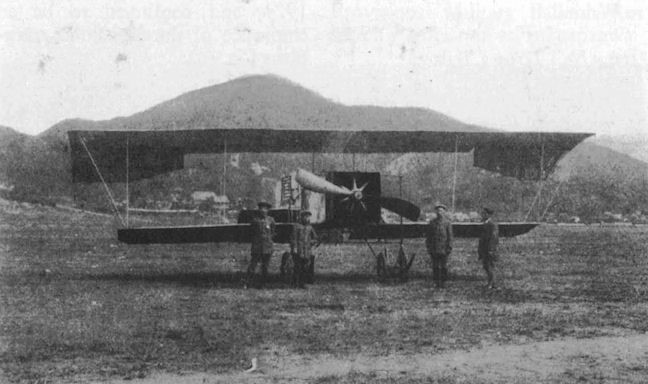
While the Narahara No.4 Ohtori-go was touring Japan with demonstration flights by Shimo, the Narahara No.5 Ohtori Nisei-go (meaning Ohtori the 2nd) was built. It was almost identical to the No.4 but was powered by a 70hp Gnome rotary engine and had a strengthened undercarriage. This aeroplane was completed in June 1913 and made exhibition flights at Ibaragi, Toyama, Ishikawa and Niigata from June to September that year.
Sanji Narahara eventually retired completely from aviation at his family’s insistence. His aviation activities were first taken over by Einosuke Shirato who then began manufacturing aeroplanes under his own name and provided flying training at Inage beach. In addition to Shirato’s activities, Otojiro Itoh also became known for his aviation endeavours, and between the two, a new era of civil aviation began in 1913 stemming from Narahara’s works and now centred at the Shirato/ltoh Airfields.
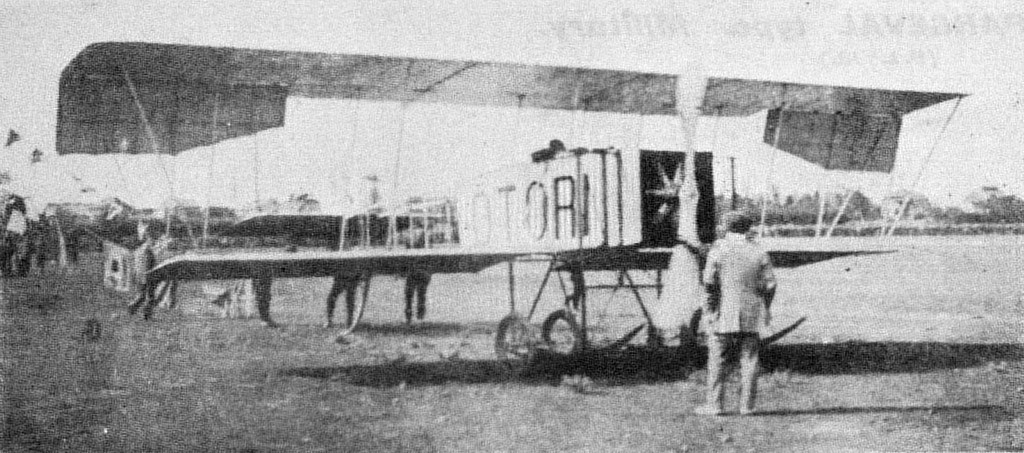
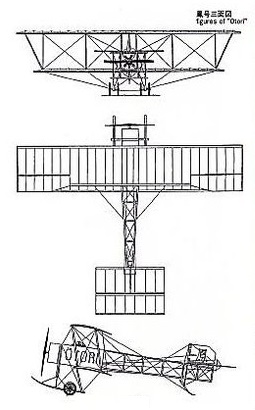
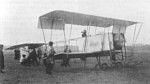
In the autumn of 1911, Narahara’s group was joined by Shuhei Iwamoto, later a professor of Tokyo University, and Kiyoshi Shiga, BSc. By March 1912 they had created the Narahara No.4 Aeroplane with the help of Saken Kawabe, Otojiro Itoh and Ginjiro Goto, themselves to become notable in aviation. The aeroplane was built at the Orient Aeroplane Company (Toyo Hikoki Shokai), having its office in Kyobashi, Tokyo. The factory was then located at Fukagawa (near or at Susaki Airfield) and final assembly was made at Tokorozawa where it was to be flown. It received the name of Ohtori-go, after a champion sumo-wrestler, Ohtori, at the request of the sponsor who supported the project.
A single-engine tractor training biplane with wooden structure with fabric covering. The pupil and instructor were in an open cockpit.
The aeroplane performed well and was taken on exhibition tours, with flights at major cities throughout Japan to demonstrate what was referred to as their ‘Japanese-made civil aeroplane’. Since there were no airfields in Japan at this time, flights were made from race tracks or military parade grounds of such relatively small size that landings and take offs were very near the spectators. During the first of these exhibition flights on 13 April, 1912, at Kawasaki Race Track, Kanagawa Prefecture, a failing engine caused the aeroplane to land short, allowing a wingtip to strike a school boy, breaking his arm.
The aeroplane was again demonstrated on 11 and 12 May for His Highness the Crown Prince (later Emperor Taisho) and his three sons (one to later become Emperor Showa [Hirohito]) along with Field Marshal Aritomo Yamagata and many other high-ranking officers at the Aoyama Military Parade Grounds. These demonstrations brought Narahara an award by the Imperial House, the first distinction given to someone involved in Japanese civil aviation.
The last exhibition flight by the Ohtori No.4 was in Seoul, Korea, on 3 and 4 April, 1913.
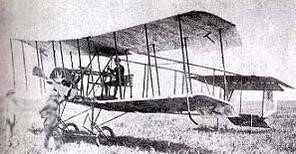
Second biplane designed and built by Sanji Narahara, dating from early 1911. Of twin-boom, open construction and powered by a 50 hp Gnôme rotary, this Japanese machine actually flew as there is at least one photograph showing it in-flight.
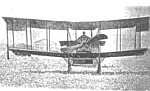
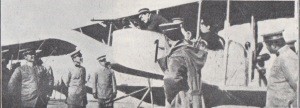
Around 1915, the Nanyuan Gun Bus No. 1 appeared, perhaps an indigenous design, perhaps based on imported aircraft. The Gun Bus was a single-engine pusher aircraft with a crew of two, a pilot and a gunner. It might have found service in China’s civil unrest at the time.
With the destruction of the NAF-1 shipboard two-seat fighter prototype in April 1933, Kiyoshi Akegawa began design of a further two-seater to meet an 8-Shi requirement, the NAF-2. Of all metal construction with fabric skinning, the NAF-2 was powered by a 580 hp Nakajiina Kotobuki 2 nine-cylinder radial and was a single-bay staggered biplane with pronounced sweepback on the upper wing. Armament comprised three 7,7-mm guns, two fixed and one on a flexible mount, and the first of two prototypes was completed in March 1934, these differing in that the first had N-type interplane struts and the second had aerofoil-section I-type struts. Although the NAF-2 met Imperial Navy requirements, a change in policy led to the abandonment of the two-seat fighter concept, and both prototypes were sold to the Asahi Press.
Engine: Nakajiina Kotobuki 2, 580 hp Max speed, 186 mph (300 km/h) Time to 9,845 ft (3 000 m), 9.66 min Endurance, 4.5 hrs Empty weight, 2,718 lb (1 233 kg) Loaded weight, 3,770 lb (1 710 kg) Span, 33 ft 9.5 in (10,30 m) Length, 23 ft 9.8 in (7,26 m) Height, 9 ft 4.2 in (2,85 m) Wing area, 283.64 sq ft (26,35 sq.m)
In 1931, the Imperial Navy instructed Nakajima to design and build, as part of a 6-Shi programme, a two-seat shipboard fighter with secondary dive-bombing capability and provision for an auxiliary fuel tank to suit the aircraft for long-range reconnaissance missions. Of all-metal construction with fabric skinning and designed by Kiyoshi Akegawa, the fighter received the company designation NAF-1. The wings could be folded aft, provision was made for an external 616 Imp gal (280 lt) auxiliary fuel tank and power was provided by a 530 hp Bristol Jupiter engine. Armament comprised two fixed for¬ward-firing 7,7-mm guns and a gun of similar calibre on a flexible mount. The sole prototype was completed in the summer of 1932, but delivery to the Navy did not take place until the following year, the NAF-1 being destroyed in a forced landing on 8 April 1933, and the programme being cancelled.
NAF-1 Engine: Bristol Jupiter, 530 hp Max speed, 173 mph (278 km/h) Time to 9,845 ft (3 000 m), 7.5 min Endurance (without external tank), 4 hrs Empty weight, 2,800 lb (1 270 kg) Loaded weight, 4,065 lb (1 844 kg) Span, 35 ft 2.25 in (10,72 m) Length, 23 ft 7 in (7,19 m) Height, 9 ft 3 in (2,82 m) Wing area, 316.36 sq ft (29,39 sq.m) Armament: two fixed for¬ward-firing 7.7-mm guns and 1 gun of 7.7 mm on a flexible mount.
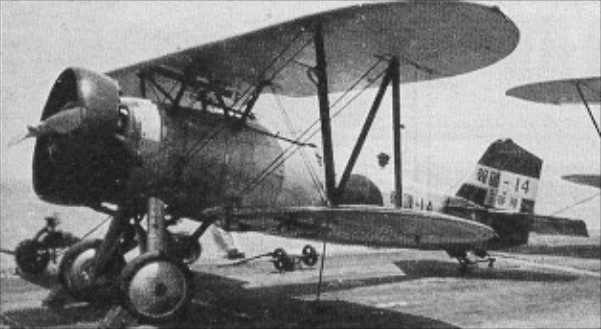
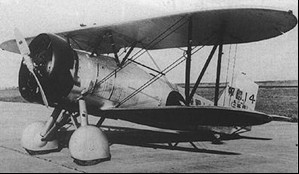
The 1930s Nakajima set to work to build a conventional single-seat biplane fighter. The resulting YM prototype being an unequal-span biplane of mixed construction and clearly owing much to the obsolescent A2N. Nevertheless, it was considered essential by the Navy until more modern types could be perfected and Nakajima was authorised to proceed with development of the biplane concept.
The resulting Navy Type 95 Carrier Fighter (Nakajima A4N1) had a divided landing gear designed to cope with carrier landings, a tailwheel instead of a tail-skid, and other minor changes. The increase in speed being due entirely to the more powerful Hikari engine.
Production totalled 221 between 1935 and 1937.
A4N1 Engine: 1 x Nakajima “Hikari”, 544kW Wingspan: 10 m / 32 ft 10 in Length: 6.64 m / 21 ft 9 in Height: 3.07 m / 10 ft 1 in Wing area: 22.89 sq.m / 246.39 sq ft Max take-off weight: 1760 kg / 3880 lb Loaded weight: 1276 kg / 2813 lb Max. speed: 350 km/h / 217 mph Ceiling: 7740 m / 25400 ft Range: 845 km / 525 miles Armament: 2 x 7.7 mm machine-guns, 120kg of bombs Crew: 1
Extensively test-flown in 1934, the Nakajima Ki-4 sesquiplane had divided landing gear with streamlined wheel spats, and accommodated pilot and observer in tandem open cockpits, the pilot just below a cut-out in the trailing edge of the upper wing. With twin forward firing 7.7¬mm (0.303 in) Type 89 machine guns in front of the pilot and single or twin guns on a ring mounting in the rear cockpit. With fewer guns, it could carry a 50 kg (110 lb) bombload and be used for ground attack or dive-bombing. The powerplant was a single 600 hp Nakajinia Ha 8 Hikari radial engine, fitted with an exhaust collector ring and driving a two blade propeller. Landing gear was nor¬mally of the twin mainwheel type, with a tail skid.
The Ki-4 went into production and service in 1935 to replace the earlier Kawasaki KDA 2 (Type 88), as the Army Type 94 Reconnaissance Aircraft Model 2 which dispensed with the wheel fairings and had a redesigned tail unit.
The Type 94 was used widely in China by the Japanese army on direct co-operation duties, in close support of the ground forces. The Japanese army tested two Ki-4s as seaplanes, one with twin floats and the other with one main and two stabilising floats. A landplane was used for flotation bag tests to check buoyancy in the event of an emergency put-down on water.
A total of 516 were built, some aircraft being licence-built by Tachikawa.
Ki-4 Type 94 Engine: 1 x Ha-8, 477kW Span upper: 12 m (39 ft 4 in) Span lower: 8.52 m (27 ft 11 in) Length: 7.73 m (25 ft 4 in) Gross weight: 2616 kg (5767 lb) Maximum speed: 300 km/h (186 mph). Armament: 4 x 7.7mm machine-guns, 50kg of bombs Crew: 2
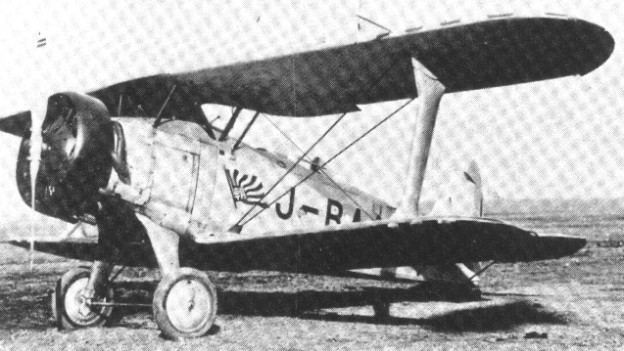
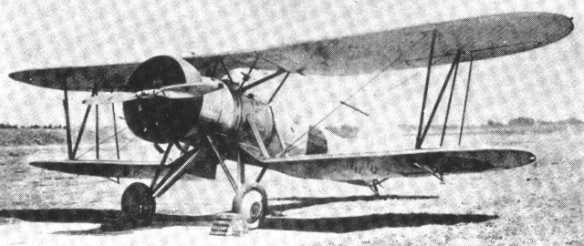
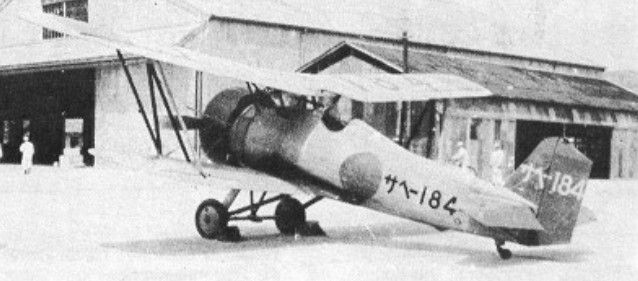
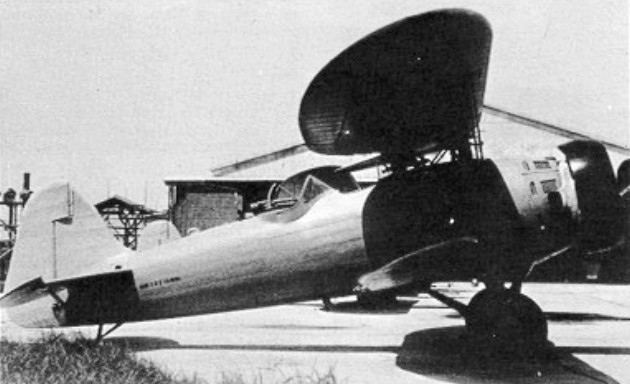
After importation in 1928 of a Boeing 69-B (F2B-1) by the Imperial Navy, and, in the following year, the fourth Boeing 100 (essentially similar to the F4B-l), the two aircraft were shown to industry as examples of the then-current US shipboard fighter technology. Nakajima, which had previous¬ly built the Gloster Gambet (A1N1-2) for the Imperial Navy, initiated development of a carrier fighter based broadly on the Boeing designs as a private venture. Responsibility for the fighter was assigned to Takao Yoshida and two prototypes powered by the Jupiter VI engine were completed in December 1929 and the NY prototype first flew in 1930.
It was an unequal-span single-seat fighter of biplane configuration, with divided fixed landing gear which had spatted wheel fairings discarded in later production aircraft. The A2N1 and A2N2 had lower wing dihedral only, whereas the A2N3 had dihedral on both wings. The twin-gun armament was installed in blast troughs on the lower sides of the fuselage in the A2N1, while later versions had them installed in the forward decking.
Type 90 type 2 Carrier Fighter
Evaluated by the Navy in the following year, these prototypes were rejected as they were considered to offer an insufficient improvement over the A1N1. Some redesign was undertaken by Jingo Kurihara, and, with a 580 hp Kotobuki 2 engine, a further prototype was completed in May 1931, the type being adopted by the Navy in April 1932 as the A2N1 (Type 90). With a fabric-covered metal fuselage and a similarly skinned wing of mixed construction, the A2N1 carried an armament of two 7,7-mm machine guns. The principal production version was the A2N2 (Type 90-II) with re¬arranged fuel tankage and armament, the A2N3 (Type 90-III) differing in having five degree of dihedral on the upper wing main panels. Series production was undertaken from 1932 until 1936 by both the parent company and Sasebo.
Production totalled 106, built between 1930 and 1935, and later 66 examples of the A3N1 two-seat training variant appeared, most being conversions of the single-seater. A2Ns from the carrier Kaga (2nd Carrier Division) flew on operations in the Shanghai area during the 1937 Sino-Japanese Incident.
A2N1 Engine: Nakajima Kotobuki 2, 580 hp / 433kW Span: 30 ft 8.9 in (9,37 m). Length: 20 ft 3.4 in (6,18 m). Height: 9 ft 11 in (3,02 m). Wing area: 212.49 sq ft (19,74 sq.m). Empty weight: 2,304 lb (1 045 kg) Loaded weight: 3,417 lb (1 550 kg). Max speed: 182 mph (293 kph) at 9,845 ft (3000 m) Endurance: 3 hrs. Time to 9,845ft (3000m): 5.75 min. Ceiling: 9000 m / 29550 ft Range: 500 km / 311 miles Armament: two 7,7-mm mg. Crew: 1
 All Aero