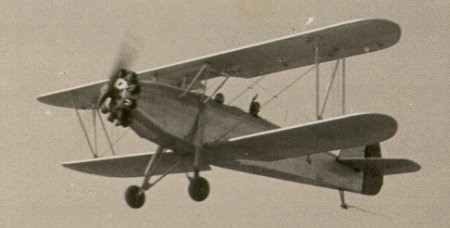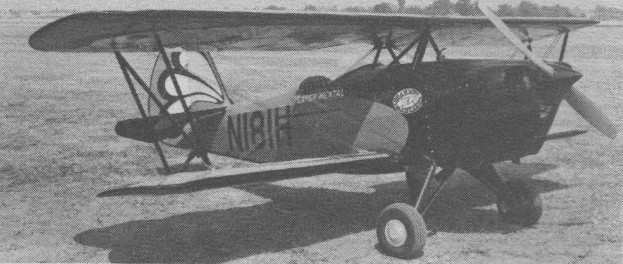
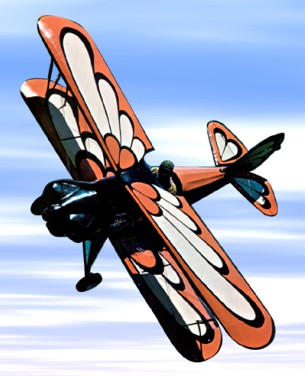
Oldfield Baby Great Lakes / Barney Oldfield Special / Baby Lakes

Designed and first built in 1960.

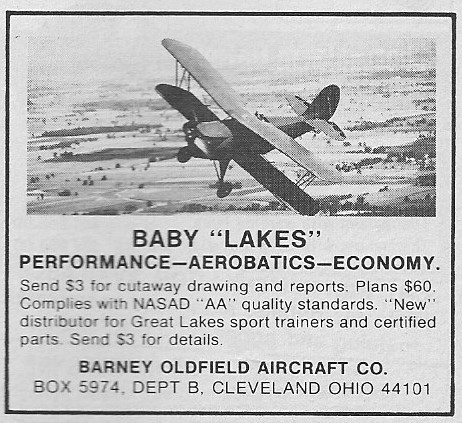
Harvey R. Swack had encountered a fellow named Barney Oldfield no relation to the auto racer who had designed a small, single seat sport biplane for homebuilders. Swack went into business with Oldfield, selling plans of the 2T 1 under the name “Baby Great Lakes” which he was entitled to do, as owner of the name, although the little homebuilt bore only a distant, imitative relationship to the original. When Champ¬lin bought Great Lakes Aircraft Company from Swack, Swack changed the name of the homebuilt design to “Barney Oldfield Special,” though it is still informally known as the “Baby Lakes.”

Dec 1973
Feb 1974

Barney Oldfield’s Baby Great Lakes flys much like its big brother, the Great Lakes Sport Trainer. The Baby “Lakes” was designed to get the same sort of flying ease and performance at lower cost. It uses a steel-tube fuselage, wood wings and fabric cover, and offers unusually lively aerobatic performance when powered by an 85-hp Continental engine. The Baby Lakes can also be fitted with 50- to 100-hp Continentals or the 108- and 125-hp Lycomings. (When fitted with the 108- and 125-hp engines, the airplane is called the Super Baby Lakes.) Its makers say it will out fly aircraft of twice the horsepower, and it is the least expensive, high-performance biplane available to the homebuilder.
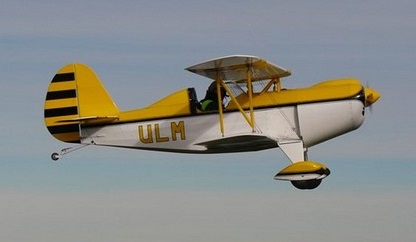
Baby Lakes

The Baby Great Lakes (one place) and Buddy Great Lakes (two place) aircraft are well proven designs which are easy to construct and fly, provide classic good looks, and are aerobatic. Construction is of wood and steel tubing and plans are well presented for the first time builder. Aircraft Spruce & Specialty Company acquired all rights to these designs in May 1996 and offers packs, plans, raw materials kits, and pre-fabricated kits for these fine aircraft.
The Baby Great Lakes Main Tank Standard holds 10 gallons. The Baby Great Lakes Tank Stretch is 3″ longer and holds 11 gallons.
Gallery

Oldfield Baby “Lakes”
Gross Wt. 850 lbs
Empty Wt. 475lbs
Fuel capaci¬ty 12 USG
Wingspan 16’8”
Length 13’9”
Height: 4.5 ft
Wing area; 86 sq.ft
Engine 85-h.p Continen¬tal
HP range: 65-100
Seats: 1
Top speed: 135 mph
Cruise: 118 mph
Stall: 50 mph
Climb rate 2000 fpm
Takeoff run: 300 ft
Landing roll: 400 ft
Ceiling: 17,000 ft
Range: 250 sm
Seats: 1
Undercarriage: tailwheel
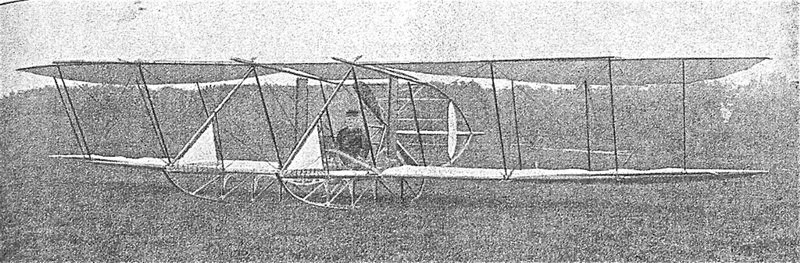
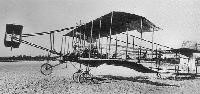
Odier-Vendome Biplane 1910

Pilot – Antoine Odier

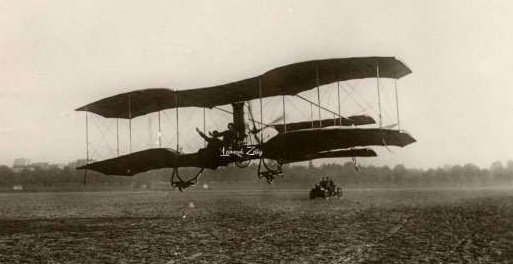
Carrying the names of its designer (Antoine Odier) and ordered by Turcat-Méry race car driver Henri Rougier, this pusher biplane was built by the Vendôme company. It appeared in 1909 and was (under)powered by one of Rougier’s employers 18hp Turcat-Méry engines.

The designer also made the first flight of this, his first aircraft in May 27, 1909, which was also Odier’s first flight, ever.

A later improved tractor biplane followed in 1910, with less arched wings.

Second version

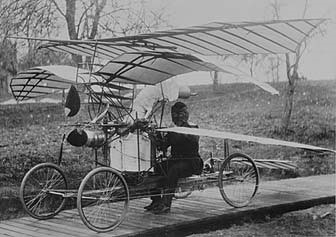
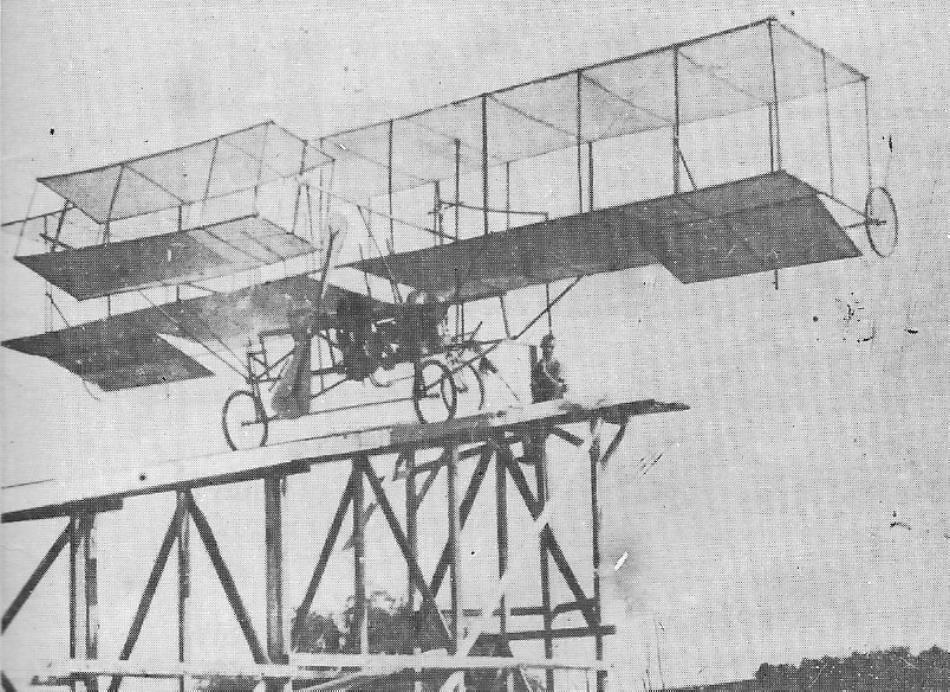
Ochoa Jersey Devil

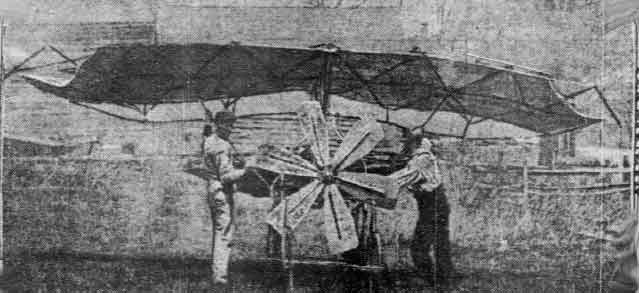
The “Jersey Devil”, also known as the “Jersey Mosquito” or “Ochoaplane” built by Victor Leaton Ochoa, and datable to 1908-09 in the USA. Based on two bicycle frames between which was mounted a six-horse power motor and below that a seat for the operator. The whole machine weighs about 250 pounds. The craft is notable for having several ‘interesting’ design features, such as the retractable truss-work wing structure, and the wing surface being concave, not convex.

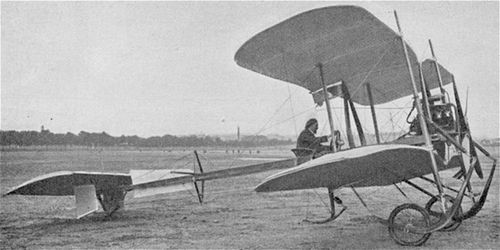
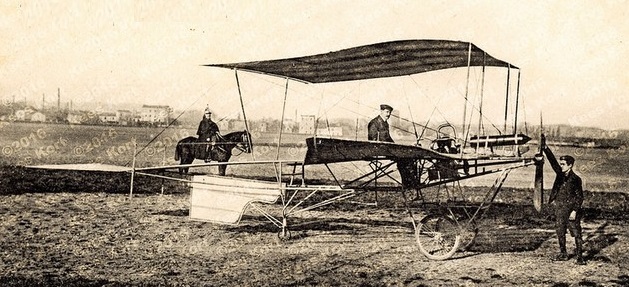
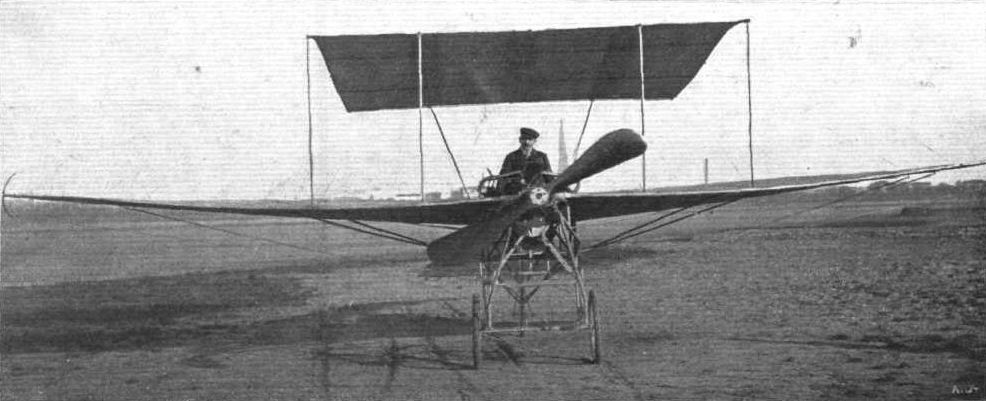
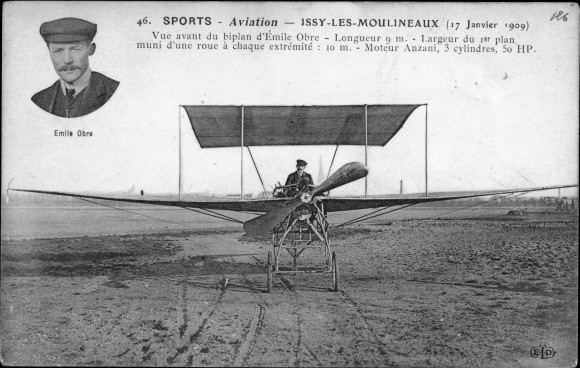
Obre No.1

Émile Obre in his first biplane on the field Issy-les-Moulineaux, Paris, France, 1908

Émile Obre designed his biplane as a tractor with the Anzani 3-cylinder air cooled engine was fitted about 1,5 meter from the nose. The top wing consisted of a rectangular form with a special curve form. The span of the lower deck is 10 metres.

The power given (50 hp) for the 3-cylinder Anzani is very optimistic.

When testing the machine on 18 January 1909 at Issy-les-Moulineaux the machine crashed and was demolished. It was not repaired.

The machine was not a success but Obre went on and designed a completely new pusher biplane.

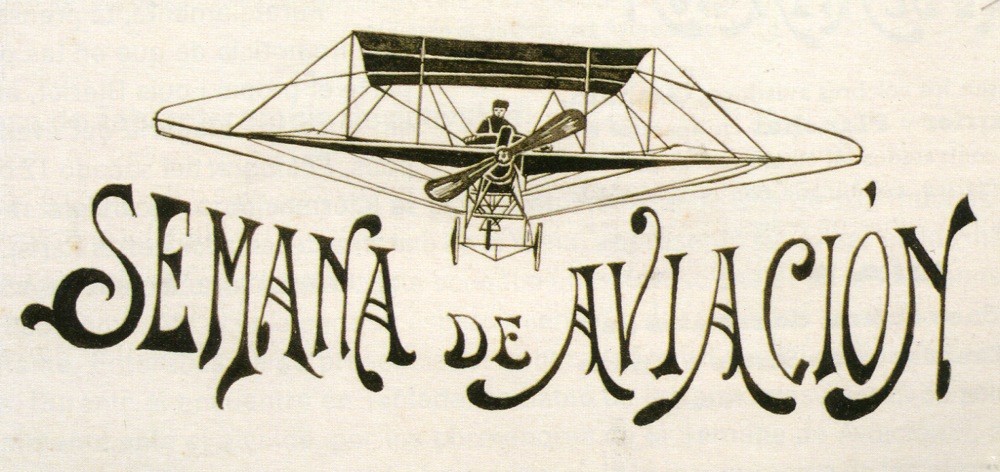
A drawing of the plane figured in a standing heading in “Flugsport” and in the logo of the 1910 Seville aviation week.

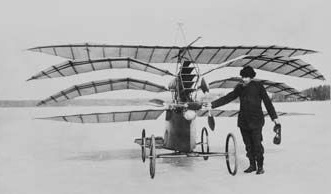
Nyberg Flugan / Fly

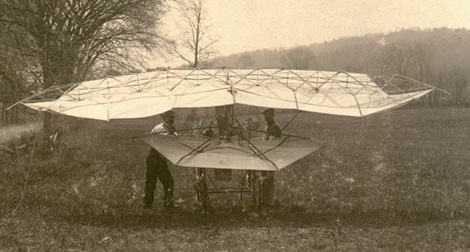
Carl Richard Nyberg (1858-1939) was a Swedish industrialist and the inventor of a successful blowtorch. He began work on this flying test-bed in 1897, with tests and alterations to the design of Flugan (The Fly) going on until around 1910. It had a wingspan of 5 meters, and the surface area of the wings was 13 m². It was powered by a steam engine heated by four of his blowtorches, producing 10 hp at 2000 rpm. The weight of the engine was 18 kg, giving a very good power-to-weight ratio for its time. The total weight of the plane was 80 kg, so the failure to fly was more related to poor propeller and wing technology. The challenge photo was probably taken in 1903 or later, when he started testing on the ice of the Baltic at his home on Lidingö outside Stockholm, rather than tethered around a circular board track in his garden.

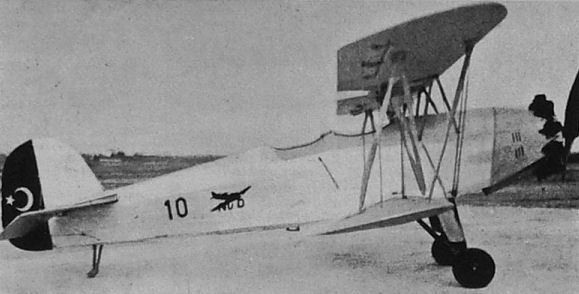
NUD NU D.36

The Nuri Demirağ Nu D.36 was a 1930s Turkish two-seat training biplane built by the Nuri Demirağ Aircraft Works in Istanbul for the Turkish military.

The Nu D.36 is an unequal-span single-bay staggered biplane with a fixed conventional landing gear with a tailskid. It was powered by a 150 hp (112 kW) Walter Gemma I nine-cylinder radial engine. It had two open tandem cockpits for the pilot and trainee.

Engine: 1 × Walter Gemma I, 110 kW (150 hp)
Propeller: 2-bladed fixed pitch wooden propeller
Wingspan: 9.74 m (31 ft 11 in)
Wing area: 21.8 sq.m (235 sq ft)
Length: 7.3 m (23 ft 11 in)
Height: 2.44 m (8 ft 0 in)
Empty weight: 650 kg (1,433 lb)
Max takeoff weight: 1,000 kg (2,205 lb)
Maximum speed: 182 km/h (113 mph; 98 kn)
Range: 500 km (311 mi; 270 nmi)
Endurance: 3 hours 30 minutes
Service ceiling: 3,350 m (10,990 ft)
Time to altitude: 500 m (1,600 ft) in 2 minutes; 1,500 m (4,900 ft) in 10 minutes
Crew: 2