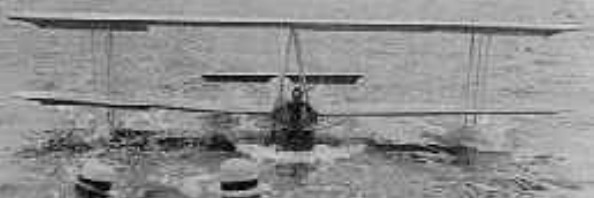
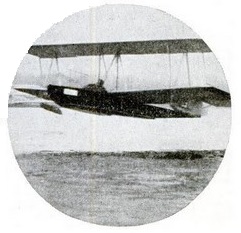
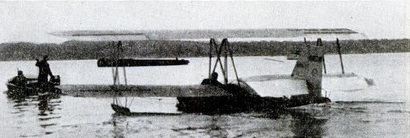
The Peel Glider Boat Company of Flushing Bay, NY was in business around 1930, designing and building the Glider Boat, a biplane glider with stepped flying boat hull and wingtip floats. A number of examples were sold.
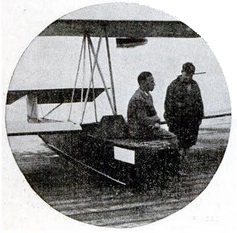
The two occupants sat in tandem in an open cockpit with conventional controls, but without instruments. The structure was wooden spar, steel ribs, fabric covered, and a duralumin hull.
Normal method of launch was behind a motor boat, the towrope being joined to a bridle which attached to either side of the nose outside the front cockpit.
One example belongs to the National Soaring Museum.
Wing span: 9.45 m / 31 ft Wing area: 25.08 sq.m / 270 sq.ft Empty Weight: 113 kg / 250 lb Payload: 159 kg / 350 lb Gross Weight: 272 kg / 600 lb Wing Load: 10.84 kg/sq.m / 2.2 lb/sq.ft L/DMax: 15 Seats: 2
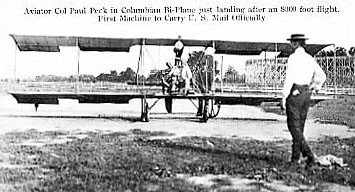
The Columbia Biplane designed by Colonel Paul Peck was fitted with a seven-cylinder, air-cooled rotary rated at 50 hp at 1500 rpm, built by the Gyro Motor Company (Washington), sponsored by, and designed under the direction of Emile Berliner.
A Gordon Bennett Cup entry did not compete.
In American Air Mail Catalogue, Vol 1, 6th Edition, Entry 3: Sep 23-Oct 1, 1911, Garden City-Mineola, NY, International Aviation Tournament. The first official US airmail was flown during the (event) at the Aerodrome on Nassau Boulevard in Garden City. Postmaster General Frank H Hitchcock authorized mail to be flown and Earle L Ovington was sworn in as the first official airmail pilot. T O M Sopwith and Capt Paul W Peck also flew mail during the meet. Ovington flew mail on the first day, and most covers and cards received a circular “Aeroplane Station #1” postmark and a 3-word (“Aerial Special Despatch”) cachet. Covers were postmarked during each day of the meet, but no mail was flown on Sep 29 or Oct 1 due to poor weather conditions. A total of 43,247 pieces of mail was serviced during the meet. [ibid.] Entry 41: July 19-21, 1912, Coney Island [an amusement park clone in Cincinnati; note roller coaster in background on postcard], Ohio. Paul Beck [spelling error] flew mail each of three days from Coney Island to California, Ohio [the town’s Post Office existed 1865-1935 on the outskirts of Cincinnati, about 1.5 miles from the park]. A Columbia biplane was used and the service was designated as Route 631,003.
Peck Columbian 1912 (postcard)
The heavy Gyro motor was fatal to Peck (and passenger) in his crash on Cicero Field, Chicago on September 11, 1912. Peck held American pilot licence No.57 and had set the American duration record at 4 hours 23 minutes, 15 seconds set on May 24, 1912.
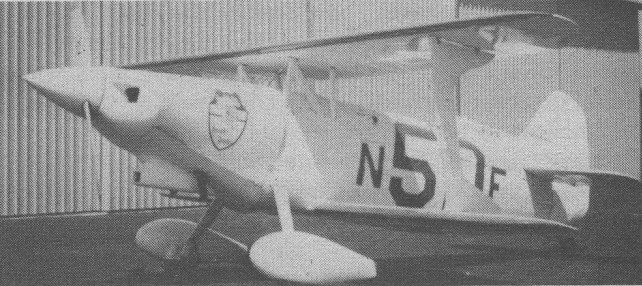
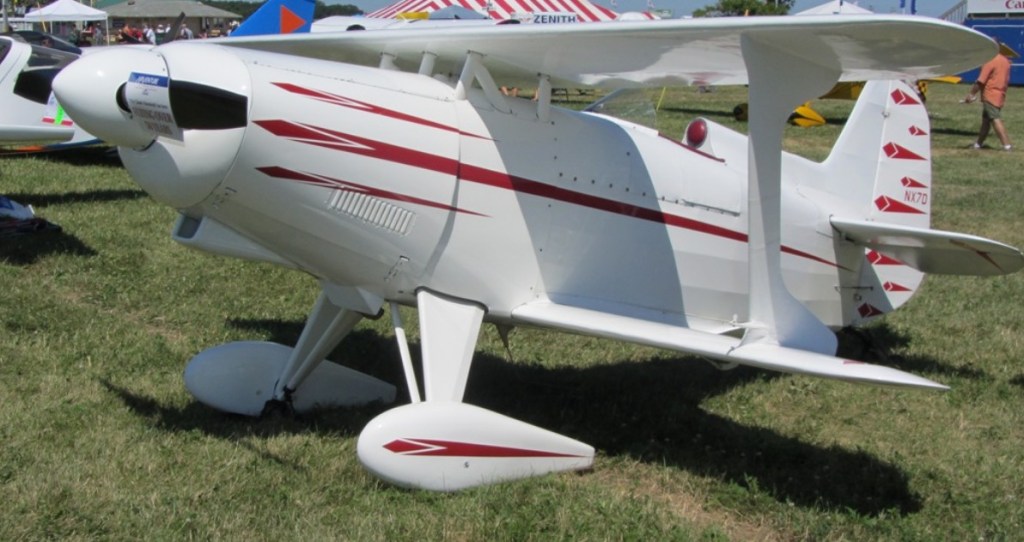
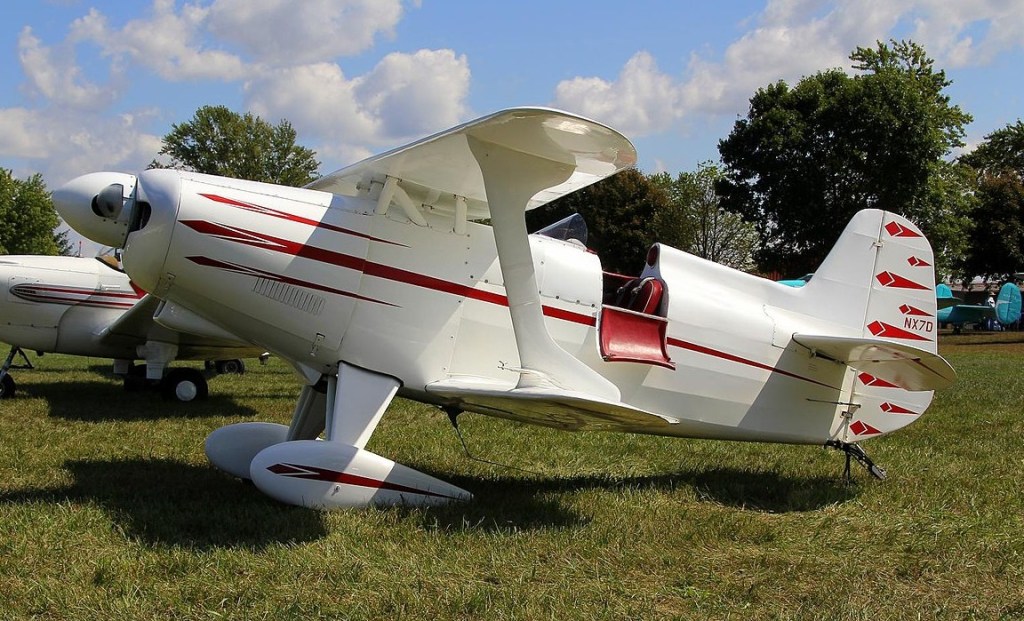
The Payne Knight Twister is a single-seat, single-engine aerobatic sport aircraft first flown by Vernon Payne Sr. in the United States in 1932 and marketed in plans form for homebuilding.
It is a conventional biplane design with slightly staggered wings of unequal span. The wings are of fully cantilever design and do not require the bracing wires commonly used on biplanes or even interplane struts; however, most builders brace the wings with I-struts and at least one pair of wires. The cockpit is open, and the undercarriage is of fixed, tailwheel type with divided main units. The wings and horizontal stabilizer are of wooden construction, skinned in plywood, while the fuselage and vertical stabilizer are of welded steel tube covered in fabric.
Payne designed the Knight Twister in 1928 while teaching aircraft design and repair at a school attached to the Aviation Service and Transport Company in Chicago. Construction of a prototype by Payne and his students commenced the following year but ended shortly thereafter when the school was forced to close as a consequence of the Great Depression. Payne began building a second prototype in 1931, which first flew in fall the following year powered by a Salmson 9Ad radial engine. This aircraft was damaged in a forced landing due to fuel exhaustion during a demonstration flight for the press, and parts of the airframe were reused to build the second Knight Twister in 1935. This machine, powered by a converted Ford Model A automobile engine, was built for an Argentine buyer who eventually declined to take delivery. After it had passed through several hands, Payne himself bought the aircraft back after World War II and his son, Richard, was killed in it during a test flight on which the engine failed shortly after take-off.
1951 D-1 Knight Twister
The Knight Twister built a reputation as a racing aircraft. In 1964, Clyde Parsons flying the “Parsons Twister”, won the Sport Biplane Championship race at Reno with a speed of 144.7 mph. In the 1970s, Don Fairbanks competed with a Knight Twister preserved initially at the Motorsports Hall of Fame of America museum in Novi, Michigan, and later in the lobby of Sporty’s Pilot Shop at Clermont County Airport, Batavia, Ohio. Fairbanks set the world record in the sport biplane class of 178 mph (284 km/h) with this aircraft.
The Knight Twister has a reputation as a “handful” to fly, but this has been vigorously denied by both its designer and by Fairbanks. Both men have attributed this reputation to the controls being lighter and more responsive than those of the light aircraft that most pilots are more familiar with.
KT-125
In the 1990s, the rights to the design were acquired by Steen Aero, who continue to offer plans for sale in 2009.
Variants KT-125 KTS-1 – first prototype with Salmson 9Ad engine (1 built) KTD-2 – second prototype with converted Ford Model A engine designated Douglas Bear (1 built), later redesignated Knight Twister Junior 75-85 KT-50 – version with 50 hp (37 kW) Continental or Franklin engine and 18-ft wingspan KT-75 Knight Twister Junior – version with 75 hp (56 kW) Continental or Lycoming engine and 17 ft 6 in-wingspan KT-80 – version with 80 hp (60 kW) Franklin engine KT-85 – standard version with Continental engine of 85 to 90 hp (63 to 67 kW) and 15-ft wingspan KT-90 – version with 90 hp (67 kW) engine and 15-ft wingspan KTT-90 – version with 90 hp (67 kW) Lycoming engine and 18-ft wingspan KT-95 – version with 95 hp (71 kW) Lambert engine KT-125 – version with 185 hp (138 kW) engine KT-140 – version with 140 hp (104 kW) engine. SKT-125 Sunday Knight Twister – version with 125 hp (93 kW) Lycoming engine and 19 ft 6 in-wingspan KT Imperial – version with engine of 135 to 150 hp (101 to 112 kW) and wing area increased (span: 17 ft 6 in) to comply with Sport Biplane class rules KT Holiday – version with 125 hp (93 kW) engine and wingspan of 19 ft 6 in KT Acro – version with wingspan of 15 ft 6 in KT Coed – version with passenger seat in tandem with pilot’s; wingspan of 22 ft 6 in. Double Twist – A two place model with an untapered 21 ft M6 airfoil. Pretty Prairie Special II model 1 – Straight leg conventionally braced based on a Knight Twister, stretched 16 inches Pretty Prairie Special III – A Menasco powered variant displayed in the EAA Airventure Museum in Oshkosh, Wisconsin until 2006, and now at the Kansas Aviation Museum.
Payne Knight Twister Span upper: 15.00 ft Span lower: 13 ft Length: 14 ft
Knight Twister Imperial Engine 140-hp Lycoming. Gross Wt. 900-1100 lb Empty Wt. 694 lb Fuel capacity 35 USG Wingspan 17 ft Length 16 ft 1 in Top speed 170 mph Cruise 120 mph Stall 50 mph Climb rate 1000 fpm Takeoff run 475 ft Landing roll 800 ft Range 680 miles
KT-85 Powerplant: 1 × Continental C90 , 90 hp (67 kW) Wingspan: 15 ft 0 in (4.57 m) Wing area: 60 sq ft (5.6 m2) Length: 14 ft 0 in (4.27 m) Height: 5 ft 3 in (1.60 m) Empty weight: 535 lb (243 kg) Gross weight: 960 lb (435 kg) Maximum speed: 160 mph (257 km/h, 140 kn) Range: 390 mi (625 km, 340 nmi) Rate of climb: 900 ft/min (4.6 m/s) Crew: One pilot
Albert Paulson, of Northwood ND., USA, built the single-place Aeronef, or Gold Bug, in 1910.
Built on the box-kite principle, with the forward box used for changing the angle of flight, while the rear box was adjusted for the direction of flight. Made its public appearance at the June 1910 Indianapolis Air Meet, but not known if it flew.
Ion Paulat built the first Romanian seaplane in 1911. As the Ministry of War provide no assistance to him, Paulat had difficulties obtaining an engine to power the aeroplane. In the end – through friendly help in order to conduct a flight test – he obtained one of the two 55 hp Hilz engines needed. With one engine the machine flew in early November 1911, making a jump of 10 meters at a height of 35 centimetres.
As Paulat did not succeed in obtaining the required second Hilz engine, he designed the light 1912 Hydro-Aero Monoplane – suited for one Hilz engine
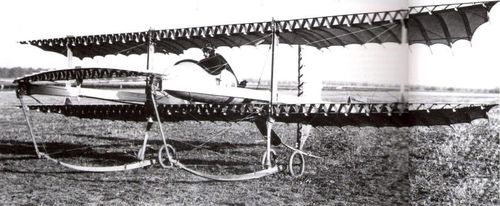
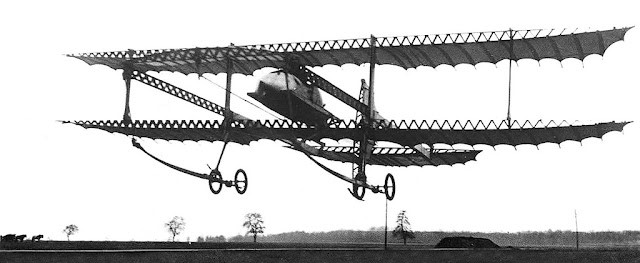
The first biplane built by Louis Paulhan in September/October 1910 [not February 1911 as given by Opdycke] in association with Henri Fabre. This explains the Fabre like wing construction. It was a big pusher with elevator in front and huge skids, powered by a 50 hp Gnome rotary engine. A later version of the biplane, featuring ‘conventional’ wooden spars, was notable for it being able to be re-configured, so that it could be towed on a road behind a car, and also to be demountable so that all its parts could be fitted into packing crates.
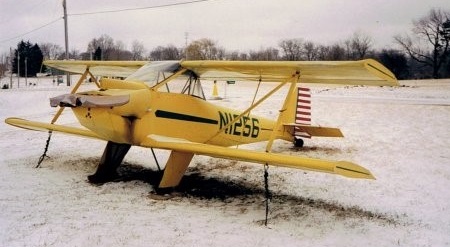
Elton L. Patterson was designer and builder of the unique single-seat Pipsqueek. The aircraft had negative stagger, a retractable undercarriage and was powered by a 40hp VW1500 engine. The construction was started in 1963 and N1256 made the first flight on 26 February 1968.



 All Aero