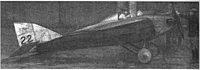
A 1922-23 moto-aviette (very light a/c) with “moteur auxiliaire” of conventional layout.
1 x nose-mounted 16 hp air-cooled upright inline 4-cyl Sergant A
The wings folded up on approach, Lympne trials 13 Oct 1923, Alexis Maneyrol killed
A 1922-23 moto-aviette (very light a/c) with “moteur auxiliaire” of conventional layout.
1 x nose-mounted 16 hp air-cooled upright inline 4-cyl Sergant A
The wings folded up on approach, Lympne trials 13 Oct 1923, Alexis Maneyrol killed
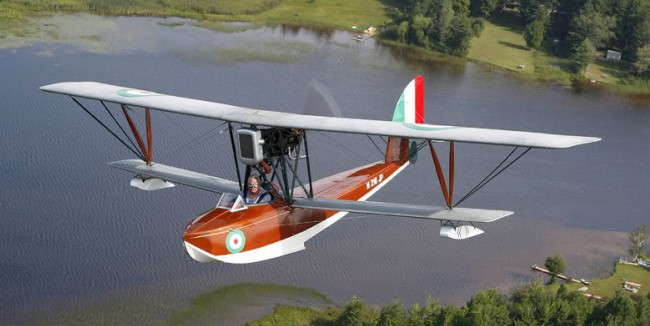
Jason Petroelje’s first project, an Emeraude RG, was a 1979 Oshkosh award winner and a feature in the May 1980 EAA Sport Aviation magazine. Other airplane projects included two World War I reproductions for a museum.
“I was building a SPAD replica for them, and they mentioned the Macchi,” Petroelje said. “I didn’t know anything about the type, but when I looked into it I decided I really liked it.”
Jason Petroelje built his beautiful Macchi M.5 flying boat using only his left hand – the one hand he had to use after a stroke 10 years earlier. “I built this thing after I had the stroke,” Petroelje said about his three-quarter scale Macchi M.5 flying boat. He added, “I built it with my left hand.” It didn’t stop him, however, worked about 5,000 hours, day and night, in the cramped workshop next to his home on Hazel Avenue, turning out everything from the wing struts to the tiniest of fittings.
Petroelje’s Macchi, a type used as a fighter by the Italian forces in World War I, has the appearance of a fine, classic watercraft with a natural Honduran mahogany skin and a solid Brazilian rosewood instrument panel. The woods are both adorned with a deep, high gloss marine finish.
The control stick has a hand-carved Madagascan ebony handle, and thrust comes from a hand-laminated, hand carved cherry-and-birch propeller.
His little flying boat is three-quarter scale for a good reason. The reason for building the airplane in 7/8 scale is unique to seaplanes. Hangers next to the water with easy access are very rare. Jason had a friend who used to have a Volmer Sportsman. He had sold the airplane, but the hanger remained. Jason had to scale down the airplane to fit in this existing hanger.
No original drawings of the Macchi existed, so Petroelje had to create his own designs from a set of dimensions and from photographs. “I just went more by the dimensions,” Petroelje said of the plans, which he secured years ago for $40 from “WWI Aero” magazine.
A variation drawn from experience was a decision to scale the tail to 80 percent instead of 75 percent. Petroelje said the 75-percent version was just too small.
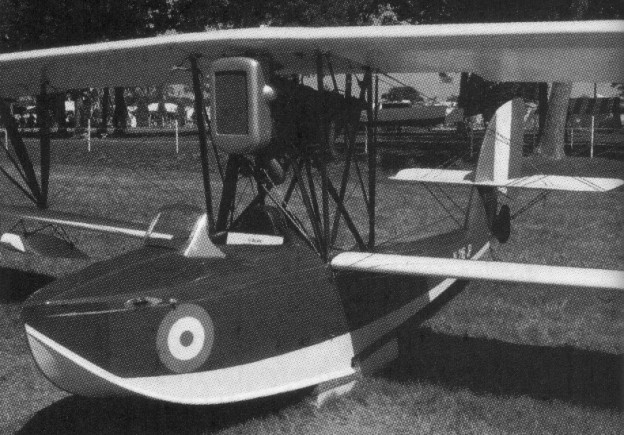
The hull of the seaplane varies from the original as well. Petroelje layered the bottom first with plywood, then foam, and finished it off with fiberglass. The modern bottom is more durable than the likely single-plywood layer of the original and should better tolerate the rigors of normal water operations. As for the mahogany finish, no color photos exist of the type, so that choice may well be artistic license on Petroelje’s part.
The wings of the plane fold back, a feature certainly not part of the original. But at three-quarter scale, the collapsed craft is only 8 feet wide, well within legal trailering limits. This has a more modern airfoil, a 4412 like on a Luscombe.
A modern air-cooled Lycoming powerplant provides the motive force. The radiator on Petroelje’s plane, necessary for the liquid-cooled powerplant on the original, is purely decorative.
The Macchi M.5 Italian fighter is mostly authentic, except for not sporting machine guns like those used during the plane’s heyday.
Registered as N216JP, to Jason Petroelje of Michigan, Eric Presten did the first three flights on the Macchi M-5.
The airplane performed well, but due to limited aileron travel, Presten was only able to do flights down the lake in ground effect on the first day. It has since been flown to altitude. It gets out of the water easily on only 125 hp. The missing outer struts are now installed. The landing gear shown is only a beaching gear, as the airplane is a true seaplane. Cruise speed for the craft is around 75 miles per hour.
The replica appeared at Oshkosh 2009.
Engine: Lycoming 125-horsepower
Fuselage length: 24 feet
Wing span: 31 feet
Weight: 940 pounds
Cruising speed: Up to 70 mph
Fuel capacity: 12 gallons
Hours to build: About 5,000
Size of workshop: 18 by 24 feet
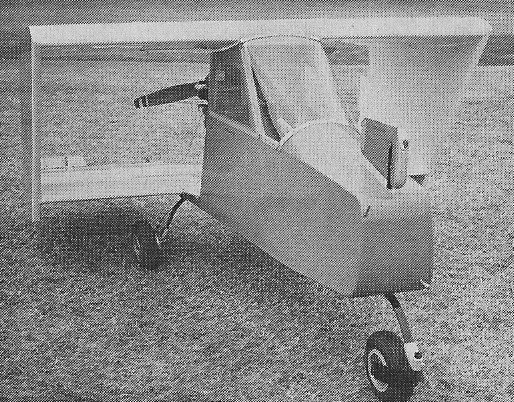
Roger F. Peterson built the Bijou in 1974 merely as a research vehicle to check out his theories. The all-wood single-seater has ground-adjustable stabilisers and variable-control elevons on the trailing edges of the lower wing, and ground-adjustable stabilisers on the upper wing.
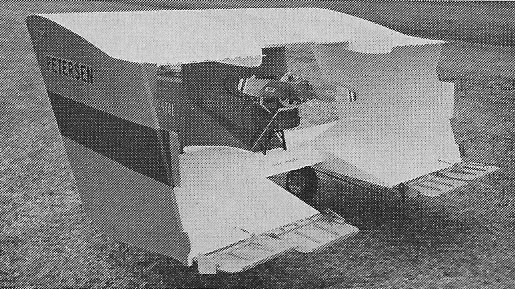
The side wing panels are to keep the air from washing out due to the short, 8 ft 9 in, wingspan, as well as to help directional stability.
Bijou is towable on its gear and is powered by a 40 hp German JLO snowmobile engine.
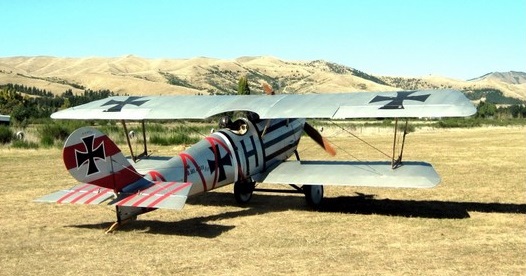
20th Century Fox purchased the film rights of Jack D Hunter’s “The Blue Max” and the film was to be a multi-million dollar production, and the stars were to be the full sized reproductions of World War I fighters constructed for the film- two Pfalz D.III biplanes, two Fokker Dr.I triplanes, two S.E.5a scouts and three Fokker D.VII biplanes.
The reproductions had to be built in a hurry to meet the time frame for shooting and were constructed in different locations. One Pfalz D.III reproduction each was constructed by Personal Plane Services (G-ATIF, ZK-FLZ) and the other by the Hampshire Aero Club (reported as G-ATIJ and G-ATIG).
The availability of these aircraft would see them appearing in more movies. “Darling Lili” of 1970 was a vehicle for Rock Hudson and Julie Andrews.
Personal Plane Services Ltd built Pfalz D.III
Serial number PPS/PFLZ/1 registered EI-ARC. After filming it was sold to the Fighting Air Command in USA.
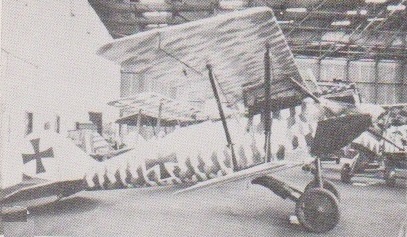
Both of the Pfalz replicas and one Fokker D.VII now belong to New Zealand film director Peter Jackson’s 1914–18 Trust All three aircraft are kept in fully airworthy condition.
The Billing biplane was crashed on 4 October 1911 by N.S. Percival, who rebuilt it as the Percival Parseval I at the end of 1911-1912.
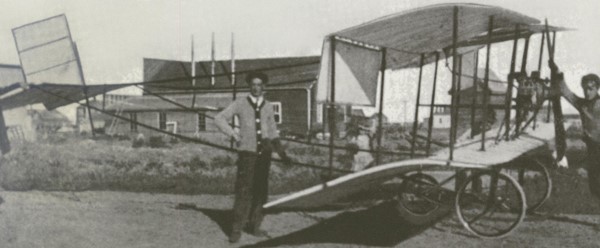
George and Ackley ‘Ace’ Pepper did their flying in Davidson, Saskatchewan, Canada. The machine was built with community support during 1910-11, mainly of wood and bamboo, powered by a 20-30 hp Detroit aero engine. A first flight attempt in July 1911 resulted in a damaged undercarriage and propeller, but another attempt on Aug. 1 was successful, but resulted in a crash.
Pensacola FL.
USA
In 1930 Pensacola Metal Aircraft Co built a four-place float-equipped biplane, powered by four 575hp P&W Hornet.
Designed by Walter Eade, the all-metal aircraft had a wingspan of 80’0″.

Known officially as the Scout, the P.B.25 was a development of the P.B.23. The most obvious differences were in the design of the nacelle, which was fabric covered, and in the wing cellule, the mainplanes featuring 11 degrees of sweepback and inversely-tapered ailerons. Twenty P.B.25s were ordered by the Admiralty, all but one of these being powered by the 100hp Gnome Monosoupape, the exception having a 110hp Clerget rotary. Armament comprised a single 7.7mm machine gun mounted on the nacelle. The last P.B.25 was delivered to the RNAS in February 1917, by which time this type had acquired an unenviable reputation, the take-off and landing characteristics being particularly hazardous. Apart from poor flying qualities, its performance was inadequate and, being viewed as something of an anachronism, the Scout was quickly discarded.
Max take-off weight: 699 kg / 1541 lb
Empty weight: 490 kg / 1080 lb
Wingspan: 10.04 m / 33 ft 11 in
Length: 7.34 m / 24 ft 1 in
Height: 3.17 m / 10 ft 5 in
Wing area: 25.73 sq.m / 276.96 sq ft
Max. speed: 143 km/h / 89 mph

Designed in 1915 by Noel Pemberton-Billing, and built by the company bearing his name, the P.B.23E single-seat pusher fighting scout biplane was of wooden construction, but the nacelle mounted between the wings and accommodating the pilot was unusual for its time in being covered with light alloy sheet metal. Armament consisted of a single 7.7mm machine gun mounted in the nose of the nacelle and power was provided by an 80hp Le Rhone rotary. The P.B.23E was first flown in September 1915, but was not adopted in its original form, being further developed as the P.B.25.
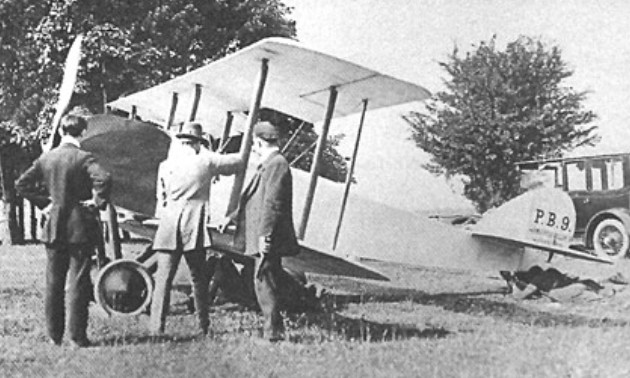
A single-seat open-cockpit equal span biplane scout aircraft, built by Pemberton-Billing Limited, which later became the Supermarine Aviation Works. Only one P.B.9 was built. The wings had full span spars with the upper and lower wings connected by four pairs of interplane struts. The fuselage had a fixed landing gear with a tail skid. While designed to allow the use of Grome 80 hp engine the prototype P.B.9 was powered by a 50 hp (36 kW) Gnome rotary engine taken from the company’s prototype P.B.1. Using a set of wings that had been obtained from Radley-England it was designed, built and made its first flight within nine days, though for publicity reasons its designer Noel Pemberton Billing claimed it had taken a week (giving rise to the nickname “Seven Day Bus”). It was first flown August 1914. Although the aircraft performed well only the prototype was built. it was later used by the Royal Naval Air Service as a trainer.
Exhibited at the 1914 Olympia Show.
 All Aero