Pischoff Avionette

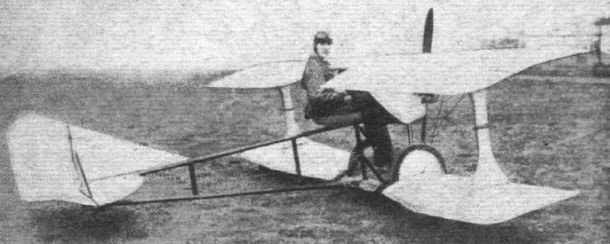
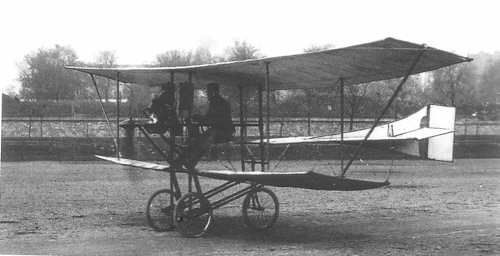
Pillot in seat

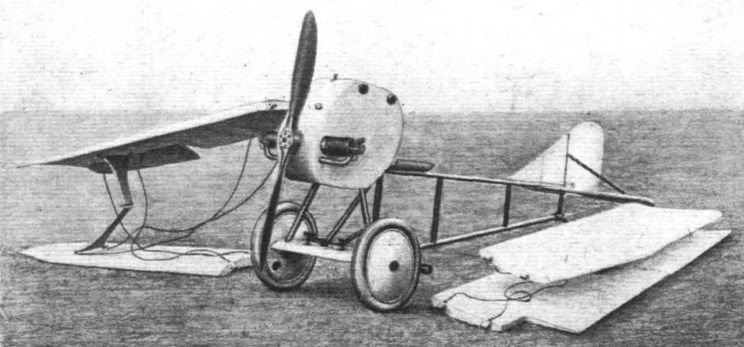
Austrian / French designer Alfred de Pischoff built a bare minimum ultralight in 1921-22.

The fuselage is two horizontal tubes fixed together by three other tubes. The pilot sits on a saddle and the engine, a Clerget-Blin two-cylinder rated at 16 hp, was also the bare minimum. The landing wheels were set into the lower wings.
A Mr. Pillot (in photo) and Alfred de Pischoff flew the machine. Pillot was mortally wounded when the machine crashed into the ground on 12 August 1922.
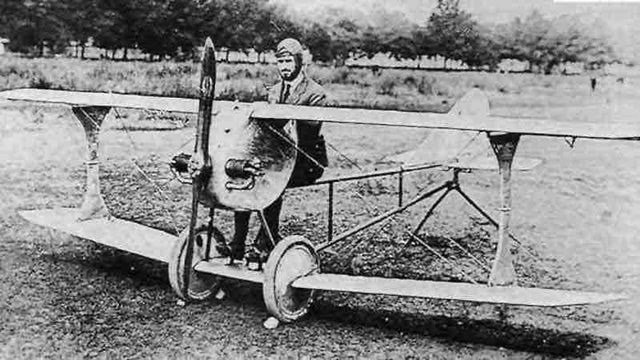
Only one copy was built.

Engine: Clerget-Blin, 16 hp
Wingspan: 17 ft / 5,20 m
Length: 11ft 6in
Height: 4 ft 3.25 in
Wheel track: 2 ft 7 0.5 in
Speed: 90 – 95 km/h
Endurance: 2 hrs
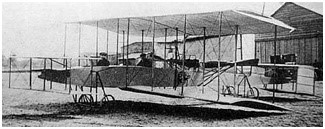
Piquerez 1909 biplane

Charles de Piquerez was an explorer who asked de Pischoff and Koechlin in December 1908 to build him a large biplane. The design had an engine in the middle of the fuselage, driving two pusher propellers via chains. Elevator(s) were mounted in the front and the end of the fuselage. Crew one pilot and a passenger. The biplane flew in at Issy-les-Moulineaux, France, in April and May 1909 but not very successfully, so it was radically redesigned as a monoplane (also with two pusher propellers), but alas this was not a great success too.

Powerplant: 1 x 40 hp 4-cylinder Dutheil and Chalmers engine.

Pilgrim KR-135

Pilgrim KR-135 NC248V

The 1931 Pilgrim KR-135 (ATC 415) was based on the Kreider-Reisner 21 series. Three were built; [NC248V, X311H, and NC963V. X311H was used as a test bed for Fairchild’s 100hp experimental Ranger 6-375 engine.

Engine: 125hp Fairchild (Ranger) 6-390
Wingspan: 27’0″
Length: 21’6″ Useful load: 590 lb
Max speed: 116 mph
Cruise: 93 mph
Stall: 51 mph
Range: 380 mi
Seats: 2

Pigeon Hollow Spar Co Thomas-Pigeon

The Pigeon Hollow Spar Company also produced a flying boat called the Thomas-Pigeon about 1920. This hydroplane was built for Reginald deNoyes Thomas, a WWI naval aviator and director of the Thomas-Pigeon Aeroplane Corporation of Boston, Massachusetts.

The fuselage is spruce and ash ribboned all-wood construction with mahogany planking. This type of construction was said to insure safety, long life and reliability in all weather conditions.

The engine is mounted over the fuselage and below the upper wing. The only control is a joystick, and it may never have been completed.

The fuselage of which was located and purchased by Cole Palen, and reported in 1994 at “Yanks Air Museum in Chino.”