The PLV 1915 biplane was Chance Vought’s second design, in league with Anthony Stadlman.
A two-place, open biplane, powered by a Sturtevand 6 engine, it was built in the machine shop of Frank Pontkowski & John Lichorsik, hence the PLV designation.
The PLV 1915 biplane was Chance Vought’s second design, in league with Anthony Stadlman.
A two-place, open biplane, powered by a Sturtevand 6 engine, it was built in the machine shop of Frank Pontkowski & John Lichorsik, hence the PLV designation.
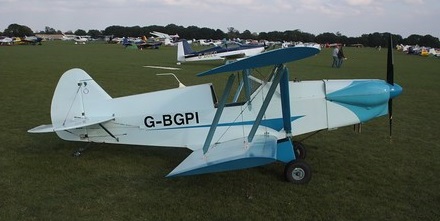
Plumb BGP.1 Biplane PFA 083-10359 G-BGPI
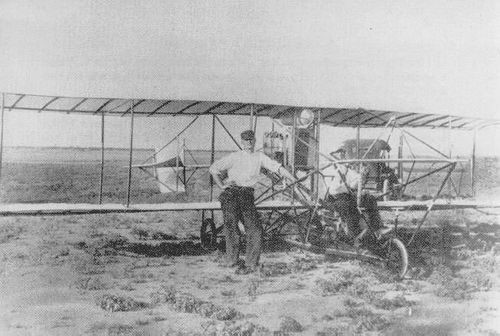
A Curtiss-pusher influenced design built by John V. Pliska and Gray Coggin of Midland, Texas; famed as being the first aeroplane to be built and flown in that state. In the photo, Pliska is on the left: his partner in the aviation project, Coggin, is in the pilot’s seat. Pliska was claimed to have been inspired by a Wright Flyer II (piloted by Robert G. Fowler) that landed in the area on November 19, 1911, and that he and Coggin carefully studied. It flew only once, but not very well, so was stored until rediscovery in 1962 and donation to a museum at Midland-Odessa airport and today is on exhibit at the Midland International Airport.
Engine: 50hp converted Roberts marine
Seats: 1
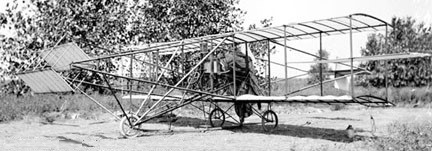
Built by J E Plews, the Plews 1910 biplane was a single-place Curtiss copy.
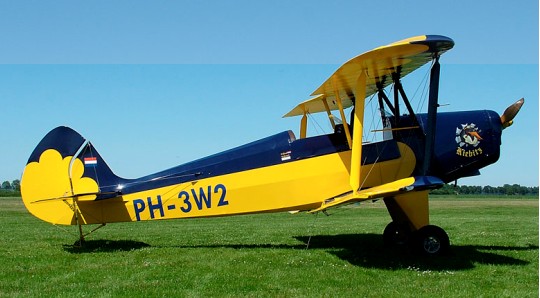
Based on the 1927 Focke-Wulf S-24 “Kiebitz”, the modern Kiebitz was designed by Michael Platzer and has been available as an UL-biplane kit since 1984. Almost 300 Kiebitz biplanes had been built by homebuilders throughout the world.
Various engine options have flown, including Rotax 2 and 4 stroke, Limbach 2000, Sauer 2100, Nissan MA12, and English built 100 hp Mid-West rotary.
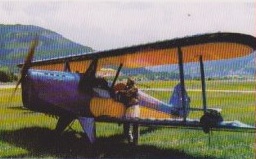
Engine: Nissan 12 P, 50 hp
Wing span: 7.6 m
Wing area: 18.3 sq.m
MAUW: 400 kg
Empty weight: 200 kg
Fuel capacity: 50 lt
Max speed: 140 kph
Cruise speed: 125 kph
Minimum speed: 50 kph
Climb rate: 3 m/s
Certification: Vz
Seats: 2
Fuel consumption: 9.5 lt/hr
Plan price (1998): 1500 DM
Engine: Nissan MA12
Seats: 2 Tandem
Wing Span: 7,6 m
Wing Area: 18,3 sq.m
Length: 6,9 m
VNE: 77 kts
Cruise: 60 kts
Stall speed: 38 kts
Empty Weight: 220 kg / 485 lbs
Max. take-off weight: 472 kg
A reconnaissance biplane
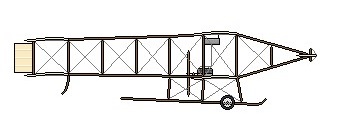
Emil Plage, son of the founder of Mechanical Works Plage & Laśkiewicz in Lublin (which, in independent Poland become one of major aircraft manufacturers) built in 1910 at Rumpler works in Berlin a biplane modeled after Farman aircraft. Unfortunately, during the first flight attempt the engine malfunctioned and aircraft crashed, although the designer/pilot was unhurt.
An aerobatic two place open cockpit biplane from Pitts constructed at Steen Aero Lab around 2002. Curtis Pitts, at age 90, was actively involved in its construction.
Engine: Vendenyev M14, 400hp
Wing span (upper): 21’6″
Wing span (lower): 20’6″
Empty weight (est): 1500 lb
Gross weight (est): 2250 lb
Max speed est: 190 mph
Cruise speed est: 180 mph
Stall est: 57 mph
Seats: 2
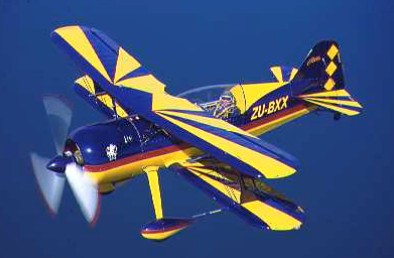
Designed by Curtis Pitts, the Pitts Model 12 is a 2 place fully aerobatic biplane designed specifically around the 360 HP (400hp) Russian built Vedeneyev M-14P (PF) radial.
In March 1996 the completed Pitts Model 12 was test flown and earned the nickname “Macho Stinker” as part of the long line of Pitts prototypes. The name “Bolshoi” is no longer used. Professional pilot, airshow performer, Ben Morphew performed all acro test flights in the model 12 and decided he wanted one and contacted the Kimballs at Jim Kimball Enterprises for them to provide some of the components.
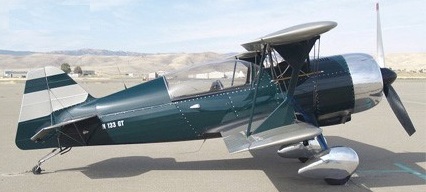
Marketed by Jim Kimball Enterprises in Zellwood FL in kit and component form. The Kimballs made their own modifications to Model 12, which was known as the HP performance version. The type was available as plans built, HP kit, or factory built Model 12S by Jim Kimball Enterprises.
All are two seat except the 12S, which is a single seater. All are tube and fabric, fully aerobatic, and powered by the M14P or M14PF engine.
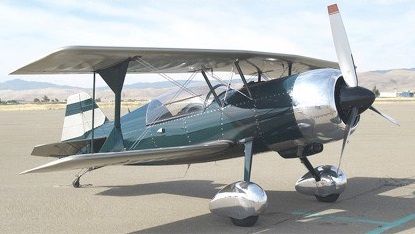
Plans Version Model 12
Engine: Vendenyev M14P/PF, 360 hp
Span: 23ft
Length: 20ft 6in
Empty weight: 1550lb
Gross weight: 2250lb
Wing loading: 14.9lb/sq.ft
Fuel: 54 USgallons
Baggage: 40lb
Cruise speed: 170mph
Rate of climb: 2900ft/min
Stall speed: 64mph
Roll rate: 240deg/sec
Range: 500 mile
G Limit: +6, -4.5 (+9, -7.5 ult)
Seats: 2
Useful load: 750lb
Vne: 239 mph
Cruise @70% Power: 175 mph
Cockpit width: 26 in
HP Kit Version Model 12
Engine: Vendenyev M14P/PF, 360 hp
Span: 22ft
Length: 19ft 8in
Empty weight: 1525lb
Gross weight: 2250lb
Wing loading: 15.3lb/sq.ft
Fuel: 54 USgallons
Baggage: 40lb
Smoke: 7 USgallons
Cruise speed: 175mph
Rate of climb: 3200ft/min
Stall speed: 64mph
Roll rate: 300deg/sec
Range: 525 mile
G Limit: +6, -4.5 (+9, -7.5 ult)
Seats: 2
Useful load: 750lb
Vne: 239 mph
Cruise @70% Power: 175 mph
Cockpit width: 26 in
Model 12 S
Engine: Vendenyev M14PF, 360 hp
Span: 21ft
Length: 19ft 8in
Empty weight: 1400lb
Gross weight: 1900lb
Wing loading: 13.8lb/sq.ft
Fuel: 36 USgallons
Baggage: 40lb
Smoke: 12 USgallons
Cruise speed: 75mph
Rate of climb: 3800ft/min
Stall speed: 62mph
Roll rate: 370deg/sec
Range: 350 mile
G Limit: +8, -6 (+11, -9 ult)
Seats: 1
Useful load: 750lb
Vne: 239 mph
Cruise @70% Power: 175 mph
Cockpit width: 26 in
Model 12
Engine: Vendeneyev M-14P, 360hp or 400hp
Wingspan (upper): 23’0″
Wingspan (lower): 22’0″
Length: 20’6″
Useful load: 700 lb
Max speed: 235 mph
Cruise speed: 175 mph
Stall: 64 mph
Range: 520 mi
Model 12 HP
Wingspan (upper): 22’0″
Wingspan (lower): 21’0″
Length: 19’8″
Useful load: 775 lb

In 1991 Curtis and a group of friends formed a new company, Aero Design Eleven, and he designed the Model 11-260. A single seat Lycoming powered aerobatic biplane incorporating all that has been learned including his “Aerodynamically Boosted Ailerons.” Construction of the model 11 then began.
In 1993 the prototype model 11 was completed by Curtis Pitts, Pat Ledford, Don Lovern, Bill Lancaster and Will Teft. The new airplane was dubbed “Super Stinker” in the tradition of many of the prototype designs Curtis created through the years.
S-1-11B Super Stinker
Engine: IO-540, 250 hp
Speed max: 205 mph
Cruise: 187 mph
Range: 350 sm
Stall: 64 mph
ROC: 3300 fpm
Take-off dist: 300 ft
Landing dist: 1200 ft
HP range: 250-328
Fuel cap: 29 USG
Weight empty: 1025 lb
Gross: 1500 lb
Height: 6 ft
Length: 17.5 ft
Wing span: 18 ft
Wing area: 110 sq.ft
Seats: 1
Roll sate: 360 deg/sec
Landing gear: tail wheel
 All Aero