Romano Ro 90

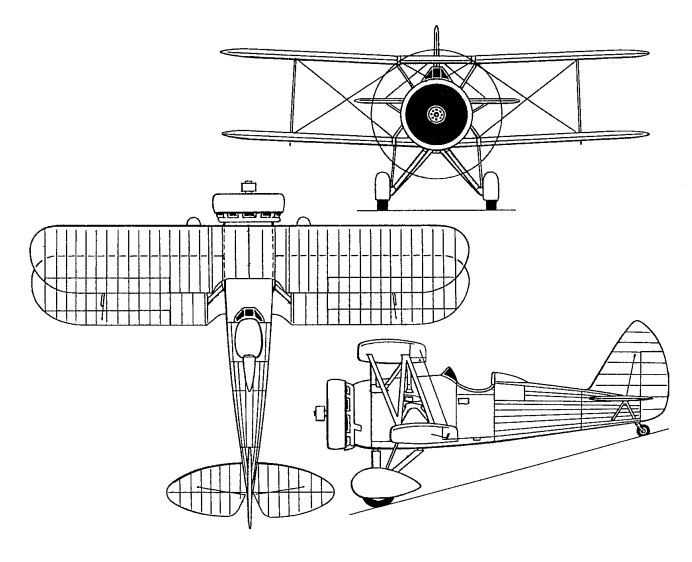
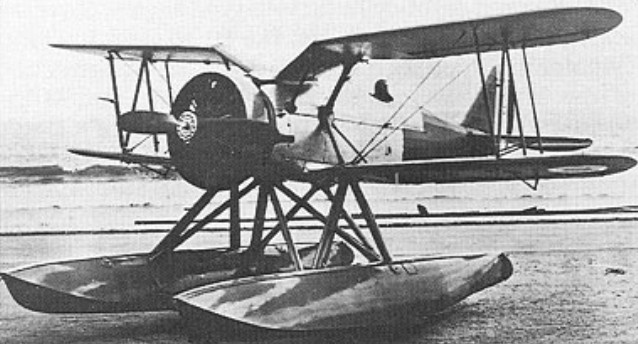
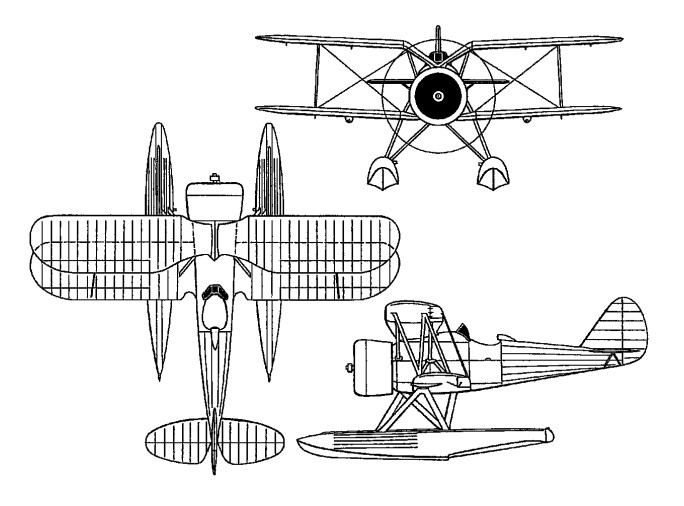
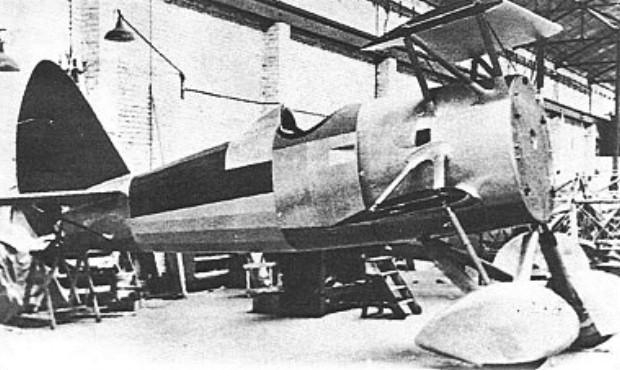
Dated in concept by comparison with other contenders designed to meet the 1933 Marine Nationale requirement for a single-seat float fighter, the R-90 proffered by the Chantiers Aeronavale Etienne Romano was a twin-float single-bay equi-span staggered biplane of mixed construction, the fuselage being of welded steel-tube and the wings of wood.

Powered by a 720hp Hispano-Suiza 9Vbrs nine-cylinder radial, the R-90 was flown in August 1935, attaining a speed of 352km/h at 3500m. During the following October, it was re-engined with a smaller-diameter 14-cylinder HS 14Hbrs two-row radial enclosed by a longchord NACA cowling. At the same time, the volume of the floats was increased and more substantial floatbracing struts were provided.

At the request of the Services Techniques, the prototype was again re-engined, this time with a liquid-cooled 12-cylinder HS 12Ycrs-l rated at 900hp at 1900m. A 20mm cannon was mounted between the cylinder banks, and, in this form, the R-90 could exceed 400km/h in level flight. It flew with the HS 12Y engine in October 1937, but in the previous March, the Marine Nationale had selected the Loire 210 to meet its requirement, and subsequent testing of the R-90 was related to the clandestine development of a shore-based version specifically for the Spanish Republican government.

Max take-off weight: 1990 kg / 4387 lb
Empty weight: 1642 kg / 3620 lb
Wingspan: 8.88 m / 29 ft 2 in
Length: 8.67 m / 28 ft 5 in
Height: 3.93 m / 13 ft 11 in
Wing area: 21.00 sq.m / 226.04 sq ft
Max. speed: 368 km/h / 229 mph
Range: 650 km / 404 miles
Romano R-90

Romano Ro 83

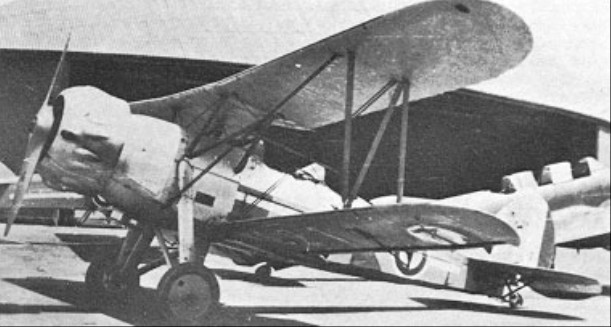
One of several contracts, most of which were clandestine, negotiated with representatives of Etienne Romano by a purchasing commission of the Spanish Republican government early in 1937, involved 24 land-based derivatives of the R-90 single-seat float fighter.

To support the subterfuge that Spain had actually ordered a re-engined version of the entirely different tandem two-seat R-82 trainer, the land-based fighter was allocated the non-sequential designation R-83, part manufacture and final assembly being undertaken clandestinely in Belgium by LACEBA (Les Ateliers de Construction et d’Exploitation de Brevets Aeronautiques).

The R-83 was fundamentally similar to the R-90 apart from having a 450hp Pratt & Whitney R-985 Wasp Junior engine, a cabane replacing the gulled upper wing centre section and a spatted wheel undercarriage. In order to further the pretence that the R-83 was purely a tuitional aircraft, a 280hp Salmson 9Aba radial engine was fitted in Belgium for flight testing and delivery to Spain where it was intended that the Wasp Junior engine be installed.

The first of an initial batch of six R-83s reached Spain on 20 April 1938, and the last on the following 5 July, these allegedly being re-engined as planned after arriving in Barcelona. The ultimate fate of these aircraft is unknown. The wings and fuselages of the remaining 18 were completed, but the aircraft had still to be assembled when the Spanish conflict terminated.

Romano R-83

Romano Ro 80 / Ro 82

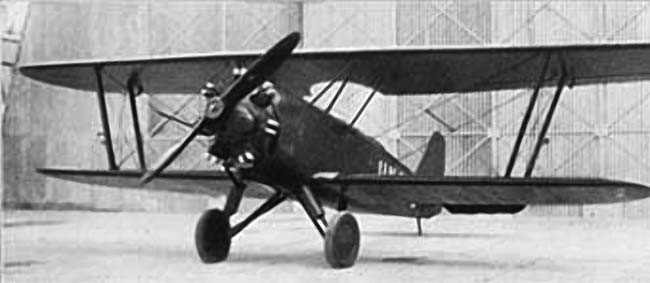
The Romano R-80.01 first prototype was a private venture by Etienne Romano, and was designed to provide an aerobatic two-seat biplane for company pilot Lemoigne to demonstrate at air shows. Tested in early 1935, it was also flown with great success by Michel Detroyat. Its design features included the provision of ailerons on both wings, robust divided landing gear, and a 179kW Lorraine 7Me radial engine in a NACA cowling. After testing also by the official STAe, the R80.01 then gave many aerobatic shows with Lemoigne at the controls.

In response to official suggestions, R-80.02 with the more powerful Salmson 9Aba engine was first flown in March 1936 and exhibited at the Paris Salon de I’Aeronautique of that same year. It incorporated changes already made on the aerobatic prototype, including ailerons on the lower wings only and a fin of increased area. Intended as a two-seat dual-control intermediate trainer, it was soon redesignated R-82.01. Two further protoypes were built, both of them being sold to private owners, one of them the well-known aviatrix Lucienne Saby.

Meanwhile, Romano had become part of the nationalised SNCASE and Michel Detroyat became Inspector of Flying Equipment for all the nationalised companies. On the latter’s urging, large orders were placed by the state for R-82 trainers for the Armee de I’Air. In the event, the total of production aircraft was 147, to which was added a further 30 ordered in 1937 by the Aeronavale. Series trainers featured a number of refinements and some simplifications, the principal external change being the introduction of a long-chord engine cowling.
By 1 August 1939 70 R-82s had been taken on charge, and all 177 series aircraft had been delivered by May 1940. The R-82 have excellent service with the Armee de I’Air and Aeronavale, largely equipping the Centres d’lnstruction and Ecoles de Pilotage.

In February 1938 two R-82s were purchased by a French intermediary company and ferried to Spain, where they were used for training and liaison duties by the Republican government fighting the Nationalist forces. It is uncertain whether these were new aircraft or machines taken from Armee de I’Air contracts.

R-82
Engine: 1 x Salmson 9Aba radial piston engine, 209kW
Wingspan: 9.88 m / 32 ft 5 in
Length: 7.82 m / 26 ft 8 in
Height: 3.34 m / 11 ft 11 in
Wing area: 23.72 sq.m / 255.32 sq ft
Max take-off weight: 1328 kg / 2928 lb
Loaded weight: 918 kg / 2024 lb
Max. speed: 240 km/h / 149 mph
Ceiling: 6500 m / 21350 ft
Range: 660 km / 410 miles

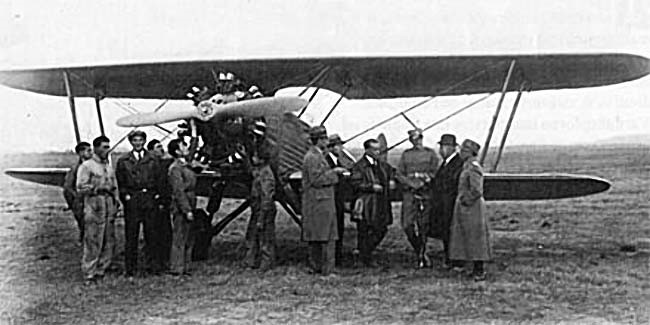
Rogožarski AŽR

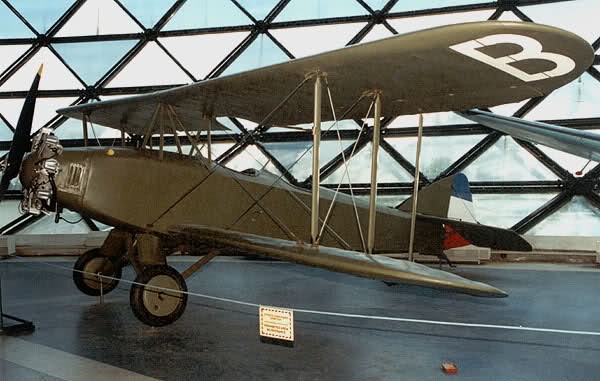
The Rogožarski AŽR (Serbian Cyrillic: Рогожарски АЖР) was a single-engined, two-seat biplane aircraft designed as a trainer in Yugoslavia before World War II. It was designed by Viljem Šuster and built at the Rogožarski factory in Belgrade.

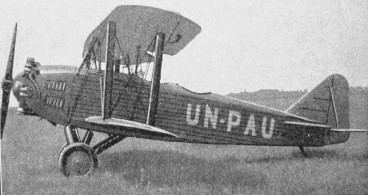
The aircraft was a biplane with the lower wing smaller than the upper. It was equipped with a seven-cylinder Walter Castor air-cooled radial engine of 240 hp and a wooden double-bladed propeller. The plane had dual controls, the two crew (pilot and flight instructor), sat one behind the other. It was to be employed as an intermediate trainer, replacing the outdated Hansa-Brandenburg C.I. The fuselage, which was of rectangular cross-section, was made of wood and covered with plywood. The wings had rounded ends, each was connected by a pair of metal struts and wire tensioners. Construction of the wing involved the use of wood covered with canvas. The landing gear was fixed and had no axle.

The first flight was conducted by a factory test pilot on November 5, 1930 and after the completion of factory tests, was handed over to the Yugoslav Royal Air Force Commission for testing.

The AZR was planned to replace the obsolete Hansa Brandenburg aircraft in the future. However, the flight characteristics were lower than the requirements, and they refused mass production.

The aircraft was only used in 1931 for advertising purposes, demonstration flights and participation in air shows. It also competed in the King’s Cup and the like; AZR still hoped to come to some arrangement with the military. This did not happen, Rogozarski withdrew from aircraft design, the prototype was registered as a civilian plane and used by the factory. It received the civil registration UN-PAU. In the meantime, the economic situation was such that the AŽR was standing in its hangar, waiting for better days; despite bank loans, there was a distinct lack of orders and the company went bankrupt in 1933.

Circumstances improved in the summer of 1934 when the Yugoslav Air Force bought the AZR and the fortunes of the factory improved, becoming a shareholder company. The AŽR was used as a trainer until 1937.

Engine: 1 × Walter Castor 7-cyl radial, 176 kW (236 hp)
Propellers: 2-bladed
Wingspan: 10.55 m (34 ft 7 in)
Wing area: 27.00 sq.m (290.6 sq ft)
Length: 7.55 m (24 ft 9 in)
Height: 3.05 m (10 ft 0 in)
Empty weight: 859 kg (1,894 lb)
Gross weight: 1,433 kg (3,159 lb)
Maximum speed: 215 km / h
Cruising speed: 185 km / h
Range: 745 km (463 mi; 402 nmi)
Service ceiling: 5,320 m (17,450 ft)
Rate of climb: 4.78 m/s (941 ft/min)
Crew: 2

Rogožarski Fizir FN / Zmaj Fizir FN

The Fizir FN (Физир ФН in Serbian) was a plane designed by Croatian Rudi Fizir for primary training in Yugoslavia before World War II.

Fizir FN was single-engine two-seat, trainer biplane with one pair of struts on each side. The wings are rounded at the ends of the flaps had been located on the lower and upper wings.

The first prototype Fizir FN (Fizir teaching) was designed and manufactured in 1929.

Fizir in Petrovaradin did not have the capacity for industrial production of aircraft, their area of work was the design and prototyping. It was built at the Zmaj Zemun and Rogožarski factory in Belgrade, and Albatros in Sremska Mitrovica.

Forty examples were built.

Variants:

Fizir FN – Mercedes – Mercedes 88 kW

Fizir FN – Walter – Walter NZ-120 88 kW

Fizir FN – Walter-Mars 106 kW
Seaplane nicknamed “Little Fizir” or “Fizir Mars”.

Zmaj Fizir FN
Engine: 1 × Walter NZ-120, 88 kW (118 hp)
Propeller: 2-blade
Wingspan: 11.20 m (36 ft 9 in)
Wing area: 32.50 sq.m (349.8 sq ft)
Length: 8.80 m (28 ft 10 in)
Height: 3.10 m (10 ft 2 in)
Empty weight: 820 kg (1,808 lb)
Gross weight: 1,426 kg (3,144 lb)
Maximum speed: 120 km/h (75 mph; 65 kn) 140 at sea level
Range: 540 km (336 mi; 292 nmi)
Service ceiling: 6,500 m (21,325 ft)
Crew: 2

Rogers Sea Eagle RBX

Hisso engine

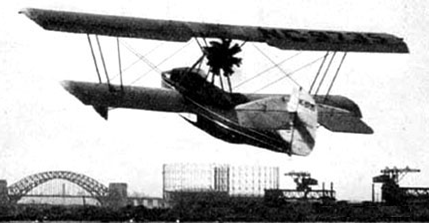
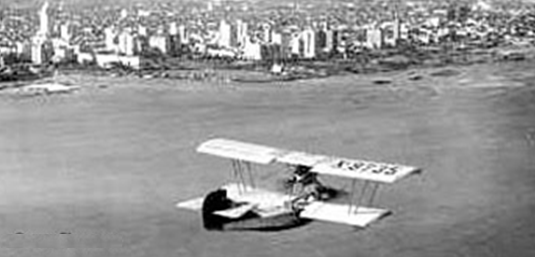
Designed by Harry Rogers, as a close copy of the Curtiss F, the 1929 Rogers Sea Eagle RBX flying boat was first powered by a 150hp Hisso A engine, and priced at $12,500. Only the one, NX/NC9735, was built, receiving ATC 274.

Sea Eagle RBX
Engine: 225hp Wright J-6 pusher
Wingspan: 40’0″
Length: 32’0″
Useful load: 1034 lb
Max speed: 105 mph
Cruise: 85 mph
Stall: 43 mph
Range: 270 mi
Seats: 4
Undercarriage: flying boat

Robinson Mere Merit

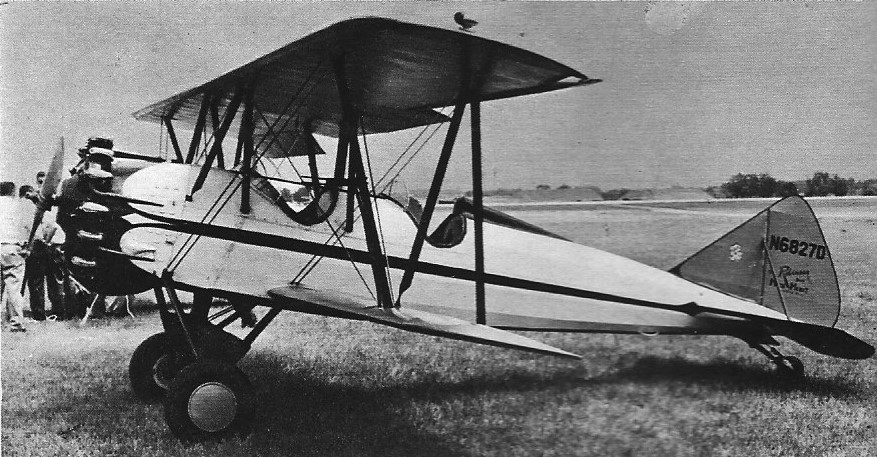
The tandem two-seat Robinson Mere Merit N6827D is actually a 2/3 scale of a 1929 Ken Royce-Rearwin and was built by father and son Cleo and Howard Robinson of Phillipsburg, Kan., SA. Construction took 21 months and $1700, including an antique-like paint job. First flying in late 1964, the wings are wood, fuselage and tail steel tube, all fabric covered.

Engine: Warner, 145 hp
Wingspan: 28 ft / 8.54 m
Length: 20 ft / 6.10 m
Empty weight: 900 lb / 408 kg
MAUW: 1400 lb / 635 kg
Cruise: 120 mph / 193 kph
Landing speed: 43 mph / 69 kph
ROC: 1000 fpm / 5.08 m/sec
Range: 400 mi / 644 km

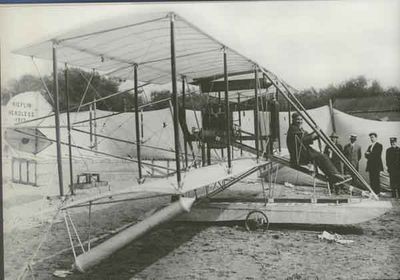
Rieflin Headless Aeroplane Co Hydro-aeroplane 1912

The Rieflin Headless Aeroplane Co Hydro-aeroplane of 1912 set a world’s record for sustained hydro-aeroplane flight over water when piloted by Fred C. Eels on June 25, 1912 over Irondequoit Bay, New York, seventy-three miles in 1:21:00, at an average speed of fifty-four miles per hour. Eells’ flight was cut short when his supply of gasoline gave out and he dropped his machine to the bay. The best previous record for sustained flight was forty-six miles.