In 1906, Santos-Dumont took the nacelle of his dirigible balloon no. 14 and added to it a fuselage and biplane wings and an Antoinette V8 engine. The airplane flew rear-first and was denominated 14-bis (since it was descendent of the dirigible balloon no. 14).
Biplane
Santa Ana Aircraft Co 1925 Biplane
In 1925 Santa Ana built a three place open cockpit biplane powered by a 90hp Curtiss OX-5 engine, and featuring flaperons.
San Jose Flying Club E
In 1930 members of the San Jose Flying Club Ltd rebuilt a wrecked Travel Air 3000 with a Hisso and reregistered it N837Y c/n 29.
Sandlin Bug
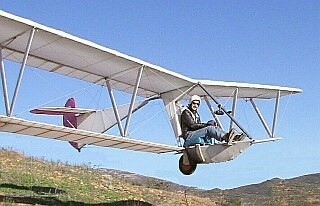
The Bug2 airchair biplane (or sesquiplane) first flew in Februauy of 1999. Bug 4 was intended to be an improved version of Bug2, and was considered superior.
The monoplane airchairs were a furthur development of the Bug4. Construction is of aluminum tubing and steel cable covered with a heat shrunk fabric.
Safety design aspects include:
Extensive frangible structure around the pilot for crash impact protection
4 point safety belts
A hand deployed emergency parachute which is intended to bring the glider and pilot down together, tail first, so that the pilot is protected by the tail and wing structure during the parachute landing

Construction of the Bug wheeled sailplane is from readily available materials without special welding, machining, or molds. The empty weight, for a not foot launchable glider, is substantially less than the ultralight regulatory weight limit; about the same weight as the pilot.

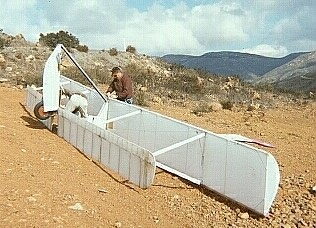
Quick assembly & roof rack transport make flying convenient. A Bug or Goat can be strapped down onto an ordinary hang glider rack, with no special saddles or pads.

Bug2 and Bug4 have demonstrated casual and comfortable airchair soaring, drogue chute landings in small fields, and novice instruction on training hills. They have been towed by trucks, winches, and ultralight airplanes. The Bugs have soared high, if not far, and have always returned for a safe landing. An airchair can be launched by ultralight aerotow, car tow, winch cable, or just by rolling down an open slope.
Accomplishments of these biplanes include:
Self launch soaring by rolling down hillsides
Self launch training by rolling down hillsides
Car top transport on non-specialized racks
The Bugs fly at about the same speeds as a hang glider, readily mixing with hang glider and paraglider traffic. No formal performance measurements have been made, but all are in the hang glider range and can stay up in good lift conditions. The Bug has soared thousands of feet above take off altitude.
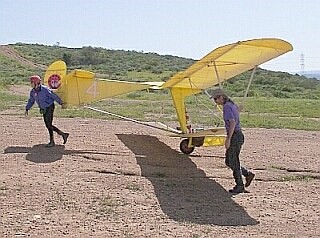
Sandlin has flown the Bug2 and Bug4 for soaring only, not aerobatics. He considers the structural redline (maximum safe airspeed) for flying to be 45 mph.
Bug2 and Bug4 performance has not been measured but seems to be about the same as a single surface hang glider. As of April 2010 only a single Bug4 is known to be currently flying .
Posting of the complete technical drawings of an aircraft on the Internet, freely available in the public domain for downloading and study.
Sandlin Pig
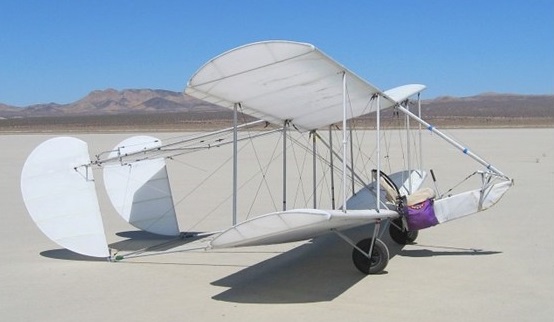
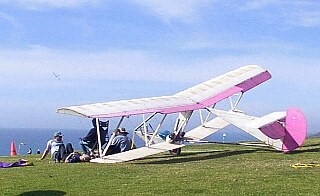
The Pig (Primary Instruction Glider) is an airchair, ultralight biplane sailplane with a two axis control system (rudders & elevator, but no ailerons). A center stick & rudder pedals provide a traditional control system.
The Basic Ultralight Gliders are best characterized by their light wing loading, which is about the same as that of a hang glider (around 1.7 lb. of gross weight for every square foot of wing area). Light wing loading results in slow flight, which is safe, comfortable, and allows soaring in small thermals (because of the ability to turn tightly).
The Pig features:
low wing loading for forgiving flight characteristics and rolling launches (1.5 lb/sqft.)
open air pilot seating (allows hand thrown emergency parachute)
center of lift landing gear (allows simple balance check for proper center of mass)
car top transport (major sections separate, wings and tail fold up)
one person assembly (37 minute setup for me in my backyard)
light weight airframe (about 148 lbs. with parachute)
nose skid for quick stops, nose down or tail down attitude for take off or landing
The Pig features simple construction from readily available materials, no molds, no welding, no special machining, no spray rig, no sail making, no sheet metal, etc. The airframe is made of bolted aluminum tubing with braided steel cables, covered with a light grade of conventional aircraft fabric (polyester fabric is cemented on, heat shrunk, then adhesive sealant is applied by brush).
All secondary structures (small ribs) are composites of foam, carbon rod, & fiberglass tape.

Low time pilots should use a glider that is easy to fly, forgiving, and robust, and which has good crash protection for the pilot. Controls and airframe must look and feel good, to engender the confidence that will reduce pilot stress and allow effective learning. The mechanics of launching and landing should be simple and non-athletic. Things should be happening slowly so the student has time to see mistakes and react to them. The Pig is a version of this slow/simple/safe aircraft.
The Pig has two wheels (40 cm. diam. standard kite buggy type), 8 feet apart, rudder turn control, no ailerons (stick moves fore and aft only). 6 degree wing dihedral angle for yaw/roll coupling, and Box kite structure for torsional rigidity.
The wing airfoil is a simple utility type that Sandlin made up (Pigfoil 3012, 12% thick at 30% chord) with a completely flat bottom. This airfoil is similar to that of some radio controlled trainer gliders, and much like a Piper Cub. This is for good low speed flying characteristics and easy construction. This airfoil can also provide a strong and stiff trailing edge which will tolerate rough assembly on irregular terrain (the wing section is assembled with the trailing edge on the ground).
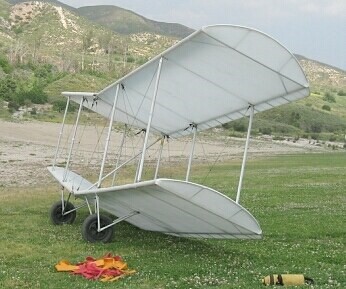
Folding wing design provides a large area wing in a small, light package, allowing transport & assembly by one person.

The eight main wing struts are mounted on swiveling eye bolts, so that during disassembly the struts can be detached at one end and rotated ninety degrees on the other. This allows each upper wing half to be lowered onto the lower wing half, making a compact stack for car top transport. A Pig can be strapped down onto an ordinary hang glider rack, with no special saddles or pads.

Room has been allowed behind the the pilot for installation of a small motor and pusher propeller at about the trailing edge of the wings. The engine frame might replace the two centerline struts, and there are other hard points nearby if required. The prop wash can exit through the box tail without hitting any control surface, avoiding a common source of vibration and drag. Adding a motor to the Pig would create a “motor floater”, a self launching airchair which could play the game of minimal power flight to the nearest thermal.
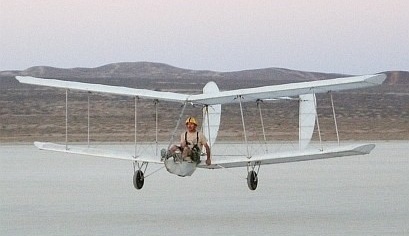
The two axis control system has proven to be adequate, simple to use, and fun for recreational flying. Launches have been made by line towing and by rolling off open hillsides.
The release handle fot the tow hook is in the middle of the nose tube.
Flying the Pig is simple, a two axis system like a hang glider, “fast-slow, right-left”, not requiring any coordination between the yaw and roll axes as does the three axis system. There is no yaw string, and the general instruction is: “nose level, turn with your feet”.
The initial use of the rudder induces a skid, quickly followed by banking of the wing. Generally, the control feel is quick and stable, and the controls function just as well as on any of the three axis airchairs. There are special two axis procedures, such as keeping the nose low while ground rolling in a cross wind, so the weight of the glider on the wheels will keep the wings level.
Its first high flight was made in September, 2008.
Nothing is for sale and there are no commercial intentions. The Pig1 technical drawings are available for on line viewing or download, Basic Ultralight Glider homepage, “Pig Drawings”. There are 81 drawings available in three different file formats.
Wingspan: 26 ft
Empty weight, with parachute: 147.5 lb
Gross weight: 308 lb
Wing area: 194 sq.ft
Wing loading: 1.6 lb/sq.ft

San Diego Aeroplane Mfg Co 1911
Apparently Walsh built a Macomber powered open cockpit biplane that he eventually modified with three seats in order to carry his wife and young son on publicity flights in the Los Angeles area. Around that time there was a similar craft ordered by San Diego sportsman Harry Harkness, designed by Walsh and built by the Eaton Brothers in Los Angeles, which might have been the same plane.
San Diego Aeroplane Mfg Co 1910 [2]
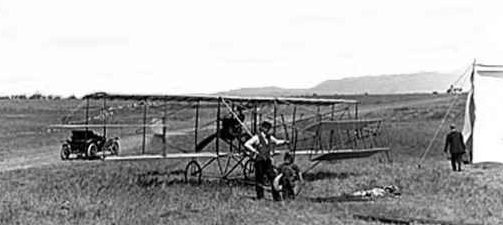
The second San Diego Aeroplane Mfg Co aircraft of 1910 was based on the prevailing Curtiss design. A single place, open cockpit biplane powered by a 25hp Cameron engine, Walsh succeeded in making two flights on 3 April 1910, and, with several design modifications and an Elbridge motor, continued exhibition and competition flights in Southern California into 1911.
A similar craft, with a Hall-Scott motor, was used by Walsh for exhibition work throughout the nation in 1911-12, but he was known to have also used Curtiss-built planes, while a member of the Curtiss Exhibition Co team.
Sandford-Miller biplane
In 1913 New Zealand, the homebuilt Howard Wright biplane constructed by the Walsh brothers was later modified by Fredrik Sandford and William Miller as the Miller Sandford biplane.
Sanders No. 1 biplane
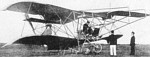
The 1909 Sanders No. 1 biplane was designed by Capt.H.A. Sanders and built by London Aeroplanes and Navigation Co. in the UK.
Span: 50′
Sanders Curtiss Pursuit
The 1918 Curtiss Pursuit is possibly a rebuild or modification from something surplus, possibly JN-4, and OX-5 powered.
Bought by B Larsen and E E Terrell of Oakland in 1928 and registered NC471 c/n TL100sub, it was reported overhauled in 1929, and registration cancelled by CAA on 7 May 1930 for unspecified reason.
 All Aero