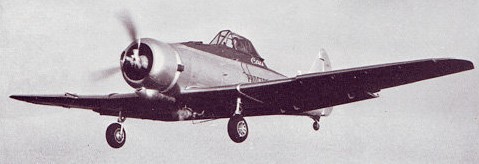
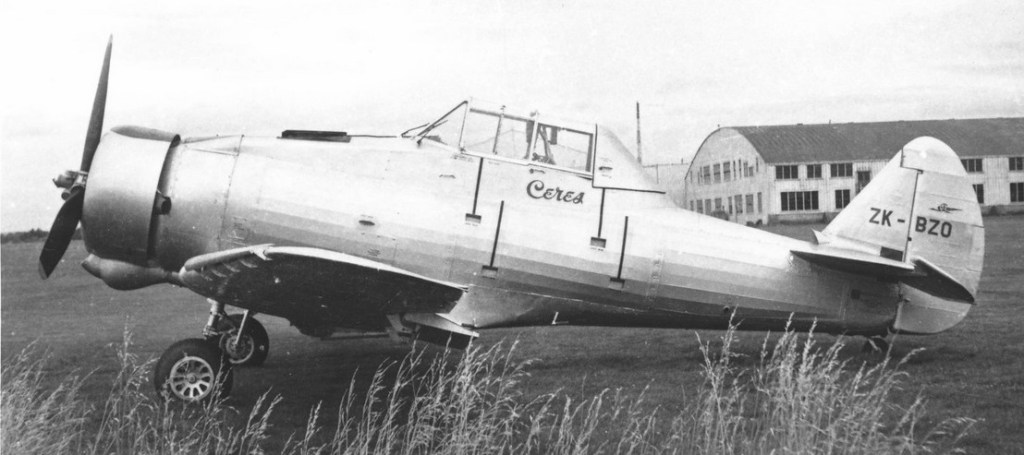
The CA-28 agricultural aircraft was designed around components of the wartime Wirraway. It first flew in the southern summer of 1958. Basically a single-seater, it also had a rear-facing seat behind the pilot for ferrying. There was a 40 cu.ft. hopper forward of the pilot. No hydraulic or electrical systems were fitted. The Ceres did have leading edge slats and manually operated flaps.
Fourteen were registered in Australia and five in New Zealand in the early 1960’s.
Commonwealth Aircraft CA-28 Ceres C ZK-BZO
Engine: Pratt & Whitney R-1340-AN-1, 600 hp. Wingspan: 14.30 m / 47 ft 11 in Length: 9.36 m / 31 ft 9 in Height: 2.74 m / 9 ft 0 in Wing area: 29.0 sq.m / 312.15 sq ft Take-off weight: 3048 kg / 6720 lb Empty weight: 1995 kg / 4398 lb Cruise speed: 179 km/h / 111 mph Accommodation: 1-2
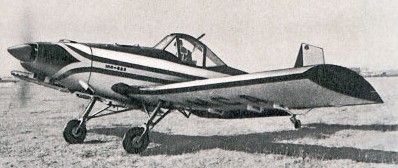
Designed for agricul¬tural use the first I.A.R. 822 flew in 1970. Series production started in 1971.
The IAR-822 was the initial single seat version of mixed wood and metal construction. The tandem two seat IAR-822B was used for training and glider towing.
The IAR-826 was as the IAR-822 but of all-metal construction.
IAR-826
IAR-826 Engine: 1 x Lycoming IO-540-G1D5, 215kW Take-off weight: 1900 kg / 4189 lb Loaded weight: 1060 kg / 2337 lb Wingspan: 12.8 m / 41 ft 12 in Length: 9.4 m / 30 ft 10 in Height: 2.8 m / 9 ft 2 in Wing area: 26.0 sq.m / 279.86 sq ft Max. speed: 195 km/h / 121 mph Cruise speed: 170 km/h / 106 mph Ceiling: 4500 m / 14750 ft Range w/max.fuel: 500 km / 311 miles
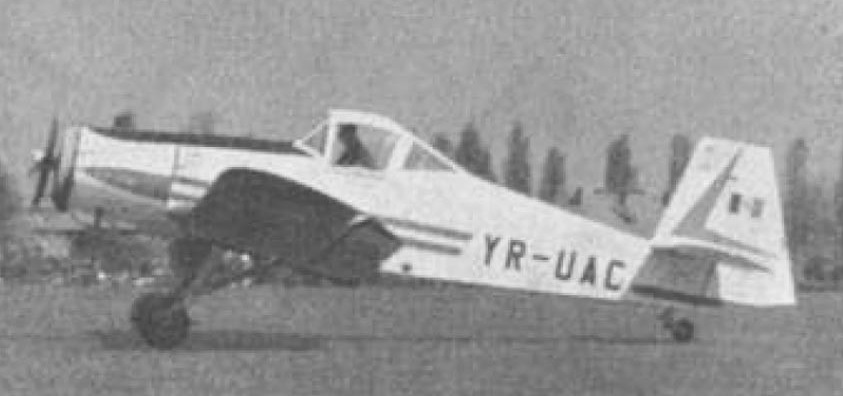
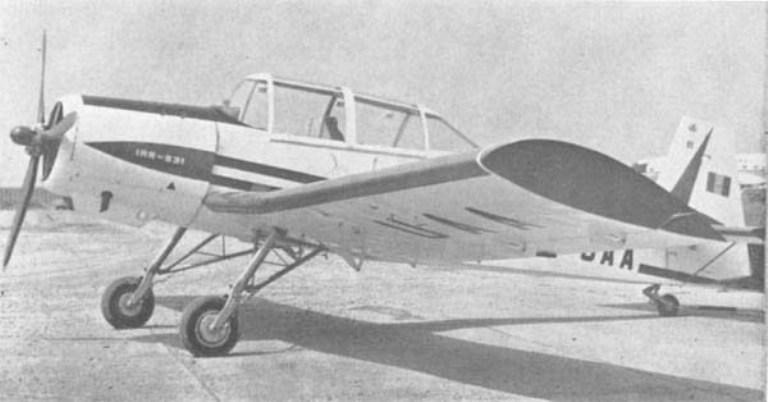
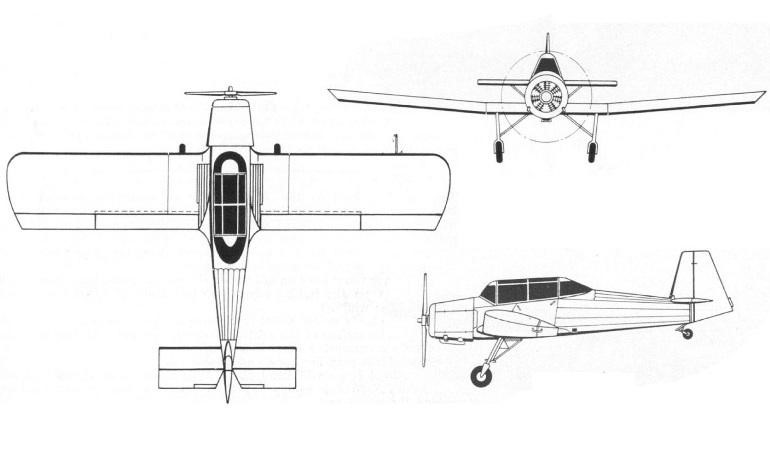
The IAR-821 is an agricultural crop sprayer and duster aircraft. The design was completed under the leadership of eng. Radu Manicatide in 1967, at IMFCA Bucharest (Institutul de Mecanica Fluidelor si Cercetari Aerospatiale – Institute of Fluid Mechanics and Aerospace Research).
A low-wing monoplane, it featured mixed wood-metal structure, with the fuselage and wing roots built from welded chrome-molybdenum tube, and the outer wings and tail unit from wood. The three-part, self-supporting rectangular wing is attached to the fuselage with a 5 ° angle of incidence. While the wing center part is designed without a V-position up to about 1/3 of the span, the wing ends have a V-position of + 5 °. The wing center section, which runs straight through, has a frame of welded chrome-molybdenum tubes and is clad with metal planking that can be walked on. The outer wings made of wood and covered with fabric also house the two fuel tanks with a total capacity of 130 lt. The front fuselage had aluminium panels, while the rest of the surface was plywood covered with fabric.
The ailerons are also made of wood and covered with fabric. As landing flaps simple slotted flaps are used. The container for 800 kg of spray is located between the fire bulkhead and the cockpit. Both solid and liquid funds can be applied.
The propulsion was provided by an Ivchenko AI-14 RF, a single row air-cooled 9-cylinder radial capable of delivering 300 hp (221 kW), located at the apex of the front fuselage contained in a NACA cowling and combined with a three-blade propeller with fixed pitch. It was with fixed, tailwheel undercarriage.
It was built at IRMA (Intreprinderea de Reparatii Material Aeronautic – Enterprise for Aeronautical Material Repairement), in Bucharest, first flying in 1967. A small series of 20 aircraft was produced in 1968 and 1969, plus a single example of a trainer aircraft designated IAR-821B that had a second cockpit installed in place of the IAR-821’s chemical tank, and was equipped with a new chemical tank of smaller capacity (100 lt). The fuel capacity was been increased to 160 lt. This version flew for the first time in September 1968. It was intended that this aircraft should equip Romanian flying schools from 1969, but this did not happen.
IAR-821B
The IAR-821 was built until the end of 1969, when replaced by the IAR-822 which had a six-cylinder Lycoming engine.
IAR-821 Engine: 1 × Ivchenko AI-14RF, 220 kW (300 hp) Wingspan: 12.80 m (42 ft 0 in) Wing area: 26.0 sq.m (280 sq ft) Wing profile: NACA 23012 Wing chord: 2.10 m Wing extension: 6.3 m Length: 9.20 m (30 ft 2 in) Height: 2.78 m (9 ft 1.5 in) Empty weight: 1,080 kg (2,380 lb) Gross weight: 1,900 kg (4,180 lb) Capacity: 600 kg (1,300 lb) chemicals Maximum speed: 212 km/h (132 mph, 115 kn) Cruising speed: 205 km / h Application speed: 120-150 km / h Endurance: 2 hours 36 minutes Service ceiling: 6,200 m (20,300 ft) Rate of climb: 8.0 m/s (1,575 ft/min) Takeoff roll: 130 m Crew: One pilot
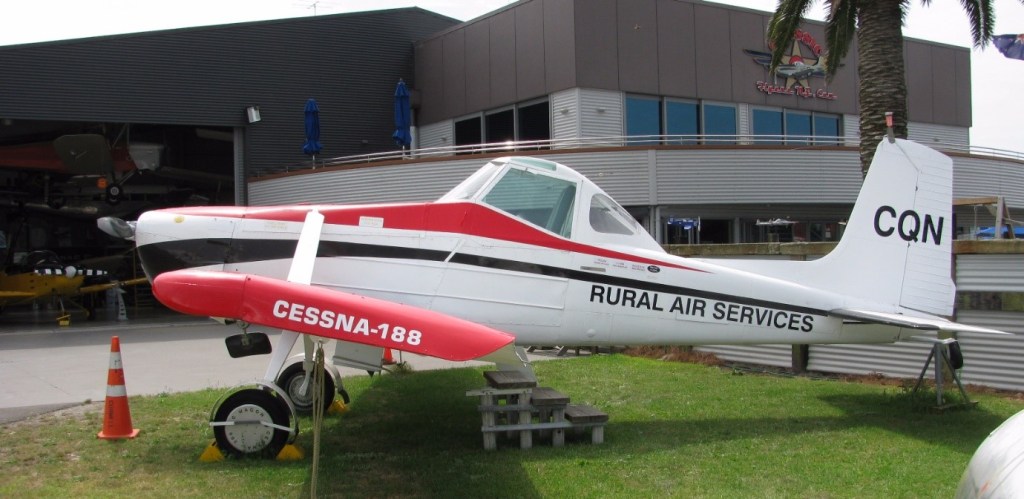
Cessna model 325 was essentially a 305 Bird Dog powered by a 230-hp engine and fitted with a CSU, a hopper in the rear of the cockpit, and under-wing spray bars.
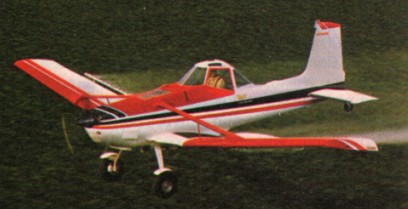
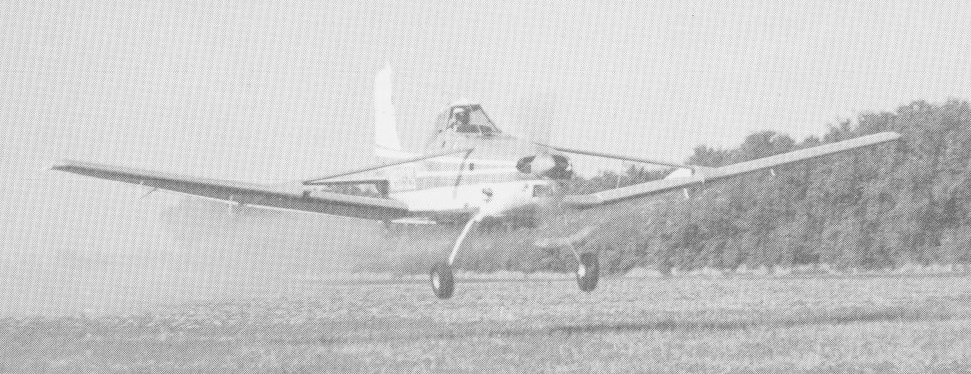
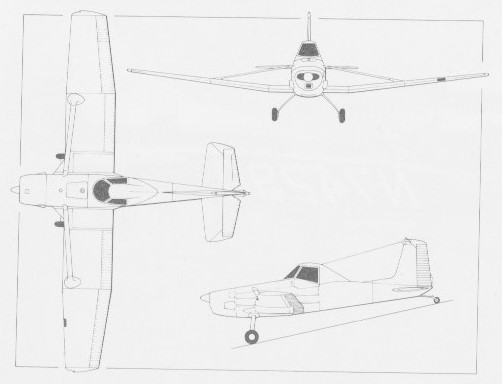
First flown on 19 February 1965, the Agwagon was Cessna’s first production low-wing single. Utilising as many model 180 parts as possible, the Agwagon was sensibly priced and proved a good seller. The Cessna Model 188 AGwagon (later renamed AG Wagon) is a braced low-wing monoplane of all-metal construction, with non-retractable tailwheel landing gear, and accommodation for the pilot in an enclosed cabin protected by a steel overturn structure.
AGwagon
Power was provided by either a 172kW Continental IO-470-R or a 224kW Continental IO-520-D engine for the AGwagon 230 or AGwagon 300 respectively. Standard agricultural equipment included a 757-litre or 816kg capacity glassfibre hopper between the engine firewall and the cabin, and optional dusting or spraying equipment was available.
An increasing market for the AGwagon resulted in the introduction of a new model of this aircraft in late 1971; plus two additional versions designated as the AGpickup and AGtruck. The AGpickup was the basic model, a new name applied to the Continental O-470-R version of the original AGwagon; the Continental IO-520-D AGwagon was renamed AGwagon C and introduced a number of detail refinements; and the AGtruck was generally similar to the AGwagon C, except for the provision of a 1060-litre hopper plus a complete spray system and a wide range of equipment as standard. Of these three types the AGpickup was discontinued in 1976, and production of the AGwagon ended during 1981, after 1,589 had been built.
The final production version, introduced in 1979, was the T188C AG-HUSKY was powered by a turbocharged 310 hp / 231kW TSIO-520-T engine. US conversions to 400 hp are known of. Three hundred and eighty-five Cessna T188C AgHuskys, variants of the popular Cessna Agwagon and AgTruck agricultural aircraft, were built until late in 1985 when production ended. In total, 3976 CE-188 were built
A two seat conversion was performed on three Cessna Al88 Agwagons for Hazelton Air Services of Cudal, NSW. Aerosmith converted VH DOD (s/n AI 88 0125) at Sydney in 1967. Major work included widening the rear fuselage and installing a raised turtledeck. The cockpit sides are near vertical and a much larger windscreen fitted. The flying controls were shifted to the port side, but dual controls were not fitted. When a second aircraft was required, Aerosmith converted and certified another aircraft on 18 January 1971. The aircraft, VH KVA (s/n A188 0169), was registered as a Cessna A.188A/2 on 07 May 1971. A third aircraft (s/n A188 0066) was also converted and registered in February 1972. This aircraft was damaged beyond repair in January 1984 and first conversion, VH-DOD, was written off in 1986.
Aviones de Colombia Sa, originally a Cessna dealership (1961), then also assembled selected Cessna aircraft, produced a two-seat training derivative of the Cessna AgTruck, known as AgTrainer.
CE-A188 AgPickup Engine: Continental O-470-R, 230 hp Length: 26 ft (8 m) Wingspan: 41 ft 8 in (12.7 m) Maximum speed: 121 mph (195 kph) Range: 370 miles (595 km) Service Ceiling: 11,000 ft (3,383 m)
CE-A188A Agtruck
AGwagon Engines: Continental IO-520-D, 300 hp. Seats: 1. Wing loading: 16.3 lb/sq.ft. Pwr loading: 13.3 lb/hp. Max TO wt: 4000 lb. Empty wt: 2189 lb. Equipped useful load: 1759 lb. Payload max fuel: 1447 lb. Range max fuel 75% pwr: 253 nm / 2.6 hr. Service ceiling: 11,100 ft. Hopper cap: 200 USG. 75% cruise: 99 kt. Working speed: 105 kt. Working endurance: 3.1 hr. Stall: 50-53 kt. ROC: 690 fpm. Min field length: 1265 ft. Fuel cap: 312 lb.
CE-A188A Agwagon B
CE-A188B Agwagon C Engine: Continental IO 520 D, 300 hp. Cruise speed: 113 mph. Std empty wt: 2,164 lbs. Max wt Restricted Category: 4,000 lb. Hopper cap: 200 USG. Range 75% pwr: 295 sm. Takeoff dist 50 ft obstacle: 1,090 ft. Landing dist 50 ft obstacle: 1,265 ft.
CE-A188B AGtruck First built: 1972. Engine: 1 x Continental IO-520-D, 300 hp, 224kW. TBO: 1200 hrs. Prop: McCauley 2 blade, constant speed 86 in. Seats: 1. Length: 7.9 m / 25 ft 11 in Height: 2.49 m / 8 ft 2 in Wingspan: 12.7 m / 41 ft 8 in. Wing area: 19.05 sq.m / 205.05 sq ft Wing aspect ratio: 8.47. Max ramp wt: 4200 lbs. Max take off wt: 4200 lbs. Standard empty wt: 1012 kg / 2231 lb Max useful load: 1901 lbs. Max landing wt: 3300 lbs. Wing loading: 20.5 lbs/sq.ft. Power loading: 14 lbs/hp. Max useable fuel: 324 lbs. Hopper capacity: 280 USG. Climb rate: 465 fpm. Service ceiling; 7,800 ft. Max speed: 122 kts. Working speed: 100 kts. Cruise speed: 187 km/h / 116 mph Fuel flow @ working speed: 82 pph. Endurance @ working speed: 3.7 hr. Stalling speed clean: 66 kts. Stall speed flaps down: 56 kts. Ceiling: 2375 m / 7800 ft Range: 466 km / 290 miles Turbulent air penetration speed: 98 kts. Fixed tail-wheel undercarriage.
CE-T188C AGhusky First built: 1978. Engine: 1 x Continental TSIO-520-T, 310 hp. Prop: McCauley 3 blade, constant speed 80 in. Seats: 1. Length: 26.69 ft. Height: 8.2 ft. Wingspan: 41.7 ft. Wing area: 205 sq.ft. Wing aspect ratio: 8.2. Max ramp wt: 4400 lbs. Max take off wt: 4400 lbs. Standard empty wt: 2322 lbs. Max useful load: 2078 lbs. Max landing wt: 3300 lbs. Wing loading: 21.5 lbs/sq.ft. Power loading: 14.2 lbs/hp. Max useable fuel: 324 lbs. Hopper capacity: 280 USG. Climb rate: 510 fpm. Rate of climb @ 8000 ft: 255 fpm. Certificated ceiling: 14,000 ft. Max speed: 113 kts. Working speed: 100 kts. Fuel flow @ working speed: 93 pph. Endurance @ working speed: 3.2 hr. Stalling speed clean: 62 kts. Stall speed flaps down: 58 kts. Turbulent air penetration speed: 98 kts. Fixed tail-wheel undercarriage.
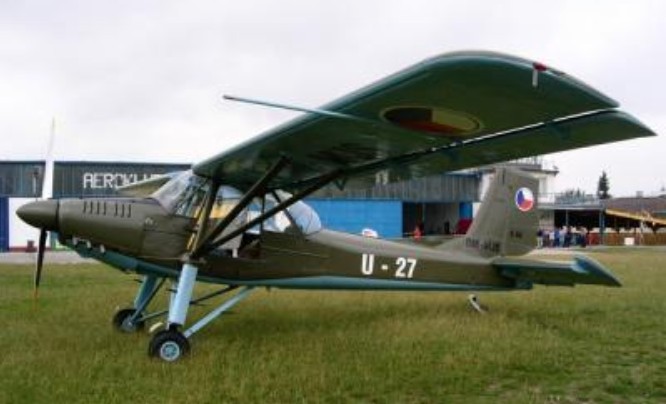
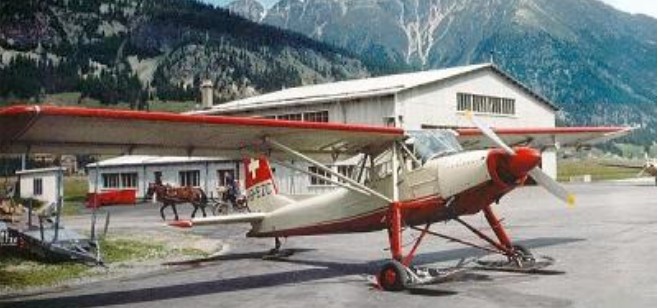
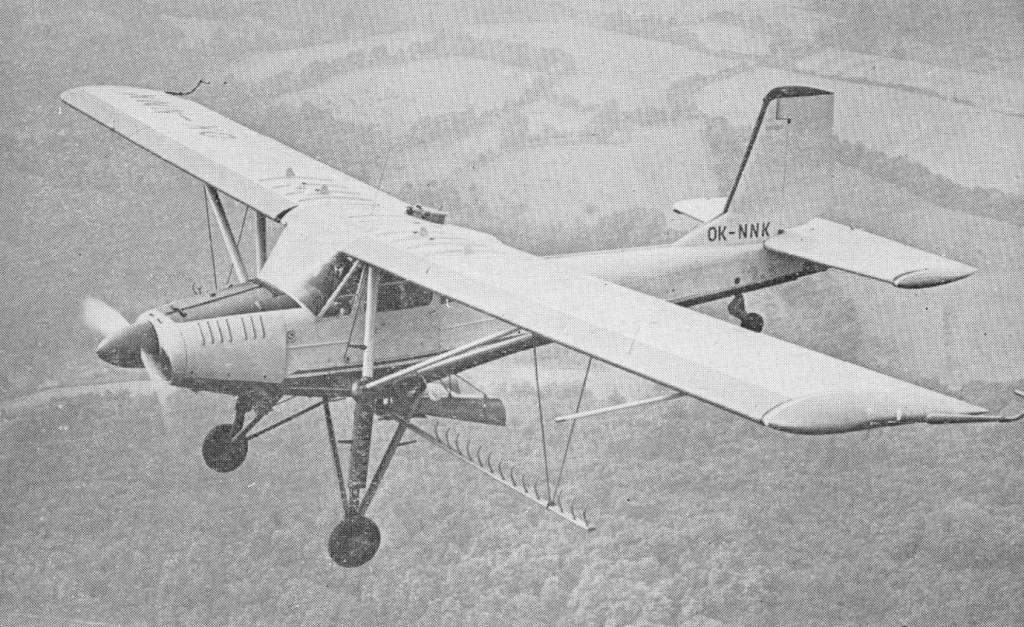
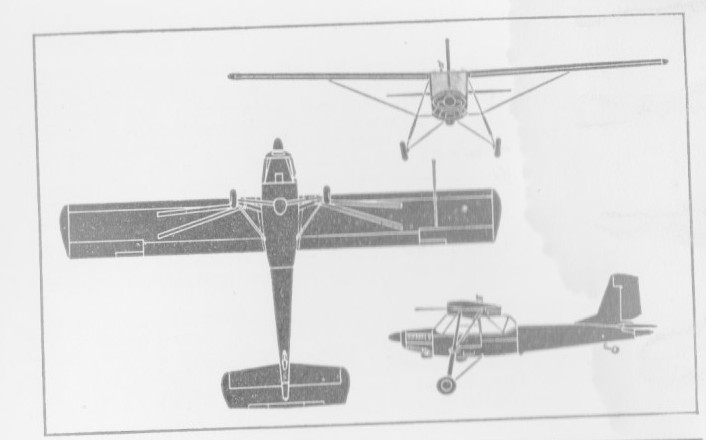
A three/four-seat light STOL monoplane, designed for use as an agricultural aircraft and glider towing. Each wing carries a full-scan one-piece leading-edge slat, and double-slotted flaps are fitted between the cabin and the ailerons.
First flown 1955 production deliveries began in March 1956, and remained in production until 1960.
The L-60 Brigadýr resembles much the Mráz J-65 ‘Èáp’ (Czech version of the Fiesler Fi 156 ‘Storch’), because it was designed and built in the same factory.
The agricultural L-60 utilised a 92 Imp.Gal. tank in the rear cockpit, or a hopper for 660 lb of dust.
A military air observation post and liaison model with RSI-6 and RPK-10 radio, full blind-flying equipment and provision for a machine gun, was supplied to the Czech Air Force.
Engine: Praga Doris M 208 B, 220 hp Wingspan: 45.801 ft / 13.96 m Wing area: 261.565 sqft / 24.3 sq.m Length: 28.018 ft / 8.54 m Height: 8.858 ft / 2.7 m Max take off weight: 3120.1 lb / 1415.0 kg Weight empty: 2194.0 lb / 995.0 kg Max. speed: 120 mph Cruising speed: 94 kts / 175 km/h / 109 mph at SL Service ceiling: 14764 ft / 4500 m Climb to 3280 ft:4.3 min Wing load: 11.89 lb/sq.ft / 58.00 kg/sq.m Range: 486 nm / 900 km Crew: 1+3






 All Aero