Small civil aircraft projects covered the M-202PW Olen enlarged development of the Indian Saras, M-203PW Barsuk radial-engined general-purpose transport, and M-500 piston-engined agricultural monoplane suited also to other roles.
Agricultural
Murrayair MA-1
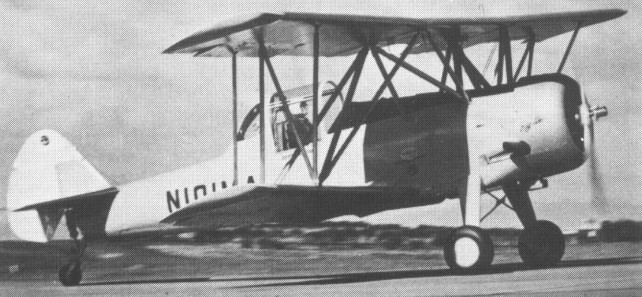
The Murrayair MA-1, a conversion of the Stearman Kaydet, was designed by the technical services section of Air New Zealand at Mangere during 1968 and 1969. The conversion of the Stearman involved the fitting of a 600 hp P & W R-l340 Wasp engine from a Harvard to double the aircraft’s payload to 30 cwt, and the redesigning of the entire centre fuselage using a New Zealand-made integral fibreglass hopper. With a capacity of 62 cu ft it is the largest in the ag aviation industry. Fuselage panels are also of moulded fibreglass and are quickly removable for maintenance. An enclosed cockpit was also fitted. The rear fuselage, tail unit and strengthened undercarriage were from the Stearman. The wooden and fabric wings were increased in area by 35 per cent, and the entire strut system was redesigned to eliminate the flying and landing wires, using steel lift struts to accommodate the increased gross weight (3,495 lbs to 6,250 lbs).
Work on the conversion of the Stearman began towards the end of 1968, and the first aircraft, N101MA, first flew from Mangere on July 27, 1969. The job was carried out for the Honolulu-based aviation service firm, Murrayair Ltd, which operated a fleet of modified Stearmans for spraying pineapple and sugar plantations in the Hawaiian Islands. By mid-1972 N101MA had flown 1,100 hours and production of five more pre-production aircraft, the MA-1, was begun. In 1974 the MA-1 was being produced at Harlingen in Texas by a subsidiary of Murrayair, Emair Ltd, at the rate of one aircraft per month, with completion of 2-3 air¬craft per month planned by the middle of that year.
The Emair MA-1, was offered with a 1,200 hp Wright R-1820 engine derated to 900 hp. The MA-1B, which began its flight tests from Harlingen, Texas, in August, also has a new slower turning propellor with larger diameter and broader blades.
MA-1
Engine: P&W R-1340, 600 hp
Seats: 1-2
Wing loading: 15.7 lb/sq.ft
Pwr loading: 11.7 lb/hp
Max TO wt: 7000 lb
Empty wt: 3550 lb
Equipped useful load: 3398 lb
Payload max fuel: 2750 lb
Hopper cap: 450 USG / 30 cwt / 62 cu.ft
75% cruise: 95 kt
Working speed: 90 kt
Working endurance: 2.9 hr
Stall: 56 kt
Fuel cap: 648 lb
MA-1B
Engine: Wright R-1820, 900 hp
Seats: 1-2
Wing loading: 15.7 lb/sq.ft
Pwr loading: 8.9 lb/hp
Max TO wt: 8000 lb
Empty wt: 4300 lb
Equipped useful load: 3648 lb
Payload max fuel: 3000 lb
Hopper cap: 450 USG
75% cruise: 115 kt
Working speed: 105 kt
Working endurance: 2.3 hr
Stall: 63 kt
ROC: 1750 fpm
Min field length: 1600 ft
Fuel cap: 648 lb
Mitchell P-38 / AG-38
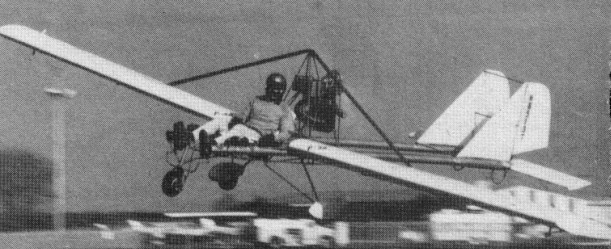
Single seat single engined mid wing monoplane with conventional three axis control. Wing has unswept leading and trailing edges, and constant chord; two fin tail. Pitch control by fully flying tail; yaw control by fin mounted rudders; roll control by full span ailerons also usable as flaps; control inputs through stick for pitch/roll and pedals for yaw. Wing braced from above by struts, wing profile NACA 23015; double surface. Undercarriage has three wheels in tricycle formation, with addi¬tional tailskids; steel spring suspension on nosewheel and glass fibre suspension on main wheels. Push right go right nosewheel steering connected to yaw control. Brake on nosewheel. Aluminium tube/wood/steel tube framework, with optional pod. Engine mounted above wing driving pusher propeller.
The P 38 was designed by Jim Meade and christened Lightning after the famous twin boom fighter of the Second World War. The prototype appeared at the end of 1980 and the first P 38 was sold during the second quarter of 1981. The prototype was fitted with a 26.0ft (7.92m) span wing having a 4.0ft (1.22m) chord, giving 104sq.ft (9.7 sq.m) of wing area using the same NACA 23015 profile as the B 10. With 200 lb (91 kg) empty weight and 450 lb (204 kg) maximum gross weight, this machine carried 250 lb (113 kg) useful load with a wing loading of 4.32 lb/sq.ft (21.1 kg/sq.m).
On the production models, the wing span was increased to 28.0ft (8.53m) and the chord also increased.
Initially fitted with a Honda Odyssey engine of 250 cc giving 20 hp, or as an option a Zenoah G25B also of 20 hp, the P 38 was in 1983 powered by the twin cylinder Cuyuna 430RR 30 hp engine. Its characteristics and performance figures do not allow its classification as an ultralight, so it is therefore necessary to hold at least a private pilot’s licence to fly the Lightning in the US.
The complete kit, requiring 80 h for assembly, has less than 200 pieces, the principal components being prefabricated and partly assembled. The wing ribs are wood, bonded with epoxy to the tubular Duralumin spar, while the leading edges are of polyurethane foam shaped and then covered with birch plywood. On the P 38, the ‘flaperons’ a combination of flap and aileron are made with ribs every 6 inch (15 cm). Like the other Mitchell models, this one is also available as an economy kit or as plans only.
Units delivered by June 1981 35 kits and plans.
The AG 38 is the crop spraying version of the P 38 Lightning, to which it is very similar except a pod is fitted. The prototype AG 38 was shown to the public during the EAA Convention at Oshkosh in August 1982. This aircraft is fitted with Micron X15 100 variable speed rotating nozzles, which are said to control droplet size and so reduce the amounts of chemical and water required. They are supplied from a shaped tank which carries 14.0 US gal (11.7 Imp gal, 53.0litre) of spray chemical. The tank is fitted under the seat and central wing section, between the legs of the main landing gear. An electric pump feeds the spray booms which are fitted with 19 fan nozzles across the full wing span. For a better spread, the two spray bars are placed at not the trailing edge as is usual, but 9.5 inch (24 cm) below the level of the wing.
At 50mph (80kph) the AG 38 spray swath varies from 20ft (6m) wide at 6ft (2m) altitude to 45 ft (14 m) wide at 15 ft (5 m) altitude. With the equipment set for maximum delivery, the AG 38 can deliver 48oz/acre (3.4 litre/hectare) and can treat 37 acre (15 hectare) per load. Reloading is required every 30 min, allowing an average coverage of 60 acre/h (24 hectare/h). At the other end of the scale, the machine can be set up for maximum acreage, when it will deliver 6oz/acre (0.42 litre/hectare) and treat 300 acre (120 hectare) per load. Reloading is required approximately every 2h, giving an average coverage of 140 acre/h (56 hectare/h).
P-38
Engine: Cuyuna 430RR, 35 hp at 5500 rpm
Power per unit area 0.29 hp/sq.ft, 3.1 hp/sq.m
Length overall 17.0ft, 5.18 m
Height overall 5.0ft, 1.52m
Wing span 28.0ft, 8.53m
Constant chord 4.3 ft, 1.29 m
Sweep forward 5 deg
Total wing area 120 sq.ft, 11.2 sq.m
Wing aspect ratio 6.5/1
Wheel track 5.0 ft, 1.52 m
Nosewheel diameter overall 10 inch, 25 cm
Main wheels diameter overall 10 inch, 25 cm
Empty weight 305 lb, 138kg
Max take off weight 700 lb, 317kg
Payload 395 lb, 179kg
Max wing loading 5.83 lb/sq.ft, 28.4 kg/sq.m
Max power loading 20.0 lb/hp, 9.lkg/hp
Load factors; +4.0, 4.0 ultimate
Max level speed 65 mph, 105 kph
Max cruising speed 55 mph, 88 kph
Stalling speed 32 mph, 51 kph
Max climb rate at sea level 500 ft/min, 2.5 m/s
Min sink rate 400 ft/min, 2.0 m/s
Best Wide ratio with power off 7/1
Take off distance 210ft, 64m
Landing distance 250ft, 76m
Service ceiling 12,000ft, 3660m
Range at average cruising speed 110 mile, 177 km
AG-38
Engine: Cuyuna 430RR, 35 hp at 5500 rpm
Power per unit area 0.29 hp/sq.ft, 3.1 hp/sq.m
Length overall 17.0ft, 5.18 m
Height overall 5.0ft, 1.52m
Wing span 28.0ft, 8.53m
Constant chord 4.3 ft, 1.29 m
Sweep forward 5 deg
Total wing area 120 sq.ft, 11.2 sq.m
Wing aspect ratio 6.5/1
Wheel track 5.0 ft, 1.52 m
Nosewheel diameter overall 10 inch, 25 cm
Main wheels diameter overall 10 inch, 25 cm
Empty weight 325 lb, 147kg
Max take off weight 700 lb, 317kg
Payload 375 lb, 170kg
Max wing loading 5.83 lb/sq.ft, 28.4 kg/sq.m
Max power loading 20.0 lb/hp, 9.lkg/hp
Load factors; +4.0, 4.0 ultimate
Max level speed 65mph, 105kph
Stalling speed 35mph, 56kph
Max climb rate at sea level 500ft/min, 2.5 m/s
Take off distance 275 ft, 85 m
Landing distance 325 ft, 100 m
Lebedev 1911 P.T.A.
The 1911 P.T.A. folding wing biplane was designed and built by V. A. Lebedev in Russia.
Span: upper 45’11” / lower 32’10”
Weight loaded: 1100 lb
Speed: 50 mph
Larson D.1
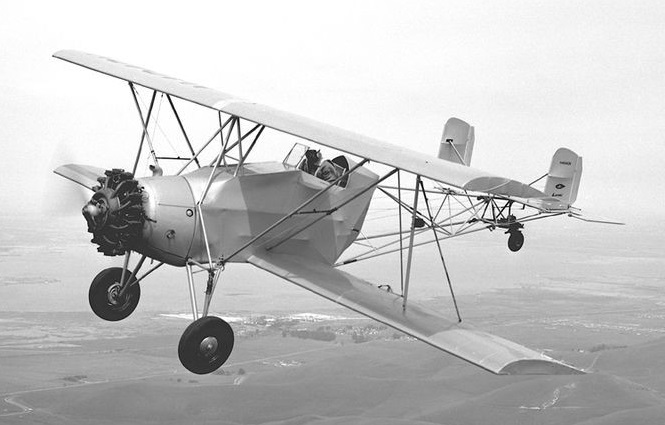
In 1955, Merle Larson designed the D-1 with updated features to improve cropdusting compared to the popular Boeing Stearman in use at the time. The aircraft used only 25 percent of the number of parts as a Stearman.
The biplane featured a steel tube fuselage, and aluminum covered wings. The fuselage was fabric covered only to behind the cockpit, leaving the rest of the tail structure exposed, preventing dust buildup in the tail. The aircraft had twin rudders mounted outboard of the spray trail. Each of these were all-moving with anti-servo tabs. Standard automotive wheels and tires were employed to reduce cost as low-cost World War II surplus was becoming too old, and new aviation tires cost nearly five times as much.
Powerplant: 1 × Lycoming R-680, 225 hp (168 kW)
or 220 hp (164 kW) Continental R-670
or 245 hp (183 kW) Jacobs R-755
Propeller: 2-blade McCauley ground-adjustable propeller
Upper wingspan: 30 ft 0 in (9.14 m)
Lower wingspan: 33 ft 0 in (10.06 m)
Wing area: 315 sq ft (29.3 m2)
Aspect ratio: 6
Airfoil: Göttingen 365
Length: 25 ft (7.6 m)
Height: 11 ft 00 in (3.35 m)
Empty weight: 1,700 lb (771 kg)
Gross weight: 3,600 lb (1,633 kg)
Fuel capacity: 30 US gal (25 imp gal; 114 l) fuel ; 4.4 US gal (3.7 imp gal; 16.7 l)
Cruise speed: 90 mph (140 km/h, 78 kn) at sea level
Landing speed: 40 mph (35 kn; 64 km/h)
Stall speed: 40 mph (64 km/h, 35 kn)
Rate of climb: 1,400 ft/min (7.1 m/s) at sea level, empty
Wing loading: 11.4 lb/sq ft (56 kg/m2)
Take-off run, empty, nil wind: <200 ft (61 m)
Take-off run, 1,000 lb (454 kg) payload, nil wind: 600 ft (183 m)
Crew: 1
Lamson L.101 Air Tractor
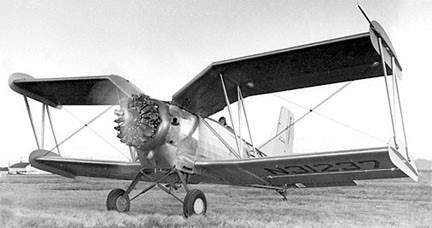
A 1953 agricultural aircraft designed by R T Lamson. Two crop sprayers and seeders with a predominant upper gull-wing were built, registered N31237 and N31238. On the former, wing roots served as fuel tanks, the latter had a metal-covered fuselage with internal fuel tank. Wing units were interchangeable on both prototypes, as were all six tail units.
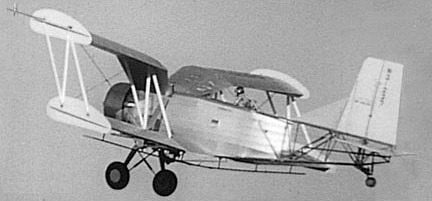
The first flight was on 10 December 1953, piloted by R T Lamson, a former test pilot for Boeing Co.

Production ceased in 1955.
Engine: P&W R-985, 450 hp
Wing span: 33’7″
Length: 26’5″
Height: 10 ft 8 in
Wing area: 350 sq.ft
Empty weight: 3200 lb
Loaded weight: 5600 lb
Useful load: 2400 lb
Cruise speed: 70-90 mph
Stall speed: 35 mph
ROC: 450 fpm
Hopper load: 360 USgal
Price: c.$15,000 (equipped)
Seats: 1
Kingsford Smith KS.3 Cropmaster
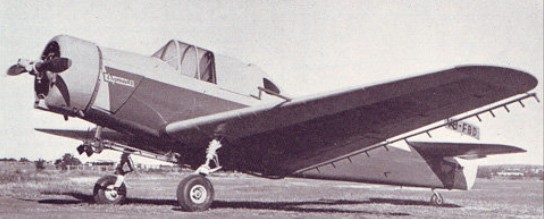
The 1959 Cropmaster was a low-wing monoplane, modified from the CAC Wackett.
Engine: 1 x 170hp Warner Super Scarab
Wing area: 17.6 sq.m / 189.44 sq ft
Cruise speed: 158 km/h / 98 mph
Kingsford Smith PL-7 Tanker / Pellarine PL-7
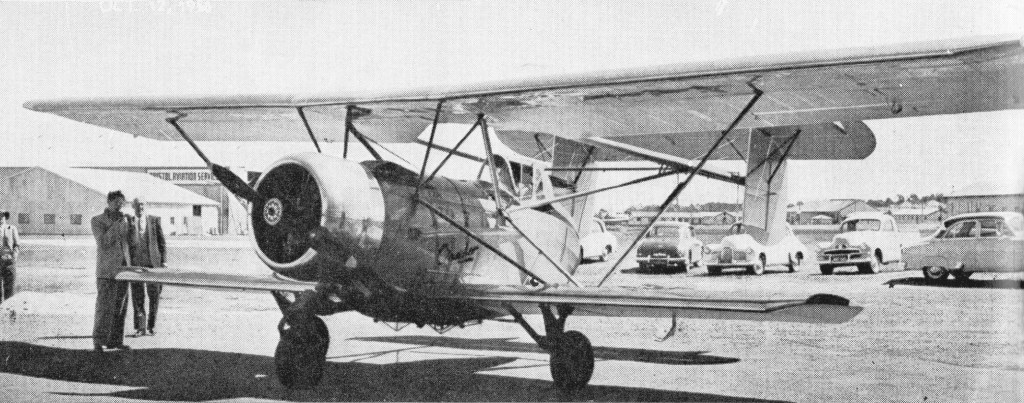
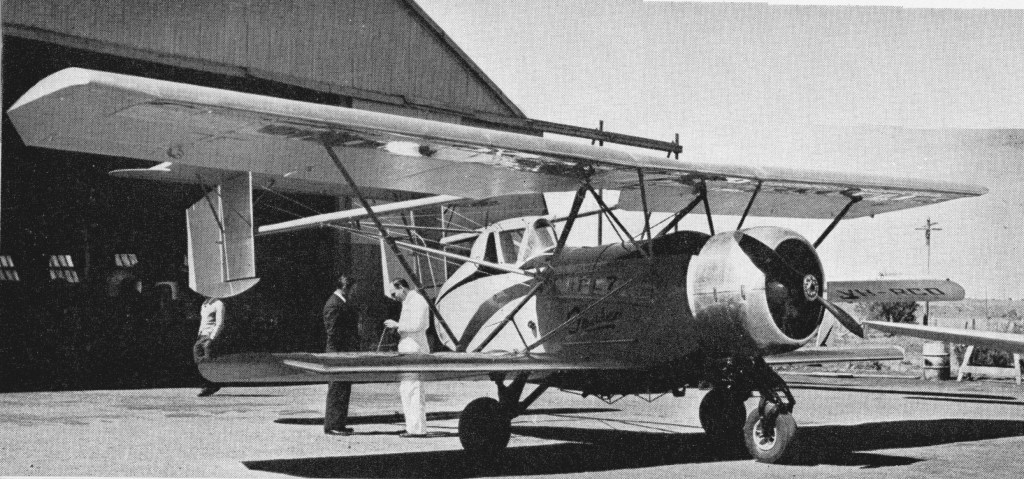
In 1955 Kingsford Smith began design of special agricultural type which materialised as the PL-7 Tanker biplane. Fuselage was mild-steel tank, tail carried on tubular booms, tricycle landing gear. Flew September 1956.
Kensgaila VK-8 Ausra
Design of this two seat agricultural homebuilt was undertaken by Vladas Kensgaila in Lithuania. Panevezys District “Dawn” kolkhoz (Chairman Vilius Pasiukas) decided to pay the costs. Pasiukui, over the years, have not changed, and thousands of bills paid for the materials. Work began in 1987 and the construction of the prototype began in 1989 and later that year the VK-8 appeared at the 5th National Homebuilt Convention held at Riga. At that time it was the largest homebuilt in the Soviet Union and carried the Lithuanian registration LY-21. The designer was hopeful of series production.
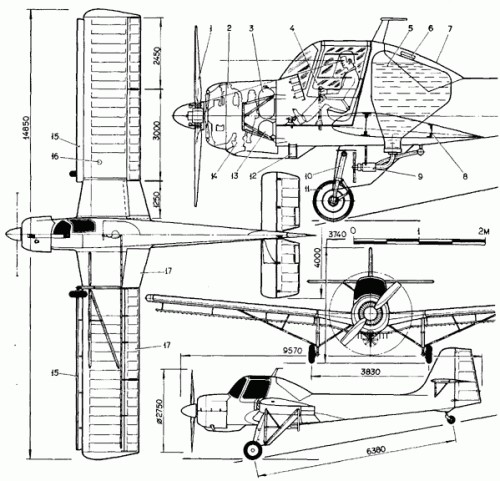
It was an aircraft designed for agricultural, training and transport roles, and conformed to experimental regulations. It was a strut-braced low-wing monoplane, of composite construction. It had three axis control plus flaps, leading-edge slats and electric trim. Spray booms were carried below the wing trailing edges ahead of the ailerons. The undercarriage was not retractable and the main wheels were fitted with trouser fairings and brakes.
It had a high raised cockpit, slightly forward of the wing which gave a good view. An 800 litre container was carried behind the cockpit for 309 kg and the VK-8 could spray a swathe of 30 metres width. The Vedeneyev 360 hp radial engine drove a two bladed variable pitch wooden propeller with reduction gearing. The airscrew diameter was 2.75 m. Powered by a 360 hp power M 14 F engine, either the M-14P or M-14PS could be fitted.
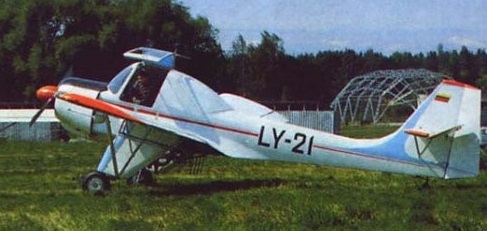
The plane was built in two years. The VK-8 Ausra two-seat agricultural aircraft first flew in May 1989 piloted by Vlad Kensgaila, from Panevezys aviation technical sports club hangar.
Designed as a potential An-2 replacement, only one was built. It fully complied to FAR 23 standards.
Engine: 1 x Vedeneyev M-14P (268kW)
Prop dia: 2.75 m
Wing span: 14.85 m
Wing area: 28.4 sq m
Length: 9.57 m
Height: 3.74 m
Empty weight: 1140 kg
MTOW: 2,200 kgs
Max fuel: 180 litres
Max payload: 1,000 kgs
Maximum speed: 220 km/p
Cruise: 180 km/p
Economic cruising speed: 160 km/p
Stall speed: 70 km/p
Range: 450 km
Endurance: 3 hr 40 min
Take off speed: 60 km / h
Service ceiling: 4,000 m
Rate of climb: 300 m per minute
Take-off run: 60 m
Landing run: 40 m
G Stress: +3.5 & -2.0
Accommodation: 2
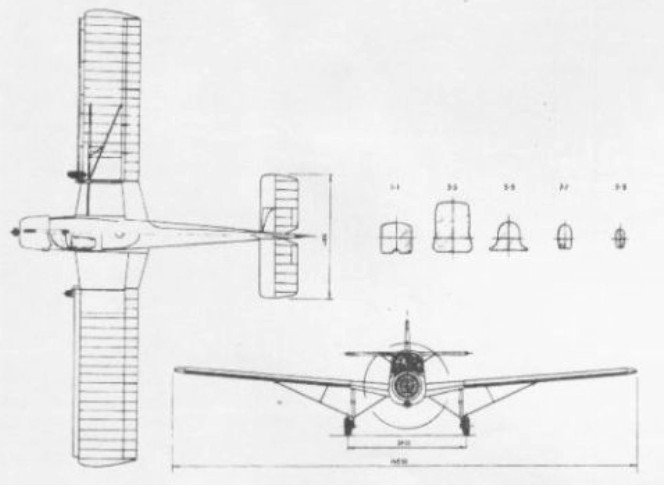
Hollandair HA-001 Libel
One example only of the Hollandair HA-001 Libel (Dragonfly) single-seat agricultural aircraft was built in 1957.
 All Aero