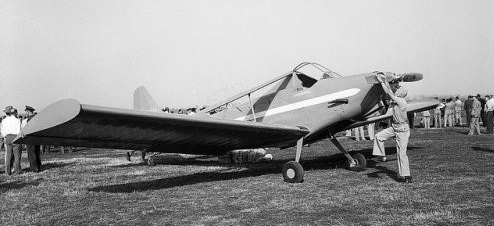
Snow began designing his first aerial application aircraft, the S-1, in 1951 when he was 21 years old.
In August, 1953, the S1 flew for the first time, powered by a 190 hp Lycoming. Unusually for a US ag-plane, the pilot sat between the engine and the hopper, and, unlike later Snow models, the aircraft had wing struts.
The aircraft was successful, enough for Snow to take it to Nicaragua for a season the following year.
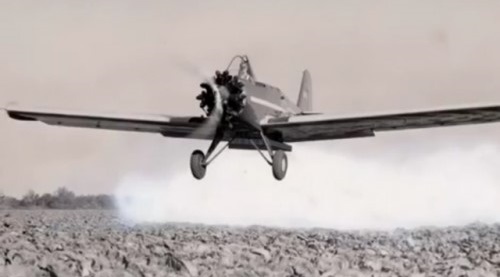
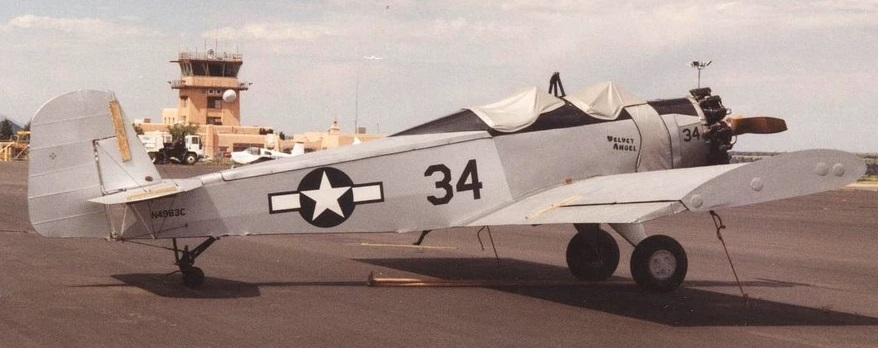
To give it more power, it was fitted with a Continental radial of 220 hp. The radial engined S-1 lost its wing struts.
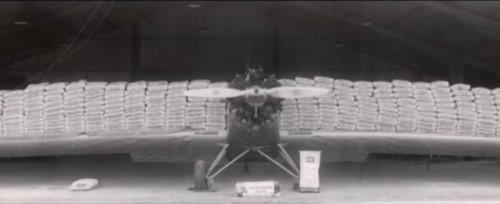
Dam¬aged by a thunderstorm in 1958, this aircraft was destroyed in a warehouse fire a few years later.
That airplane remained in production until 1957, after which Snow introduced the S-2A and S-2B models.
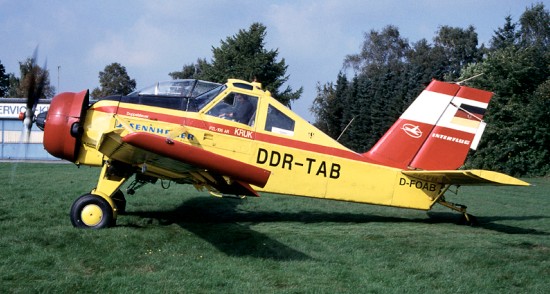
In early 1972 design was initiated for a new agricultural aircraft to replaceme the Z-37 Cmelak. Of braced low-wing monoplane configuration with fixed tailwheel landing gear, a T-tail, and enclosed accommodation for the pilot. First flown in P.Z.L. 106 prototype form on 17 April 1973, then powered by a 298kW Avco Lycoming IO-720 engine, it was followed by five more prototypes, one of which was similarly powered, but four each had a P.Z.L. 3S radial that was the chosen powerplant for production aircraft, the first version being the P.Z.L. 106A Kruk (raven) of which series construction began in 1976. Generally similar to the prototypes, it differed primarily by adopting a conventional tail unit and a larger-capacity chemical hopper, features adopted as standard on all production aircraft.
Subsequent P.Z.L. 106A variants have included the P.Z.L. 106AR which introduced a geared P.Z.L. 3SR engine and a larger-diameter propeller; the P.Z.L. 106AS prototype with a 746kW P.Z.L-built Shvetsov ASz-62IR radial engine and, following satisfactory tests, 60 P.Z.L. 106A aircraft operated overseas by Pezetel were converted to this powerplant; and the initial version of the Turbo-Kruk, the P.Z.L. 106AT, which, powered by a 567kW Pratt & Whitney of Canada PT6A-34AG turboprop engine, flew for the first time on 22 June 1981.
PZL-106
The prototype of an improved version of the P.Z.L. 106A was flown on 15 May 1981. Designated P.Z.L. 106B, this introduced a redesigned wing of increased span and area, and the 106B, 106BR and 106BS production variants superseded the corresponding A-series aircraft during 1982. These were followed by the P.Z.L. 106BT Turbo-Kruk which first flew on 18 September 1985. Powered by a 538kW Czech-built Motorlet M601D turboprop engine, improvements included increased sweep back on the wing, a taller fin and improved chemical payload. Production of all versions of the Kruk had totalled some 250 aircraft by 1990, including 54 exported to East Germany, and 60 plus Kruks used by the Pezetel agricultural air service organisation operating in Egypt. By 1992, however, production was reported to be at a standstill.
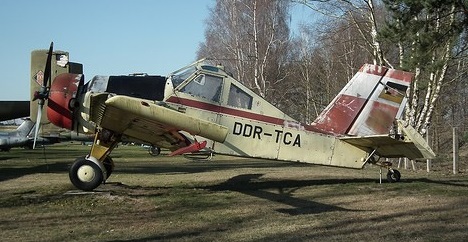
Interflug ordered 53 PZL-106A of which c/n 48040 was converted to a dual-control trainer. After the end of the DDR and elimination of Interflug all Kruks were put out of service.
(D-FOCA) PZL-Okecie 106 A Kruk 07810140 marked DDR-TCA
PZL 106 Kruk Engine: 584 hp Length: 29.856 ft / 9.1 m Height: 10.892 ft / 3.32 m Wingspan: 48.556 ft / 14.8 m Max. speed: 76 kts / 140 kph Service ceiling: 15092 ft / 4600 m Crew: 1
PZL 106B Engine: 1 x PZL 3S radial, 441kW / 600 hp Max take-off weight: 3000 kg / 6614 lb Loaded weight: 1670 kg / 3682 lb Max. speed: 137 km/h / 85 mph Ceiling: 4600 m / 15100 ft Range: 1100 km / 684 miles
PZL 106 BT Turbo Kruk Engine: M 601 D, 537 shp Length: 33.465 ft / 10.2 m Height: 12.467 ft / 3.8 m Wingspan: 49.213 ft / 15.0 m Wing area: 341.219 sq.ft / 31.7 sq.m Max take off weight: 7717.5 lb / 3500.0 kg Weight empty: 3704.4 lb / 1680.0 kg Max. weight carried: 4013.1 lb / 1820.0 kg Max. speed: 135 kt / 250 km/h Landing speed: 49 kt / 90 km/h Cruising speed: 92 kt / 170 km/h Initial climb rate: 1181.1 ft/min / 6.0 m/s Wing loading: 22.55 lb/sq.ft / 110.0 kg/sq.m Range: 486 nm / 900 km Crew: 1
In 1985 construction began of five airframes of an improved M-24 Dromader Super, one intended as a static test specimen, two as flying prototypes with the 746kW ASz-621R engine, and another two with the 860kW P.Z.L. K9-AA engine. The first of these flew on 14 July 1987 and all were flying by November 1988.
The Super was fitted with longer wings, from 17.7 metres on the M-18 to 19.9 metres on the M-24. The fuselage was also stretched from 9.5 metres to 10.8 metres, in¬cluding a larger hopper.
Of the five built, one as a test airframe, with the remaining four flown, however, none were sold and all were with¬drawn from use by 1998 and stored engineless.
However, no production of the type was launched. The M-24T turboprop version, fitted with an 875kW PT6A engine in an extended nose, was planned, but only existed in mock-up form.
WSK-Mielec M 24 Dromader Super Cropduster, Poland, 1987 Length : 35.433 ft / 10.8 m Height: 12.467 ft / 3.8 m Wingspan : 65.289 ft / 19.9 m Wing area : 484.38 sqft / 45.0 sq.m Max take off weight : 11025.0 lb / 5000.0 kg Weight empty : 6328.4 lb / 2870.0 kg Max. weight carried : 4696.7 lb / 2130.0 kg Max. speed : 119 kts / 220 km/h Landing speed : 59 kts / 110 km/h Cruising speed : 103 kts / 190 km/h Initial climb rate : 590.55 ft/min / 3.00 m/s Service ceiling : 13123 ft / 4000 m Wing load : 22.76 lb/sq.ft / 111.0 kg/sq.m Range : 972 nm / 1800 km Engine : PZL Kalisz 9 AA, 871 hp Crew : 1-2
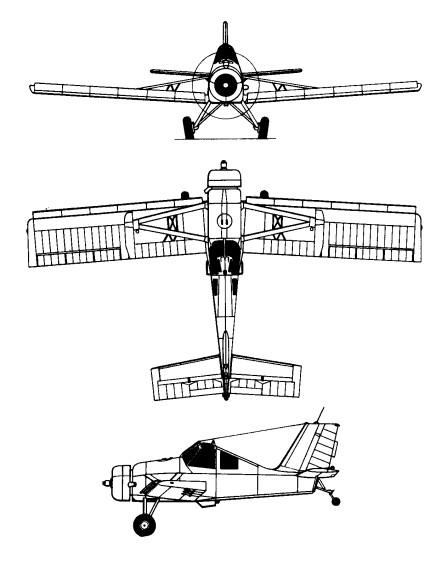
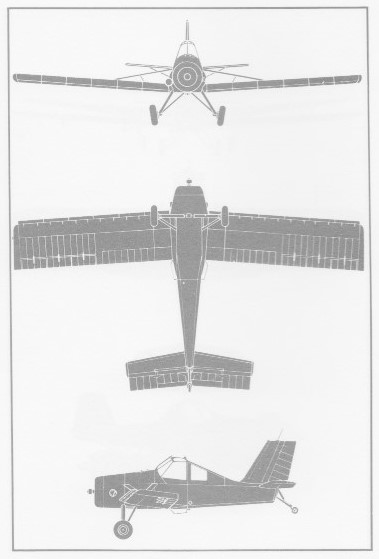
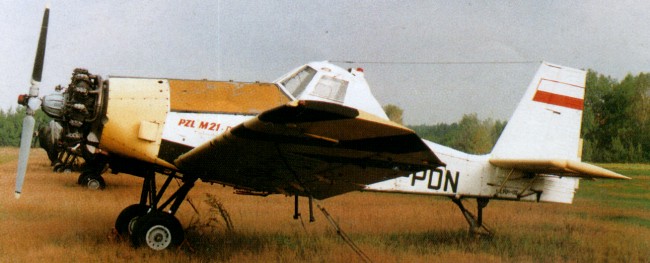
Two prototypes of the scaled-down reduced-capacity M-21 Dromader Mini were flown, the first, 5P-PDM, powered by a 447kW P.Z.L.-3S engine on 18 June 1982 followed by the second, fitted with a geared PZL-3SR 599 hp version. The aircraft had no centre wing section and the span was reduced to 14.51 metres and the length to 9.48 metres.
Although the type was provisionally certificated, no production has followed. Both examples of the M-21 were withdrawn in June 1990.
The even smaller Dromader Mikro, proposed in 1982, did not proceed further.
Engine: A PZL-35R radial, 599 hp Wing span: 14.51m Length: 9.48m
The M-18 was designed in co-operation with Rockwell International in the USA to FAR Part 23 standards. It uses several components of the then Rockwell S2R Thrush, including the outer wing panels. The cockpit is a sealed unit and has a similar layout to the Snow S2D-600. With a requirement for a crew seat, the rear canopy was later redesigned with a hatch on the port side for entry to a rear facing seat. The earlier M-18 models that were converted and new production aircraft were designated M-18A.
Described as a low wing agricultural mono¬plane with fixed landing gear, the unswept cantilever wings are of constant chord, with 2o 30’ dihedral on the centre section and 6o on the outer panels. The wing sections are NACA4416 at the root and NACM412 at the tip. The aircraftis fitted with a steel-capped wing spar with all-metal, two section, trailing-edge flaps, actuated hydraulically. Metal slotted ailerons and metal wing tips complete the 58’ wing span and 430.56 sq ft wing area.
The fuselage is of all-metal tubular construc¬tion and incorporates an all-metal tailplane. It stretches 31 feet long and in a flying attitude stands at 15’01”. The hopper is made from glass fibre and has a capacity of 2,500 litres, or 660 US gallons. The aircraft’s empty weight is 5,445 lbs with a maximum take-off weight of 11,684 lbs. It has a maximum speed of 138 knots and a stalling speed, with flaps extended, of 59 knots. The pilot being accommodated in a cockpit stressed to survive an impact of 40g. Special materials and treatment limit airframe corrosion to a minimum.
PZL-Mielec built three prototype aircraft powered by the uprated P.Z.L. ASz-621R engine. The first, for testing, was non-flying, but the second aircraft, SP-PBW, and the third aircraft, SP-PBZ, first flew on 27 August 1976 and 2 October 1976 respectively. From April 1978, a batch of ten pre-production aircraft were built, of which two were non-flying test aircraft. Five of them used for operational trials, in Eastern Europe and and two were used in trials in Egypt during the summer of 1978. Another was test flown (on 11 November 1978) as a firefighter to test the concept. The Polish type certificate was issued on 27 September 1978 and two aircraft from this batch were sold to Yugoslavia the following year.
Deliveries of the second batch of five air¬craft began in 1980, with four going to Canada. Canadian certification of the fire-fighting version was awarded on 10 March 1980. Another batch of ten aircraft was built in 1980, six of which went to Canada.
Production of the M-18 began following the receipt of Polish certification on 27 September 1978, but came to an end in 1984, shortly after the M-18A two-seat version was certificated by the Polish authorities. A dedicated two-seat agricultural trainer, designated the M-18AS, was constructed with a smaller hopper to allow an instructor to sit behind the pilot, and flew for the first time on 21 March 1988. Five were built by 1992.
In common with most East European air¬craft, Dromaders are built in batches. This is evident in the constructor number sequences. In the Soviet Union series of numbers are used, however, PZL-Mielec used an alphabetical and numerical sequence. The prototype Dromaders used 1ZP and the production Dromader 1ZO. Mielec has produced a two-seat trainer Dromader, the M-18BS, first flying in November 1997.
The fifth batch to come out of Poland saw the first aircraft, 1ZO05-01, being delivered to the USA as N42255. Of the fifteen aircraft built, nine were sold to the United States, three to Hungary and two to Cuba. The fifteenth airframe was used for spares. In 1981 the Polish com¬pany had two new customers. Turkey purchased four aircraft and South Africa two. Hungary, Cuba and the USA were the main buyers until 1982, when Bulgaria purchased four aircraft and followed with another fourteen by the end of that year. From December 1983, the Greek Air Force took delivery of eighteen aircraft for use as fire bombers. As mentioned above, Cuba took delivery of their first M-18 in January 1981 and by October1988, forty-six aircraft had been reg¬istered in that country.
The nine-cylinder, supercharged radial engine, the AS-621z, which drives the four-blade PZL-Warszawa SP.00 propeller, has been the only power plant supplied by the factory. Operators in the United States have taken advantage of this large airframe with some replacing the PZL radial with turbine power. Turbine Conversion of Nunica, MI, converted some M-18/M-18A aircraft by installing P&WPT-6A-45 and -65 series engines and 800 US gallon hoppers. Delta Turbines have also converted a number of Dromaders to turbine power, fitting a TPF-33-10UA. One of the most unusual conversion was the installation of a 1000 shp Lycoming T53-L-3 from a Grumman OV-1 Mowhawk.
By the end of 1997, six hundred and eighty-three aircraft had been registered and more air¬craft were awaiting assembly.
The M-18B Dromader is certified under European Aviation Safety Agency EASA A.056.
PZL Mielec M-18a Engine: 1 x P.Z.L. Kalisz ASz-62IR radial, 746kW Max take-off weight: 4700 kg / 10362 lb Empty weight: 2470 kg / 5445 lb Wingspan: 17.7 m / 58 ft 1 in Length: 9.47 m / 31 ft 1 in Height: 3.7 m / 12 ft 2 in Wing area: 40.0 sq.m / 430.56 sq ft Max. speed: 237 km/h / 147 mph Cruise speed: 185 km/h / 115 mph Range: 520 km / 323 miles
M18A Engine: ASz-621RM, 967 hp Prop: AW-2-30, 4 blade Wing span: 58 ft Wing area: 430.56 sq.ft Length: 31 ft Hopper cap: 2500 lt (660 USG) Empty wt: 5445 lb MTOW: 11,684 lb Max speed: 138 kts Stall: 59 kts


 All Aero