Fabrica de Aviones Anahuac SA, Mexico, was established in 1966 to develop agricultural aircraft suited to national requirements. The rototype Tauro 300 first flew on 3 December 1968. The improved Tauro 350 with a more powerful radial engine (350 hp) followed into production from 1977.
Agricultural
American Airmotive Corp NA-75
Agricultural aircraft, a development of Stearman Model 75 (Boeing Kaydet). Alternatively offered new high-lift wings and special modification kits. In eight years more than 200 Stearmans were fitted with new wings, permitting loads of over 2,000 Ib (907 kg).
American Airmotive Corp
In the late 1950s built in quantity NA-75 agricultural aircraft, a development of Stearman Model 75 (Boeing Kaydet). Alternatively offered new high-lift wings and special modification kits. In eight years more than 200 Stearmans were fitted with new wings, permitting loads of over 2,000 Ib (907 kg).
1968: American Airmotive Corp
pres: John D MacArthur
Miami FL.
USA
Air Tractor AT-802 / OA-1K Skyraider II
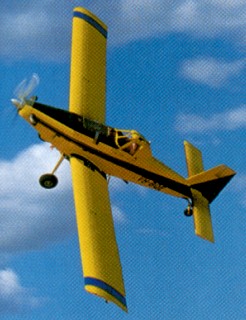
The Air Tractor AT-802 was designed primarily for the air tanker role. It was the first single engined fire fighter (as the AT-802F) to be designed from the ground up and with a similar hopper capacity to the twin engined Grumman S2F’s used by the Californian Division of Forestry.
Air Tractor AT-802 / OA-1K Skyraider II Article
The AT-802 is, in appearance, an enlarged AT-503. The length is 3l feet and the wingspan is 58 feet. The 800 gallon hopper also incorporates computer controlled hopper doors to drop the load of retardant as required. The first dual cockpit AT-802, N802LS, was flown on 30 October 1990, and was fitted with a P&W PT6A-67R of 1424 hp. By the time the aircraft was ready for production, it was certified for the installation of a PT6A-4SR or -6SB, both of 1173 hp. A single seat version, the AT-802A, N 1558W, flew on 6 July 1992, fitted with a -6SB turbine. The empty weight for the single seater is 6200 lbs and they both have an operating weight of 16000 lbs.
The introduction of Hoerner wingtips increased the span to 59.2 ft and a 2 in extencion of the engine mount was incorporated to ease the C of G limit on the two seaters.
Croatia ordered three AT-802A Fire Boss amphibians, the first delivered to Zadar-Zemunik in March 2007.

The U.S. Air Force’s newest light attack and reconnaissance aircraft, the OA-1K Skyraider II, was undergoing developmental testing in July 2025 at Eglin Air Force Base as part of its path toward operational service within Air Force Special Operations Command (AFSOC).
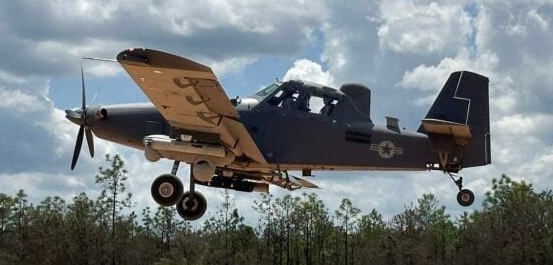
According to the Air Force, the aircraft is being evaluated by the 96th Test Wing in partnership with U.S. Special Operations Command to verify its airworthiness and validate manufacturer L3Harris’ performance claims. The effort also includes mission-effectiveness assessments to determine how well the aircraft performs in austere and remote environments, where AFSOC personnel often operate.
The OA-1K Skyraider II is designed as a cost-effective, crewed aircraft capable of supporting special operations forces in geographically isolated regions. It is equipped for mission sets that include close air support, precision strike, and armed intelligence, surveillance, and reconnaissance (ISR). The platform is based on the rugged AT-802 airframe and has been adapted for military use with integrated sensors and weapons systems.
One of the Skyraider II’s most distinctive features is its tailwheel landing gear—a configuration not seen on an active-duty U.S. Air Force aircraft in over 50 years. This unusual design element required the test team to develop new evaluation methods tailored to the aircraft’s landing characteristics.
“There was quite a bit that went into this, from making sure we were compliant on the regulatory side, to ensuring we had the proper operations support for the Skyraider II,” said Maj. Stephen Wakefield of the 96th Test Wing.
Due to the unique configuration, Air Force pilots received additional training using the Skyraider II’s civilian counterpart, the AT-802, to gain proficiency with tailwheel aircraft handling. The Air Force says this type of training was essential to safely operate the aircraft during its early evaluation phase.
Maj. Jacob Marsh, a test pilot with the 96th TW, said flying the OA-1K has been both demanding and rewarding. “Flying the OA-1K has been a rewarding experience and certainly something that has required me to bring my skills to work every day,” Marsh said. “The fun of flying it is just a perk of the job.”
Marsh, who previously flew un-augmented UH-1N helicopters at the United States Naval Test Pilot School, noted the coordination required in the OA-1K shares similarities with rotary-wing operations, particularly at lower airspeeds.
The test campaign has so far included evaluations of human factors, handling qualities, and austere landing capabilities. Future trials will involve weapons release and sensor performance tests.
The manufacturer, L3Harris, states the aircraft can fly at 245 miles per hour at 10,000 feet and has a range of 1,500 miles at an altitude of 8,000 feet.
The Skyraider II is being positioned as a rugged, flexible platform that can operate from unprepared runways and support combat operations where more complex and expensive aircraft may be unavailable or unsustainable. This matches AFSOC’s need for adaptable aircraft in environments where logistics are limited and risk is high.
While the Skyraider II is not intended to replace high-performance fighters or dedicated ISR platforms, it offers commanders a versatile tool to support missions ranging from overwatch and target identification to rapid strike against time-sensitive threats—all while operating from forward locations with minimal infrastructure.
AT-802
Engine: PT6A-67R, 1425 hp
Capacity: 800 USG
Seats: 2
Empty weight: 6200 lb
Operating weight: 16000 lb
Length: 3l feet
Wingspan: 58 feet
Engine: PT6A-67AG, 1414 shp
AT-802A
Engine: PT6A -6SB, 1173 hp
Operating weight: 16000 lb
AT-802AF
Engine: PT6A-67AF
Air Tractor AT-602
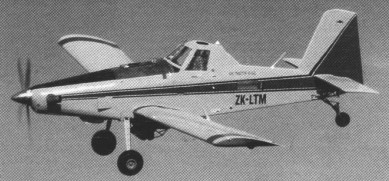
The first Air Tractor AT-602 aircraft had its maiden flight in 1995, deliveries beginning with N6084K in January 1996. The 602 shares many of the components of the larger AT-802A (including the fin and rudder).
AT-602
Engine: PT6A-60AG or -45R, 1050 shp
Prop: five-blade
Wing span: 56 ft
Length: 32 ft 6 in
Wing area: 336 sq.ft
Empty weight: 5,600 lb
Operating weight: 12,500 lb
Hopper cap: 630 US gallon
Air Tractor AT-501 / AT-502 / AT-503
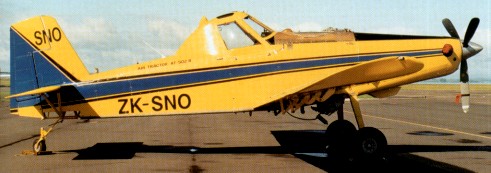
On the drawing boards at the same time as the 401/402 develop¬ment, was a two seat, long range sprayer powered with a P&W PT6A-45R of 1100 hp, and fitted with a five bladed prop for quietness. The airframe was lengthened by fourteen inches and a 500 gallon hopper installed. The wingspan was 48 feet and, as the model AT-503, N7309X first flew on 25 April 1986. The machine was intended for use in the US State Department’s narcotics eradication programme. However the aircraft went to Spain in 1989 for use in the fire bombing and agricultural role.
Not far behind the AT-503, was the AT-501 and AT-502, both with a wingspan of 50 feet. The AT-501, was powered by a geared P&W 600 hp R-1340-53H1-G, driving a three blade propeller. The variant was thought to be an option for an increased hopper load but with the cheaper piston engine. The first example was first flown in January 1987 as N7314C, but only nine were subsequently sold, and the development was set aside for production of the AT-502. The first AT-502 Turbo, N4531K, flying in April 1987, powered by a 680shp P&W PT6 engine.
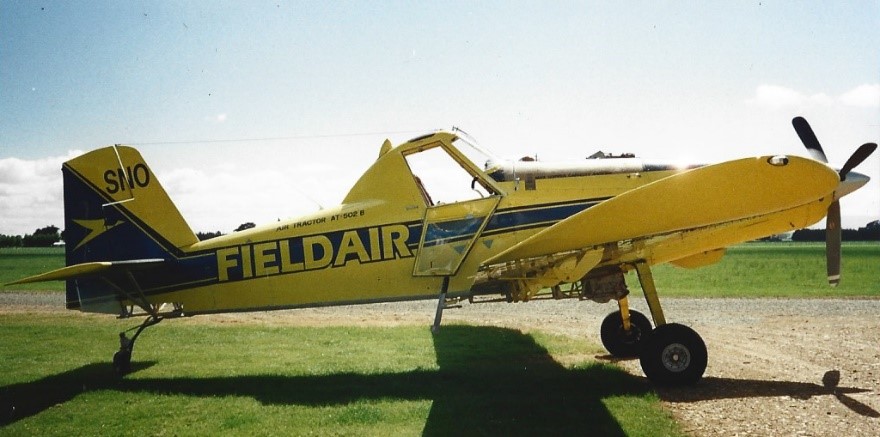
The Air Tractor AT-502, N7314D serial –0003, was first flown in April 1987. N7391L was first to enter service in February 1988. The aircraft were single seaters on quite long undercarriage legs. The same fuselage as the AT-501 from the firewall back, provision had to be made for the 11 foot diameter of the piston engine propeller. The engine for the AT-502 is the PT6A-15AG of 680HP, the same as the AT-402. The airframe has also been certified for installation of the PT6A-34AG of 750 hp, however very few examples have been fitted at the factory. The weights for the AT-502 are 4200 lbs empty and 9200 lbs operating.
The AT-502A model was first flown in January 1992 and is powered by a PT6A-4S of 1100 HP. To compensate the big engine, it has the larger fin and rudder of the AT-802. The operating weight is 10400 lbs.
N1558P was first flown in July 1992, the first AT-502B. Introduced in November 1993, it is the standard 502 with Hoerner wing tips extending the wing span by two more feet. The operating weight increases from 9200 to 9700 lbs. The engine is still the PT6A-15AG, but can easily fitted with -15, -27, -28, or -34AG variants as supplied by the customer. Up until January 1995, two hundred and seventy-six AT-500 series had been produced.
The AT-503A was a two seat trainer which didn’t fly until September 1990 (N503CP). The AT-503A uses many fuselage parts of the AT¬502 and the same 50 foot wing but has the PT6A-34AG engine fitted. The rear cockpit has the same dimensions as an AT-401 and is set up exactly the same as the front cockpit, including hopper controls.
AT-501
1984
Engine: 600hp P&W R-1340
AT-502
Engine: PT6A-15AG, 680 shp
Wingspan: 50 ft
Hopper Cap: 500 USG
Length: 32.5 ft
Empty weight: 4200 lb
Operating weight: 9200 lb
AT-502A
Engine: PT6A-45R, 1100 hp @ 1700 rpm
Propeller: Hartzell 3 blade, reversing
Wing span: 52.0 ft
Wing area: 312 sq. ft.
Operating weight: 10400 lb
Landing weight: 8,000 lb
Empty weight: 4,570 lb
Useful Load: 5,910 lb
Hopper capacity: 500 U.S. gallons
Fuel capacity: 216 U.S. gallons
Never exceed speed: 176 mph
AT-502B
Engine: PT6A-34AG, 750 shp
Wingspan: 52 ft
Wing area: 312 sq.ft
Length: 32 ft 6 in
MAUW: 9700 lb
Hopper Cap: 500 USG
AT-503
Engine: 1100shp P&W PT6-45R
Seats: 2
AT-503A
Engine: PT6A-15AG, 680 shp
Wingspan: 50 ft
Seats: 2
Air Tractor AT-400 / AT-401 / AT-402

The first turbine version, the AT-302 aircraft was fitted with a 400 gallon hopper and a PT6A-15AG turbine and first flown in December 1979 as the AT-400. Eighty-six of the AT-400 were produced until 1987. These aircraft had a 45-ft wingspan, fitted with steel spar caps and reinforced leading edges. The fuselage initially remained the same. A 400 gallon hopper became the standard, and all metal elevators and rudder replaced the fabric covering. N8888S first flew in December 1986 and deliveries began the following June.
The redesigned AT-301 wing received a redesigned fuselage and 600 hp to produce the AT-401 (R-1340).
The AT-401A was also offered, powered by the Polish PZL R3S of 592 hp and first flew in October 1989.
The turbine version, the AT-402, first flew in December 1988 as N1005V, powered by a PT6A-15AG of 680 hp, and the wingspan was increased to 49 ft, and then to 51 ft, for the later B models (incorporating Hoerner wingtips). Deliveries of the AT-402 commencing in March 1989. The operating weight for both the 401/402 models was 7800 lbs.
A reduced horsepower version of the 402B, first flown in January 1990- N10189 – was introduced in June 1997, designated AT-402A, fitted with the smaller PT6A-20 of 550 hp and with a 320 gallon hopper.
Eighty-six AT-400 and AT-400A aircraft were built between 1979 and 1987.
AT-400
Engine: PT6A-15AG, 680 shp
Hopper cap: 400 USG
Max Op weight: 7800 lb
AT-400A
Engine: PT6A-15AG, 680 shp
Wingspan: 45 ft
AT-401
1986
Engine: R-1340, 600 hp
Wingspan: 49 ft
MAUW: 7860 lb
Hopper cap: 400 USG
AT-401A
1991
Engine: PZL-3S
AT-401B
Engine: R-1340, 600 hp
Wingspan: 51 ft
AT-402
Engine: PT6A-15AG, 500 shp
Wingspan: 49 ft
AT-402A
Engine: Pratt & Whitney PT6A-11AG, 550 hp
Wing span: 49 ft
Length: 29 ft 6 in
Empty wt: 3739 lb
Operating wt: 7860 lb
AT-402B
Engine: PT6A-15AG, 680 shp
Wingspan: 51 ft 6 in
Length: 29 ft 6 in
Air Tractor AT-300 / AT-301 / AT-302

Leland Snow moved to Wichita Falls, Texas, and started design work on a new cropduster, derived from the S2B he had designed and built in the fifties. In 1972 he obtained a small business loan, rented a building back in Olney and started to build jigs and tooling for what was to become the Air Tractor AT-300 – a conventional layout crop-duster powered by a Pratt and Whitney R-985-AN1 of 450hp. A 320 US gallon hopper was installed in a fuselage made of tube construction and included a sealed enclosed cockpit. The aircraft had a conventional tail but with fabric covered control surfaces. The vertical portion incorporated a dorsal fin giving the tail a round shape, unlike later aircraft. The cantilever 45 foot span wing is of all metal construction and incorporates large Fowler type trailing edge flaps. The prototype took seven months to build and Snow first flew the aircraft, N44200, in Septertiber 1973. FAA Certification took fifty-nine days and the first production Air Tractor was sold in March 1974. Seven more were delivered that year including the first Air Tractor AT-301, N4327S, the same aircraft but fitted with a P&W R-1340-AN1 of 600 hp and with an operating weight of 7300 lbs. Twenty aircraft were built during 1975 and, at the end of the year, a new hangar was erected to house the expanding company.
In June 1977, N44415, a turbine version of the AT-301, was flown. Known as the AT-302, it was powered by the then new Avco Lycoming LTP101-A1A of 600 hp. Fourteen were built, followed by the AT-302A in 1980 which had a 400 gallon hopper installed. With an operating weight of 7700 lbs, the aircraft had a wider hopper box and was designed for dry fertilisers.
By the end of 1979, some 229 AT-301 had been built. In 1986 the AT-301 design was improved, including redesigning the wing. Before being superseded by the 401 in 1988, 863 AT-301s were built.
AT-300
Engine: Pratt and Whitney R-985-AN1, 450 hp
Wing span: 45 ft
MAUW: 7300 lb
Hopper cap: 300 USG
AT-301
Engine: Pratt & Whitney R-1340, 600 hp
AT-302
Engine: LTP-101-A1A, 600 hp
Hopper cap: 320 USG
AT-302A
Engine: LTP-101-A1A, 600 hp
Hopper cap: 400 USG
Air Tractor AT-250
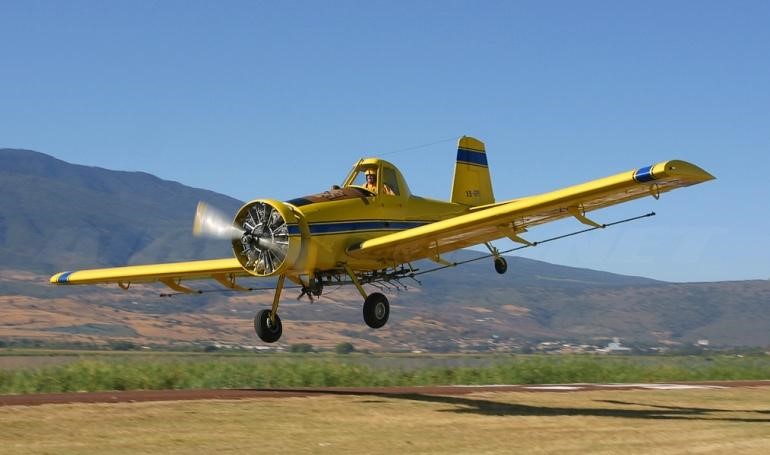
In July 1982, a smaller aircraft was flown, N3163L, the AT-250 with a 260 gallon hopper. The wingspan had been reduced to 41 ft 6 in and it was powered by the P&W R-985, the 450 hp radial used on the AT-300. Only one was built and it was sold to a US operator in March 1992.
Engine: P&W R-985, 450 hp
Wingspan: 41 ft 6 in / 12.5 m
Length: 8.2 m
Height: 2.6 m
MTOW: 4000 kg
Fuel Capacity: 817 lt
Hopper cap: 260 USG
Max Speed: 135 kt
Optimum Speed: 124 kt
Max Climb Rate: 1100 ft/min
Max Range: 550 Nm
Absolute Ceiling: 15000 ft
Optimum Ceiling: 12000 ft
Take Off Distance: 400 m
Seats: 1
Air Tractor
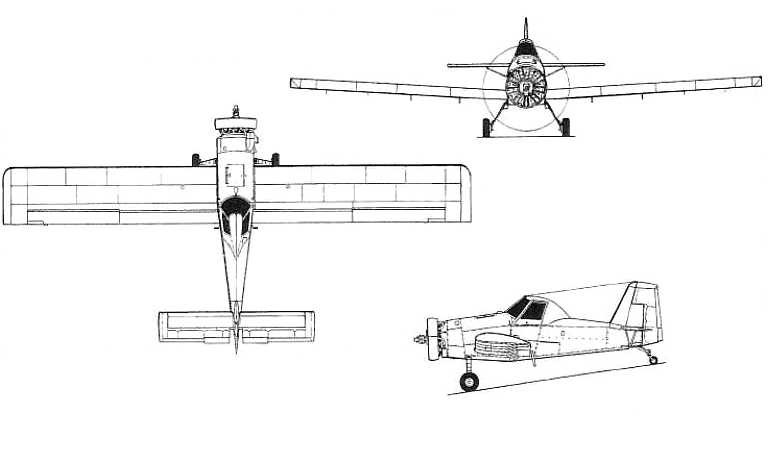
Founded 1958 in Wichita Falls, Texas, Leland Snow became Air Tractor president. Derived from the S2B he had designed and built in the fifties, Snow started design work on a new cropduster. In 1972 he obtained a small business loan, rented a building back in Olney and started to build jigs and tooling for what was to become the Air Tractor AT-300 – a conventional layout crop-duster powered by a Pratt and Whitney R-985-AN1 of 450hp.
Has built more than 1,650 Air Tractors, with radial pistonengined AT-401B (can be converted to turboprop power), turboprop-powered AT-402A (available since 1997), higher-powered AT-402B with 680 shp engine, heavier and 1,100 shp turboprop-engined AT-502A, 680 shp AT- 502B, AT-503A two-seater for agricultural work and training, AT-602 with 1,050 shp engine and the second largest Air Tractor model, AT-802 two-seater and the largest of all Air Tractors suited to agricultural and firefighting roles (first flown 1990), and AT-802 single-seat verson, available for purchase.
 All Aero