PAM 100B

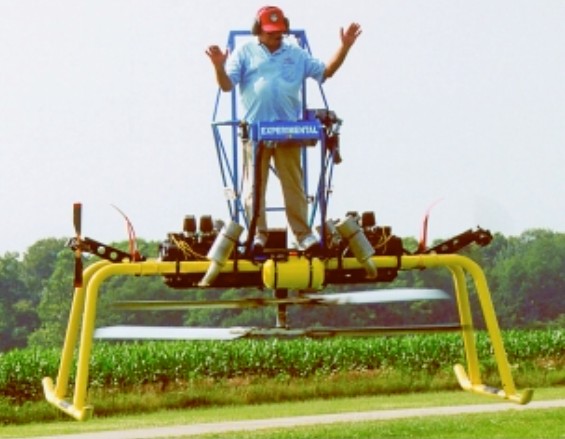
PAM 100B Single place, stand-on Individual Lifting Vehicle (ILV) with two composite 24″ diameter props for directional control. Simple tubular helicopter-type high strength airframe made of aircraft grade aluminum. Controls consist of a throttle and a fly-by-wire joy stick for directional control. There is no collective control. Kit price of $50,500 includes everything but shipping in 2009. Plans were also available.

Engines: (2) Hirth F-30 100 hp
Rotor Blades: Four extruded aluminum
Blade diameter: 9.17 ft
Chord: 8″ chord

Min Speed Hover
Cruise 45 mph
Top Speed 60 mph
Empty Weight 640 lbs
Useful Load 360 lbs
Gross Weight 1,000 lbs
Skid Width 10 ft
Height 9 ft
Length 8 ft

PAL-V One

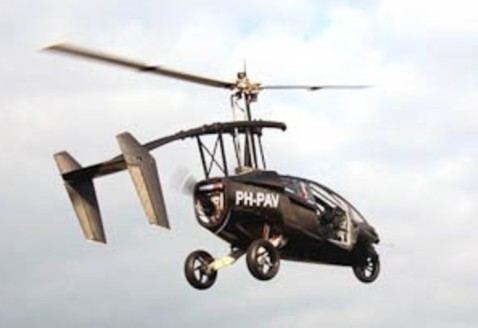
The PAL-V (Personal Air and Land Vehicle) in flight is an autogyro or gyrocopter designed by C. Klok (exterior design), with a pusher propeller at the rear of the fuselage providing forward thrust and a free-spinning rotor providing lift. Directional stability is provided by twin boom-mounted tailfins. It has a tricycle undercarriage with relatively large wheels.

On the ground, the propeller and rotor are stopped and power is diverted to the wheels, allowing it to travel as a three-wheeled car. Unusually, it leans into turns like a motorcycle, a solution pioneered by the Carver vehicle, also produced by a Dutch company. However, the PAL-V does not tilt as a Carver but like the BMW “Simple Concept” from 2009. The PAL-V ONE transforms into a gyrocopter within minutes as its rotor unfolds and its tail extends. Converting the PAL-V ONE from airplane to automobile takes about 10 minutes. The propeller folds itself automatically into the driving position. Pushing a button then lowers the rotor mast into the horizontal position. The same motion lowers the tail. The outer blades are folded over the inner blades via hinge mechanisms. And then driver/pilot has to push the tail into its driving position and secure the rotor blades.

The PAL-V One has two seats and a 160 kW flight certified gasoline engine, giving it a top speed of 180 km/h (112 mph) on land and in air, and a Maximum Takeoff Weight of 910 kg.

A prototype model was first test flown in March 2012 and the company was seeking funds to develop the type for production. Estimated unit price is around $300,000 in 2014.

Engine: 160 kW
Dimensions Road (LxWxH): 4.0 x 1.6 x 1.6 m
Empty weight: 1,499 lb (680 kg)
Gross weight: 2,006 lb (910 kg)
Maximum speed: 97 kn (112 mph; 180 km/h)
Minimum control speed: 27 kn (31 mph; 50 km/h)
Range inflight: 220-315 mile
Range on land: 750 mile
Takeoff dist: 165m (540 ft)
Landing roll: 30 m (100 ft)
Capacity: 2
PAL-V Europe NV

PAL-V Europe NV started in 2001 to design a roadable aircraft. It evaluated many potential technologies and created numerous concepts in cooperation with research institutes and universities. The most important breakthrough was the maturing of the DVC tilting technology in 2005. This brought into reach the design of a real flying car instead of a roadable aircraft. This technology allowed for safe driving without compromises while having a high centre of gravity and a narrow aerodynamic shape necessary for flying. A “flying car” concept.

Having designed and patented their findings and concepts, PAL-V Europe NV hired a team of engineers with automotive, aviation and motorcycle backgrounds and started the engineering of its proof-of-concept prototypes. Partners were selected and contracted for several system elements. This led to the first flight of PAL-V’s proof-of-concept prototype in 2012.

Since then the company entered the next phase of development, engineering the first commercial version, optimizing the design, and starting up production. This was to result in the market launch of the first model: the PAL-V ONE.

Palomino Aircraft / San Antonio Aviation Palomino

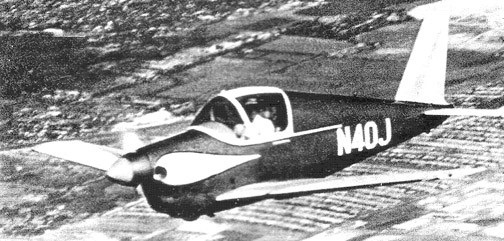
The original 1962 Palomino was a single plane low wing cabin monoplane powred by a 125 hp Lycoming O-209 (registered N40J). Circa 1965, the aircraft was rebuilt as a two place with a 150 hp Lycoming O-320. Marketing of this all-metal tandem-seater was moderately successful.

1962
Engine: Lycoming O-290, 125hp
Seats: 1

1965
Engine: Lycoming O-320, 150hp
Wingspan: 28’2″
Length: 20’7″
Useful load: 710 lb
Cruise speed: 167 mph
Stall: 70 mph
Range: 575 mi
Seats: 2

Palmgren American

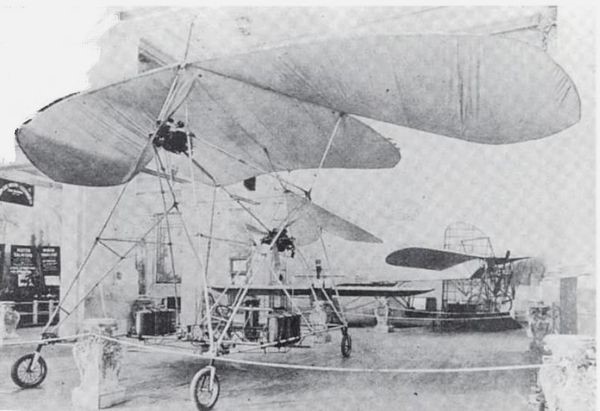
A monoplane equipped with two 50-horse power motors and two propellers. There are two blades in front and three in the rear. Built of steel tubing and aluminium, the machine weighed 1,000 pounds and had a stated carrying capacity of twelve persons. Designed and built by David A. Palmgren, as displayed at the Grand Central Palace Aero Exhibition, New York, in May 1912.

Palmgren Auto-plane

1910 newpaper reports describe this as an “auto-plane” with folding wings. Two 35hp Adams-Farwell rotary motors geared together so that “if one stops, the other keeps the propeller moving while the first acts as a flywheel.” The two motors also revolved in opposite directions to neutralize the gyroscopic effect. Reports failed to mention if it ever flew.