PDQ Aircraft Products PDQ-2

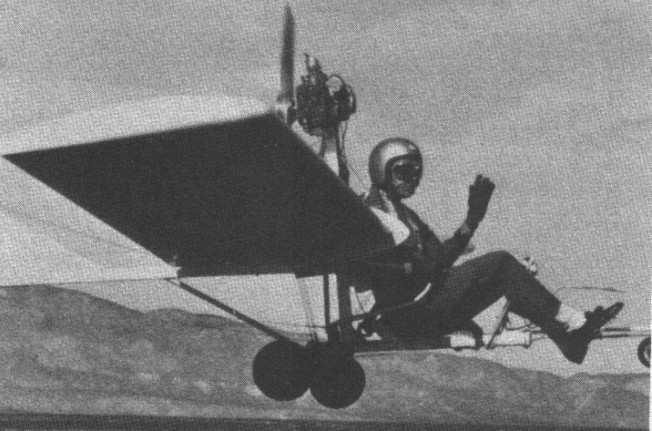
Back in the early 1970’s Wayne Ison designed the P.D.Q. The PDQ-2 is a sort of strap-on monoplane with shoulder-high wings, a tiny tricycle gear and a pylon-mounted JLO snowmobile engine that swings a two-bladed pusher prop. The pilot sits up front biting bugs at a Vmax of 80 mph. On a cold day vertical velocity is 400 fpm. The I-tail is hung at the end of a boom borrowed from the Bensen gyrocopter. The wings are made from Styrofoam bonded over plywood ribs at root and tip of each panel, with seven foam ribs in between. The foam is then covered with Dynel, bonded at the edges and heat¬shrunk, with resin squeegeed into the cloth and sanded light¬ly. Finally, the direct-driven prop develops 45 hp at 5500 rpm or 35 hp at 5000 rpm.

Engine: 1385cc VW, 40hp
Wingspan: 22 ft
Length: 14 ft 6 in
Max wt: 600lbs
Empty wt: 340 lb
Max speed: 80mph
Cruise: 70mph
Climb rate: 500 fpm

PC Flight PG

The PG is a side by side two seater with a spaceframe fuselage. The wings are made of riveted sheet dural and can be folded for transport.

Engine: Rotax 912 UL, 80 hp
Wing span: 10 m
Wing area: 11.66 sq.m
MAUW: 450 kg
Empty weight: 280 kg
Fuel capacity: 100 lt
Max speed: 210 kph
Cruise speed: 195 kph
Minimum speed: 63 kph
Climb rate: 5.5 m/s
Certification: vVz
Seats: 2
Fuel consumption: 17 lt/hr
Price (1998): 85 000 DM

PC-Aero Elektra Two

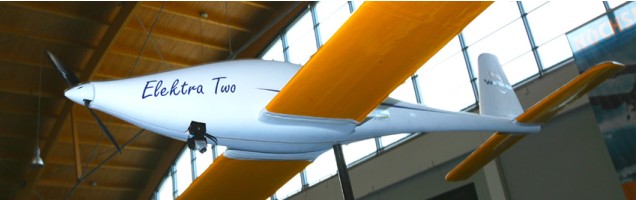
The Elektra Two aircraft are scaled versions of the Elektra One Solar. Two versions are:

Version 1: Elektra Two Standard, with two different wing span: 17 meters and 14 meters
Version 2: Elektra Two Record. Only one unit for a range over 2000 km was to be built.

The outer shape of the Elektra Two Standard is the same as the Elektra Two Record. Two versions will be provided: the long span version (17 meters) and the short span version (14 meters).

Elektra Two Standard (long & short version) are for cruise, flying clubs and training

Construction is carbon / glass and solar cells on the wing surface provide the energy to fly. The solar cells will be laminated in the wing skin structure.

Specifications

Elektra Two Standard
Max. engine power: 40 kW
Wing span: 14 m / 17 m
Wing surface: 15 sq.m / 19 sq.m
MTOW: 350 kg
Empty weight: 200 kg
Battery weight: up to 100 kg
Payload: 180 kg
Max. range:
14 m wing span: 500 km
17 m wing span: 700 km
Max. endurance:
14 m wing span: 5 hours
17 m wing span: 8 hours
Cruise:
14 m wing span: 140 km/h
17 m wing span: 120 km/h
Aspect ratio:
14 m wing span: 13
17 m wing span: 15
Best glide ratio:
14 m wing span: 28
17 m wing span: 34
Certification: LTF-UL germany

Elektra Two Record
Max. engine power: 16 kW
Wing span: 17 m
Wing surface: 19 sq.m
MTOW: 350 kg
Empty weight: 140 kg
Battery weight: 80 kg
Payload: 150 kg
Max. range: more than 2,000 km
Max. endurance: over 20 hours
Cruise: 80 km/h
Aspect ratio: 15
Best glide ratio: 34
Certification: LTF-UL Germany

PC-Aero Elecktra One / Elektra One Solar

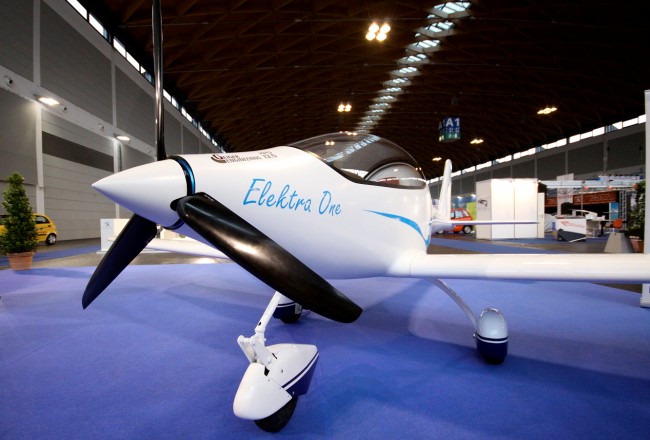
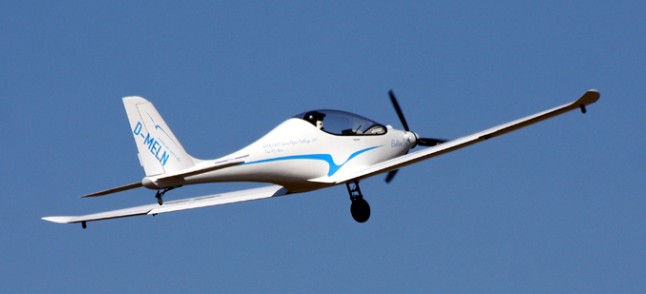
The Elektra 1, designed by Calin Gologan and built by a group of Romanians including Sorin Mares, received an award for innovation in aviation, the Lindbergh Electric Aircraft Prize.

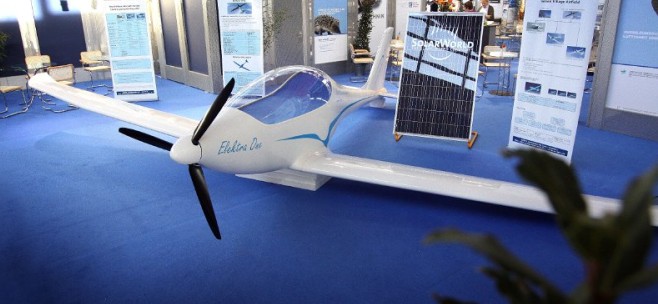
The one-seater plane is made of light carbon composite materials, utilising an electric motor, the batterys are charged while hangered, through solar panels. Elektra One Solar has six square meter solar cells on its wings to provide over 1 kilowatt (kW) of power for flying. Since the aircraft requires at least 2.5kW power for horizontal flight, this is slightly less than half the energy required for the plane to fly. The Elektra One Solar is not completely powered by the solar panels on its wings. To enable full flight, the plane has a series of high energy density rechargeable Li-Ion batteries on board. These can be recharged using the solar panels when the plane is parked outside. If the plane is parked inside, a specially outfitted solar hangar can take over the recharging duties.

PC-Aero developed the Elektra One Solar with the support from Solar Hangar and Solar World. The business idea behind it is that the solar panel equipped hangars will provide energy for the plane while the excess energy would be fed back into the grid. This predecessor of the Elektra One Solar, the Elektra One, has a range of 500 kilometers and an endurance of 3 hours. Its wingspan is also smaller at just 8.6 meters compared to 11 meters in the Elektra One Solar.

The Elektra One is in the German Ultralight LTF-UL-class powered by a 13.5 kW brushless electric engine. Germany’s Geiger Engineering developed the electric drive unit which includes the HPD 13.5 (16 kW maximum power) electric motor, controller, battery management system and propeller.

As the Elektra One was designed for minimum energy requirements at 160 km/h, once airborne, it is remarkably frugal with its use of energy. It can remain airborne for three hours and its claimed range has now increased to 500 kilometers. PC-Aero claims that the system offers operational costs per hour of less than EUR 35 or EUR 0.2 per km, which is a lot less than a roadgoing car.

Though the driving force and design of the Elektra One emanated from PC-Aero’s founder Calin Gologan, the team included team leader Einar Enevoldson, a 30 year veteran NASA-test pilot, engineer and test pilot.

Elektra One first flew on 19 March 2011, piloted by Jon Karkow, from Augsburg Airport in Germany. Three flights were performed, showing a climb rate of 400 fpm. Karkow checked flight performance and characteristics and briefed the German test pilot Norbert Lorenzen for the next flight on March 21.

A new 30 minute flight was performed on 23 March 2011. Only about 3kW from the total on board of 6kW energy was used and this was before the new variable pitch propeller and retractable landing gear were installed.

Endurance is estimated to be up to three hours and a cruising speed of 160 kph. The single seat Elektra One weighs 200 kg complete with battery and cost US$145,000 in 2012.

One of the Elektra One’s greatest advantages is its very low level of noise. The propeller speed is optimized for low noise too (under 50 dB). Cruising at 160 km/h, the propeller is rotating at just 1400 RPM. At this speed, PC-Aero claims it makes one fifth of the noise of a classic light aircraft and half the noise of an ultralight. Operating costs are below 35 €/hour and 0,2 €/km (2012).

Gallery

Elektra One
Engine power: 16 kW
Wingspan: 8.6 m (28 ft 3 in)
Wing area: 6.4 sq.m (69 sq ft)
Aspect ratio: 11.65
Empty weight: 100 kg (220 lb)
Gross weight: 300 kg (661 lb)
Battery weight: 100 kg
Payload: 100 kg
Best glide ratio; 25
Range: 500 km (311 mi; 270 nmi)
Endurance: 3 hours
Crew: one

Elektra One Solar
Wingspan: 11 m
Range: 1000 km
Endurance: 8 hours
Crew: one
PC-Aero GmbH

The PC-Aero GmbH is a design & certification company. It is specialized in Structure Design, Development and Certification. The experience covers all classes of aircrafts: light, transport and military. The service ranges (2012) from the design and certification of single components (STC’s) to a complete aircraft certification package.

PC-Aero’s expertise in design and development, certification and the experience with certification authorities enables this company to complete a structure certification process of a light aircraft in less than one year. By means of integrating the main structure design, tasks (aerodynamic/CFD, loads, structure calculation/FEM and structure tests) PC-Aero cut down the design/certification costs and time. It can finish the whole structure certification process in less than one year for an aircraft in the four-seater class

The PC-Aero Elektra One is such a modern single-seat Ultralight Electric Aircraft in composite construction. With the Elektra One and the existing technology it is possible to fly electric without CO2-emission and without noise for over three hours. In addition, in comparison to a classic aircraft, the operating costs are much lower”, says Calin Gologan, developer of the Elektra One

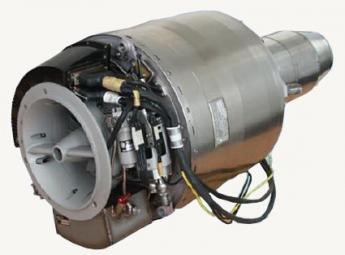
PBS TJ 100

Development of the TJ 100 turbo-jet engine began in 2002, as a drive unit for MAE UAV and piloted flying vehicles.

The TJ 100 is single-shaft engine with single-stage radial compressor, annular combustion chamber, single-stage axial turbine, and stationary exhaust jet.

In the compressor intake there is a brushless starter generator, which enables the starting from the board network and power generating in course of the engine operation.

The intake air is compressed in the radial compressor wheel, proceeds through radial and axial diffuser into the combustion chamber, where it is mixed with fuel sprayed by several fuel nozzles. Combustion gases arising in fuel burning in the combustion chamber expand through the single-stage axial turbine and exhaust jet into the atmosphere.

The rotor of the engine is mounted on 2 ball bearings lubricated with pressure oil.

Several versions were produced, varying by length of output nozzle, mounting, and by power.

PBS produce TJ 100, TJ 100C, TJ100E, and TJ 100I of 100 daN (225 lbf) power. The TJ 100A and TJ 100S are produced with 110 daN (247 lbf) power.

Static Thrust: 100 daN / 225 lbf
Spf. Fuel Consumption: 1.2 kg/daN.hr / 1.2 lb/lbf.hr
Oil Consumption: 180 ml/hr / 0.16 qt/hr
Electric Power Output: 28 V/800W
Weight – Engine: 16 kg / 35 lb
Weight – Wth/Access: 19 kg / 41 lb
Outside Diameter: 272 mm / 10.7 in
Length: 485 mm / 19 in
Fuel Consumption: < 128 kg/hr / < 281 lbs/hr
Max Running Altitude: 8 000 m / 26 246 ft

PBS TJ-100 E3S
Max Thrust (max 5 min.): 258.53 lbf [1150 N]
Electric Power Output: 650 W
Specific Fuel Consumption (max thrust): < 1.1376 lb/lbf/hr
Fuel Consumption at Idle: 11 gal/hr
Outside Diameter: 10.7″
Engine Length: 24.6″
Engine Weight: 43 lbs
Max Operating Altitude: 32,808 ft. msl
Max Starting Altitude: 19,685 ft. msl
Flight Speed Range: 0 to 0.8 mach
Speed Range for Startup: 0 to 0.6 mach
Fuel Requirements: JET-A, JET-A1, JP4, JP8, TS-1, T2, RT
Lubrication: according to MIL-L-23699 (Mobil Jet Oil II, Aeroshell 560)
Price 2020: $65,000